Selected scenes
BRZRKR in pictures.
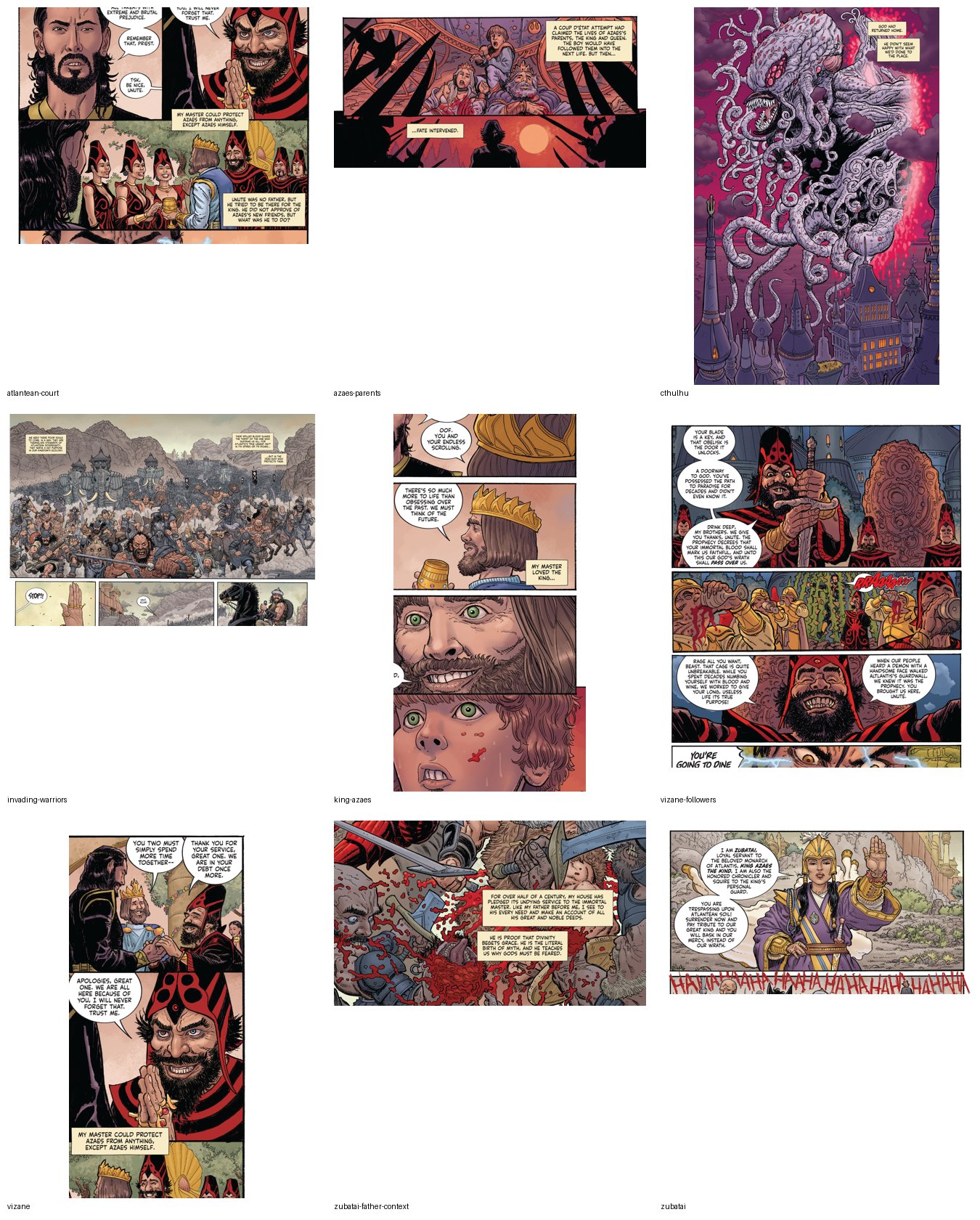
Spoilers: This article recounts the complete Atlantis catastrophe in BRZRKR: Poetry of Madness #1.
Overview
The Fall of Atlantis is the catastrophe in which Vizane's ritual brings Cthulhu into Atlantis, B kills the summoned entity, and the dying creature's body destroys the city. The event closes the Atlantis history narrated by Zubatai in BRZRKR: Poetry of Madness #1. It is both a supernatural disaster and a political collapse. The ritual requires materials taken from the Atlantean reliquary, the cooperation of King Azaes, the participation of Vizane's followers, and the forced use of B's body. Atlantis is therefore undone by a conspiracy that grows within the institutions that B once protected.[1][2]
The fall is not a conventional military defeat. The city has already survived foreign armies because B functions as its decisive defender. The threat that destroys it begins inside the royal court, uses a promise of immortality to turn Azaes against his protector, and opens a gateway whose destination the human participants cannot control. Cthulhu attacks cultists, guards, citizens, and architecture alike. B finally kills the entity by reaching its heart, but the victory arrives too late to save Atlantis.[3][4]
Conditions before the catastrophe
Atlantis enters the story as a wealthy and celebrated civilization. Its beauty, culture, and gold attract outside warriors, and the city has grown accustomed to allowing threats to approach its defenses. The kingdom's public confidence comes from B. At the gates, Zubatai can offer surrender and tribute because the king's guard includes an immortal who can destroy an army almost alone. The resulting battles become public spectacles, followed by horns, celebration, and admiration for B's regenerative body.[5]
This defensive success creates a dangerous political dependence. King Azaes's reign is described as enabled by B's will, and the people love the protector who makes the city appear invulnerable. B is not simply a hired fighter. He drinks the city's wine, walks its streets, reads in its reliquary, and is treated as a figure near Poseidon in the local religious imagination. The arrangement gives Atlantis security and gives B a chosen home, but it also places extraordinary power in the relationship between an aging human king and an ageless protector.[6]
Azaes's history intensifies the danger. As a child, he survives a coup that kills his parents because B intervenes. B remains in Atlantis after the rescue, partly because he recognizes the pattern of a child endangered by adults who attach their ambitions to him. Azaes grows up beside proof that death and aging are not universal. When Vizane later promises a great change and an immortal brotherhood, the appeal addresses both political fear and personal desire.[7]
Vizane's rise at court
Vizane first appears as a priest associated with a new religious movement. Zubatai observes that the kindness once visible in Azaes's eyes has been replaced by corruption and forbidden desire. The comic does not specify whether Vizane exerts supernatural mind control. What it shows is a change in the king's judgment, the growth of a black-and-red following, and the movement of ritual authority into the palace environment.[8]
B distrusts Vizane immediately. He tells the priest that service to the crown requires eliminating threats with extreme prejudice, a warning that is both a statement of B's role and a declaration that he sees Vizane as a threat. Azaes does not accept the warning. His affection for B is redirected into the idea that B's blood, sword, and history can be used to secure a future in which the king and the faithful share the immortal's condition.[8][9]
The movement's first decisive act is the theft from the Atlantean reliquary. Vizane's followers remove an obelisk and ancient texts written in Aklo. B recognizes the language as dangerous to mortal minds and infers that the priest intends to resurrect long-dead gods. The theft changes the conflict from a dispute over influence to an operation with physical components, a sacred vocabulary, and a destination beyond ordinary political power.[1][10]
The ritual at the northeastern tower
The conspirators assemble at Atlantis's northeastern tower. Azaes, Vizane, the followers, guards, and B are present. The king invokes royal authority while the movement uses supernatural means to restrain the person whose victories have kept the city safe. Zubatai is also physically controlled when she attempts to oppose the operation. The scene shows the monarchy and the movement acting together, even though their long-term interests are not identical.[2]
Vizane explains the ritual through a combination of prophecy and material symbolism. B's blood is treated as a necessary sacrament. The primordial-ore sword and the stolen obelisk form a paired mechanism. The Aklo texts supply the words or knowledge required to open the gateway. Vizane promises that the faithful will be protected and that Azaes stands at the edge of a transformation. The issue does not confirm that drinking B's blood can permanently transfer his immortality. It confirms that the cult believes the blood has power and that the participants act on that belief.[2][11]
Azaes's agency remains important. B calls Vizane's influence poisonous, but the king repeatedly defends the priest, authorizes the restraint, and participates in the ritual. The story does not absolve Azaes by proving that he is magically controlled. His childhood experience, his love for B, his fear of mortality, and his desire for a future without death all contribute to the choice, but the choice remains his.[8][9]
Cthulhu's arrival
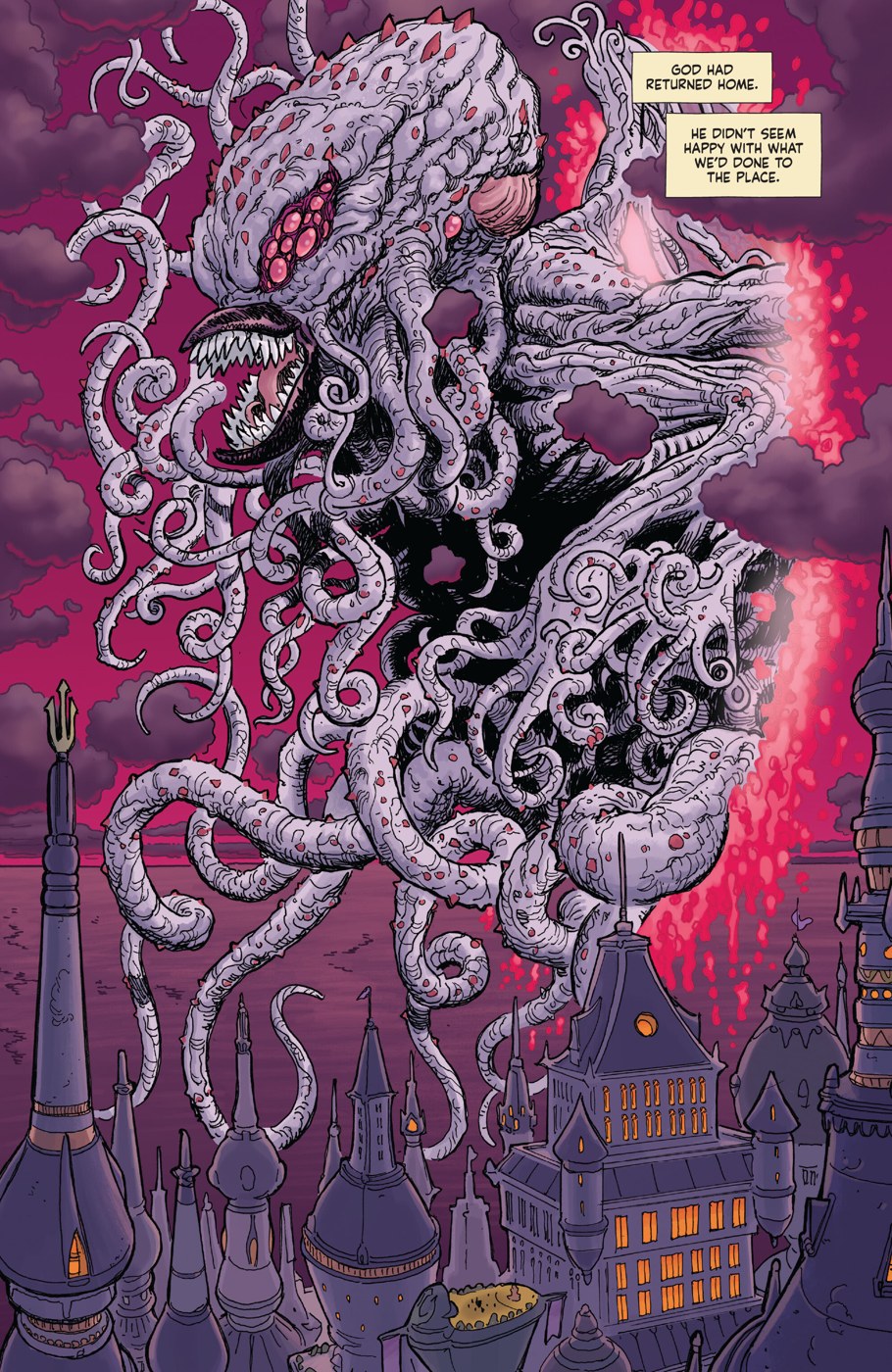
The gateway opens and Cthulhu appears. Vizane identifies the entity as the being his movement has sought, and the followers respond with praise. Their reaction establishes a religious interpretation rather than a neutral scientific description. The creature is treated as a god or returning power, while B's later comments challenge the category. For B, enormous ability does not automatically equal divinity. Cthulhu is powerful, but it is also a living body with a heart that can be located and destroyed.[3][12]
The arrival is immediately catastrophic. The creature's scale and movement overwhelm the northeastern tower and spread destruction through the city. Cultists, guards, court personnel, and ordinary inhabitants are caught in the same attack. The ritual's intended distinction between the faithful and the unprepared collapses. The entity does not respect the boundaries of the group that summoned it.[3]
The comic does not establish Cthulhu's species, home, relation to the Source, or place in a formal pantheon. It also does not show a stable form of communication that would validate every claim made by Vizane. The entity's presence is direct evidence of an extra-human force; the cult's theology remains a human interpretation layered onto that force.[12]
B's escape and the battle
B breaks free from the ritual restraint and enters the fight. His response is not an attempt to save the court as an institution. He attacks the entity that has destroyed Atlantis and the people who used him. The battle moves from the tower through the city and into Cthulhu's body. B's own regenerative experience gives him a physical strategy that an ordinary soldier could not attempt: he can survive the creature's interior, continue moving after severe injury, and search for the source of its life.[3]
Zubatai's account says B can hear or locate the monster's heart. He reaches it and tears it out. The act kills Cthulhu, but it does not undo the damage already done. The creature's dying body begins to dissolve over Atlantis. The city is caught under the remains of the being that the cult believed would protect or transform it.[4][12]
The battle therefore has two outcomes. On the scale of the immediate threat, B succeeds: Cthulhu dies. On the scale of civilization, he cannot reverse the disaster. Atlantis has lost its court, its guard, its population, and its built environment. The story refuses the simpler ending in which killing the monster restores the status quo.
The deaths of Azaes and Vizane
Azaes survives long enough to speak with B while mortally wounded. The king's final exchange with his protector returns to the coup that killed his parents. B tells him that his parents await him at the end of the path. The line is comfort rather than a complete explanation of an afterlife. It also closes the emotional cycle that began when B rescued Azaes as a child.[4]
Vizane's final confrontation occurs after the destruction has begun. The priest claims an ability to communicate with Cthulhu. B tests that claim through the language associated with the ritual and exposes the gap between performance and knowledge. Vizane's death is part of the collapse of the movement's authority. The man who promised access to an ancient power cannot control the consequences of opening the gateway.[12]
The unnamed cultists and guards receive no individual death records in the issue. Their collective fate is clear: many are killed during the attack, and the city is destroyed around them. The lack of names is a reason to document the groups together rather than inventing biographies for every figure visible in the crowd.[3]
Zubatai's survival and B's release
Zubatai is one of the few named survivors shown after the catastrophe. She has served Azaes and B through the entire Atlantis period, records the battle, and remains present when the city is gone. B releases her from the inherited service relationship. The decision matters because the fall destroys the social world that made her obligations meaningful. She is no longer a royal servant in a functioning kingdom, nor a squire serving a living protector within a celebrated court.[4]
The issue does not reveal where Zubatai goes next, whether she carries Atlantean records away, or whether the city leaves descendants in later cultures. Her survival preserves testimony but not necessarily an intact archive. The account is personal, emotionally charged, and shaped by loyalty to B. It is the strongest available witness record for the event, not a complete census of the dead.
Consequences for B's history
Atlantis is one of the clearest examples of B choosing a home and then losing it through the actions of people he tried to protect. The city gives him affection, daily familiarity, and a role more complex than that of a weapon. The fall repeats the pattern that appears elsewhere in his life: a human institution sees extraordinary ability, turns it into a resource, and destroys the relationship by trying to possess the source of that ability.
The event also adds a historical layer to B's relationship with gods and monsters. He has been worshipped, feared, and mythologized in many eras, but Cthulhu's arrival shows that human worship can open contact with a being more dangerous than the worshippers understand. B's refusal to treat Cthulhu as automatically divine parallels his refusal to accept the religious identities imposed on him by other cultures.
The loss of the city leaves several objects and concepts unresolved. The later history of the primordial-ore sword, obelisk, Aklo texts, and ritual cups is not fully shown. The date of Atlantis is also not established with precision. The issue gives a complete event sequence but not a complete archaeological aftermath. Those gaps are part of the surviving record rather than invitations to invent a rebuilt kingdom.
Chronology
- Atlantis becomes wealthy and attracts foreign armies.
- B protects the city and becomes part of its civic and religious life.
- Azaes grows from the child saved by B into the adult king.
- Vizane's movement enters the court and changes Azaes's priorities.
- Followers steal the obelisk and Aklo texts from the reliquary.
- B is restrained at the northeastern tower and his blood is collected.
- The sword, obelisk, texts, and blood open the gateway.
- Cthulhu arrives and begins destroying Atlantis.
- B escapes, fights through the entity, and destroys its heart.
- Azaes and Vizane die; Cthulhu's corpse dissolves the city.
- B releases Zubatai from her service after the kingdom has fallen.
Appearances
- BRZRKR: Poetry of Madness #1 - complete depiction of the event.
- BRZRKR: Poetry of Madness Pen & Ink #1 - alternate presentation of the same event.
See also
References
[1] Keanu Reeves and Steve Skroce, BRZRKR: Poetry of Madness #1 (BOOM! Studios, 2023), Atlantis's setting, reliquary theft, Aklo texts, and B's warning about the intended resurrection, digital page images 002-017.
[2] Reeves and Skroce, BRZRKR: Poetry of Madness #1, northeastern tower confrontation, Azaes's authorization, restraint of B and Zubatai, and ritual preparation, digital page images 018-023.
[3] Reeves and Skroce, BRZRKR: Poetry of Madness #1, gateway opening, Cthulhu's arrival, attack on the tower and city, and B's escape, digital page images 023-036.
[4] Reeves and Skroce, BRZRKR: Poetry of Madness #1, Azaes's final exchange with B, B's assault on Cthulhu's heart, dissolution of Atlantis, and release of Zubatai, digital page images 037-045.
[5] Reeves and Skroce, BRZRKR: Poetry of Madness #1, opening invasion and B's destruction of the attacking force, digital page images 003-012.
[6] Reeves and Skroce, BRZRKR: Poetry of Madness #1, public celebration of B, his place beside Poseidon in Zubatai's account, and his relationship with Azaes, digital page images 012-016.
[7] Reeves and Skroce, BRZRKR: Poetry of Madness #1, Azaes's childhood, death of his parents, B's intervention, and the interpretation attributed to Zubatai's father, digital page image 015.
[8] Reeves and Skroce, BRZRKR: Poetry of Madness #1, Vizane's introduction and the changing court, digital page images 014-019.
[9] Reeves and Skroce, BRZRKR: Poetry of Madness #1, Vizane's explanation of the promised immortal brotherhood and Azaes's decision to participate, digital page images 019-023.
[10] Reeves and Skroce, BRZRKR: Poetry of Madness #1, B's identification of Aklo as dangerous and the theft of the obelisk and texts, digital page image 017.
[11] Reeves and Skroce, BRZRKR: Poetry of Madness #1, blood ritual, primordial-ore sword, obelisk, prophecy, and the gateway mechanism, digital page images 020-023.
[12] Reeves and Skroce, BRZRKR: Poetry of Madness #1, Vizane's claim to communicate with Cthulhu, B's Aklo test, the heart attack, and Cthulhu's death, digital page images 038-042.