Selected scenes
BRZRKR in pictures.
Spoilers: This article discusses the complete events of BRZRKR: Poetry of Madness #1.
Overview
Vizane's followers are the organized religious adherents who gather around the Atlantean priest Vizane during the final days of Atlantis in BRZRKR: Poetry of Madness #1. The comic does not provide an official name for the movement, individual names for its members, or a complete account of how the group formed. What it does establish is enough to make the faction important: its members enter the royal court under King Azaes, participate in the theft of forbidden material from the Atlantean reliquary, help prepare a ritual centered on B's blood, his primordial-ore sword, an ancient obelisk, and Aklo texts, and celebrate the return of Cthulhu as the fulfillment of prophecy.[1]
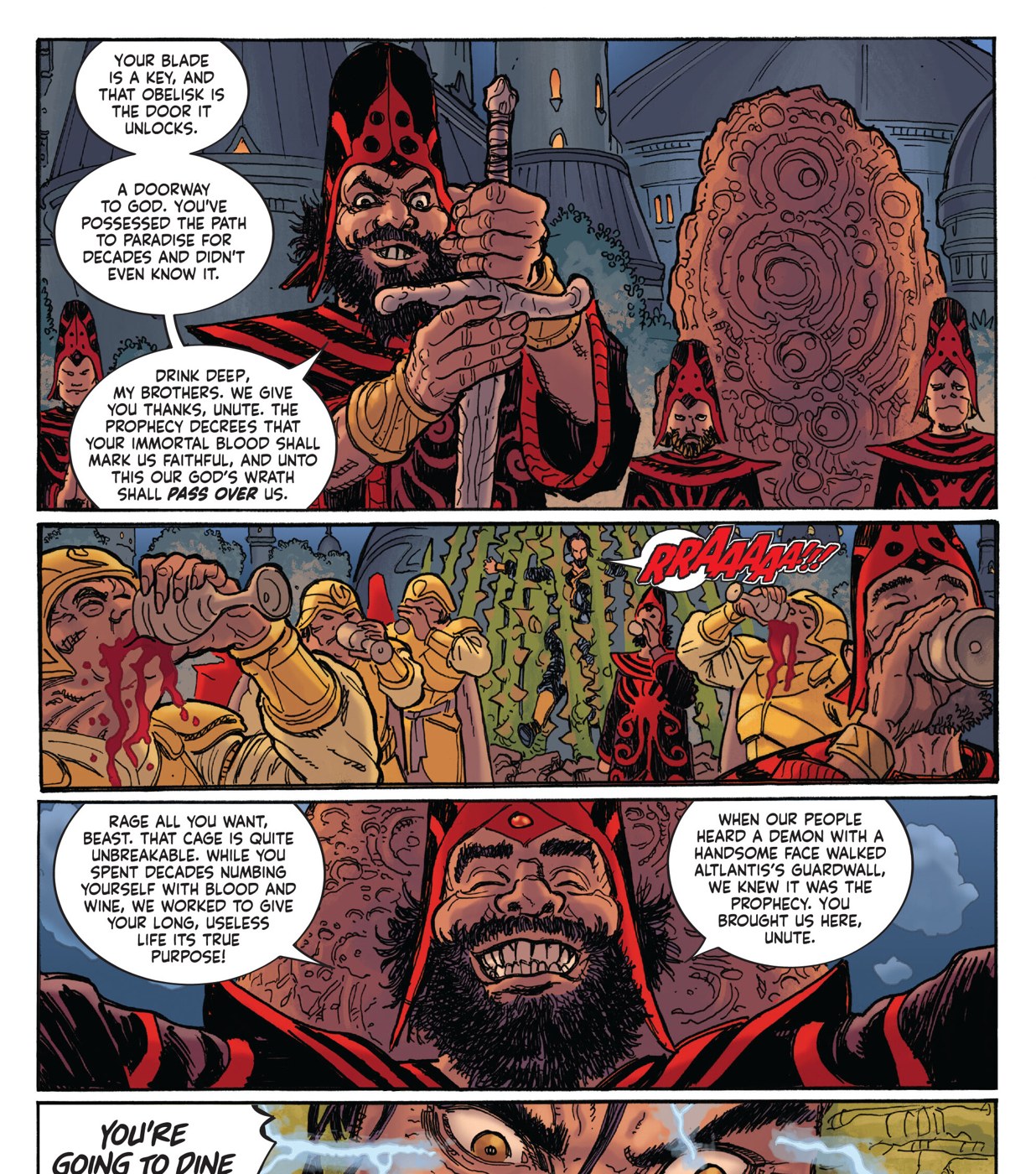
The faction is one of the clearest examples in BRZRKR of a human institution trying to convert B's extraordinary nature into a religious shortcut to immortality. The followers do not simply worship B. They interpret him as a sign within a larger prophecy. Vizane tells them that the arrival of a seemingly demonic immortal in Atlantis proves that the promised moment has come, and the group uses B's blood as a sacrament intended to mark the faithful so divine wrath will pass over them.[2]
That belief is catastrophically wrong. Cthulhu does not distinguish between believers and nonbelievers when the gateway opens. The creature devastates Atlantis, kills or scatters members of Vizane's movement, and contributes directly to the destruction of the civilization the cult expected to transcend.[3]
For the wiki, the group should receive a dedicated faction article rather than individual pages for anonymous cultists. Individual ritual participants can still be represented as structured appearance records when a recurring figure is visually identifiable.
Formation and origins
The comic begins after Vizane's movement has already gained access to Azaes and the royal court. It does not show the first sermon, first convert, or first meeting between Vizane and the king. Zubatai instead records the movement at the point when it has become significant enough to alarm both her and B.[4]
Azaes personally introduces Vizane to B and asks the immortal protector to trust the priest. Vizane is already surrounded by visually coordinated attendants in black and red clothing. The imagery suggests an organized religious identity rather than a single private counselor advising the king.[4]
B's reaction is immediate hostility. He tells Vizane that his duty is to serve the crown and eliminate threats with extreme violence, then makes clear that the warning applies to the priest. Vizane responds with a smile and a claim that everyone present owes their circumstances to B.[4]
The followers' exact social origins are unknown. The story does not establish whether they are native Atlanteans, foreigners, aristocrats, priests from an older tradition, recruited commoners, or a mixture of groups. Because the movement operates within the palace and has enough access to raid a protected reliquary, some members must have acquired substantial institutional reach, but the mechanism is not shown.
The safe encyclopedia treatment is therefore to describe Vizane's followers as an organized occult religious movement active in Atlantis under the patronage of King Azaes, not as a traditional Atlantean church or a hereditary order unless future sources establish those facts.
Relationship with King Azaes
The cult's rise is inseparable from Azaes. B and Zubatai both understand that Vizane's access to the king changes the political balance of Atlantis.[4]
Zubatai describes a visible change in Azaes. The kindness she associates with his earlier reign has given way to corruption and forbidden desire. She does not claim that every change is caused supernaturally by Vizane, but she clearly connects the king's new religious interest with a broader moral decline.[5]
Azaes gives the movement something more valuable than private belief: royal legitimacy. When B confronts the cult at the northeastern tower, Azaes is present and asserts his authority as king. He refuses to let B simply execute Vizane and the other participants. Royal guards restrain Zubatai while supernatural growths restrain B.[6]
This moment explains how the cult can advance so far. The movement does not need to defeat Atlantis's political system. It operates through the monarch. The king's command neutralizes the ordinary institutions that might otherwise remove Vizane.
Azaes also shares the cult's expectation of transformed existence. He tells B that once B's purpose is realized, the two can become immortal brothers together.[6] That statement connects Azaes's personal fear of mortality, his attachment to B, and Vizane's religious promises.
Relationship with B / Unute
Vizane's followers build their theology around B without understanding him as a person.
To the movement, B is evidence. His existence validates prophecy. His blood is sacred material. His sword is a ritual key. His presence in Atlantis signals that the promised divine event has arrived.[2]
This instrumental treatment mirrors a recurring theme across BRZRKR. Governments, rulers, cults, scientists, and armies repeatedly reduce B to what his body can do for them. Vizane's movement differs in language rather than underlying structure. Where a modern laboratory sees regenerative biology, the cult sees holy blood. Where a military sees an indestructible weapon, Vizane sees a prophetic mechanism.
The followers collect B's blood in cups after he is restrained. Vizane orders them to drink because prophecy supposedly promises that immortal blood will mark the faithful and allow Cthulhu's wrath to pass over them.[2]
The scene is one of the most literal examples of people attempting to consume B's immortality. The followers do not ask B's permission. His body is treated as communal ritual property.
B, by contrast, rejects their interpretation. He calls Vizane evil, warns that the ritual can end the world, and attempts to kill the participants for Azaes's own good.[6]
The resulting conflict should connect this faction to the site's larger pages for People Who Attempted to Exploit B, B's Blood, Immortality, Cults and Religions, and B Through the Ages.
Theft from the Atlantean reliquary
Zubatai discovers that the reliquary has been robbed. A large stone object, later used as the gateway obelisk, is missing. She also reports that a priest and his followers stole dangerous ancient texts B had hidden there.[7]
B identifies the language of the texts as Aklo and explains that it poisons mortal minds. He says the thieves are trying to resurrect long-dead gods.[7]
This makes the followers active conspirators before the public ritual. Their role is not limited to attending a ceremony organized by Vizane. The group participates in acquiring restricted objects and knowledge necessary to carry out the plan.
The exact division of labor is unknown. The comic does not identify who physically removes the obelisk, who steals the manuscripts, who transports them to the northeastern tower, or whether Azaes authorizes the theft in advance.
The wiki should therefore assign the collective movement a relationship to the robbery while avoiding false individual attribution.
The stolen Aklo texts
Aklo is presented as a dangerous ancient language connected to forbidden knowledge. B treats the texts seriously enough to have hidden them in the reliquary.[7]
Vizane's followers appear to accept his interpretation of the material and his claim that the texts provide a path to divine return. The story does not show ordinary members reading Aklo, and only Vizane is directly demonstrated speaking or understanding it.
The faction should therefore not be described wholesale as Aklo speakers. The supported claim is that the movement possessed and used Aklo texts under Vizane's leadership.
This distinction matters for the site's lore system. USES_AKLO_TEXTS can be attached to the group, while SPEAKS_AKLO should be attached to Vizane and B only where the comic demonstrates it.
The sword and obelisk
At the northeastern tower, Vizane explains that B's sword and the stolen obelisk form parts of an ancient set. The sword, forged from primordial ore and once given to B by the king, acts as the key. The obelisk is the door it opens.[2]
The followers help prepare the ceremony around these objects. Their faith depends on the idea that artifacts associated with B are pieces of a predestined mechanism rather than coincidences of history.
The comic does not reveal who made the objects, who first separated them, or how Vizane learned the mechanism. Those questions belong under Atlantean Obelisk, Primordial-Ore Sword, and Mysteries and Unanswered Questions.
For the faction article, the important point is organizational behavior. Vizane's movement is capable of locating, stealing, transporting, and deploying dangerous objects within the capital. That indicates planning, access, and coordination.
Blood ritual
The followers' most distinctive act is drinking B's blood.
After B is restrained, ritual participants fill cups with blood taken from him. Vizane tells them that prophecy requires the immortal's blood to mark the faithful. The wording presents blood as both sacrament and protective seal.[2]
The act should be linked to a dedicated Bloodletting of B event record because it combines physical violence, religious exploitation, prophecy, and attempted acquisition of immortality.
Nothing in the issue demonstrates that drinking B's blood grants lasting regenerative ability. The followers remain vulnerable when Cthulhu attacks. No survivor is shown regenerating from fatal injury, and no later source in the supplied material identifies a lineage of immortal cultists created by the ritual.
The wiki must therefore reject statements such as "the cultists became immortal" unless a future story explicitly establishes it.
Prophecy
Vizane presents the cult's actions as fulfillment of prophecy. He tells his followers that when people heard a demon with a handsome face was walking Atlantis's guard wall, they knew the prophecy had been fulfilled. B's arrival is interpreted as the sign that brought the faithful to Atlantis.[2]
This gives the movement a history that may predate Vizane's arrival at court. The prophecy apparently existed before the cult recognized B in Atlantis. However, the comic does not state when it was written, who authored it, or whether Vizane's interpretation is accurate.
A dedicated Vizane's Prophecy lore record can store the known components without presenting it as objective cosmic truth.
Supported elements include:
- an immortal or demon-like figure with a handsome face;
- the presence of B in Atlantis as a prophetic sign;
- use of B's blood to mark believers;
- expectation that divine wrath will spare those marked;
- use of the sword and obelisk to open a path to the god.
The protective promise fails visibly. That failure raises the possibility that the prophecy is false, misunderstood, mistranslated, manipulated by Vizane, or never intended to guarantee safety. The story does not resolve which explanation is correct.
Opening of the gateway
The ritual succeeds in one narrow sense: it opens a gateway and brings Cthulhu into Atlantis.[8]
The obelisk activates, energy tears through the sky, and a presence older than human history begins to emerge. The sensory description emphasizes alien rot and decay. The cultists interpret the event as the return of their god.[8]
When Cthulhu appears, Vizane and his followers praise the entity by name. Their reaction confirms that this is the being they intended to summon, not an accidental substitute.[9]
The ritual's success immediately becomes the movement's destruction. Cthulhu has no visible interest in rewarding the faithful. The creature begins devastating the city.
Cthulhu worship
The followers explicitly praise Cthulhu after the entity's arrival.[9]
The relationship is one-sided. The cult recognizes Cthulhu as divine. Cthulhu does not recognize the cult as privileged servants.
This is especially important for a definitive wiki because fandom terminology often converts worship into alliance. The comic depicts devotion, not partnership.
Casualties during Cthulhu's attack
Cthulhu's arrival turns the ritual site and surrounding city into a mass-casualty zone. Cultists, guards, and other Atlanteans are struck by debris, tentacles, alien matter, collapsing structures, and the wider destruction caused by the entity.[3]
The precise number of dead followers is unknown. No roll call exists, and most are unnamed.
Individual background figures should not be assigned precise deaths unless a panel clearly shows that person being killed. The group status can instead be recorded as destroyed or dispersed during the fall of Atlantis, with no confirmed surviving member identified.
Vizane survives the initial manifestation long enough to regroup with remaining followers and attempt another incantation.[10]
Final gathering with Vizane
Late in the crisis, Vizane is shown with a surviving group of adherents away from the main battle. He prepares to begin another incantation and believes his Aklo knowledge may still let him communicate with Cthulhu.[10]
B arrives before the ritual can meaningfully continue.
The scene demonstrates that at least some followers survive the initial attack long enough to remain loyal to Vizane. Their continued participation is notable because the promised protection has already failed and the city is collapsing.
Whether this persistence reflects fanaticism, fear, desperation, magical influence, or belief that Vizane can still fix the catastrophe is not stated.
B confronts Vizane in Aklo, exposes the priest's arrogance, and kills him brutally.[10]
The comic does not linger on the remaining followers' individual fates. Atlantis is later destroyed completely, making long-term survival unlikely but not individually documented.
Visual identity
Vizane's followers are primarily identified by black and red ceremonial clothing. The garments use repeating spiral, eye-like, and geometric motifs that distinguish the faction from Atlantis's gold-clad royal personnel.[4][6]
The visual identity is useful for the appearance database. Because members are not named, clothing and location are the best evidence for classifying background figures.
Editors should still avoid assuming that every person wearing dark clothing is a cultist. Classification should be scene-specific and confidence-tagged.
Organization and hierarchy
Vizane is the only named leader.
The comic does not establish ranks such as high priest, acolyte, initiate, deacon, guard, or scribe. It also does not show a governing council, written membership system, or chain of command beneath Vizane.
The movement clearly contains enough people to steal materials, gather publicly, collect B's blood, perform ritual actions, and remain organized during a crisis. That supports describing it as a faction, but not inventing internal offices.
Structured minor entities can use descriptive IDs such as:
Those labels should never appear as canonical names in public prose.
Beliefs and motivations
The group's explicit beliefs include the prophetic importance of B, the sacred use of his blood, the existence and divinity of Cthulhu, and the expectation that the ritual will produce protection or transformed existence.[2][9]
Individual motivation is not shown. It is possible that different members seek immortality, spiritual revelation, political advancement, favor with Azaes, or simple belonging. Those possibilities should remain interpretation, not canon.
The movement's public appeal is nevertheless understandable within the story's setting. Atlantis lives beside an actual immortal. Its people watch B survive injuries that should kill any human. Under those conditions, a priest claiming that immortality can be shared is offering a promise anchored to visible evidence.
That context does not validate Vizane's theology, but it explains why the movement can become persuasive.
Relationship with Zubatai
Zubatai is one of the movement's clearest opponents. She notices Azaes's deterioration, discovers the reliquary theft, and brings the information to B.[5][7]
Her position as royal chronicler and B's squire gives her unusual perspective. She is close enough to the court to observe the movement's rise and close enough to B to understand why the stolen material is dangerous.
When guards restrain her during the ritual, the institutional conflict becomes personal. The monarchy she serves is now protecting the faction she believes is destroying it.[6]
The entire surviving narrative is filtered through Zubatai's chronicle. This does not make her account unreliable by default, but the site should record the narrator because her language about corruption, evil, and loyalty is explicitly interpretive.
Relationship with the Atlantean court
Vizane's movement operates inside, not outside, Atlantean elite society.
The king is a convert or patron. Cult figures stand among royal personnel. The ritual uses objects drawn from the kingdom's own reliquary. Royal guards enforce Azaes's commands against B and Zubatai.[6]
A dedicated Atlantean Court article should therefore document the faction as a political penetration of existing authority rather than as a foreign army that conquers the palace.
The exact number of converts among ordinary courtiers remains unknown.
Role in the fall of Atlantis
Vizane's followers are secondary causes of the fall of Atlantis because they enable the ritual that opens the gateway.
The causal chain is:
- Vizane gains Azaes's trust.
- The movement obtains forbidden Aklo texts and the obelisk.
- The cult restrains B and uses his blood.
- The primordial-ore sword and obelisk activate the gateway.
- Cthulhu emerges.
- Cthulhu devastates Atlantis.
- B kills Cthulhu.
- Cthulhu's dying body destroys what remains of the city.[7][8][11]
The faction should therefore connect directly to the Fall of Atlantis event, but the article should distinguish intentional and unintended consequences. The followers intend to summon Cthulhu. They do not appear to intend the extermination of Atlantis.
Historical significance
Vizane's followers demonstrate how B's presence creates religions as well as armies.
The faction is important not because any individual cultist receives deep characterization, but because the movement represents a collective response to immortality. Its members see B and conclude that transcendence can be extracted, consumed, ritualized, and shared.
Their failure reinforces one of BRZRKR's recurring ideas: people repeatedly mistake access to B for understanding of B.
The movement also anticipates later institutions that study B's body, history, and origins for their own ends. The vocabulary changes from prophecy to science, but the underlying desire remains familiar.
Appearances
- BRZRKR: Poetry of Madness #1 - sole confirmed story appearance of the movement.
- BRZRKR: Poetry of Madness Pen & Ink #1 - alternate presentation of the same canonical story, not a separate event.
Canon limitations and unresolved questions
The source does not establish:
- an official name for Vizane's religion;
- when the movement was founded;
- where it originated;
- how many members it had;
- whether all members were Atlantean;
- whether Azaes formally converted the state religion;
- who authored the prophecy;
- who wrote the Aklo texts;
- who first discovered the sword-obelisk connection;
- whether any follower gained regenerative properties from B's blood;
- whether any follower survived Atlantis's destruction;
- whether the movement existed elsewhere after the catastrophe.
These questions should remain open until primary material resolves them.
References
[1] Keanu Reeves and Steve Skroce, BRZRKR: Poetry of Madness #1 (BOOM! Studios, 2023), introduction of Vizane's organized black-and-red religious presence at Azaes's court and later cult conspiracy, digital page images 016-023.
[2] Reeves and Skroce, BRZRKR: Poetry of Madness #1, Vizane's explanation of prophecy, B's blood, the primordial-ore sword, the obelisk, and the promised protection of the faithful, digital page images 021-023.
[3] Reeves and Skroce, BRZRKR: Poetry of Madness #1, Cthulhu's arrival and indiscriminate attack on Atlantis, including guards and cult participants, digital page images 024-036.
[4] Reeves and Skroce, BRZRKR: Poetry of Madness #1, Azaes introducing Vizane, B's immediate warning, and Zubatai's explanation that the king's new religion lies beyond normal guard authority, digital page image 016.
[5] Reeves and Skroce, BRZRKR: Poetry of Madness #1, Zubatai's description of corruption and forbidden desire replacing the kindness in Azaes's eyes, digital page image 014.
[6] Reeves and Skroce, BRZRKR: Poetry of Madness #1, northeastern-tower confrontation, Azaes invoking royal authority, supernatural restraint of B, guards restraining Zubatai, and ritual preparation, digital page images 019-021.
[7] Reeves and Skroce, BRZRKR: Poetry of Madness #1, robbery of the reliquary, theft of the obelisk and dangerous Aklo texts, and B's warning that the thieves seek to resurrect long-dead gods, digital page image 017.
[8] Reeves and Skroce, BRZRKR: Poetry of Madness #1, activation of the gateway and emergence of the ancient entity, digital page images 023-024.
[9] Reeves and Skroce, BRZRKR: Poetry of Madness #1, Vizane and his adherents identifying and praising Cthulhu as the entity emerges, digital page image 025.
[10] Reeves and Skroce, BRZRKR: Poetry of Madness #1, Vizane regrouping with surviving followers, preparing another incantation, B's Aklo exchange, and Vizane's death, digital page images 038-040.
[11] Reeves and Skroce, BRZRKR: Poetry of Madness #1, B killing Cthulhu by reaching and destroying its heart and the dying creature's body consuming Atlantis, digital page images 040-045.