Selected scenes
BRZRKR in pictures.
Spoilers: This article discusses the complete events of BRZRKR: Poetry of Madness #1.
Overview
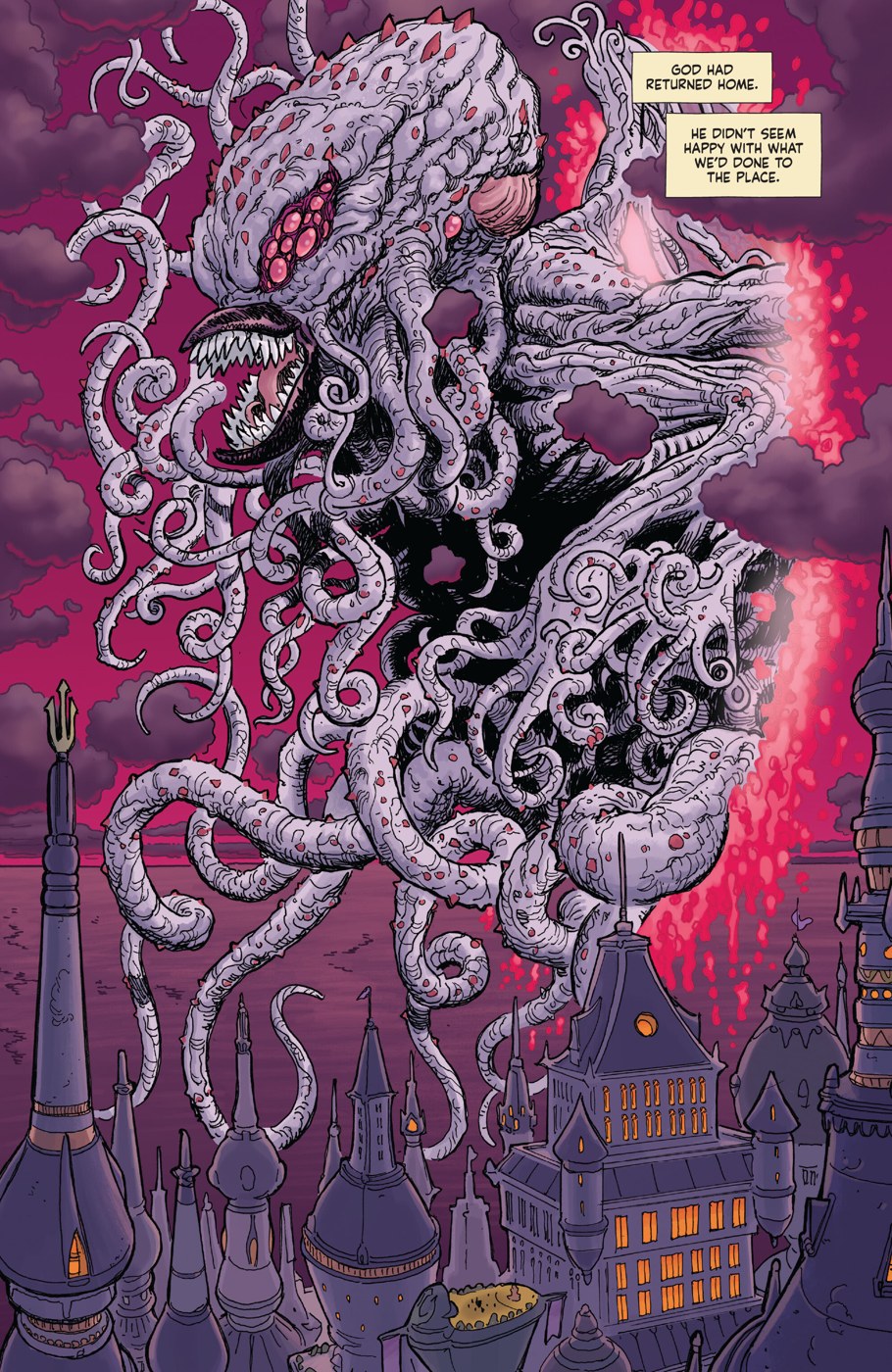
Cthulhu is an enormous extra-dimensional or alien entity summoned into Atlantis by Vizane and his followers in BRZRKR: Poetry of Madness #1. The cult treats Cthulhu as a god whose return will inaugurate a promised transformation, while B rejects that interpretation and ultimately describes the creature in more material terms. To B, divinity is simply a word humans use when something has more power than they can understand. Cthulhu is immensely destructive, but it is still a living thing with a heart that can be found, torn out, and killed.[1]
Cthulhu's arrival is the central catastrophe of the story. Vizane steals an Atlantean obelisk and forbidden Aklo texts, uses B's primordial-ore sword as a key, drains B's blood for the faithful, and opens a gateway. Cthulhu emerges over the city and immediately demonstrates that the cult's promise of protection is false. The entity attacks indiscriminately, overwhelms Atlantis's conventional defenses, kills cultists and guards, and reduces buildings to debris. B eventually enters or cuts through its body, locates its heart by sound, and destroys it.[2]
Death does not end the danger. Cthulhu's dying body releases an alien fire, corrosive substance, or other destructive material that dissolves Atlantis itself. B and Zubatai survive, but the city, its monarchy, its cultural institutions, and much of its population disappear beneath the remains of the summoned being.[3]
Nature and classification
The issue deliberately leaves Cthulhu's ultimate nature ambiguous. Vizane and his followers call the entity a god. The narration around its arrival speaks of a god returning home. B, however, refuses to treat the label as a metaphysical fact.[1][4]
According to Zubatai, B often says that "god" is simply a word that means more power than sense. Once B destroys Cthulhu's heart, Zubatai concludes that despite its seemingly infinite destructive power, Cthulhu was an animal like any other.[1]
This creates an important canon distinction for the wiki. The article can state that:
- Vizane worships Cthulhu as a god;
- Cthulhu possesses power far beyond ordinary humans and can devastate Atlantis;
- Cthulhu comes through an interdimensional or supernatural gateway;
- B is able to kill it through destruction of a vital organ.
The article should not state as objective fact that Cthulhu is a literal deity, an Elder God in a formal pantheon, a member of the same species as the Source, or a being from any outside fictional cosmology unless later BRZRKR material explicitly establishes that connection.
Before the summoning
Cthulhu does not physically appear during the first part of Poetry of Madness, but the cult's activities prepare the way for it. Vizane steals ancient texts written in Aklo from the Atlantean reliquary. B describes the language as one capable of poisoning mortal minds and correctly infers that Vizane and his followers intend to resurrect long-dead gods.[5]
The cult also steals an obelisk that has a specific mechanical or magical relationship with B's sword. Vizane later says the blade is a key and the obelisk is the door. That language indicates that Cthulhu's arrival is not created by faith alone. The ritual uses real artifacts capable of bridging spaces or realities.[6]
B's blood is incorporated as well. Vizane drains it into cups and tells the followers that drinking it will mark them as faithful so the god's wrath will pass over them. Nothing in the later battle shows that this protection works.[6]
The Aklo connection
Aklo is the clearest linguistic connection between Cthulhu and the Atlantean occult tradition. Vizane believes he can speak Cthulhu's language. B also knows Aklo and later mocks Vizane by testing his command of grammatical gender.[7]
The exchange implies that B has encountered the language or related beings before. It does not establish where, when, or whether B has encountered Cthulhu specifically before Atlantis.
Cthulhu's own telepathic or nonverbal expressions are depicted differently from ordinary speech balloons. The creature appears capable of communicating thoughts or reactions, including fear and protest as B attacks its internal organs.[1]
Whether those communications are directly in Aklo is not explicitly explained. A definitive article should keep language used by Vizane and Cthulhu's depicted psychic speech as related but distinct evidence.
Opening of the gateway
Vizane begins the ritual while B is restrained by supernatural thorned growths. The obelisk glows, then releases a blood-colored beam that reaches toward the moon or sky. A portal opens above Atlantis, accompanied by imagery of corruption, alien decay, and a roar described as older than time.[8]
Cthulhu emerges on a scale dwarfing buildings. Vizane greets the creature by name and celebrates the return of the god. For a brief moment the cult reads the manifestation as vindication.[4]
That interpretation collapses almost immediately.
Physical appearance
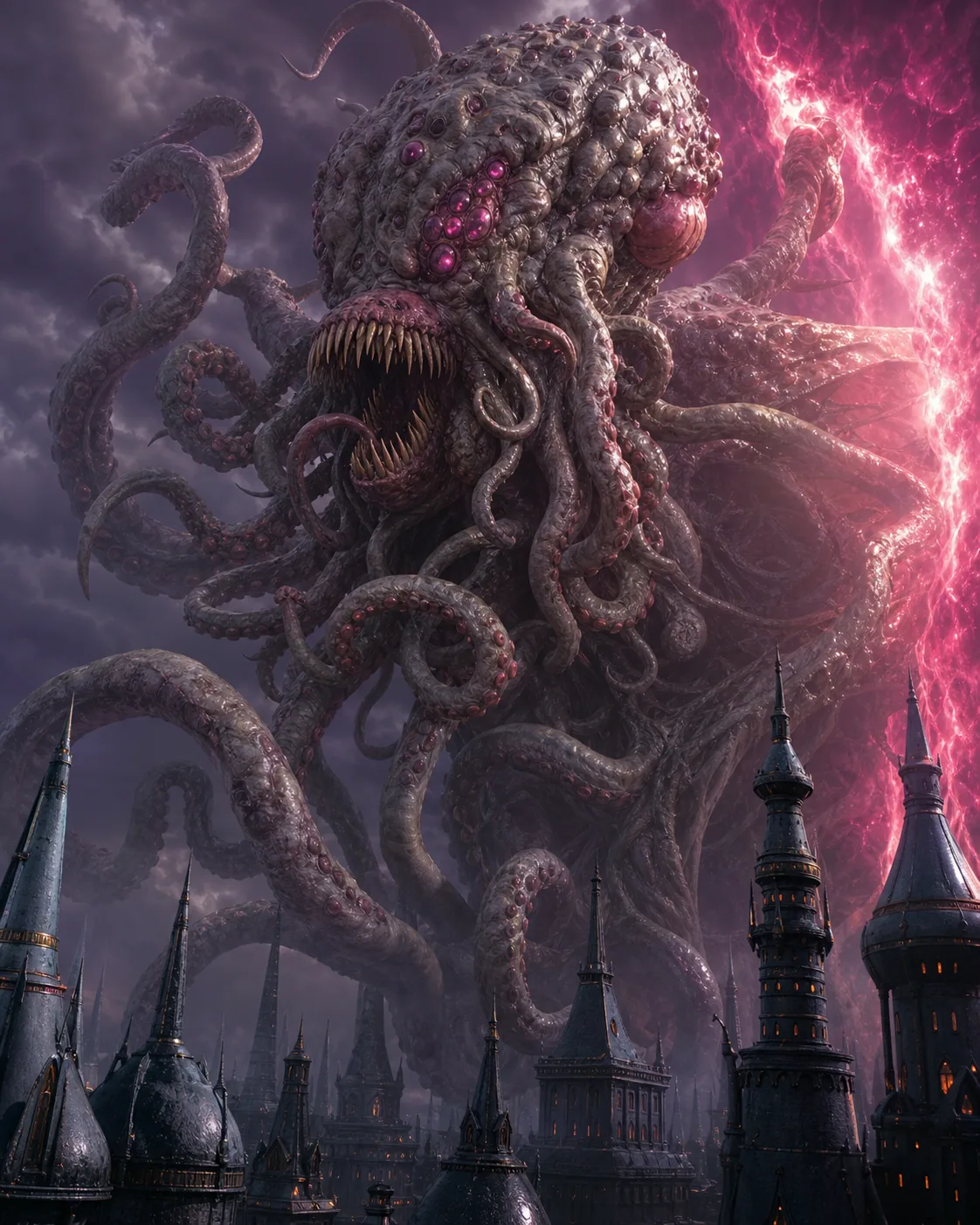
Cthulhu is depicted as a colossal pale creature with numerous tentacles, multiple mouths or jaw structures, clusters of pink or red eyes, ridged and fleshy surfaces, and a body large enough to loom over Atlantis's towers. The design is not a simple humanoid with an octopus head. Its anatomy is deliberately unstable and excessive, with limbs and sensory organs appearing across an enormous mass.[4]
The creature's body contains recognizable internal structures despite its alien form. Most importantly, it has a beating heart. This anatomical fact becomes the basis of B's strategy.
The wiki should use the comic's appearance rather than importing standard descriptions of Cthulhu from other media. Even if the name invokes a broader literary tradition, the BRZRKR version should be documented from what this issue actually depicts.
Destruction of Atlantis
Once free, Cthulhu attacks Atlantis rather than rewarding the cultists. Its tentacles smash buildings, sweep through defenders, and generate mass casualties. The creature's scale renders ordinary military action largely irrelevant.[9]
Vizane's followers and Atlantean guards are both caught in the devastation. Azaes is mortally wounded during the wider catastrophe. Zubatai survives but witnesses the destruction of the city she serves.
The event demonstrates the fatal error in Vizane's theology. Summoning the entity does not create a controlled alliance between god and worshipper. There is no visible covenant, recognition, or preferential protection. Cthulhu behaves as an independent organism with its own reactions.
Combat with B
B is initially trapped by the cult's magic, but the restraint cannot hold him indefinitely. He breaks free and engages Cthulhu directly.[10]
The battle is unusually difficult even by B's standards. Cthulhu can smash, swallow, crush, and physically overwhelm him. B's regenerative ability lets him continue after injuries that would kill a normal human, but the creature's mass means brute force against the exterior is not enough.
B changes tactics by exploiting his enhanced senses. Zubatai narrates that B can hear the monster's beating heart and begins carving his way toward it.[11]
The process takes him inside Cthulhu's body. The comic depicts alien tissue, fluids, and internal structures as B moves deeper. Cthulhu appears to become aware of what B is doing and reacts telepathically or psychically with alarm.[1][11]
This sequence provides one of B's clearest monster-killing strategies in the BRZRKR historical stories. He does not need to understand Cthulhu's theology or origin. He identifies a biological vulnerability and attacks it.
Death
B reaches Cthulhu's heart and tears it out. Zubatai states that the creature dies once its heart is removed.[1]
The simplicity of the cause of death is thematically important. Cthulhu has been summoned as a god, framed as an ancient power, and depicted as capable of annihilating one of the world's greatest civilizations. Yet B kills it in the same fundamental way he has killed mortal opponents: by destroying the body part necessary for life.
This does not mean Cthulhu is weak. Almost no ordinary combatant could reach the heart or survive long enough inside the creature to attack it. The feat depends on B's immortality, regeneration, strength, senses, and willingness to endure catastrophic injury.
Dying-body catastrophe
Cthulhu's death triggers the final destruction of Atlantis. Alien fire or a dissolving substance spreads from the corpse. The city disappears beneath the dying body and the material released from it. Zubatai describes every spire and structure being consumed until the sea covers what remains.[3]
The destructive process appears to continue after Cthulhu is no longer actively fighting. This makes its corpse a catastrophic hazard independent of the creature's will.
The exact nature of the substance is not named. It may be biological fluid, otherworldly energy, corrosive matter, or a combination of these. The safest database label is alien postmortem discharge / dissolving remains, with a note that the comic does not provide a scientific classification.
Powers and abilities
Colossal size
Cthulhu is large enough to tower over much of Atlantis and physically interact with major buildings.
Extreme strength
The creature can crush structures, move enormous debris, and overpower conventional defenders.
Tentacular manipulation
Its many tentacles function as limbs, weapons, and grasping appendages. They can attack multiple targets across a wide area.
Durability
Cthulhu withstands massive physical damage from B and the destruction occurring around it. Its external body is difficult to kill through ordinary assault.
Psychic or telepathic communication
The issue depicts the creature's thoughts or speech in distinct visual bubbles during B's attack. This supports some form of nonstandard communication, though its mechanism is not defined.[1]
Gateway travel
Cthulhu enters Atlantis through a ritual gateway opened by the sword and obelisk. Whether the creature itself can open such portals is not shown.
Postmortem destructive effect
Its dying body releases material capable of dissolving Atlantis. It is not clear whether this is a deliberate final attack or a natural consequence of death.[3]
Weaknesses
Heart
Cthulhu has a physical heart whose destruction is fatal.[1]
Biological vulnerability
B's success demonstrates that the entity can be injured from within even when its exterior resists conventional destruction.
Limited control over B
Cthulhu can injure and engulf B but cannot permanently kill him during the encounter. B's regeneration turns the monster's normal methods of killing into temporary obstacles.
Relationships
Vizane
Vizane worships Cthulhu, opens the gateway, and believes he can communicate with the being. Cthulhu shows no clear loyalty to him.
Vizane's followers
The followers drink B's blood believing Cthulhu's wrath will pass over them. The belief proves unreliable, and many die in the catastrophe.
King Azaes
Azaes supports the ritual that summons Cthulhu because he expects immortality and a transformed future. Instead, the creature's arrival contributes directly to his death and the end of his kingdom.
B / Unute
B is Cthulhu's killer. Their conflict contrasts two forms of apparently divine power: Cthulhu's enormous alien destructive capacity and B's regenerative persistence. B wins by treating Cthulhu as a living organism rather than a god.[1]
Zubatai
Zubatai survives the encounter and provides the principal surviving narrative account of Cthulhu's arrival, battle, death, and effect on Atlantis.
Religious significance
Within Vizane's religion, Cthulhu is a promised god whose return validates prophecy. The cult's language frames the being as capable of recognizing and sparing faithful worshippers.[6]
The story rejects that certainty. Cthulhu does not behave as the cult expects. Its existence proves that the supernatural or extra-dimensional threat is real, but not that Vizane's interpretation is correct.
This distinction should shape the wiki's broader mythology pages. BRZRKR repeatedly places human belief systems around real extraordinary phenomena. The existence of a powerful entity does not automatically validate every doctrine constructed around it.
Status and continuity
Cthulhu is dead at the end of Poetry of Madness according to Zubatai's account. The issue states that it dies when B destroys its heart and shows the corpse disintegrating over Atlantis.[1][3]
No later supplied BRZRKR comic establishes a resurrection, surviving fragment, offspring, or second Cthulhu. A page should therefore list the character as deceased in comic continuity, while leaving open the possibility that other beings of the same class may exist.
Appearances
- BRZRKR: Poetry of Madness #1 - summoned by Vizane, destroys Atlantis, fights B, and is killed.
- BRZRKR: Poetry of Madness Pen & Ink #1 - alternate edition presentation of the same story.
Canon limitations and unresolved questions
The comic does not establish Cthulhu's age, original world, species name, relationship to other elder entities, relationship to the Source/Pollinator, whether it has appeared on Earth before, whether "Cthulhu" is a personal name or title, or whether Vizane's prophecy originated with the creature itself.
It also does not confirm that Aklo is Cthulhu's native language, only that Vizane believes he can use the language to communicate with the entity and that B recognizes the linguistic tradition.
No connection between Cthulhu and the Source should be stated as canon. That relationship belongs under Mysteries and Unanswered Questions unless later primary material establishes one.
References
[1] Keanu Reeves and Steve Skroce, BRZRKR: Poetry of Madness #1 (BOOM! Studios, 2023), B's internal assault, Cthulhu's reactions, Zubatai's discussion of gods, and the statement that Cthulhu dies after its heart is torn out, digital page images 040-042.
[2] Reeves and Skroce, BRZRKR: Poetry of Madness #1, gateway ritual, manifestation, battle, and B's attack on the creature, digital page images 023-042.
[3] Reeves and Skroce, BRZRKR: Poetry of Madness #1, Cthulhu's dying body dissolving Atlantis and the surviving aftermath witnessed by B and Zubatai, digital page images 043-045.
[4] Reeves and Skroce, BRZRKR: Poetry of Madness #1, first full appearance and Vizane's identification of Cthulhu, digital page images 024-025.
[5] Reeves and Skroce, BRZRKR: Poetry of Madness #1, stolen Aklo texts and B's warning that the priest intends to resurrect long-dead gods, digital page image 017.
[6] Reeves and Skroce, BRZRKR: Poetry of Madness #1, Vizane's explanation of B's blood, prophecy, primordial-ore sword, obelisk, and faithful protection, digital page images 021-023.
[7] Reeves and Skroce, BRZRKR: Poetry of Madness #1, Vizane's claim that he can communicate with Cthulhu and B's Aklo grammar test, digital page images 038-039.
[8] Reeves and Skroce, BRZRKR: Poetry of Madness #1, gateway opening and the arrival of the creature, digital page images 023-024.
[9] Reeves and Skroce, BRZRKR: Poetry of Madness #1, large-scale destruction of Atlantis, digital page images 024-036.
[10] Reeves and Skroce, BRZRKR: Poetry of Madness #1, B's escape from ritual restraint and direct combat with Cthulhu, digital page images 027-036.
[11] Reeves and Skroce, BRZRKR: Poetry of Madness #1, Zubatai's statement that B can hear the monster's heart and B's movement through its body, digital page images 040-041.