Selected scenes
BRZRKR in pictures.
Spoilers: This article discusses the complete events of BRZRKR: Poetry of Madness #1.
Overview
Vizane is an Atlantean priest, occult leader, and the principal human antagonist of BRZRKR: Poetry of Madness #1. He enters King Azaes's court as the leader of a religious movement promising a transformative future, gains the king's confidence, organizes a faction of devoted followers, steals forbidden material from the Atlantean reliquary, and engineers a ritual intended to exploit B's blood and ancient artifacts to open a gateway to a long-dead god. The ritual succeeds in opening the gateway, but the being that emerges, Cthulhu, destroys Atlantis rather than granting the immortality Vizane and Azaes seek.[1][2]
Vizane is dangerous because he combines several forms of power at once. He possesses religious authority, political access to the king, knowledge of the Aklo language, access to hidden Atlantean texts, practical ritual magic, and a coherent ideology capable of transforming Azaes's personal fear of mortality into a state-backed cult. He understands that B's primordial-ore sword and the stolen obelisk form a paired mechanism and knows enough of the prophecy surrounding them to identify B as the necessary participant in the ritual.[3]
At the same time, Vizane is not presented as all-knowing. His interpretation of prophecy is catastrophically self-serving. He believes the cult has been chosen, treats Cthulhu as a god whose return will validate the faithful, and assumes his command of Aklo will give him leverage when the summoned entity turns hostile. B exposes the limits of that confidence by killing Vizane before the priest can negotiate with Cthulhu.[4]
Biography
Rise at the court of King Azaes
Vizane's life before entering the story is not described. The comic does not identify his parents, birthplace, training, prior temple, or the moment he first encountered the Aklo texts. What matters is that by the time B returns to court after a period of solitude and study, Vizane has become important enough for King Azaes to introduce him personally.[1]
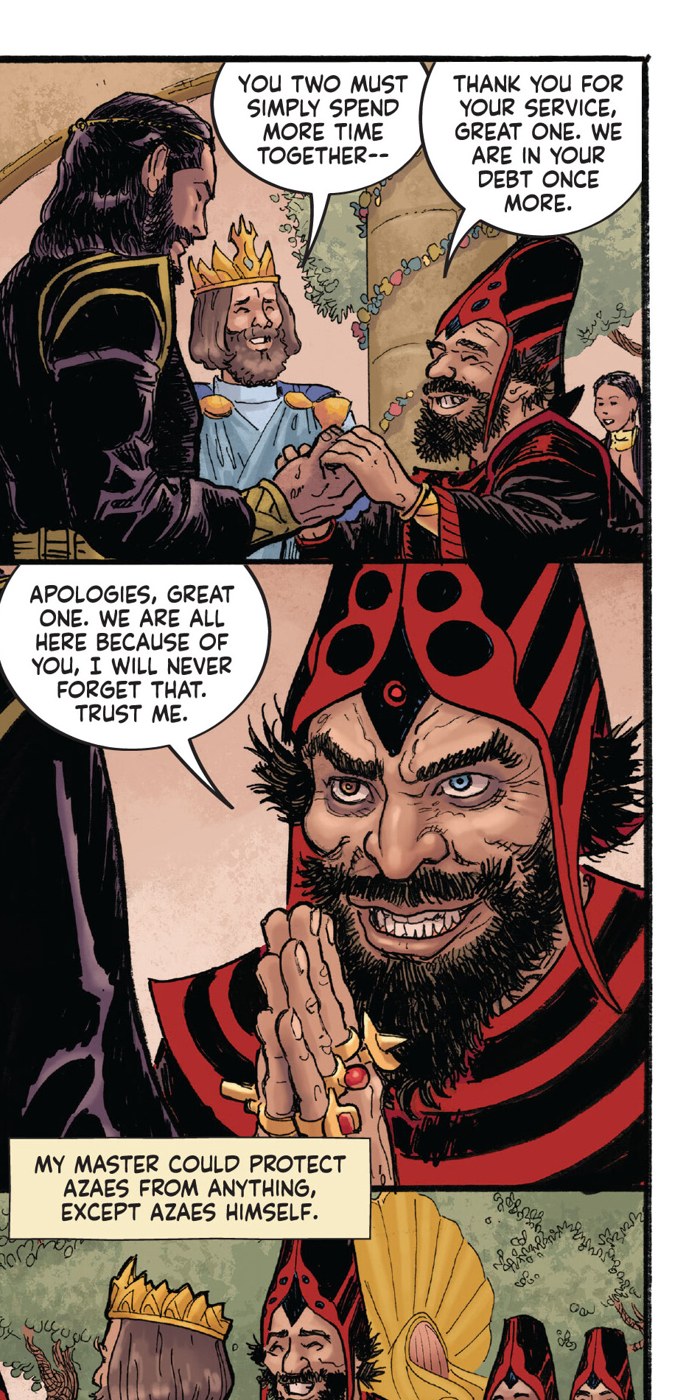
Azaes wants B and Vizane to spend more time together. Vizane thanks B for his service to the crown and presents himself as part of the same royal order B has protected for decades. B immediately rejects the overture. He tells the priest that his duty to the crown includes expunging threats with extreme and brutal prejudice and tells Vizane to remember it.[1]
Vizane's response is superficially polite. He apologizes and tells B that everyone in Atlantis is there because of him, then asks for trust. The exchange establishes their relationship at once. Vizane attempts to absorb B into his religious framing. B responds by defining himself as a guardian capable of killing the priest if he becomes a danger.
Religious influence over Azaes
The strongest evidence of Vizane's success is Azaes himself. Zubatai describes the adult king as once kind and loving, then observes a change in his eyes associated with corruption and forbidden desire. The new religion spreads beyond private spiritual practice and becomes part of the life of the royal court.[5]
Vizane's teaching centers on transformation, chosen status, prophecy, and immortality. When B later confronts the cult, Azaes says they stand at the precipice of a great change and that all present are chosen, especially B.[6]
The priest's strategy is effective because it does not ask Azaes to abandon his love for B. It redirects that love into possession. B's immortality becomes something the king and cult are entitled to share. Vizane reframes B not as a person with autonomy, but as the long-awaited component in a prophetic mechanism.
This ideological move connects Vizane to one of BRZRKR's central patterns. Across B's life, governments, rulers, scientists, and religious movements repeatedly interpret his body as a tool. Vizane's language is mystical rather than scientific, but the underlying exploitation is similar.
The theft from the reliquary
Vizane's movement becomes an active conspiracy when the Atlantean reliquary is robbed. Zubatai reports that the thieves took a large obelisk and dangerous ancient texts that B had hidden. B identifies the writing as Aklo, which he says poisons the minds of mortal men. He concludes that the priest and his followers have grandiose plans to resurrect long-dead gods.[7]
The theft proves that Vizane has moved beyond preaching. He is willing to violate royal or sacred storage, seize dangerous material, and conceal the operation from B.
The exact origin of the Aklo documents is not stated. The issue does not explain who wrote them, how Atlantis acquired them, or how B came to understand the language and its danger. Vizane's ability to use them therefore represents a major unresolved point in his biography.
The northeastern tower
B tracks Vizane and Azaes to a gathering at the northeastern tower. Vizane and his followers are arranged around the obelisk, while Azaes attempts to persuade B to listen rather than attack.[6]
Vizane tells B that he has only the immortal's destiny to offer. His language is deliberately manipulative. Rather than admitting that the cult intends to bleed, restrain, and exploit B, he presents participation as fulfillment.
B refuses and warns Azaes that Vizane is evil and intends to end the world. Azaes rejects the warning and invokes royal authority. Vizane's most important victory has already occurred before any magic begins. He has convinced the king to treat B's refusal as disobedience rather than consent withheld.
The restraint of B
When B tries to act, thorned growths erupt and immobilize him. The comic presents the phenomenon as part of the cult's ritual capabilities. Vizane is either the direct caster or the ritual leader under whose control the magical restraint is produced.[8]
The followers begin collecting B's blood in cups. Azaes speaks of becoming immortal brothers. Vizane explains the deeper mechanism. Years earlier, the king had given B a blade made from primordial ore. According to Vizane, the weapon has a larger destiny. It forms a set with the obelisk. The sword is the key, and the obelisk is the door.[3]
This knowledge shows that Vizane has conducted research beyond ordinary religious teaching. He understands the relationship between artifacts, prophecy, B's arrival in Atlantis, and the requirements of the gateway.
B's blood and the faithful
Vizane instructs the followers to drink deeply from ritual cups filled with B's blood. He says the prophecy decrees that B's immortal blood will mark them as faithful and that the god's wrath will pass over them.[3]
The ritual is a revealing mixture of theology and opportunism. Vizane is not simply summoning a god. He expects to protect a chosen community from the consequences and to use B's biological condition as a sacrament.
The story later demonstrates the flaw in this belief. B's blood does not make the cultists safe from Cthulhu. The entity kills or consumes them along with other Atlanteans.
A definitive wiki should avoid stating that drinking B's blood grants immortality, powers, or permanent biological changes. Poetry of Madness establishes the cult's belief and action, not the successful transfer of B's abilities.
The prophecy
Vizane tells B that the people heard a prophecy that a demon with a handsome face would walk Atlantis's guardwall. He claims they recognized B as the prophetic figure and that B had been brought to Atlantis for this reason.[3]
The story never establishes the prophecy's source or reliability. It may derive from the Aklo texts, an older Atlantean tradition, Vizane's interpretation, or deliberate manipulation. The fact that the sword and obelisk genuinely interact gives the prophecy some connection to real supernatural mechanisms, but that does not validate Vizane's entire theological system.
The article should therefore distinguish between:
- confirmed mechanism: the sword and obelisk can open a gateway;
- confirmed cult belief: B fulfills a prophecy and his blood protects the faithful;
- unconfirmed claim: the cult is divinely chosen or destined for immortality.
Opening the gateway
Vizane begins the ritual using B's sword and the obelisk. The obelisk glows and sends a blood-colored beam into the sky. A gateway opens, and the entity later identified as Cthulhu emerges.[9]
Vizane reacts with ecstasy rather than fear. He sees the enormous alien being as the fulfillment of his religion and cries out its name. The language of divine return is explicit in the narration surrounding the creature's arrival.
The result immediately contradicts the cult's expectations. Cthulhu attacks Atlantis and begins destroying the city.
Failure of the immortality promise
Vizane's followers discover that neither their ritual participation nor B's blood provides immunity. Cthulhu's body and secretions overwhelm cultists, guards, and civilians alike.[10]
Azaes's dream of immortal brotherhood also fails. The king is mortally injured. The city itself becomes collateral damage in the return of the supposed god.
Vizane nevertheless continues to rely on occult knowledge. The persistence can be read as fanaticism, opportunism, or genuine belief. The comic does not show him renouncing the ritual after the disaster begins.
Aklo and the attempt to communicate with Cthulhu
Near the climax, B confronts Vizane while the cult leader is still trying to survive the catastrophe. Vizane pleads for his life by claiming he can speak Cthulhu's language and communicate with the entity.[4]
B tests the claim by speaking a phrase in Aklo. Vizane is surprised that B knows the language. B asks whether Vizane understands the grammatical masculine and feminine forms, emphasizing that elder gods are known to be finicky about grammatical usage. Vizane recognizes B's accent as accurate.[4]
The exchange is darkly comic, but it reveals important lore. B knows Aklo well enough to challenge Vizane's expertise. Vizane's confidence is therefore not based on unique knowledge. The immortal has encountered the language or related entities before.
Death
Vizane's attempt to negotiate fails because B no longer needs him. B kills him violently, tearing into his body and leaving his remains as potential food for Cthulhu. B's final remark expresses contempt for the priest who created the catastrophe.[4]
Vizane dies before he can demonstrate whether communication with Cthulhu would have worked. The story does not show Cthulhu recognizing him as priest, chosen servant, summoner, or protected worshipper.
His death completes the collapse of his authority. The man who promised access to divine immortality ends as disposable flesh inside the disaster he opened.
Personality
Vizane is charismatic, manipulative, theatrical, confident, secretive, and fanatical. His first interaction with B shows social intelligence. He does not challenge B openly at court. He smiles, offers thanks, and asks for trust.[1]
He also demonstrates patience. The cult has time to steal artifacts, gather followers, study texts, construct a ritual site, and convince Azaes that the project serves the future of the kingdom.
Vizane's confidence becomes arrogance. He assumes his reading of prophecy is correct, assumes B can be forced into a predetermined destiny, assumes B's blood will protect the faithful, and assumes knowledge of Aklo makes him valuable enough to survive once Cthulhu is free.
The final encounter with B exposes the gap between knowledge and wisdom. Vizane knows enough to open the door. He does not know enough to control what comes through it.
Skills and abilities
Religious leadership
Vizane recruits and commands a visually distinct body of followers. His movement gains access to the king and becomes influential at court.
Occult scholarship
He studies or uses forbidden ancient texts, understands Aklo, knows the relationship between the primordial-ore sword and the obelisk, and interprets prophecy connected to B.
Ritual magic
Vizane conducts the gateway ritual and appears capable of producing or directing supernatural restraints. The thorned cage holding B is not explained technologically and is presented as magical.[8]
Aklo language
Vizane can speak Aklo and believes the language can be used to communicate with Cthulhu. B's final exchange confirms that Vizane has at least real linguistic knowledge rather than merely pretending expertise.[4]
Political influence
His greatest practical ability is persuading Azaes to override B's warnings. Through the king, Vizane obtains protection, access, followers, and the authority needed to operate inside Atlantis.
Relationships
King Azaes
Azaes is Vizane's most important convert. The priest turns the king's fear of mortality and affection for B into support for a ritual designed to share or appropriate immortality.
B / Unute
Vizane sees B as both obstacle and sacred component. He flatters B publicly while secretly planning to use his blood, sword, and prophetic identity. B recognizes Vizane as a threat almost immediately and ultimately kills him.
Zubatai
Zubatai opposes the transformation of Azaes's court and discovers the reliquary theft. Her chronicle is the principal surviving record of Vizane's rise and fall.
Vizane's followers
The followers treat Vizane as leader and priest. They steal the artifacts, participate in ritual preparations, drink B's blood, and remain around the obelisk during the opening of the gateway.
Cthulhu
Vizane worships or reveres Cthulhu as a god and believes the entity's return fulfills prophecy. Cthulhu does not reciprocate any visible loyalty. The creature's arrival destroys Vizane's movement and Atlantis.
Appearance
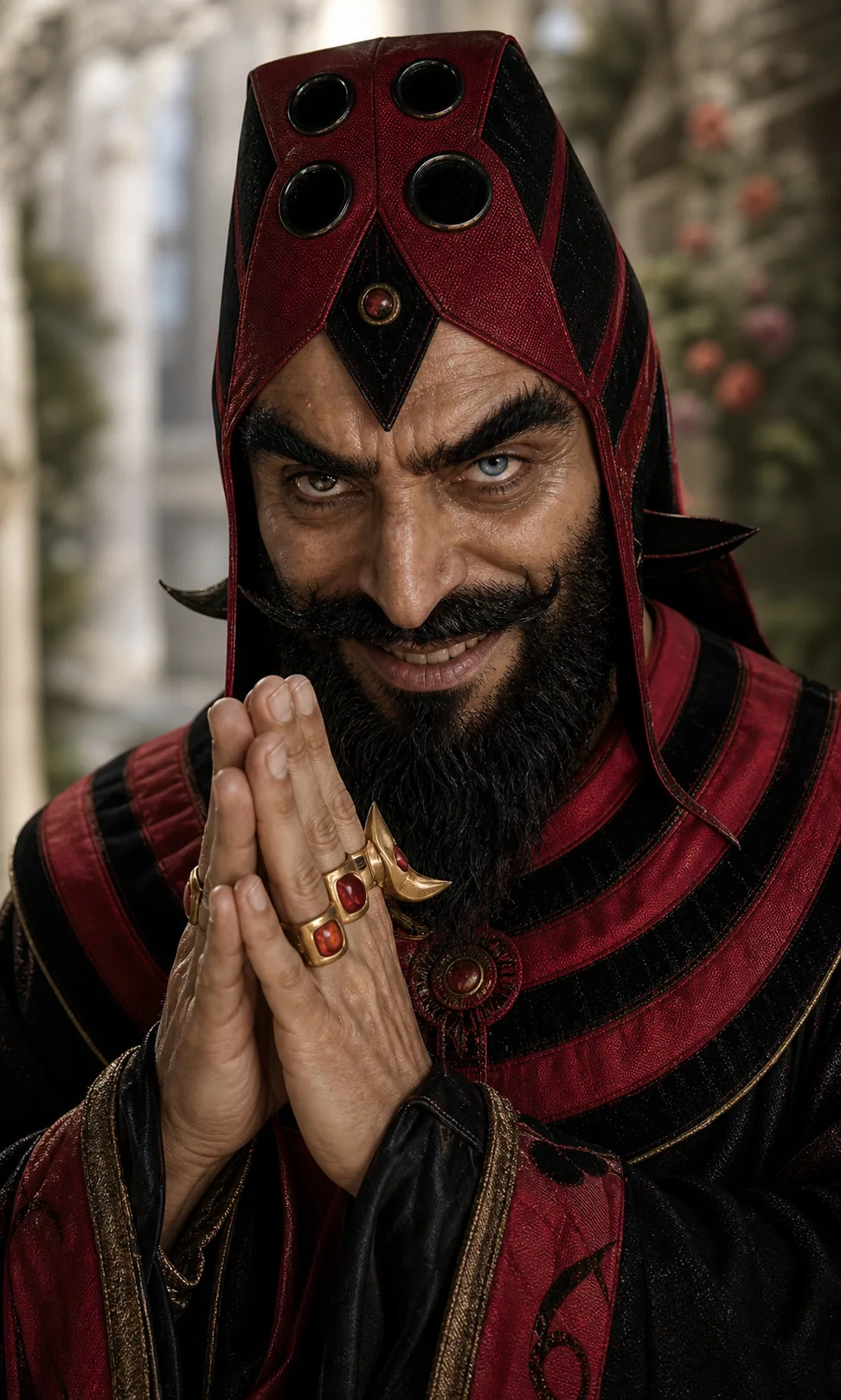
Vizane is depicted as a bearded man wearing highly distinctive black and red ceremonial clothing. His tall pointed headdress contains circular or eye-like black motifs, and his robes repeat spiraling red designs. His followers wear related clothing, visually turning his religious faction into an organized body separate from the gold-clad Atlantean guard.
His exaggerated smile is a recurring visual feature and contributes to the character's unsettling presentation.
Status and legacy
Vizane is deceased, killed by B before Cthulhu's destruction of Atlantis is complete.
His legacy is enormous. He is the direct architect of the event that ends Atlantis as a civilization. Even though B kills Cthulhu, the creature's dying body dissolves the city. Vizane therefore belongs on pages concerning Fall of Atlantis, People Who Attempted to Exploit B, BRZRKR Cults and Religions, Aklo, Cthulhu, Atlantean Artifacts, and B Through the Ages.
Appearances
- BRZRKR: Poetry of Madness #1 - sole confirmed canonical story appearance.
- BRZRKR: Poetry of Madness Pen & Ink #1 - alternate edition of the same story, not a separate event.
Canon limitations and unresolved questions
The comic does not establish Vizane's birthplace, age, family, how he became a priest, when he first met Azaes, where he learned Aklo, who wrote the texts he stole, whether he personally discovered the sword-obelisk mechanism, or whether he had contact with Cthulhu before the ritual.
The exact name of Vizane's religion is not given. "Vizane's followers" or "Vizane's religious movement" should therefore remain the neutral wiki terminology unless a later primary source supplies an official faction name.
The story also does not establish whether Vizane is a conventional human wizard, whether his magical abilities come from Aklo study, whether the obelisk amplifies his power, or whether another entity empowers him.
References
[1] Keanu Reeves and Steve Skroce, BRZRKR: Poetry of Madness #1 (BOOM! Studios, 2023), Vizane's introduction at Azaes's court and B's warning to him, digital page image 016.
[2] Reeves and Skroce, BRZRKR: Poetry of Madness #1, cult conspiracy, stolen reliquary material, ritual, and destruction of Atlantis, digital page images 017-045.
[3] Reeves and Skroce, BRZRKR: Poetry of Madness #1, Vizane's explanation of the primordial-ore blade, obelisk, B's blood, prophecy, and gateway, digital page images 021-023.
[4] Reeves and Skroce, BRZRKR: Poetry of Madness #1, B's final confrontation with Vizane, Aklo-language exchange, and Vizane's death, digital page images 038-040.
[5] Reeves and Skroce, BRZRKR: Poetry of Madness #1, Zubatai's observation that Azaes's kindness has been replaced by corruption and forbidden desire, digital page image 014.
[6] Reeves and Skroce, BRZRKR: Poetry of Madness #1, northeastern tower meeting, Azaes's "great change" language, and Vizane's offer of destiny, digital page images 018-019.
[7] Reeves and Skroce, BRZRKR: Poetry of Madness #1, robbery of the reliquary, stolen obelisk and ancient Aklo texts, digital page image 017.
[8] Reeves and Skroce, BRZRKR: Poetry of Madness #1, magical restraint of B and ritual preparation, digital page images 020-023.
[9] Reeves and Skroce, BRZRKR: Poetry of Madness #1, opening of the gateway and appearance of Cthulhu, digital page images 023-025.
[10] Reeves and Skroce, BRZRKR: Poetry of Madness #1, Cthulhu's attack on the cultists, guards, and city, digital page images 024-036.