Selected scenes
BRZRKR in pictures.
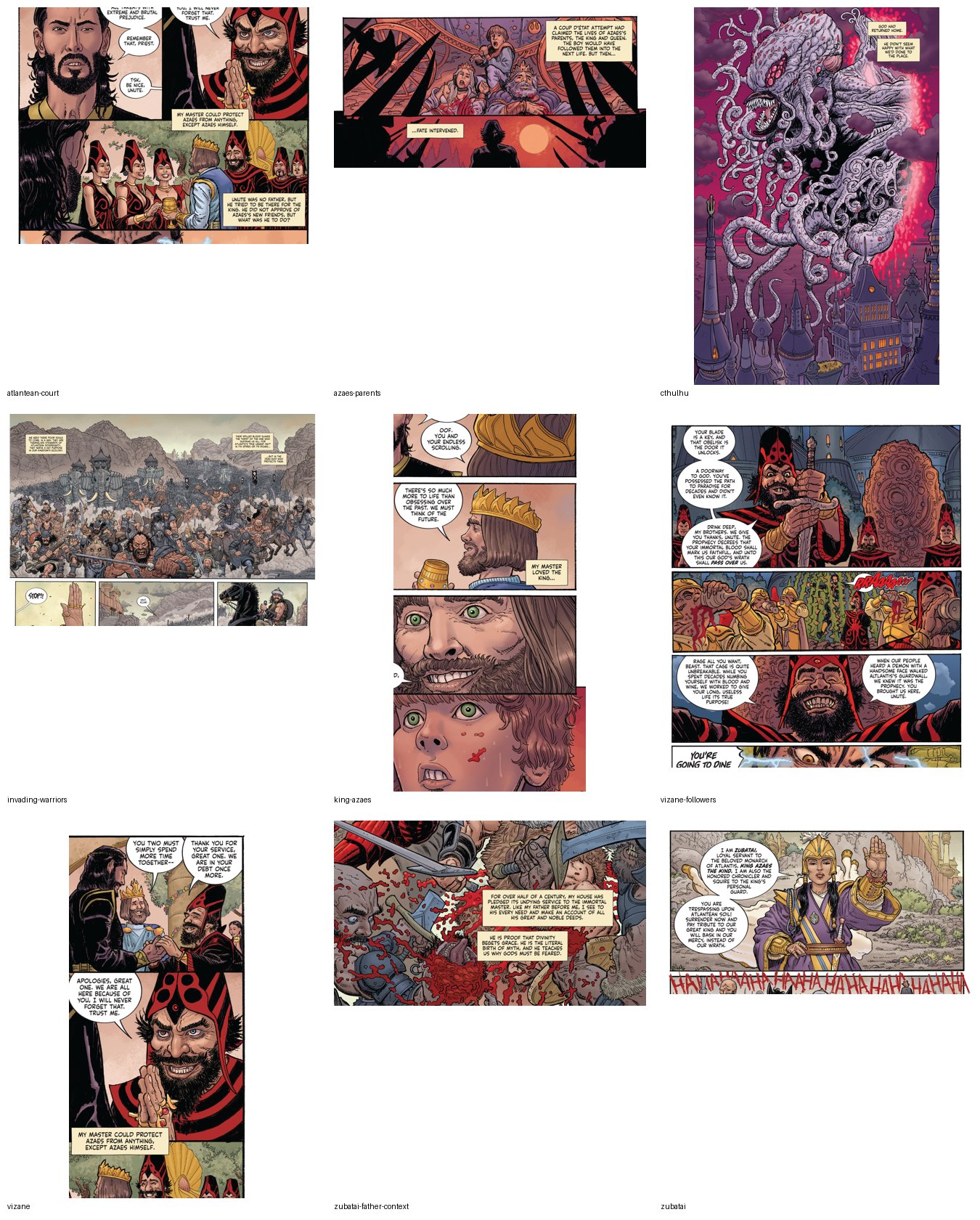
Spoilers: This article covers the Atlantis history depicted in BRZRKR: Poetry of Madness #1.
Overview
Atlantis is the ancient city and kingdom where B, known there as Unute the Berserker, spends one of the longest and most settled periods shown in his history. In BRZRKR: Poetry of Madness #1, Atlantis is presented as a wealthy maritime civilization whose beauty, culture, gold, and defensive strength attract armies from distant regions. Its survival depends on an unusual arrangement: King Azaes rules, the royal court supplies the institutions of government, and B functions as a nearly unstoppable personal defense force. The city is not protected by an anonymous legend. Its people see B in the streets, drink with him, celebrate his victories, and place him beside Poseidon in their religious imagination.[1][2]
Atlantis is also the setting of one of B's sharpest reversals. He chooses the city as a home and protects Azaes from childhood, but the monarchy later allows Vizane and his followers to use B as a ritual component. The conspiracy begins inside the palace, not beyond the walls. The gateway opened with B's blood, a primordial-ore sword, an Atlantean obelisk, and Aklo texts brings Cthulhu into the city. B kills the entity, but its dying body dissolves Atlantis. The city therefore ends through the failure of the same court that had benefited from B's protection.[3][4]
Geography and cityscape
The issue introduces Atlantis through a panoramic account of abundance. The city is associated with beauty, culture, wealth, and gold, and its reputation travels far enough to draw outside peoples toward it. The narration links the city's fame to a long-distance world of movement and exchange, naming distant cultural points while keeping Atlantis itself at the center of the story. The comic does not provide a modern map, an exact coastline, or a definitive latitude. It does show a city with a harbor, monumental buildings, palace spaces, elevated towers, and an enclosed ritual environment.[1]
The harbor is the practical face of Atlantis. Foreign forces approach from outside, and the city receives the threat at its gates rather than meeting every army in a distant field. The walls and gate area allow the royal court to make a formal offer of surrender and tribute. Atlantis's defensive posture is therefore both military and theatrical: an enemy is permitted to see the city it wants, hear its terms, and then discover that the real defense is a single immortal combatant.[1][5]
The palace is the political and social center of Azaes's reign. B visits the court, speaks privately with the king, and is invited to participate in palace festivities. The palace is not represented as a silent fortress. It is a place of drinking, sexual revelry, ceremony, guards, attendants, and competing loyalties. Vizane enters this environment as a priest with a growing movement, and the court gradually becomes the setting in which royal authority and religious ambition merge.[6]
The reliquary is a separate site of study and custody. B retreats there to read ancient scrolls, and Zubatai knows how to find him. Vizane's followers steal an obelisk and Aklo texts from it, turning a place associated with preservation into the starting point for the city's destruction. The issue does not provide an architectural floor plan or identify every object held inside. It does establish the reliquary as a protected Atlantean institution whose contents include material dangerous enough to concern B.[7]
The northeastern tower is the key ritual location. Vizane, Azaes, the cult followers, guards, and B converge there after the theft. The tower gives the movement a high and exposed setting for the sword-and-obelisk mechanism. It is not merely a meeting room. It becomes the point where the court attempts to convert history, blood, prophecy, and alien contact into a single act.[3][8]
Monarchy and civic life
The monarchy shown in the story consists of King Azaes and the unnamed royal couple who ruled before him. Azaes survives a coup attempt as a child because B intervenes after his parents are killed. The issue does not name the conspirators, define Atlantean succession law, or explain the parents' reign. It does show that the royal line is hereditary enough for the survival of the child to determine the city's political future.[9]
Azaes's adult reign is stable in public because B makes conventional invasion almost irrelevant. Zubatai says the king's rule is enabled by B's will. This does not prove that Azaes lacks administrative ability; it shows that the city's visible security and the king's political confidence are inseparable from the immortal protector. The people cheer B after battles, and the horns that announce victory transform destruction into civic celebration.[2]
Zubatai occupies several positions at once. She is a royal servant, an honored chronicler, a squire attached to the king's personal guard, and a member of a family that has served B across generations. Her role provides the story's human view of Atlantis. She can explain the court's customs, the city's pride, B's habits, and Azaes's childhood while also participating in the danger. Her testimony is personal rather than omniscient, but it is the main surviving account of the city's final days.[2][10]
The city's relationship with B has a religious dimension. Zubatai places him near Poseidon in the local hierarchy while emphasizing that he walks the same streets as beggars, drinks the same wine, and responds to ordinary people. The comparison does not establish a formal theology or a complete pantheon. It establishes that Atlantis treats B as more than a soldier. His body, victories, and presence have become part of public life.[2]
B as protector of Atlantis
B's first major appearance in the Atlantis story occurs at the gate, where Zubatai offers invading warriors the choice of surrender, tribute, and mercy. The commander assumes that the king's guard means the human soldiers visible around the city. Zubatai points instead to B. The exchange makes the city's military system legible in a few lines: Atlantis has a court, a guard, and ordinary defenses, but the decisive weapon is a single person whose capacity for violence exceeds the scale of the invading force.[1]
B destroys the army in an extended sequence. The comic emphasizes the mismatch between the number of attackers and the speed with which B reaches them. His body is damaged, soaked in blood, and then visibly regenerates. The people of Atlantis respond with celebration rather than fear. That reaction distinguishes the city from the tribes and governments that use B as a disposable weapon elsewhere in his life. Atlantis's people know he is dangerous, but they also treat him as a beloved protector who belongs among them.[2]
The arrangement is emotionally important because B chooses it. Zubatai's father believes B recognized his own childhood in Azaes, a child whose fate had been attached to the ambitions of violent adults. B remains after saving the boy. The issue does not state that he becomes a formal officer, husband, or citizen. It shows a voluntary attachment that gives Atlantis the status of a chosen home.[9][10]
Vizane and the court's fracture
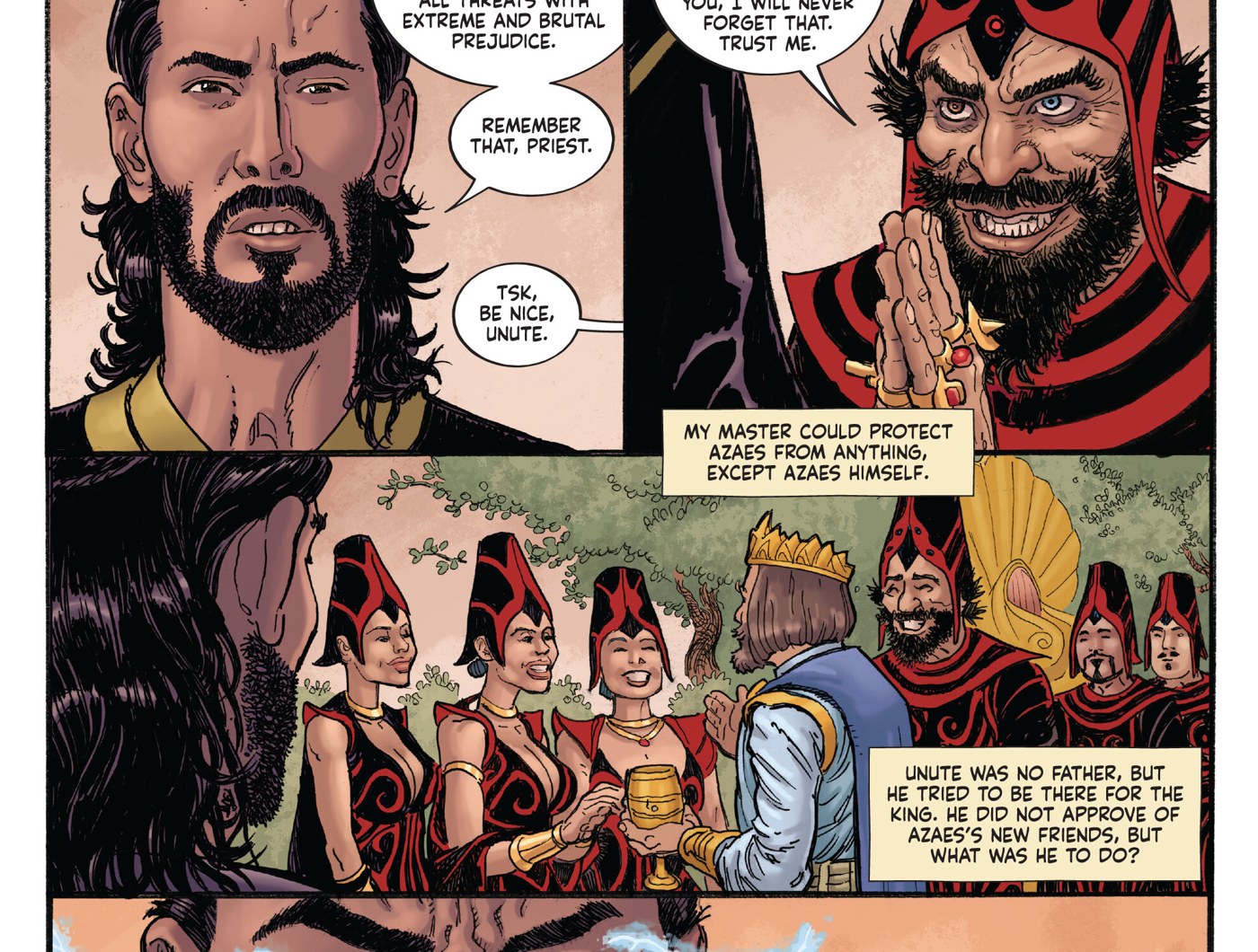
The city's political decline is visible before the gateway opens. Zubatai remembers Azaes as kind and then notices corruption and forbidden desire replacing that kindness. Vizane enters the court with black-and-red followers and a doctrine promising a great change. B distrusts him immediately and warns that the priest's work is connected to dangerous texts and the resurrection of long-dead gods.[6][7]
Azaes does not accept B's warning. The king's affection for his old protector is redirected into possession. Because Azaes has spent his life beside an immortal being, the prospect of an immortal brotherhood has a personal force that ordinary political promises would not have. Vizane reframes B's existence as a resource that the king and the faithful are entitled to use. The court's guards remain present, but royal authority now protects the ritualists rather than the person who made the monarchy secure.[8]
The theft from the reliquary turns ideological change into an organized operation. The movement takes the obelisk and Aklo texts, restrains B with supernatural means, collects his blood, and positions the sword and obelisk as parts of a gateway. The issue leaves the exact mechanics partly unexplained. It is clear that the cult believes B's body, the primordial-ore blade, and the ancient writing form a system. It is not clear that the blood actually grants immortality to anyone who drinks it.[3][8]
Destruction of Atlantis
When the gateway opens, Cthulhu emerges as an enormous entity whose presence overwhelms the tower, the cult, the guards, and the city beyond. The creature's arrival is not a controlled manifestation that leaves the court in possession of new power. It is an invasion from the other side of the ritual. Vizane and his followers praise the being, but the entity attacks indiscriminately. The people who summoned it are exposed to the same destruction as the population they intended to transform.[3][11]
B escapes the ritual restraint and fights Cthulhu across the ruined city. He moves through the creature's body, hears or locates its heart, and destroys it from within. Cthulhu's death does not restore Atlantis. The dying body dissolves over the city, leaving the surviving B and Zubatai to witness the end of the civilization that had protected and celebrated him.[4][11]
Azaes is mortally wounded during the catastrophe. B speaks to him about his parents waiting at the end of the path, returning the king's final moment to the family history that began with the coup. Vizane dies after B tests the priest's claim to speak the language of the entity and rejects his performance. Zubatai survives long enough for her account to preserve the sequence, but Atlantis itself has no shown political successor.[4][12]
Later history and unanswered questions
The supplied comic does not establish whether Atlantis is rediscovered, whether survivors rebuild it, or whether later cultures preserve an accurate memory of its fall. It does not give a reliable date for the city's existence, a complete list of rulers, a map of its territory, or a definitive explanation of its relationship to the Atlantis of real-world legend. The BRZRKR setting uses the name as part of its own fictional history; similarities to outside myths do not establish identity between continuities.
The fate of Zubatai after B releases her is unknown. The later history of the reliquary, obelisk, Aklo texts, and primordial-ore sword is also not fully traced in this story. Atlantis ends as a physical city in the closing sequence, but its objects, stories, and survivors may continue to influence later records. Those possibilities remain open rather than confirmed.
Appearances
- BRZRKR: Poetry of Madness #1 - primary depiction of Atlantis, its monarchy, defense, court, ritual, and destruction.
- BRZRKR: Poetry of Madness Pen & Ink #1 - alternate presentation of the same story, not a separate historical event.
See also
The city as a memory of power
Atlantis is remembered through a sequence of rooms and thresholds: the harbor where danger arrives, the palace where B is honored, the reliquary where knowledge is kept, and the tower where the ritual turns that knowledge into a doorway. The city is impressive because its institutions are real, but those institutions also make the catastrophe possible. The court can welcome B as a protector and still allow his blood to be treated as a resource.
Zubatai's presence keeps Atlantis from becoming only a mythic spectacle. She knows the city through inherited service, and she recognizes the gap between the public story of B and the private cost of that story. When the city dissolves, her memory becomes one of the few surviving structures. Atlantis survives as a narrative because someone was present to understand what was lost.
Why B cannot save Atlantis
B can defeat the creature that emerges through the gateway, but he cannot reverse the choices that opened the gateway. The city has already decided that protection is worth possession and that a sacred object can be used if the result promises security. His strength arrives too late to undo that decision. The tragedy is not that B lacks power. It is that power cannot repair a political culture that has made every relationship conditional.
The same pattern appears later in Olos and the government program. A society sees B's survival and assumes that survival makes consent optional. Atlantis is the earliest fully dramatized warning that a protector can become the instrument of a city's destruction when institutions stop seeing the protector as a person.
References
[1] Keanu Reeves and Steve Skroce, BRZRKR: Poetry of Madness #1 (BOOM! Studios, 2023), opening description of Atlantis, outside peoples drawn to its wealth, the gate confrontation, and B's introduction, digital page images 002-006.
[2] Reeves and Skroce, BRZRKR: Poetry of Madness #1, B's battle, public celebration, Zubatai's account of B's civic status, and the comparison with Poseidon, digital page images 005-013.
[3] Reeves and Skroce, BRZRKR: Poetry of Madness #1, reliquary theft, northeastern tower, restraint of B, blood collection, sword, obelisk, and gateway preparation, digital page images 017-023.
[4] Reeves and Skroce, BRZRKR: Poetry of Madness #1, Azaes's final moments, Vizane's death, B's assault on Cthulhu, and Atlantis's dissolution, digital page images 037-045.
[5] Reeves and Skroce, BRZRKR: Poetry of Madness #1, Zubatai's surrender demand and the distinction between the visible guard and B, digital page images 003-005.
[6] Reeves and Skroce, BRZRKR: Poetry of Madness #1, Azaes's changing character, Vizane's arrival, B's warning, and the court sequence, digital page images 014-017.
[7] Reeves and Skroce, BRZRKR: Poetry of Madness #1, B's discussion of Aklo and the stolen reliquary materials, digital page image 017.
[8] Reeves and Skroce, BRZRKR: Poetry of Madness #1, northeastern tower confrontation, Azaes's authorization, supernatural restraint, and the cult's ritual, digital page images 018-023.
[9] Reeves and Skroce, BRZRKR: Poetry of Madness #1, coup flashback, deaths of Azaes's parents, B's intervention, and the reason attributed to Zubatai's father, digital page image 015.
[10] Reeves and Skroce, BRZRKR: Poetry of Madness #1, Zubatai's inherited service and chronicle of B, digital page images 004-006 and 014-018.
[11] Reeves and Skroce, BRZRKR: Poetry of Madness #1, Cthulhu's manifestation and attack on the city, digital page images 023-036.
[12] Reeves and Skroce, BRZRKR: Poetry of Madness #1, B's Aklo exchange with Vizane and the final battle, digital page images 038-042.