Selected scenes
BRZRKR in pictures.
Spoilers: This article discusses the complete events of BRZRKR: Poetry of Madness #1.
Overview
King Azaes is the monarch of Atlantis during BRZRKR: Poetry of Madness and one of the most important historical rulers known to have formed a sustained personal relationship with B, also called Unute. Azaes first encounters B as a child after a coup attempt kills the king and queen, Azaes's parents, and threatens to kill the young heir as well. B intervenes, protects the boy, and remains in Atlantis. Over time Azaes grows into a ruler whose apparently benevolent reign depends in large part on B's willingness to defend the kingdom against external threats.[1]
The adult Azaes initially appears warm, affectionate, and deeply attached to B. He misses B when the immortal withdraws into the reliquary, encourages him to return to court, and speaks of the future rather than dwelling on ancient history. Zubatai, however, records that the king's character has changed. The kindness once visible in his eyes has been replaced by corruption and forbidden desire, a transformation linked to the rise of the priest Vizane and a new religious movement promising a "great change."[2]
Azaes's tragedy is therefore not that he begins as a conventional tyrant. He begins as a survivor protected by B from the ambitions of violent men, then eventually becomes a ruler willing to exploit B in pursuit of immortality. He repeats the basic pattern that B once saved him from. Vizane persuades him that B's body, blood, sword, and destiny can be used to transcend mortality. The king authorizes the restraint and bleeding of his former protector, participates in a ritual that opens a gateway to Cthulhu, and dies during the destruction he helped cause.[3]
Biography
Childhood and the coup that killed his parents
Azaes enters the story's chronology as a child at the center of a violent succession crisis. Zubatai narrates that a coup attempt claimed the lives of Azaes's parents, the reigning king and queen. The boy was expected to follow them into death, but B arrived and intervened before the attackers could complete the purge.[1]
The sequence is brief but fundamental. Azaes's earliest known experience of kingship is inseparable from political murder. His parents are not shown governing, and the comic does not explain who organized the coup, what faction supported it, or what policies motivated the violence. What the story emphasizes instead is the emotional pattern recognized by B. Zubatai says her father believed B saw his own history reflected in the boy's situation. B had spent his life used by ambitious people, and he recognized that Azaes had become another child whose fate was being yoked to the desires of violent adults.[1]
B's response is unusual for him. He does not simply kill the attackers and leave. He remains. Zubatai characterizes this period as perhaps the first true home B chose and built on his own terms. For an immortal accustomed to moving from war to war, the choice to protect a child and a city creates one of the closest approximations to family found in this period of his history.
B as protector and surrogate parent
Zubatai explicitly remarks that Unute was "no father," but tried to be there for the king. The phrase captures the ambiguity of their bond. B does not occupy a formal parental title, yet his behavior is parental in function. He saves Azaes as a child, keeps him alive, protects his kingdom, and remains close enough that the adult Azaes still seeks his company.[4]
This relationship should be distinguished from B's service to later rulers. In Atlantis, B is not presented merely as a mercenary or weapon borrowed by a sovereign. The king's personal history depends on him. Azaes grows up knowing that his throne and life exist because the immortal chose to intervene.
The imbalance is profound. Azaes ages from childhood into adulthood while B remains physically unchanged. This likely contributes to the king's fascination with immortality, although the comic does not explicitly state that seeing B's agelessness is the sole origin of his later obsession. What can be said safely is that Azaes spends his formative years beside living proof that death and aging are not universal conditions.
Reign over Atlantis
As an adult, Azaes is presented as a generally kind king before Vizane's influence fully takes hold. Zubatai states that his reign is enabled solely by B's will. This is not a claim that Azaes has no administrative ability. Rather, it emphasizes that Atlantis's extraordinary security depends on the immortal defender who annihilates invading armies before they can breach the city.[2]
Atlantis flourishes under this arrangement. Its beauty, culture, wealth, and gold become legendary. Those same riches attract invaders from distant regions. The city effectively turns repeated assaults into ritualized displays of B's power. Foreign armies reach the gates, refuse surrender, and are destroyed. The Atlantean population then celebrates the immortal protector's victory.[5]
Azaes benefits politically from this system. He rules a city that appears untouchable because B makes conventional military danger almost irrelevant. The population loves B, and B appears to love Atlantis in return. Azaes therefore presides over a monarchy whose legitimacy and security are intertwined with a being no human sovereign can actually compel by ordinary force.
Relationship with B as an adult
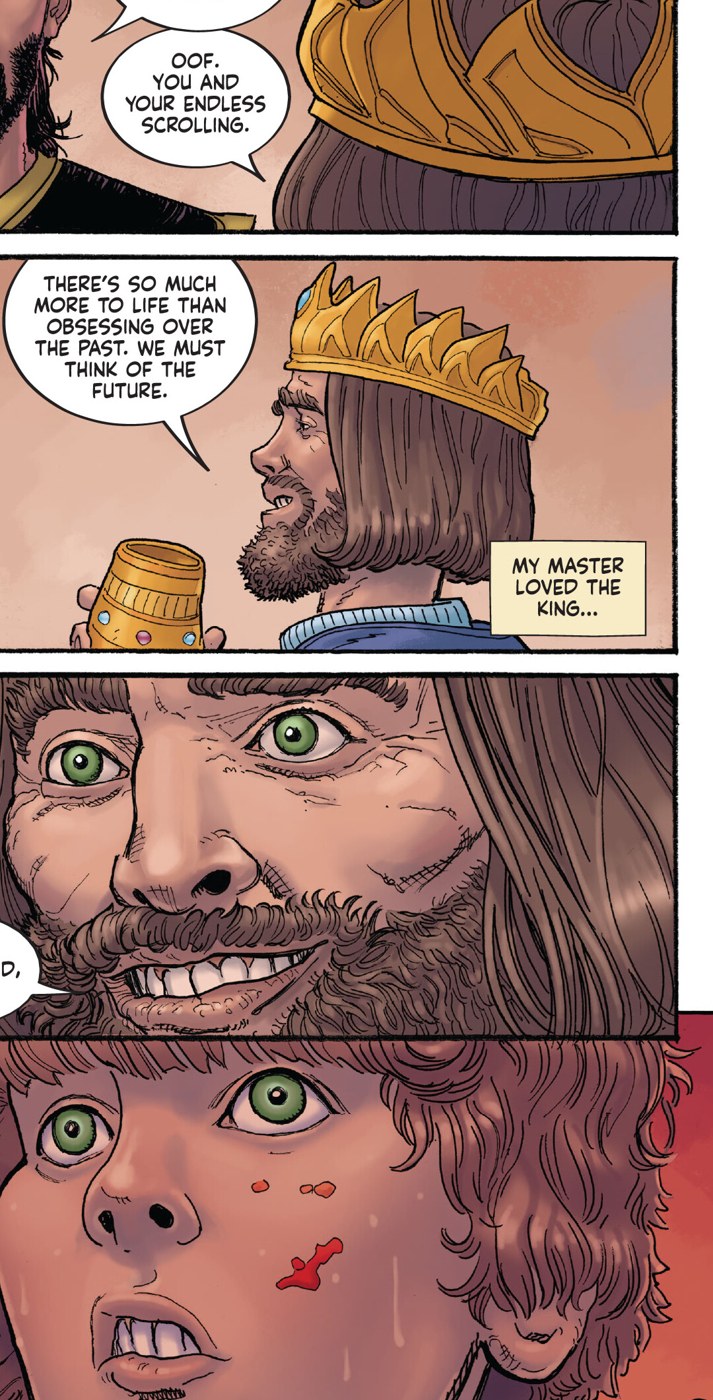
When B withdraws from court to read ancient scrolls, Azaes greets him with affection and says he misses him. He encourages B to resume their studies together, then gently mocks B's endless attention to the past. Azaes says there is more to life than obsessing over history and that they must think of the future.[2]
The exchange initially reads as the intimacy of old friends. Azaes drinks with B, touches him affectionately, and speaks with the familiarity of someone who has known him since childhood. Zubatai's narration changes the interpretation. She says her master loves the king, but that love makes it difficult for B to recognize the change in Azaes's eyes.[2]
The king's repeated use of "future" is central. B is oriented toward the past because his memory stretches across immense spans of time. Azaes becomes oriented toward a future in which death can be defeated. Vizane converts that aspiration into a religious and political program.
Vizane's arrival and the new religion
Vizane appears at court as a priest associated with Azaes's new spiritual movement. B immediately distrusts him. When Azaes asks the two men to spend more time together, B tells Vizane that it is his duty to serve the crown by eliminating threats with extreme prejudice. Vizane responds with outward politeness but obvious hostility.[4]
Azaes does not accept B's assessment. His court begins to incorporate Vizane's followers, new rituals, sexual revelry, and the language of chosen people and transformation. Zubatai sees the change as corruption. Azaes sees it as progress.
The king's vulnerability to Vizane is rooted partly in mortality. Azaes was a child when his parents were killed. He has lived beside an immortal protector ever since. The promise that humans can become like B therefore addresses both personal fear and dynastic insecurity. Even so, the story does not reduce him to a passive victim of mind control. Azaes repeatedly makes choices, defends Vizane, invokes royal authority, and participates in the ritual against B.
Theft from the reliquary
The conflict becomes open when the Atlantean reliquary is robbed. Vizane and his followers steal an obelisk and dangerous ancient texts written in Aklo. B identifies the language as harmful to mortal minds and concludes that the cult is attempting to resurrect long-dead gods.[6]
B and Zubatai trace the group to the northeastern tower, where Azaes is present with Vizane and the cult. Azaes asks B to remain calm and listen. He describes the movement as standing at the precipice of a great change and tells B that everyone present is chosen, especially him.[7]
B refuses. He calls Vizane evil and says the wizard has poisoned Azaes's mind. Azaes responds by asserting his royal authority and ordering B to obey. This is the decisive reversal in their relationship. The child B once protected from men who wanted to use him has become an adult ruler attempting to use B himself.
Restraining B and the immortality project
When B tries to intervene, magical thorned growths erupt around him. Azaes does not release his protector. Instead, he tells B that the immortal is present for a reason and that once his purpose is realized they will be "immortal brothers" together.[8]
The line reveals the king's objective more clearly than any general religious language. Azaes wants what B has. He no longer accepts the natural distinction between mortal king and immortal guardian.
Cult members drain B's blood into cups. Vizane describes B's primordial-ore sword as one half of a paired mechanism with the stolen obelisk. B's blood marks the cultists as faithful while the sword serves as a key and the obelisk as a door. The ritual is supposed to fulfill a prophecy in which a handsome-faced demon comes to Atlantis's guardwall.[9]
Azaes interprets B's suffering through the promised outcome. When B remains trapped and in pain, Azaes apologizes but tells him he will understand later. The paternal roles have fully inverted. Azaes calls the ancient immortal a child while claiming to know B's purpose better than B does.
Opening the gateway
Vizane's ritual succeeds in opening a portal, but not in the way Azaes appears to imagine. An enormous entity identified as Cthulhu emerges over Atlantis. Vizane celebrates the being's return. The summoned creature immediately begins destroying the city.[10]
Azaes's response moves between fear, denial, and dependence on Vizane's theology. He has staked his future on the priest's promises, and the collapse of those promises unfolds in real time around him.
B escapes the cult's restraint and attempts to contain the disaster. The city's guards, cultists, civilians, and royal personnel are swept into the conflict. Atlantis's political order ceases to matter as Cthulhu's scale overwhelms the built environment.
Final confrontation with B
During the destruction, Azaes remains emotionally tied to the belief that B has failed to understand his purpose. At one point he chastises B for disobedience and insists that B's role in the ritual will ultimately create immortal brotherhood.[8]
B's response becomes increasingly uncompromising. He does not accept the idea that his life has been cosmically designed to give Azaes immortality. That rejection is consistent with the larger BRZRKR theme of other people assigning B a purpose and then treating his body as a resource.
Azaes becomes another figure in that long pattern, which makes the relationship more tragic precisely because B loved him.
Death
Azaes is mortally wounded amid Cthulhu's assault and the collapse of Atlantis. The issue does not provide a clinical cause of death such as a named wound or weapon. He is shown bloodied and dying after the city has been devastated.[11]
B comes to him in his final moments. Instead of rage, B invokes Azaes's childhood. He tells the king that his parents are waiting at the end of the path and tells him to go to them.[11]
This ending deliberately connects Azaes's death to the coup that shaped his life. B saved him from joining his parents in death as a child. Decades later, B is present when that postponed death finally arrives. The protector who once kept the family line alive becomes the person who releases Azaes from fear of the end.
The scene also reveals that B's affection survives betrayal. He has every reason to hate Azaes for permitting the cult to imprison and bleed him, yet he does not use the king's last moments for punishment. He offers reassurance.
Aftermath and fall of the monarchy
Azaes's death does not restore Atlantis. B kills Cthulhu, but the entity's dying body releases alien fire that dissolves the city. The monarchy, court, reliquary, towers, civic infrastructure, and population are destroyed with it.[12]
Zubatai survives long enough to record the end. B leaves afterward. No successor to Azaes is named, and the destruction appears so comprehensive that the normal concept of dynastic succession becomes irrelevant.
Azaes is therefore the final known king of the Atlantis depicted in Poetry of Madness.
Personality
Azaes's characterization is built around contrast.
As a child, he is frightened, vulnerable, and the target of political violence. As an adult before the cult crisis, he is affectionate, sociable, optimistic, and described by Zubatai as kind. He values B personally and wants him present at court.[1][2]
Under Vizane's influence, those qualities become distorted. Optimism about the future becomes obsession with transformation. Affection for B becomes entitlement to B's body. Royal confidence becomes insistence that B obey. A desire to escape inherited trauma becomes willingness to sacrifice the autonomy of the person who saved him.
The story does not explicitly establish whether Vizane uses supernatural mind control. B says Vizane has poisoned Azaes's mind, but that can describe ideological corruption as readily as magical domination. A comprehensive article should avoid absolving Azaes of agency without evidence.
Leadership and political significance
Azaes rules a rich, culturally advanced, and militarily secure Atlantis. The issue gives little administrative detail, but his reign is described as kind before the religious turn. He holds authority over the king's guard and royal court and can direct the behavior of attendants and soldiers.
His greatest strategic advantage is B. The immortal's presence deters or annihilates foreign armies and becomes part of Atlantean public spectacle. This also creates a dangerous dependency. Atlantis becomes accustomed to external threats being solved by one person. When the existential danger comes from inside Azaes's own court, the same political system fails to recognize it in time.
Relationships
B / Unute
B saves Azaes as a child, becomes his protector, helps secure his reign, and functions as a surrogate parent or older guardian. Azaes loves B but later tries to use him to achieve immortality. B remains compassionate toward him at death.[1][11]
Azaes's parents
The unnamed king and queen are killed in the coup attempt that nearly ends Azaes's life. Their dedicated record covers the limited evidence about their reign and deaths. Their deaths define his childhood trauma and return symbolically in his final scene when B tells him they are waiting for him.
Zubatai
Zubatai serves Azaes as chronicler and royal officer. Her account preserves both his good reign and his corruption. She survives him and becomes a key historical witness.
Vizane
Vizane is Azaes's priest, adviser, ideological corrupter, and ultimately the architect of the disaster that destroys his kingdom. Azaes trusts him despite B's warnings and accepts his claims about immortality, prophecy, and a coming transformation.
People of Atlantis
Azaes is initially framed as a beloved or at least benevolent king. His later alliance with Vizane places the entire population at risk. The catastrophe turns a private desire for immortality into civilizational destruction.
Appearance
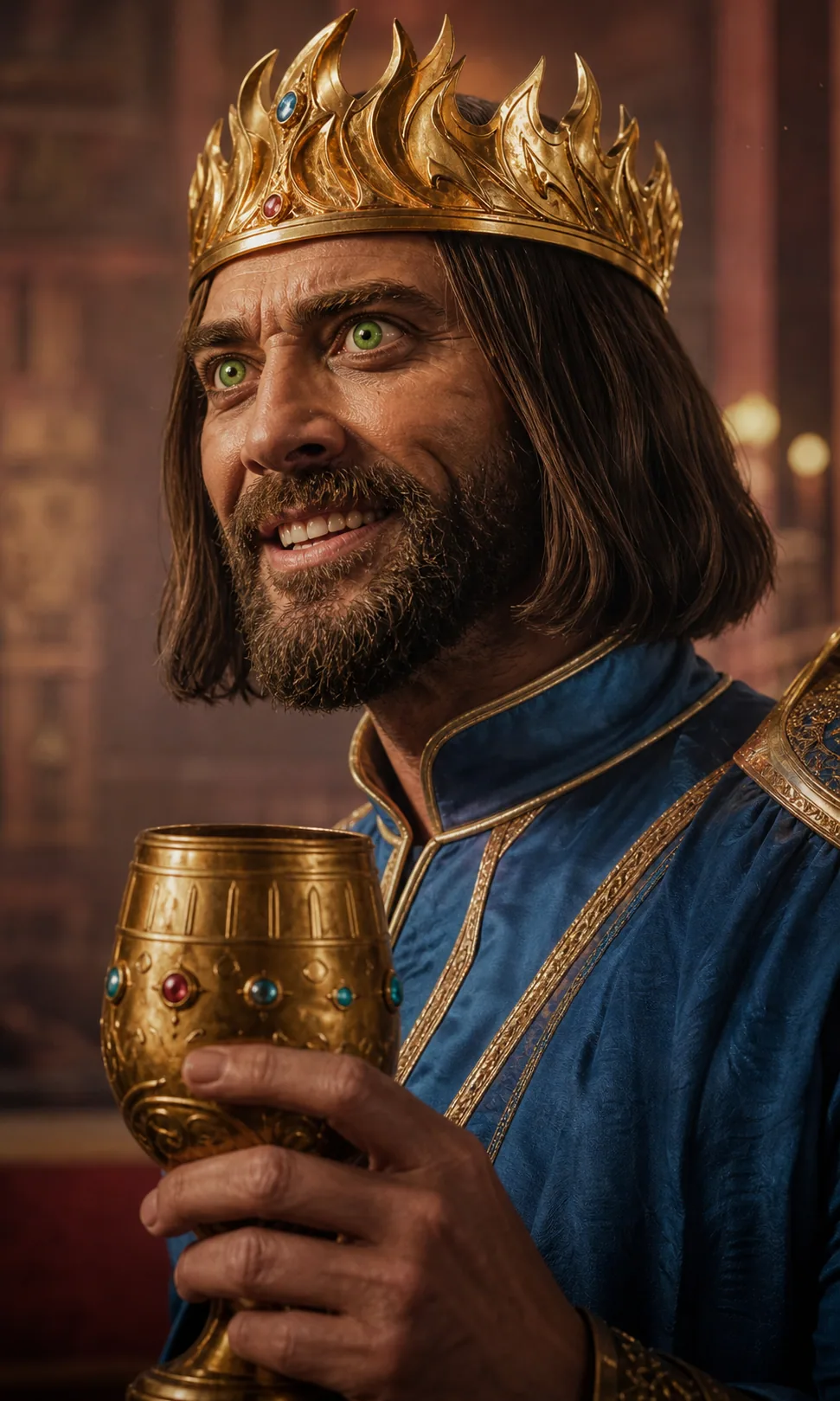
Azaes is first shown as a fair-haired child wearing a small crown or royal headpiece. As an adult he has light brown or reddish hair, a full beard, green eyes, and ornate royal clothing. His crown remains a consistent visual signifier.
During his period under Vizane's influence, his eyes and expressions become a major visual motif. Zubatai explicitly comments on the changed look in his eyes, and the art emphasizes an increasingly manic intensity.[2]
Status and legacy
Azaes is deceased. His death occurs during the same catastrophe that destroys Atlantis.
His historical legacy is inseparable from B. He is the child B chooses to save, the king whose city becomes B's home, the ruler whose reign depends on the immortal, and the friend who eventually betrays him in pursuit of immortality.
Azaes should therefore be linked from master articles on Rulers Served by B, People Who Attempted to Use B, Atlantis, Fall of Atlantis, Immortality, and B Through the Ages.
Appearances
- BRZRKR: Poetry of Madness #1 - sole confirmed story appearance, including childhood flashback and adult reign.
- BRZRKR: Poetry of Madness Pen & Ink #1 - alternate edition presentation of the same canonical events.
Canon limitations and unresolved questions
The comic does not establish Azaes's surname, exact age, date of birth, length of reign, names of his parents, identity of the coup leaders, whether he has siblings, whether he marries, whether he has children, or whether any branch of the royal family survives Atlantis.
It also does not state exactly when Vizane enters his life, how long the new religion operates before the theft, whether Azaes personally participates in every cult practice, or whether supernatural influence affects his judgment.
References
[1] Keanu Reeves and Steve Skroce, BRZRKR: Poetry of Madness #1 (BOOM! Studios, 2023), coup flashback, deaths of Azaes's parents, B's intervention, and Zubatai's account of why B stayed, digital page image 015.
[2] Reeves and Skroce, BRZRKR: Poetry of Madness #1, adult Azaes greeting B, discussion of the future, Zubatai's observation of changed eyes, digital page image 014.
[3] Reeves and Skroce, BRZRKR: Poetry of Madness #1, Azaes's alignment with Vizane, restraint of B, blood ritual, Cthulhu summoning, and Azaes's death, digital page images 019-023 and 035-038.
[4] Reeves and Skroce, BRZRKR: Poetry of Madness #1, introduction of Vizane at court, B's warning, and Zubatai's observation that B tried to be there for Azaes like a father, digital page image 016.
[5] Reeves and Skroce, BRZRKR: Poetry of Madness #1, opening invasion, B's battle, and Atlantean celebration, digital page images 002-013.
[6] Reeves and Skroce, BRZRKR: Poetry of Madness #1, robbery of the reliquary and explanation of the stolen Aklo texts and obelisk, digital page image 017.
[7] Reeves and Skroce, BRZRKR: Poetry of Madness #1, northeastern tower confrontation and Azaes's claim that the group stands at the precipice of a great change, digital page images 018-019.
[8] Reeves and Skroce, BRZRKR: Poetry of Madness #1, B's magical restraint and Azaes's promise of immortal brotherhood, digital page images 020-021.
[9] Reeves and Skroce, BRZRKR: Poetry of Madness #1, blood collection, primordial-ore blade, obelisk, prophecy, and gateway ritual, digital page images 021-023.
[10] Reeves and Skroce, BRZRKR: Poetry of Madness #1, manifestation of Cthulhu and immediate attack on Atlantis, digital page images 024-025.
[11] Reeves and Skroce, BRZRKR: Poetry of Madness #1, Azaes's mortal injuries and B's statement that the king's parents await him, digital page images 037-038.
[12] Reeves and Skroce, BRZRKR: Poetry of Madness #1, Cthulhu's death and the subsequent dissolution of Atlantis under alien fire, digital page images 042-045.