Selected scenes
BRZRKR in pictures.
Spoilers: This article discusses the complete events of BRZRKR: Poetry of Madness #1.
Overview
Zubatai is an Atlantean royal servant, chronicler, and squire to B, known in Atlantis as Unute the Berserker, during the events of BRZRKR: Poetry of Madness. She is the principal narrator of the story and the person through whom most of its history is preserved. Zubatai identifies herself as a loyal servant of King Azaes, the honored chronicler of the monarchy, and the squire assigned to the king's personal guard. Her family has also served B across generations, making her simultaneously an officer of the Atlantean crown and the latest member of a house devoted to recording and assisting the immortal warrior.[1][2]
Zubatai's importance extends far beyond the amount of physical power she possesses. She is the story's witness. Her narration establishes Atlantis as a wealthy and nearly mythic civilization, explains B's role as its protector, preserves the childhood history of King Azaes, records the rise of Vizane's religion, and supplies the surviving account of Cthulhu's arrival and Atlantis's destruction. By the final page, Zubatai is one of the very few known Atlanteans left alive to remember what the city had been.[3]
Unlike many people who attach themselves to B across his eighty-thousand-year life, Zubatai does not primarily attempt to command, study, exploit, or worship him. Her relationship is based on inherited service, familiarity, loyalty, and a degree of irreverence. She calls him her master, but speaks to him with the bluntness of someone who has known his habits for years. She knows where he hides, brings him wine, teases him about avoiding social events, alerts him to dangers, follows him into catastrophe, and remains beside him after the royal order she serves has collapsed.[4]
Biography
Service at the gates of Atlantis
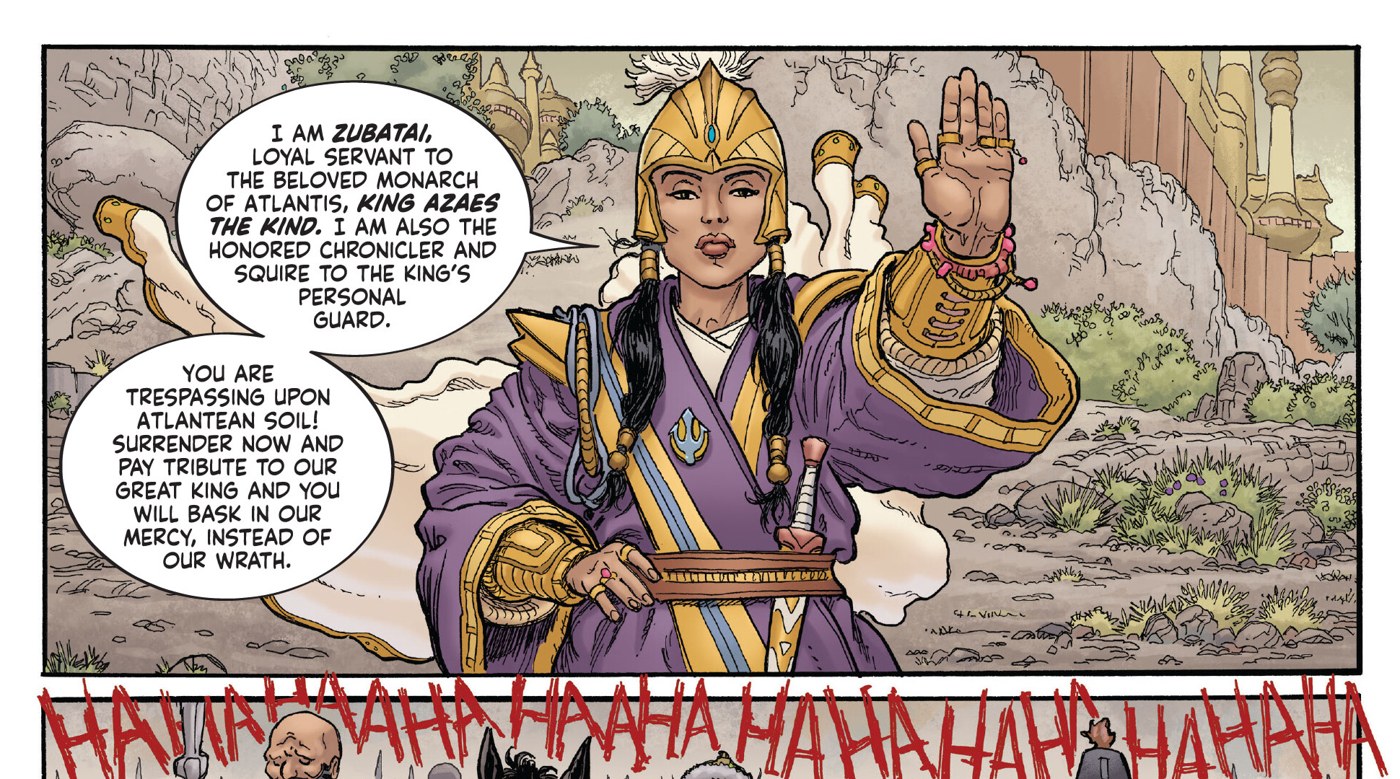
Zubatai first appears when a massive force of foreign warriors approaches Atlantis. The invaders have been drawn by stories of the city's wealth, culture, gold, and supposed vulnerability. Atlantis has deliberately allowed outsiders to reach its defenses because the kingdom treats such attacks as both proof of sovereignty and a recurring source of bloodshed for its immortal protector. Zubatai rides or walks out as the crown's representative and offers the invading army a formal choice: surrender, pay tribute to the king, and receive Atlantean mercy, or face the king's guard.[1]
The opposing commander laughs at the warning. His reaction is based on an understandable but fatal misunderstanding. He assumes Zubatai means the visible human soldiers stationed around the city. Zubatai corrects him by pointing instead to B. The gesture reveals one of the defining facts of Atlantean defense. The real meaning of "the king's guard" is not simply an organized military formation. It includes an immortal being who has spent decades slaughtering armies on Azaes's behalf.
B then destroys the invading force with overwhelming violence. Zubatai's narration explains that the legend surrounding him is so extreme precisely because those who encounter him as enemies rarely survive to describe what happened. She presents his combat not merely as military action but as an event around which Atlantean civic life has formed. The population gathers to watch, the battle's conclusion is signaled by horns, and the crowd celebrates B's ruined body as he begins to heal.[2][5]
The house that served the immortal
During the opening battle, Zubatai explains that her house has pledged itself to B for more than half a century and that her father served him before her. She describes her own task as seeing to B's needs and making an account of his deeds. This establishes an inherited service relationship rather than a short-term military assignment.[2]
The exact origin of that arrangement is not shown. It is unclear whether Zubatai's father began the family's service when B first settled in Atlantis, whether an earlier relative initiated it, or whether the phrase "my house" implies an even longer institutional tradition than the two generations specifically named. What is certain is that Zubatai thinks of service to B as a family responsibility and that the family preserves knowledge about him through oral testimony as well as written record.
Her father is particularly important as a source for the history of young Azaes. Zubatai says that her father believed B recognized his own experience in the endangered boy king. This interpretation helps explain why the famously solitary immortal chose to remain in Atlantis and protect a child whose parents had been killed in a coup attempt.[6]
Because Zubatai is both a royal chronicler and the daughter of an earlier servant of B, her narration should not be treated as omniscient objective history. She is a highly informed participant with inherited traditions, personal loyalty, and her own interpretations. A definitive wiki should therefore tag statements such as "my father said" as attributed historical testimony, while events Zubatai directly witnesses can be classified as directly depicted or first-person witness evidence.
Chronicler of B and King Azaes
Zubatai admires B intensely, yet she does not present him as a distant god. She calls his combat divine and describes him in elevated terms, but her everyday interactions show the opposite of religious awe. She knows that he drinks, prefers solitude, reads ancient texts, and avoids social obligations. The story repeatedly uses her familiarity to contrast the public legend of Unute with the private individual she serves.[5]
After battle, Atlanteans cheer B as he heals. Zubatai explains that he stands near Poseidon in the city's religious hierarchy, yet walks the same streets as beggars, drinks the same wine, and responds to the people with genuine affection. Her account makes clear that B's relationship with Atlantis is unusual in his life. He is not merely hired muscle. He has become part of the civic imagination and, for a time, appears to feel at home there.[5]
Zubatai also preserves the relationship between B and Azaes. A coup attempt killed the king's parents when Azaes was a child. B intervened before the boy could be murdered. He recognized, according to Zubatai's father, the pattern of powerful men binding a child's life to their ambitions. B remained and protected Azaes. Zubatai later concludes that Atlantis may have been the first true home B chose and built on his own terms.[6]
This background makes the later conflict painful for her. Zubatai has not simply served two unrelated masters. She has watched B protect the king, watched Azaes love B, and inherited a family tradition built around their relationship. Vizane's corruption therefore destroys the human structure at the center of Zubatai's life.
Life with B in Atlantis
One of Zubatai's most revealing scenes occurs away from the court. She finds B in the reliquary among old books and artifacts, brings him wine, and jokes that he is hiding with "the other old" things. She tries to persuade him to attend an orgy associated with the court's new social and religious culture. B refuses and complains that she keeps asking.[4]
The exchange shows an easy familiarity. Zubatai is comfortable mocking an immortal capable of destroying armies. B, in turn, does not treat her as a disposable subordinate. Their tone resembles long-term companions who understand one another's habits.
The humor ends when Zubatai reports that the reliquary has been robbed. The stolen material includes a large obelisk and dangerous ancient texts B had hidden. B identifies the writings as Aklo, a language he considers mentally poisonous to mortals. Zubatai's discovery makes her the immediate catalyst for B's investigation of Vizane's movement.[4]
She accompanies B rather than remaining behind. Their investigation leads to the northeastern tower, where King Azaes has assembled with Vizane and the priest's followers.
Opposition to Vizane's religion
Zubatai has already noticed that Azaes is changing. She records that the kindness once visible in the king's eyes has been replaced by corruption and forbidden desire. B also distrusts Vizane from their first meeting and warns the priest that he serves the crown by eliminating threats with extreme prejudice.[7]
When B and Zubatai discover the stolen reliquary material, those suspicions become concrete. Vizane has taken the obelisk and Aklo texts, while Azaes has joined the movement. The king frames the cult's project as a "great change" and tells B that they are chosen, especially B. B rejects the religion as poisonous and warns Azaes that Vizane seeks to end the world.[8]
B's attempt to intervene fails. The cult restrains him with magically produced thorned growths and begins draining his blood into ritual cups. Azaes insists that B's resistance is childish and promises that the ritual will make them immortal brothers. Zubatai is seized by guards during the confrontation but remains close enough to witness the proceedings.[9]
Her position is significant. She is an officer of the crown, yet the king himself has become aligned with the cult. She therefore reaches a point where loyalty to Azaes's office and loyalty to the civilization he is supposed to protect are no longer the same thing.
The opening of the gateway
Vizane explains that B's primordial-ore sword and the stolen obelisk form a set. The sword acts as a key and the obelisk as a door. The cult uses B's blood and Vizane's ritual to open a gateway. The process releases an enormous alien entity identified as Cthulhu.[9][10]
Zubatai survives the initial destruction as the creature tears through Atlantis. B escapes his restraints and tries to protect the king and the city. Azaes continues to interpret the event through Vizane's promises even as the disaster becomes impossible to deny. The city that had relied on B to make every external threat manageable now faces something that ignores its walls, military organization, wealth, and religious confidence.
Zubatai's narration shifts from celebratory chronicle to disaster record. She documents the physical dissolution of Atlantis and the collapse of the worldview around it.
Survival inside the catastrophe
During B's battle with Cthulhu, Zubatai remains close enough to call out to him as the creature releases corrosive or transformative material. She is shown amid dead and dying cultists and guards while B follows the monster's internal sounds toward its heart.[11]
B's ability to hear the heartbeat allows him to carve his way through the creature. Zubatai's narration later summarizes Cthulhu in strikingly secular terms. B often says that "god" is merely a word meaning more power than sense. Once Cthulhu's heart is torn out, the supposedly divine being dies like an animal.[12]
This perspective is important because Zubatai begins the story describing B in quasi-divine language. By the end, the story has shown her a literal summoned "god" whose power is catastrophic but whose biology is still vulnerable. Her chronicle therefore preserves both religious awe and its collapse.
The death of Azaes and destruction of Atlantis
Azaes is mortally wounded during the catastrophe. B speaks to the dying king and tells him that his parents wait at the end of the path. The moment closes the relationship that began when B saved Azaes from the coup that killed those same parents.[13]
Vizane also dies. When the priest attempts to use his knowledge of Aklo to negotiate with Cthulhu, B turns on him and kills him brutally. The religious project that promised transcendence leaves its king dead, its priest destroyed, and its followers consumed by the thing they summoned.
Killing Cthulhu does not save Atlantis. The creature's dying body releases an alien fire or destructive substance that causes the civilization to dissolve beneath it. Zubatai and B stand together and watch the city disappear. She records every spire and structure being devoured until only the evening sea remains.[3]
For Zubatai, this is not only the loss of a city. It is the annihilation of the monarchy she served, the archives she maintained, the court whose history she recorded, the people among whom she lived, and the physical setting that held her family's relationship with B.
Release from service
After Atlantis is gone, B thanks Zubatai for her years of loyalty and releases her from service. He chooses solitude and the wilderness again.[3]
The decision has unusual emotional weight. Zubatai's family had defined itself through service to B, and she had made his history part of her life's work. B's release therefore ends both a professional role and an inherited family obligation.
Zubatai closes the story by saying that even Unute does not cry despite everything he has endured. She does, and she weeps "for us both."[3]
The line makes her more than a neutral chronicler. She has spent the story translating B for readers, but in the final moment she also expresses grief he cannot or will not display. Her tears cover the dead city, the fallen king, her lost role, B's renewed loneliness, and the end of an era they shared.
Personality
Zubatai is loyal, courageous, observant, direct, humorous, and emotionally expressive. Her formal introduction at the city gate shows confidence in the face of an army. She understands the authority she represents and displays no uncertainty when the invaders mock her warning.[1]
Her private behavior is less ceremonial. She jokes with B, drinks, pressures him to attend court festivities, curses when she discovers the theft from the reliquary, and follows him into danger. This informality indicates trust rather than lack of respect.
As a chronicler, she is given to elevated language. She calls B's violence divine, describes Atlantis as the greatest civilization ever to exist, and treats the city's public response to B as proof of a reciprocal love. Those statements reveal both sincere affection and the possibility of narrative bias.
Her final grief demonstrates that she is not emotionally detached from the history she records. She is a participant writing from inside loss.
Skills and abilities
Historical recordkeeping
Zubatai is explicitly the king's honored chronicler. She records B's deeds and preserves court history. The story itself functions as evidence of that role.[1][2]
Royal protocol and diplomacy
She acts as the crown's emissary at Atlantis's gates, delivering surrender terms to invading armies and invoking the authority of King Azaes.
Martial competence
Zubatai carries a sword and is attached to the king's personal guard. She survives battlefield and supernatural conditions, although the comic does not present her as a fighter on B's level or provide a detailed catalogue of combat feats.
Knowledge of Atlantis
She knows the reliquary, palace, towers, religious practices, royal history, and B's routines. Her familiarity makes her one of the story's most informed human characters.
Endurance under supernatural crisis
Zubatai survives Cthulhu's attack and the dissolution of Atlantis. The comic does not attribute this survival to supernatural power. It should be treated as extraordinary fortune, resilience, or circumstances rather than evidence of enhanced durability.
Relationships
B / Unute
B is Zubatai's master, family obligation, historical subject, and friend. Her house has served him across generations. She is one of the few people shown interacting with him both as a legendary being and as a person with ordinary habits. Their final separation is affectionate rather than hostile.[2][3]
Zubatai's father
Her father served B before her and passed down an interpretation of why B chose to protect Azaes. He is the clearest known predecessor in the family's service tradition.[2][6]
King Azaes
Zubatai is a sworn servant of Azaes and chronicler of his monarchy. She remembers him as a kind king whose reign depends on B's protection and watches Vizane's influence transform him. She survives Azaes and becomes one of the few witnesses capable of preserving his full rise and fall.
Vizane
Vizane destroys the political and personal world Zubatai serves. His theft of the reliquary, manipulation of Azaes, ritual use of B, and summoning of Cthulhu turn him into the central human antagonist of her chronicle.
The people of Atlantis
Zubatai speaks of Atlantis with enormous pride. Her narration treats the city as culturally unmatched and its people as B's adopted community. Its loss defines her final status.
Appearance
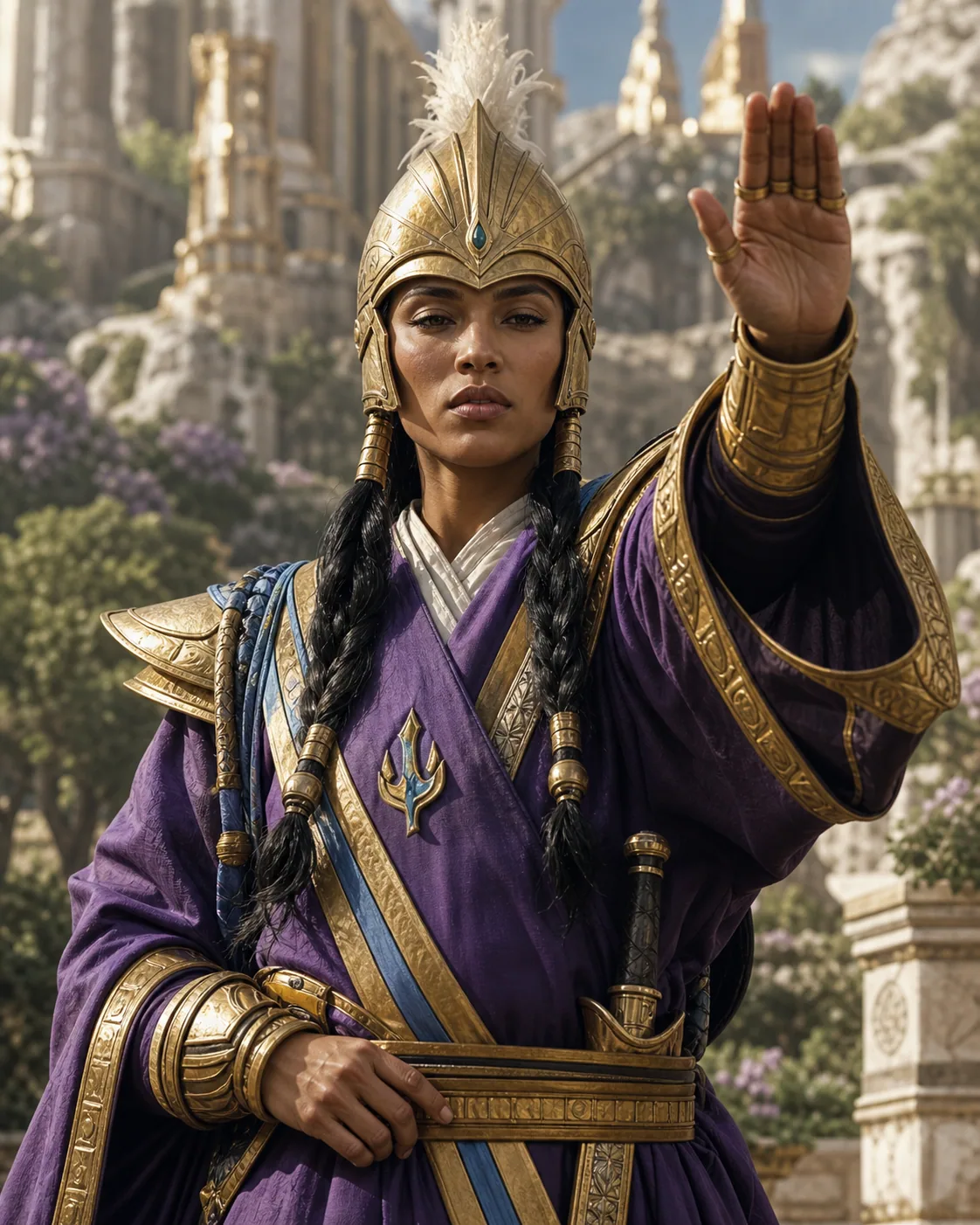
Zubatai is depicted as a dark-haired Atlantean woman. In her formal introduction she wears ornate purple, gold, and white clothing with a ceremonial helmet or crown-like headpiece and carries a sword. In less formal scenes she wears lighter yellow and gold attire suitable to palace life while retaining a weapon.
The visual shift should be treated as wardrobe variation rather than evidence of multiple characters unless later source material establishes otherwise. Her role, dialogue, continued proximity to B, and final narration support identification across these scenes.
Status and fate
Zubatai is alive when Poetry of Madness ends. B releases her from his service after Atlantis is destroyed. The story does not reveal where she goes, whether she attempts to preserve Atlantean knowledge elsewhere, whether she has descendants, or how long she lives afterward.[3]
Her post-Atlantis fate is therefore unknown.
Appearances
- BRZRKR: Poetry of Madness #1 - principal narrator, royal chronicler, squire to B, witness to the invasion, Vizane's conspiracy, Cthulhu's arrival, the deaths of Azaes and Vizane, and the destruction of Atlantis.
- BRZRKR: Poetry of Madness Pen & Ink #1 - alternate presentation of the same story. Treat as an edition appearance rather than a separate canonical event.
Canon limitations and unresolved questions
The story does not establish Zubatai's age, surname, birthplace within Atlantis, mother's identity, exact military rank, whether she has siblings, whether her family served Azaes before serving B, how her father died, or what happens to her after B releases her. The exact number of years she personally served B is also not specified beyond her description of the family's decades-long service.
The article should not invent a romantic relationship between Zubatai and B. Their intimacy is clear, but the comic presents it as service, friendship, companionship, and shared history rather than confirmed romance.
References
[1] Keanu Reeves and Steve Skroce, BRZRKR: Poetry of Madness #1 (BOOM! Studios, 2023), opening approach to Atlantis and Zubatai's formal introduction, digital page images 002-004.
[2] Reeves and Skroce, BRZRKR: Poetry of Madness #1, B's battle with the invaders and Zubatai's account of her family's service to B, digital page images 005-006.
[3] Reeves and Skroce, BRZRKR: Poetry of Madness #1, destruction of Atlantis, B's release of Zubatai from service, and Zubatai's closing narration, digital page images 043-045.
[4] Reeves and Skroce, BRZRKR: Poetry of Madness #1, Zubatai finding B in the reliquary, reporting the theft of the obelisk and Aklo texts, and accompanying him to the northeastern tower, digital page images 017-018.
[5] Reeves and Skroce, BRZRKR: Poetry of Madness #1, aftermath of B's battle and public celebration of Atlantis's protector, digital page images 012-013.
[6] Reeves and Skroce, BRZRKR: Poetry of Madness #1, childhood history of Azaes, deaths of his parents, B's intervention, and Zubatai's attribution of the interpretation to her father, digital page image 015.
[7] Reeves and Skroce, BRZRKR: Poetry of Madness #1, B's warning to Vizane and Zubatai's observation of Azaes's changing character, digital page images 014-016.
[8] Reeves and Skroce, BRZRKR: Poetry of Madness #1, confrontation at the northeastern tower and Azaes's alignment with Vizane, digital page images 018-020.
[9] Reeves and Skroce, BRZRKR: Poetry of Madness #1, restraint of B, ritual collection of his blood, explanation of the sword and obelisk, and opening of the gateway, digital page images 020-023.
[10] Reeves and Skroce, BRZRKR: Poetry of Madness #1, first full manifestation and identification of Cthulhu, digital page images 024-025.
[11] Reeves and Skroce, BRZRKR: Poetry of Madness #1, Cthulhu's attack, B's internal assault on the creature, and Zubatai's survival during the battle, digital page images 035-041.
[12] Reeves and Skroce, BRZRKR: Poetry of Madness #1, Zubatai's account of B's view of gods and Cthulhu's death after destruction of its heart, digital page image 042.
[13] Reeves and Skroce, BRZRKR: Poetry of Madness #1, Azaes's final moments and B's reference to the king's dead parents, digital page images 037-038.