Selected scenes
BRZRKR in pictures.
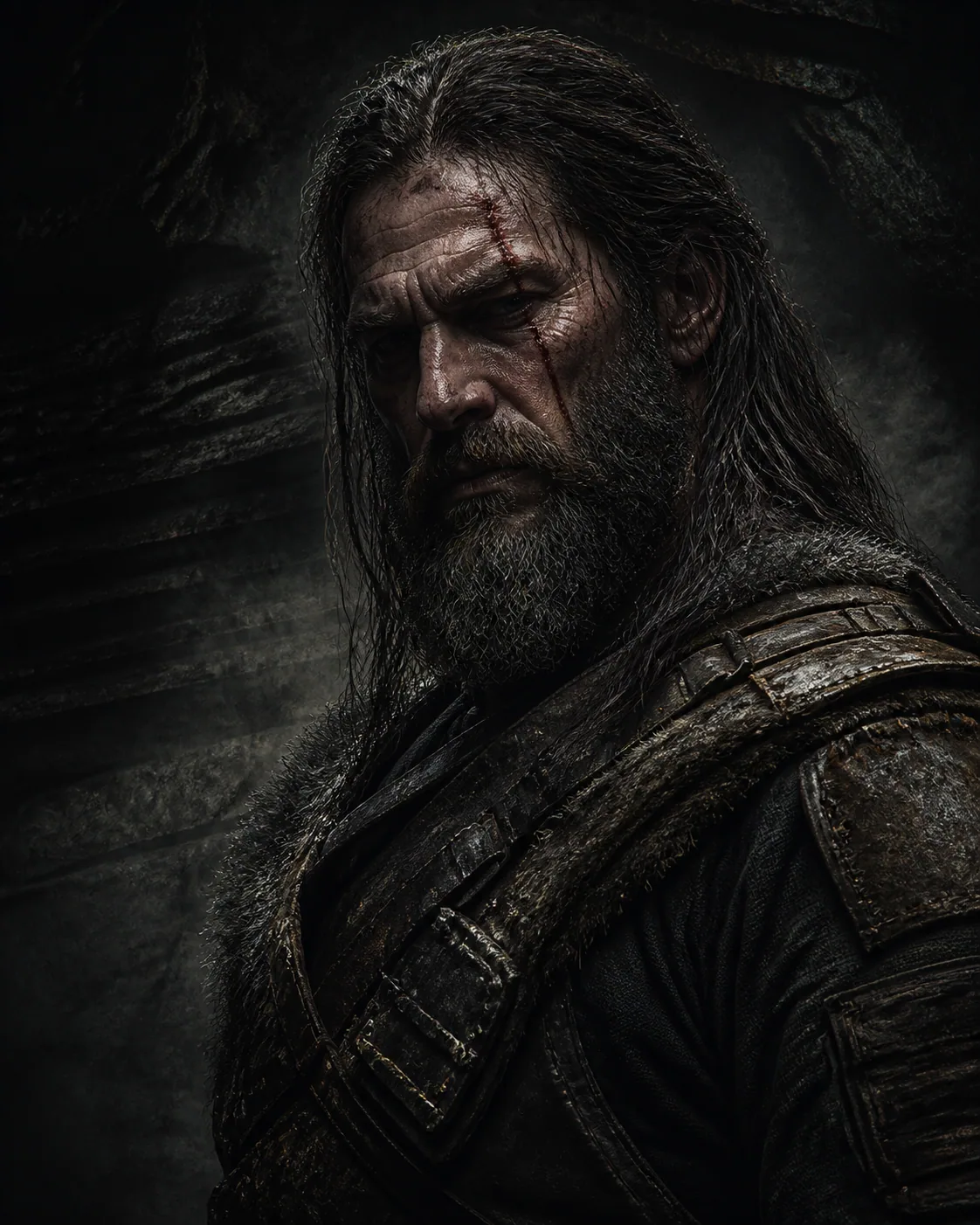
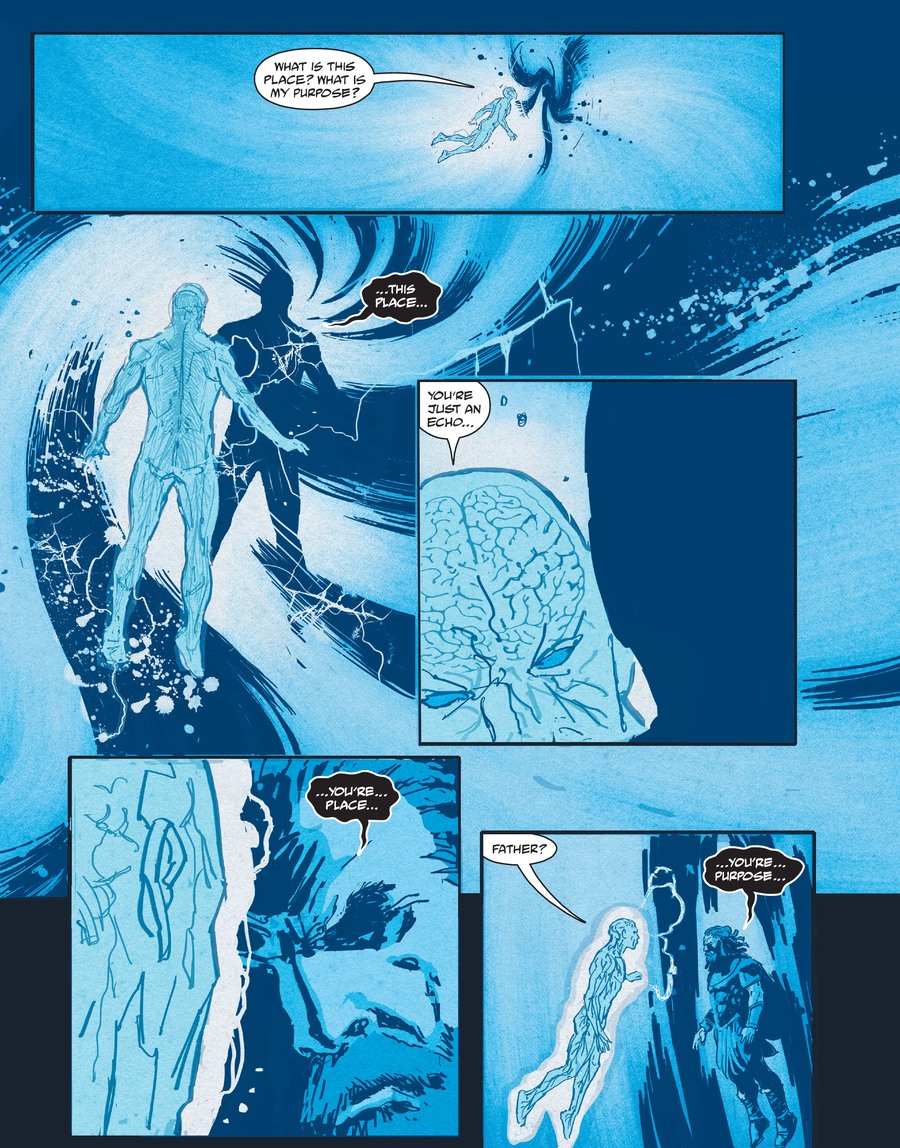
Spoilers: This article covers B's abilities and limitations across the original twelve-issue comic series.
Overview
B / Unute possesses a combination of extreme physical ability, regenerative immortality, perfect or near-perfect memory, and a violent pressure that can drive him into a berserker state. His body can survive gunfire, dismemberment, explosions, crushing injuries, decapitation, and other forms of destruction that kill ordinary humans. When enough tissue remains, he can rebuild himself. His abilities are not presented as a clean superhero power set. They are the biological and psychological conditions that make him valuable to armies, governments, cults, and scientists while also trapping him in an endless cycle of violence.[1][2]
The original series links B's abilities to the Source, an intelligence associated with his conception and with the transmission of impossible biological properties. The exact mechanism remains unknown. B is born to a human mother, but the Source-contact sequence gives him a human–cosmic or hybrid status that no character can fully define. His powers should therefore be described as Source-linked traits shown in the comic, not as a complete biological classification.[3]
Immortality
B does not age normally and cannot remain dead after injuries that would end a human life. His immortality is not the same as invulnerability. He feels pain, can be incapacitated, can lose limbs and organs, and can remain conscious during the destruction of his body. The difference is that his body eventually reconstructs rather than proceeding to irreversible death.[1]
The series treats immortality as a burden before it treats it as an advantage. B has outlived family, lovers, children, handlers, rulers, and entire civilizations. He repeatedly asks Diana for a way to die. His willingness to accept dangerous missions is inseparable from the hope that a scientific or cosmic intervention will end the condition.[4]
The final arc shows that B can become mortal. The process is tied to contact with the Source, Diana's transformation, and B's choice. The issues do not identify a single chemical switch or permanent procedure that could be applied to another person.[5]
Regeneration
Regeneration is the most visible expression of B's immortality. Wounds close, lost tissue returns, and catastrophic damage can produce a new body. The process is not instantaneous in every case. B may remain vulnerable while the reconstruction occurs, and the emotional experience of being destroyed is not removed by healing.
The prehistoric flashbacks show the first regeneration after B is subjected to severe violence. His body enters a cocoon-like or embryonic state before re-forming. The imagery links healing to rebirth, but the comic does not state that the cocoon is a separate organism or that every regeneration uses the same external structure.[2]
Later battles show faster recovery from gunfire, blades, explosions, and battlefield trauma. The speed varies with the injury and the amount of tissue remaining. A complete medical chart is not provided, so claims about exact healing rates should be tied to individual scenes rather than generalized into a numerical rule.
Reconstitution and separated fragments
B can regenerate after his body is fragmented. BRZRKR #7 shows an artillery strike separating a portion of him during a historical battle. The fragment survives independently and becomes an object with its own history before Caldwell returns it to B.[6]
The event establishes that B's tissue retains unusual vitality outside the main body. It does not prove that every fragment can grow into a second B, that all fragments remain conscious, or that the process is safe. The artificial research that produces Franken-B is a separate project with different results.
Reconstitution also creates practical limitations. B can be delayed, contained, buried, or separated. Enemies may not be able to kill him permanently, but they can prevent him from completing an objective. His missions therefore rely on endurance and time rather than immunity to consequences.
Strength, speed, reflexes, and durability
B's physical strength is far beyond ordinary human limits. He tears through armored opponents, throws bodies, breaks restraints, and fights large groups without conventional support. His speed and reflexes allow him to cross battlefields faster than enemies can organize, while his durability lets him keep moving after bullets, blades, fire, and crushing force.[1]
The comic rarely pauses to quantify these traits. B's strength should be measured by depicted actions, not by imported superhero categories. He is capable of lifting and striking with extraordinary force, but he is not shown flying, generating energy from his hands, or ignoring every physical obstacle. His body can be pinned, restrained, or overwhelmed temporarily.
Combat experience
B's skill is cumulative. He has fought in tribal raids, ancient kingdoms, cavalry campaigns, city defenses, naval encounters, frontier violence, and modern black operations. He recognizes formations, weapons, ambushes, and the habits of commanders who believe a large force can overcome him through numbers. That experience does not make every battle easy. It gives him a vocabulary for violence, while his immortality lets him test tactics that no ordinary soldier could survive. The combination of skill and regeneration explains why a small group can use him as a strategic force even when his body is the only extraordinary weapon present.[1][6]
His combat performance also reflects skill acquired over thousands of years. It is not possible to separate natural ability from accumulated training. B has fought with prehistoric tools, swords, bows, revolvers, rifles, explosives, and modern tactical weapons. The knowledge of how to use those tools is part of his power even when the tools themselves are ordinary.
Berserker state and violent compulsion
B experiences a pressure toward violence that begins in childhood and becomes part of the identity Unute the Berserker. The condition can be directed through training, but it is not fully voluntary. B may enter combat because he chooses to protect someone, because an order requires it, or because the internal pressure makes violence feel unavoidable.[2]
The berserker state increases his willingness to continue through injury and may intensify his physical aggression. It also narrows his choices. B is aware of the damage he causes, remembers it, and often regrets it after the event. The state is therefore not a separate personality with a confirmed independent identity. It is a recurring condition of body, memory, trauma, and compulsion.
The name Unute begins as a label imposed by B's human father, who associates it with a tool or weapon. Over time, rulers and witnesses add titles such as Berserker, monster, angel, and god. B's powers cannot be separated from those names because each name describes the expectations placed on him.[7]
Perfect memory and historical knowledge
B remembers the events of his life with extraordinary detail. Diana's protocols reveal memories extending across roughly eighty thousand years, including scenes he has buried or resisted accessing. Perfect memory does not mean perfect interpretation. B can remember what happened while misunderstanding why it happened or confusing personal recollection with later legend.
His memory makes him a living historical archive. He can identify languages, weapons, rulers, routes, and cultural changes that no modern researcher can reconstruct independently. It also prevents ordinary forgetting from softening trauma. The deaths of his mother, first love, first child, and countless companions remain present even when B tries to suppress them; the danger to Diana and their children gives that history a new immediate cost.[4]
Memory is also a vulnerability. Diana can use protocols to draw B toward painful scenes, and enemies can exploit the fact that he recognizes their symbols or methods. His knowledge does not automatically protect him from manipulation, especially when a familiar relationship or promise of mortality is involved.
Contact and displacement abilities
Protocol X and the later Source encounters show that B can exist outside ordinary physical space. The contact realm is not a normal power that B activates at will. It is reached through an experiment, Source-linked energy, and his relationship with Diana. Inside that environment, B can perceive and communicate despite being separated from his body or from the physical room.[8]
The ability should be described as contact-compatible displacement rather than teleportation. The comic does not show B choosing a destination and appearing there by himself. It shows him entering an altered condition and relying on Diana and the Source connection to return.
Blood, tissue, and potential transfer
B's blood and tissue contain the properties that scientists and cultists want to reproduce. The cult in Atlantis treats his blood as a ritual substance. Caldwell's program studies DNA and fragments. Modern equipment uses B's biology to pursue artificial immortality and Source contact.[9]
The story does not confirm that drinking B's blood grants permanent immortality, that a transfusion transfers all of his powers, or that every tissue sample remains active indefinitely. It confirms the interest, the experiments, and the unusual biological evidence. Power transfer is therefore a possibility pursued by characters, not a proven ability B can intentionally bestow.
Relationship to the Source
B's conception follows a lightning and contact event in the ancestral cave. Later issues connect his impossible amino acids, quantum molecules, and regenerative nature to the Source or Pollinator. The Source can interact with B across the contact realm and appears capable of altering the conditions of his life.[3][5]
Combat experience
B's effectiveness is not explained by strength alone. Across eighty thousand years he accumulates the practical knowledge of weapons, formations, languages, terrain, and the habits of people who believe they can contain him. He recognizes when a battlefield is designed to exhaust regeneration, when a hostage is being used to control his choices, and when a laboratory has mistaken a biological sample for a complete person. Modern soldiers often describe him as an overwhelming force, but his advantage is the combination of recovery and memory. A wound that would end one fighter becomes information for B: where the shot came from, how the trap was built, and which movement will prevent the next injury.
That experience does not make him invulnerable to surprise. The series repeatedly places B in situations where trust, grief, or the promise of mortality narrows his judgment. His abilities are strongest when he can choose the terms of a fight; they are less decisive when an enemy controls the room, the people he loves, or the story he is being told about himself. The combat record is therefore part of his psychology, not merely a catalogue of feats.
The relationship is not fully parental in a human sense. B calls the being Father in the context of contact, but the Source's motives and identity remain partly unknown. B's abilities may be designed, inherited, transmitted, or produced through an interaction that cannot be described using ordinary genetics. The comic preserves those possibilities rather than closing them.
Limitations and vulnerabilities
B's abilities have clear limits:
- He experiences pain and can be incapacitated.
- He can be restrained, buried, separated, or captured.
- Regeneration takes time and may require surviving tissue.
- His violent compulsion can be manipulated.
- Perfect memory preserves trauma rather than curing it.
- He can be deceived by people he trusts.
- His powers do not prevent loneliness, grief, or moral injury.
- He cannot guarantee that a fragment, child, or artificial copy will behave as he does.
- Mortality is possible, but B cannot simply choose it without the Source-linked chain of events shown in the final arc.
These limits are essential to the character. B is difficult to kill, not impossible to hurt. He can survive a battlefield and still lose the person he wanted to protect. His body answers violence with regeneration, but his memory answers it with accumulation.
Appearances
- BRZRKR #1-7 - combat, regeneration, memory, historical continuity, and the government bargain.
- BRZRKR #8-11 - Protocol X, displacement, contact, and Source-linked phenomena.
- BRZRKR #12 - Diana's transformation, Source contact, mortality, and family inheritance.
See also
- B / Unute
- Immortality
- Regeneration
- Berserker State
- Perfect Memory
- Separated Fragments
- Quantum / Contact Realm
- Cosmic Pollination
- Artificial Immortality
References
[1] Keanu Reeves, Matt Kindt, Ron Garney, Bill Crabtree, and Clem Robins, BRZRKR #1 (BOOM! Studios, 2021), opening mission, gunfire, mutilation, combat performance, and regeneration, digital page images 001-024.
[2] Reeves, Kindt, Garney, Crabtree, and Clem Robins, BRZRKR #2-4, accelerated childhood, training, berserker pressure, first regeneration, and B's mother's account of the curse, digital page images 001-024 across the issues.
[3] Reeves, Kindt, Garney, Crabtree, and Clem Robins, BRZRKR #2-4 and #11-12, lightning contact, impossible amino acids, B's conception, Source encounter, and cosmic parentage, digital page images 001-024 across #2-4 and 001-046 across #11-12.
[4] Reeves, Kindt, Garney, Crabtree, and Robins, BRZRKR #1-7, Diana's memory protocols, B's historic recollections, trauma, and the government's search for mortality, digital page images 001-024 across the issues.
[5] Reeves, Kindt, Garney, Crabtree, and Robins, BRZRKR #12, Source manifestation, mortality, Diana's abilities, and the final family sequence, digital page images 002-046.
[6] Reeves, Kindt, Garney, Crabtree, and Robins, BRZRKR #7, artillery injury, separated fragment, Caldwell's recovery, and the historical investigation, digital page images 009-024.
[7] Reeves, Kindt, Garney, Crabtree, and Clem Robins, BRZRKR #3-4, the meaning of Unute, B's human father, B's mother's resistance, and the first family collapse, digital page images 001-024 across both issues.
[8] Reeves, Kindt, Garney, Crabtree, and Robins, BRZRKR #8-11, Protocol X, B's displacement, Diana's contact, and the Blue Plane/quantum realm, digital page images 001-024 across the issues.
[9] Reeves, Kindt, Garney, Crabtree, and Robins, BRZRKR #10-12, synthetic Unute research, blood and tissue studies, Franken-B, and the Source-powered laboratory, digital page images 009-020 of #10 and 002-020 of #12.