Selected scenes
BRZRKR in pictures.
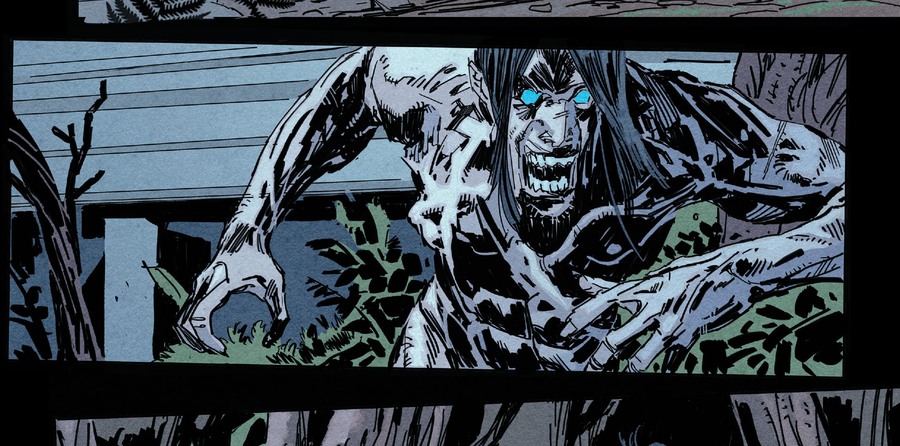
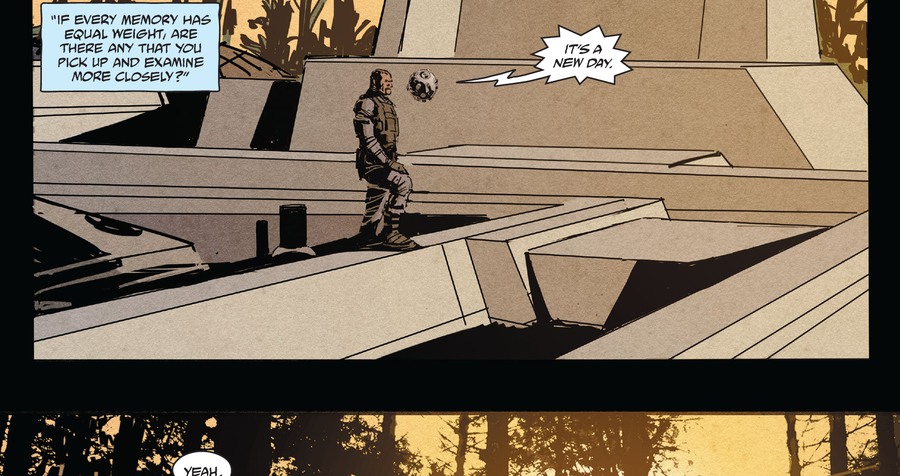
Spoilers: This article covers the body-horror and research revelations in BRZRKR #7-12.
Separated fragments are pieces of B's body left behind when violence tears him apart. They are not a second B and they are not ordinary biological samples. In the modern story, a fragment remains valuable after the wound closes because it carries some of the strange material conditions that let B regenerate. The idea turns a familiar action image—the immortal warrior putting himself back together—into one of the series' most disturbing questions: what happens to the parts of a person that other people recover after he survives?
How a fragment is created
B's healing is usually shown as a return to wholeness. A bullet is pushed out, a cut seals, or a body that has been broken in combat becomes functional again. BRZRKR #7 interrupts that rhythm. A violent injury separates material from B, and the fragment does not simply vanish when the rest of him recovers. It can be collected, carried, and examined. The panel language makes the object recognizably human without treating it as a complete person. It is part of B, but it is also a piece over which B no longer has immediate control.
That distinction matters because the body is one of the few things B has never been allowed to own. His father trained it for war. Kings displayed it. Governments contract for its use. Caldwell's cult looks for a sacred explanation. The fragment brings all of those pressures into one small object. A person can leave a battlefield alive and still lose control of what the battlefield leaves behind.
Evidence in the modern program
The United States program treats the fragment as evidence that B's condition might be reproduced. Diana's work begins with memory and behavior, but Caldwell's people want matter they can cut, store, and manipulate. The fragment appears beside laboratory equipment, records of earlier injuries, and questions about how B's tissue behaves when it is separated from the whole. It becomes a bridge between the emotional history of B's wounds and the government's technical ambition.
The comic does not show a neat procedure that turns the fragment into a cure. Instead, it shows a chain of guesses. Scientists observe regeneration, isolate material, compare it with B's blood and other samples, and ask whether the same process can be made to occur in another body. The uncertainty is important. The people handling the tissue know that it is extraordinary, but extraordinary does not mean understood. Their confidence comes from possession rather than comprehension.
From fragment to Franken-B
The most consequential use of separated material is the creation of Franken-B. The derived body is assembled from B-related tissue, research, and Source-linked equipment. The result resembles B in the most dangerous sense: it is a body built to survive and to serve a purpose chosen by someone else. The story refuses to call it a copy. Franken-B has a separate physical history and a separate claim to personhood, even when the people who made him describe him as a specimen.
This is the point at which the fragment becomes more than evidence. It becomes a beginning. A wound suffered by B is transformed into a life that B did not authorize and that the new being did not choose. The ethical problem therefore cannot be solved by asking whether the process works. If the process produces a living consciousness, the question becomes whether that consciousness can refuse the people who assembled it.
Lugalṭur offers a historical parallel. In the alchemical branch, B's material is used in a different attempt to create or extend life. The methods are not identical, and the centuries do not collapse into one laboratory, but both stories show the same desire: make B's condition portable. B's later decision to release Lugalṭur is meaningful because he rejects the idea that origin gives him ownership. The modern program has not yet learned that lesson when it begins with the fragment.
What the fragment retains
The story establishes biological significance without confirming that a separated piece retains B's memories, personality, or consciousness. A fragment can carry regenerative potential and still be only tissue. This boundary protects the difference between biology and identity. If every piece of B were automatically another B, the drama of family, memory, and choice would disappear. Instead, the material can be used to create conditions for life while leaving the resulting person radically uncertain.
The fragment also does not prove that regeneration is a simple infection or a transferable disease. Later work with blood, machines, and Source contact adds other ingredients. The comic presents a network of conditions rather than a single vial that solves immortality. Tissue is one route into the mystery, not the whole explanation.
B's consent and the politics of remains
B's consent is rarely the first concern of the people around him. A government contract can make his living body an asset; a recovered fragment exposes how far that logic extends after an injury. A soldier's remains usually mark a death. B's remains mark an opportunity, which is precisely why the opportunity is horrifying. He can be alive in the next room while a piece of him is being treated as property.
Diana's position is complicated. She is trying to help B understand his past and find a way out of the cycle, yet the research that makes a cure possible also creates new ways to use him. Her relationship with B gives the material a human context that the laboratory lacks. She can ask what the experiment does to the person whose body supplies it. Caldwell asks whether it can produce a result. The conflict between those questions drives the final arc.
Limits and unresolved consequences
The issues do not identify every injury that produces a recoverable fragment, how long a fragment remains viable, or how it is stored. They do not establish that every separated piece can regenerate on its own. Franken-B's existence proves that B-derived material can participate in a larger construction, not that a lone fragment will grow into a complete duplicate. The exact role of the Source-powered equipment is likewise left open.
Those limits keep the idea tied to the plot rather than turning it into a general rule for all immortal bodies. The fragment matters because particular people decide to use it. It carries the history of B's violence into a room where scientists and officials can pretend that the wound is no longer personal. The story never lets that pretense stand for long.
Significance
Separated fragments give BRZRKR its clearest image of how weaponization becomes reproduction. B was once trained to be a weapon; now pieces of that weapon are used to make another body. The cycle is not broken by technical progress. It is broken only when someone recognizes that survival, tissue, and power do not cancel a person's right to choose.
The fragments also make B's final decisions more consequential. When he protects Diana and the children, he is not only choosing how to use his own strength. He is rejecting the systems that treated his body as a resource that could be divided, stored, and reassigned. The pieces left behind remain part of the unresolved history, but the story's moral direction is clear: a body can be material without becoming property.
Appearances
Separated fragments are central to BRZRKR #7, the artificial-immortality work leading into #10-12, and the creation of Franken-B. Related material appears in The Lost Book of B. and in the discussion of B's blood and derived life.
[1] Keanu Reeves, Matt Kindt, Ron Garney, Bill Crabtree, and Clem Robins, BRZRKR #7 (BOOM! Studios), injury, recovery, and separated B-derived material.
[2] Reeves, Kindt, Garney, Crabtree, and Robins, BRZRKR #10-12, laboratory work, Source-linked equipment, and Franken-B.
[3] Reeves, Kindt, Garney, Crabtree, and Robins, The Lost Book of B. #1, alchemical attempts to extend life through B-related material.