Selected scenes
BRZRKR in pictures.
Spoilers: This article covers Caldwell's research, separated material, Franken-B, and the final laboratory arc in BRZRKR #7-12.
Artificial immortality is the human attempt to reproduce, transfer, or imitate B's regenerative condition. It is not one machine or one formula. In BRZRKR it is a chain of projects that includes Caldwell's cult, government laboratories, B's blood and tissue, Source-linked equipment, the hypercomputer, and the derived being called Franken-B. The projects differ in method, but they share a conviction that B's survival can be taken out of his life and turned into a usable process.
The desire to reproduce B
B's body creates a problem for every institution that encounters it. A ruler wants a defender who cannot die. A cult wants proof that its theology is true. A government wants an operative who can enter impossible situations and return. Scientists want to understand an organism that violates their expectations. In each case, the first step is observation and the second is possession.
The modern program inherits this desire from older traditions. Caldwell's ancestral network has searched for B-related knowledge across centuries, while the state supplies laboratories, funding, and personnel. The equipment is modern, but the underlying fantasy is ancient: if a person can survive death, perhaps the condition can be separated from the person and distributed to those who control it.
Material approaches
The research moves through blood, separated fragments, memories, and machines. B's tissue provides biological evidence. His blood carries clues to the Source and to the rituals that surround him. Memory reveals the circumstances of his creation. The hypercomputer and Protocol X attempt to mediate the energy or information involved. None of these elements is sufficient alone.
That incompleteness is what makes the research dangerous. A partial success can still create a living body. A fragment can be treated as a sample even when the result of the experiment will have a mind. The people involved are tempted to call the work exploratory until a person appears, at which point the language of experiment becomes a way to avoid responsibility.
Franken-B
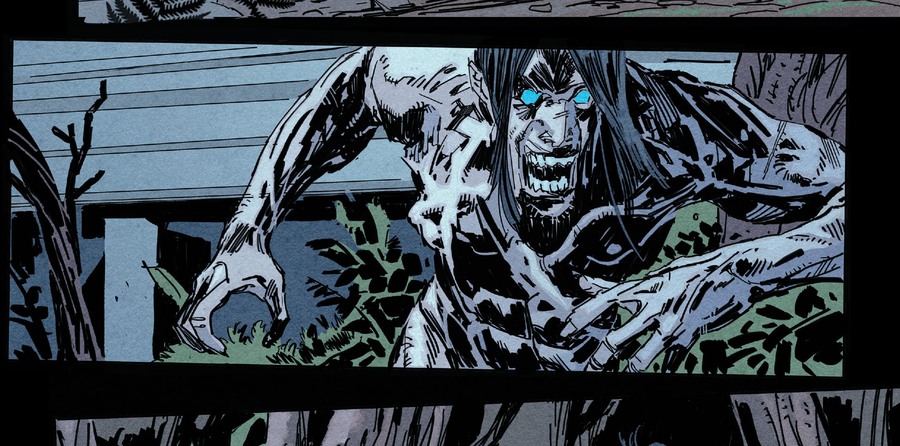
Franken-B is the clearest consequence of the program's logic. He is made from B-related material but is not B. His existence separates biological continuity from personal identity. The body may inherit regenerative potential, but it does not inherit B's memories, relationships, or consent. The new being therefore exposes the moral failure of describing a person as a specimen.
B's reaction matters because he recognizes the echo of his own childhood. Franken-B has been assembled for a purpose chosen by others, just as B was trained for war before he could decide what he wanted. The derived body is not a simple enemy or a failed copy. It is a life caught inside someone else's answer to the question of mortality.
Protocol X and the Source
Protocol X shifts artificial immortality from tissue culture to direct contact. The program realizes that B's biology is connected to a larger system and attempts to reach that system through an apparatus. B disappears, Diana is changed, and the project enters the contact realm. The event does not give the scientists a repeatable recipe, but it reveals that the conditions of B's life can be altered by forces outside the laboratory.
The final mortality transfer demonstrates the difference between changing a condition and copying a person. B can become mortal, and Caldwell can receive the regenerative burden, but the transfer does not turn Caldwell into B. Memory, identity, and responsibility do not pass automatically with the biology. The story refuses the comforting idea that a body contains a complete self that can be poured into another container.
The role of Diana
Diana's work is caught between care and research. She wants to help B understand his origin and find a way to end the condition. Her scientific ability makes the attempt possible, but her relationship with B keeps the goal from becoming a neutral technical problem. A cure can save B and still create harm if it is used to make another person immortal without consent.
Diana also sees how institutions change their language when a person becomes useful. A tissue sample becomes a resource. A child becomes a result. A machine becomes a justification for another experiment. Her resistance does not reject knowledge. It insists that knowledge remain answerable to the person whose body produced it.
Historical precedents
The Lost Book of B. provides an earlier variation through alchemy and the creation of Lugalṭur. Zosimus treats B's condition as a path toward life extension; Theosebeia protects the developing being; B eventually releases Lugalṭur rather than keeping him as a dependent. The historical story makes the modern problem easier to see. A new body can be related to B without belonging to him or to its creator.
The parallels are not identical technologies. Alchemy, Source contact, and government science remain distinct traditions. Their shared theme is the temptation to convert another person's extraordinary life into a method. Each period asks whether creation grants authority. The answer BRZRKR keeps returning to is no.
What artificial immortality cannot promise
The research does not guarantee freedom from pain, sanity, memory, or compulsion. B's immortality includes regeneration and a pressure toward violence. Transferring the biological condition can also transfer its burden, as Caldwell discovers. A new body may survive injuries while losing the person who was supposed to inhabit it. A machine may reproduce energy without reproducing meaning.
The uncertainty protects the series from treating immortality as a consumer product. There is no universal formula, no reliable timetable, and no ethical shortcut. Each attempt produces consequences that the people who began the work did not control.
Significance
Artificial immortality makes BRZRKR's science inseparable from its politics. The question is not whether human beings can imitate B. It is who gets to decide that imitation is desirable, who bears the pain of the attempt, and whether the resulting life can refuse the purpose assigned at creation.
B's final choices answer the question through action. He seeks mortality for himself, protects the children from immediate possession, and refuses to treat derived life as a tool. The research may continue in other hands, but the story's moral center has moved away from reproduction and toward consent.
[1] Reeves, Kindt, Garney, Crabtree, and Robins, BRZRKR #7-12, tissue, blood, Protocol X, Source contact, and artificial research.
[2] Reeves, Kindt, Garney, Crabtree, and Robins, The Lost Book of B. #1, Zosimus, Theosebeia, and Lugalṭur.