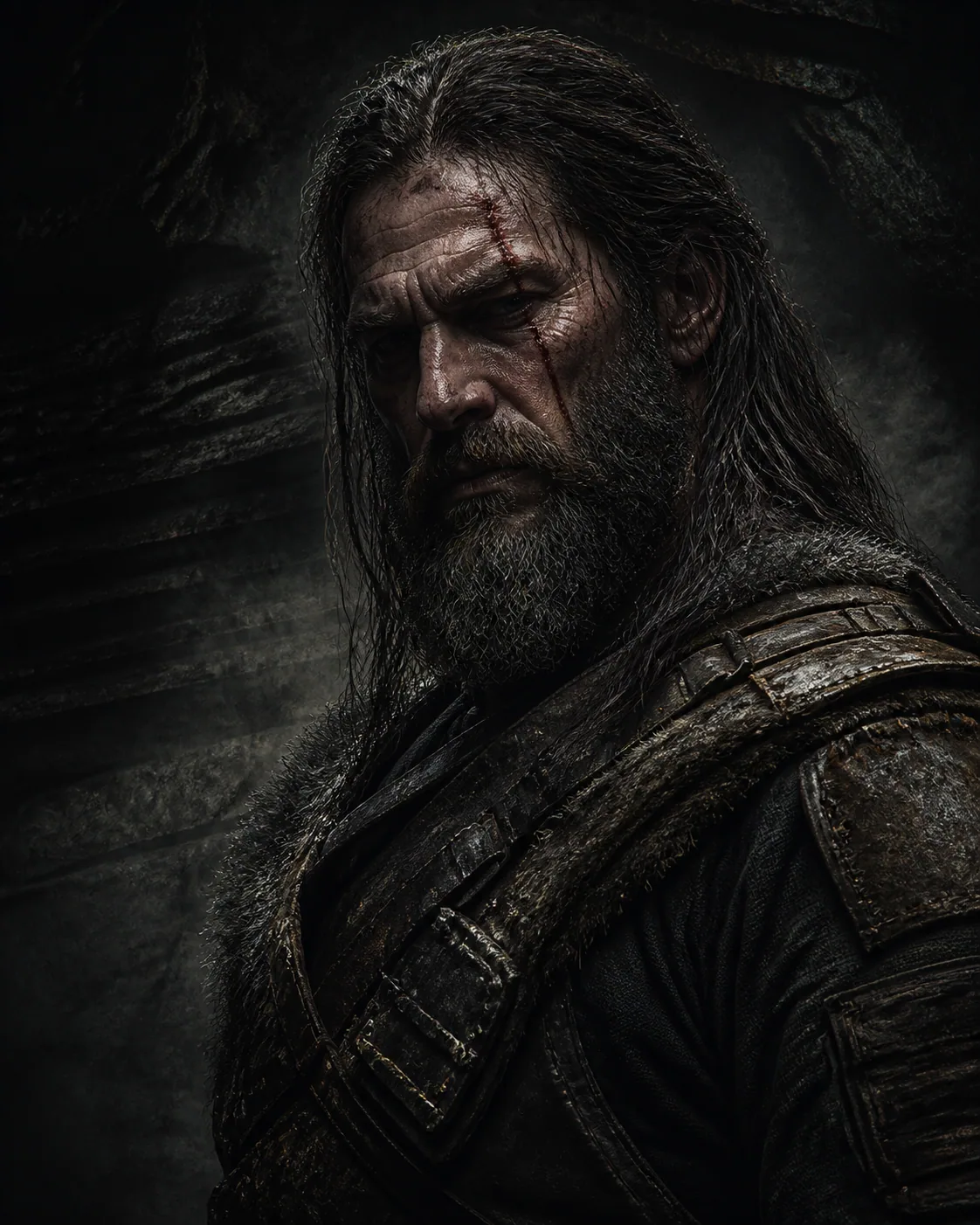
Immortality is the condition that defines B before it becomes the condition he wants to lose. His body can be destroyed by weapons, fire, pressure, and dismemberment, yet it repeatedly returns to a living form. The comic never presents this survival as a clean superpower. B feels the injury, remembers the injury, and carries the social consequences of returning when everyone around him expected a death. Immortality keeps him alive; it does not keep him safe, innocent, or free.[1]
The short answer
B is immortal because the Source-linked contact surrounding his mother's prayer and accelerated pregnancy changes what kind of body he is born with. Issues #2-4 show the prayer, lightning contact, birth, early healing, and the adults who turn that survival into weapon training. Issues #8-11 connect the birthplace and B's unusual biology to the Source, while #11-12 show that the condition can be transferred and that B can become mortal. The series establishes those events without supplying a complete scientific formula or proving that every Source-linked being regenerates in the same way.[2][3][4]
A condition rather than a gift
B is not born into a world where immortality is understood as a blessing. His mother prays because the village is being attacked and ordinary defenses have failed. His father sees the child who arrives after the lightning contact as an answer to that crisis. The difference between the two parents becomes the first definition of B's condition. His mother wants the violence to stop. His father wants a body capable of ensuring victory. The same regeneration that gives the community hope gives the father a reason to train a child for war.[2]
The origin matters because B never chooses the premise of his own life. He is not a soldier who volunteers for an experiment or a king who drinks from a fountain. He is a child whose body changes before he has the language to consent. Every later institution repeats the first mistake in a more sophisticated form. A ruler calls him a guardian, an empire calls him an instrument, a cult calls him a path to godhood, and the modern government calls him an asset. The vocabulary changes, but each name assumes that survival creates an obligation to be useful.
The body that returns
The comic shows regeneration through action. B is shot, cut, burned, crushed, or torn apart; the damage is real, and the repair follows. The return can be fast enough to change a battle, but the story does not turn it into painless spectacle. B can be conscious during the process. He can be frightened before the body closes. He can keep fighting while injured and still remember every sensation afterward. Regeneration protects him from permanent death without removing the experience of dying.
This distinction explains why B's combat ability is not simply the result of being unable to die. He has accumulated skill across thousands of years, but the body has also trained the institutions around him to spend him recklessly. A normal soldier needs cover, extraction, and medical attention. B can be sent through a wall, into a crowd, or against a weapon that would end anyone else. His survival makes him effective and makes other people less careful with his life.
The body also leaves material behind. A separated fragment can remain long enough to be recovered, studied, or combined with other tissue. The recovered fragment becomes part of Caldwell's pursuit of artificial immortality, and Franken-B is assembled from the consequences of B's healing. Light Draws Breath pushes the idea into the Bronze Age, where rogue scientists use protoplasm from a regeneration event to create a new being. Immortality therefore produces an ethical problem beyond the individual: every recovery can become the beginning of another person's captivity.[5]
Immortality and pain
B's enemies often mistake survival for indifference. They see him stand after an injury and assume the injury did not matter. The comic insists on the opposite. Pain is one of the few experiences B shares with everyone else, and the repetition of pain is part of what exhausts him. He can be killed again and again, but he cannot become unfamiliar with the feeling. The body repairs itself; the memory does not.
That memory changes B's relationship to violence. He is drawn toward combat by a compulsion that can overwhelm judgment, yet he is also aware of what every fight leaves behind. The berserker state is not the whole of his personality. It is a pressure that has been reinforced by training, captivity, and the expectation that B will always survive the consequences. When he asks Diana for a way to die, he is asking for an end to the cycle of pain, command, and recovery rather than for a simple escape from duty.
Immortality in the historical stories
The one-shots show how different societies interpret the same body. Atlantis turns B into a protector and places him beside a royal court. Olos turns him into a prisoner and a public arena spectacle. Genghis Khan recognizes a military advantage and offers B a place in an expanding campaign. A frontier community can mistake him for a guardian spirit. The Captain of The Bleeding Tide finds him as a deformed remnant beneath the sea. Each setting creates a different social meaning for survival.
These stories prevent immortality from becoming a single scientific rule. In Atlantis, B's blood belongs to a ritual system built from Aklo, an obelisk, and a primordial-ore sword. In the alchemical histories, his material becomes a path toward the water of life or the creation of Lugalṭur. In the maritime story, his return is seen through blood, predation, and the sea. The comic branch uses science, ritual, and myth without declaring that every explanation describes one mechanism. B remains continuous while the interpretations around him change.
The loneliness of outliving everyone
Immortality separates B from ordinary time. He can remember a person long after a city, language, or family has disappeared. A first love becomes a memory while B continues. A child is born during his execution and grows without him. Friends become old, rulers die, and the institutions that used him are replaced by new institutions that repeat the same demand. B's perfect memory means that these losses do not fade into a vague past. They remain accessible, even when no one else can confirm the details.
Diana understands that the problem is not only that B has lived a long time. It is that every relationship begins with an unequal future. He may love someone while knowing that the person will age. He may protect a city while expecting to watch it become a ruin. The modern sessions give him a place to say what the condition has cost, but they also create a relationship in which Diana can choose to stay after learning the truth. That choice is the beginning of a different kind of immortality: memory shared rather than memory hoarded.
Children and derived lives
The final arc changes the meaning of immortality by giving B a family whose future does not depend on his body continuing forever. His first child is a painful example of what immortality prevents. B is executed while the child is being born and never sees the newborn. With Diana, he becomes a father inside a finite span. The twins grow rapidly, show unusual eyes, and leave the refuge with a future B cannot command. Their existence suggests that continuity can be biological, cultural, or emotional without being the same as B's regeneration.[6]
Lugalṭur, Franken-B, and the being created in Light Draws Breath make the distinction sharper. They are related to B through material or process, but they are not copies of his identity. The important question is not whether they can heal in exactly the same way. It is whether the people who create them will permit them to become persons rather than instruments. B's release of Lugalṭur is the first time he actively refuses to make another extraordinary body serve him. The choice is an ethical correction to the way his own father treated him.
Why B wants mortality
B does not hate life. He hates a life in which every death is temporary and every powerful person can treat that temporary death as a resource. Mortality promises pain without recovery, but it also promises an ordinary relationship to consequence. A mortal B can make a choice that cannot be undone by the body's return. He can be a father who has to protect his children without assuming he will always be there. He can love Diana without expecting her to become another memory while he continues unchanged.
The Source contact and Diana's work make mortality possible, but the transfer is not a simple switch. It involves the birthplace, Mother's Gift, Protocol X, the contact realm, the hypercomputer, and a choice that changes what B's body is allowed to do. Caldwell receives the regenerative condition and the compulsive burden attached to it, demonstrating that immortality is not an empty advantage that can be passed between people without consequence. B becomes mortal because the story finally treats his condition as something he has the right to decide about.[3][4]
The meaning of surviving
Immortality gives BRZRKR its scale, but mortality gives it its emotional shape. Without regeneration, B would be a gifted warrior in a long war. With regeneration, he becomes a witness to the way human beings repeatedly turn survival into authority. The body that cannot stay dead becomes evidence for kings, cults, scientists, and governments. B's struggle is to make that body belong to a person.
The original series ends by allowing B to die while defending the family he chose. The death does not erase eighty thousand years, and it does not solve every mystery about the Source or the children. It changes the meaning of everything that came before. For the first time, B's survival is no longer the expected answer. His final act is valuable because it is finite, chosen, and shared with the people he loves.[4]
Immortality and institutions
Every institution that encounters B tries to translate the condition into a form it can administer. The prehistoric village turns it into training. Atlantis turns it into a civic office. Olos turns it into a ticketed spectacle. The Mongol campaign turns it into a military advantage. Caldwell's cult turns it into doctrine. The modern government turns it into a contract. These systems differ in scale and language, but they share a fear of leaving the condition unexplained. If B's survival can be named, the institution can pretend it has a right to direct it.
B resists that translation in small ways before he resists it openly. He leaves rulers, refuses certain commands, protects people who have no strategic value, and releases Lugalṭur even though the derived body could be useful. Those choices do not erase the violence of his past. They show that the condition never completely determines the person. A body may return automatically, but the meaning of the return can still be argued over.
The ordinary moments an immortal loses
The battles are memorable because they are extreme, yet the quiet losses explain B's exhaustion better. He cannot grow old beside a first love. He cannot watch a first child become an adult. He cannot promise a friend that a farewell will be temporary in the same way for both of them. A city can celebrate him as a guardian while the people he knew privately disappear. Immortality makes B present for history and absent from the ordinary continuities that make a life feel shared.
Diana's relationship changes that pattern for a while. She knows the condition and still chooses conversation, work, and family. The twins give B a future that is not only another mission. Mortality makes the ordinary visible: a pregnancy has a limited span, a child can be lost, and a night in a safehouse can be the last night a family shares. The condition has not become kind. The people around B have finally become part of the same time.
The moral weight of returning
B's return can save a person in the next room and still leave a city destroyed behind him. That mixed consequence is the moral shape of the power. A reader who sees only the healing misses the cost paid by the people who believed the first death was final, the enemies who took courage from the apparent victory, and the institutions that learn they can spend B again. A reader who sees only the destruction misses the people B protects when he chooses to return.
The comic holds both truths without turning them into a calculation. Immortality is not good because it saves more lives than it destroys, and it is not evil because it enables violence. It is a condition that magnifies the purpose given to it. B's final mortality matters because it interrupts the assumption that a body capable of returning can be asked to carry every purpose forever.
References
[1] Keanu Reeves, Matt Kindt, Ron Garney, Bill Crabtree, and Clem Robins, BRZRKR #1 (BOOM! Studios, 2021), the opening mission, catastrophic injury, regeneration, and B's stated desire to become mortal.
[2] Reeves, Kindt, Garney, Crabtree, and Robins, BRZRKR #2-4 (BOOM! Studios, 2021), the mother's prayer, lightning contact, accelerated pregnancy and development, early healing, naming, training, and the second prayer.
[3] Reeves, Kindt, Garney, Crabtree, and Robins, BRZRKR #8-11 (BOOM! Studios, 2022), return to the birthplace, Mother's Gift, Protocol X, Source contact, Caldwell's intervention, and the transfer of B's regenerative condition.
[4] Reeves, Kindt, Garney, Crabtree, and Robins, BRZRKR #12 (BOOM! Studios, 2023), B's confirmed mortality after the transfer, Diana's pregnancy, the children, B's fatal wound, and the unresolved final contact question.
[5] Reeves, Kindt, Garney, Crabtree, and Robins, BRZRKR #7 and #10-11 (BOOM! Studios, 2021-2022), recovered B-derived material, Caldwell's artificial-immortality work, Franken-B, and the consequences of transferring B's condition; China Mieville, Season Butler, and Alessio Avallone, BRZRKR: Light Draws Breath #1 (BOOM! Studios, 2026), B-derived protoplasm and a distinct created life.
[6] Reeves, Kindt, Garney, Crabtree, and Robins, BRZRKR #5 (BOOM! Studios, 2021), B's first love, execution, and first child; BRZRKR #12, the later family and the contrast created by mortality.