Spoilers: This article discusses the complete original twelve-issue BRZRKR series, including the origin of B, the Source, Protocol X, Diana Ahuja's transformation, B's children, and the ending of BRZRKR #12.
| Field | Details |
|---|---|
| Primary name | B |
| Known name | Unute |
| Common description | Berserker, immortal warrior |
| Species / nature | Human and Source hybrid |
| Gender | Male |
| Status at end of original series | Deceased as a mortal; possible post-death contact remains unresolved |
| Age | More than 80,000 years by the modern storyline |
| Place of origin | Prehistoric settlement in the region later identified by the government in Saudi Arabia |
| Parents | Human mother; human social father / tribal chief; biological cosmic progenitor known here as the Source |
| Affiliations | His prehistoric tribe; numerous historical armies and rulers; United States government program |
| Occupations / roles | Warrior, protector, conqueror, soldier, government black-operations asset |
| Primary motivation | Discover the truth of his origin and become mortal |
| First appearance | BRZRKR #1 |
| Latest original-series appearance | BRZRKR #12 |
| Creators | Keanu Reeves, Matt Kindt and Ron Garney |
Overview
B is the central figure of BRZRKR, an immortal warrior who has spent more than eighty thousand years moving through human history while being repeatedly used as a weapon by tribes, kings, armies, governments and institutions. His extraordinary physical abilities make him almost impossible to stop. His body can survive or reconstruct itself after wounds that would annihilate an ordinary human being, and his capacity for violence is matched by a compulsive internal pressure that the modern United States program attempts to measure, manage and exploit. What B wants, however, is not greater power. By the opening issue, he knows that the government intends to learn from his biology and potentially build soldiers from it, but he accepts that bargain because he wants something more valuable to him than military advantage: mortality and the truth about why he cannot die.[1]
The original series gradually reframes B from an apparently indestructible super-soldier into the product of a prehistoric act of desperation and a much larger cosmic process. His mother, seeking protection for a threatened people, calls out for help and receives an answer associated with lightning and an intelligence beyond ordinary humanity. B is born soon afterward and develops at an unnatural rate. His human father recognizes almost immediately that the child can be turned into a tool of tribal survival and conquest. Even the name Unute is associated in the story with the idea of a tool or weapon rather than with an ordinary personal identity.[2] From childhood, B therefore experiences existence through a contradiction that defines almost every later relationship: other people see a person, a god, a monster, an asset or a solution to their needs, while B struggles to determine what remains of him when those imposed purposes are removed.
His modern partnership with Dr. Diana Ahuja becomes the first sustained relationship in the original series capable of challenging that pattern. Diana initially participates in the same government structure that studies him, but she also earns his trust by treating his memories as part of a life rather than merely as data. The deeper she reaches into his past, the more the program's public objective of helping B understand himself gives way to its hidden objectives. Dr. Stephen Caldwell wants B's impossible biology, the mechanisms behind his regeneration, the source of his anomalous amino acids and quantum effects, and ultimately contact with the intelligence that created him. Jim Keever, B's field partner, occupies yet another position: he is a soldier who uses B operationally but gradually treats him as a comrade and, at decisive moments, chooses loyalty over orders.
By the final arc, B succeeds in the goal that has driven him from the beginning. He loses the immortality that has trapped him in an endless cycle of violence. He becomes fully vulnerable to age, injury and death. That victory also gives him something he has rarely been able to sustain: a family with Diana and their children. His final death in BRZRKR #12 is therefore not simply the defeat of the protagonist. It is the completion of the desire articulated in the first issue. Mortality means that his life can finally have an ending, and the ending arrives while he is surrounded by people whose connection to him is not based on worship or military utility.[12]
Birth and prehistoric origin
B's origin is reconstructed through the memory work that runs through the first four issues. Diana's sessions repeatedly push him toward the earliest moments he can access, while Caldwell treats each recovered detail as a potential geographical, genetic or cosmological clue. In BRZRKR #2, Diana emphasizes the extraordinary scale of the problem by telling B that he has been recounting versions of the same history for roughly seventy-nine thousand years. B is exhausted by the repetition and by the deeper exhaustion of living without an end. The sessions are intended to reach a point earlier than his conscious childhood, to recover the circumstances surrounding his birth.[2]
Before B is born, his mother's people are vulnerable to attacks. The settlement does not have the strength to guarantee its own survival, and B's mother makes an appeal for a protector. The series presents the response through ritual, altered consciousness and a violent lightning phenomenon. Rather than treating the event as a simple miracle, the later issues connect it to a nonhuman intelligence whose intervention can be studied through B's body. Caldwell eventually identifies biological features that do not fit ordinary human expectations, including anomalous amino acids and quantum-scale properties, and he focuses on the lightning event as part of a pattern that may be reproducible.[3]
B develops with extraordinary speed. His body reaches fighting capability in a fraction of an ordinary human childhood, and his father quickly turns that ability into a social function. At approximately two seasons old, B is already being defined through the word Unute, which the story associates with a tool or weapon. The distinction becomes psychologically important. He is not raised merely to defend himself or to participate in the community as another person. He is trained to be the means by which the tribe survives and, increasingly, the means by which his father expands power beyond immediate survival.[3]
The early wars establish the pattern that will repeat across tens of thousands of years. B can do what no one else can do, so those around him find reasons for him to keep doing it. Once an enemy has been defeated, another target appears. Once the tribe is safe, conquest can be justified as preemption, dominance or destiny. B's ability to survive removes the ordinary human limit that might force a warrior to stop. His father can send him into situations in which death is expected because death, for B, does not function as a permanent boundary.
His mother, father and first understanding of immortality
B's relationship with his parents is foundational. His mother is responsible for the plea that precedes his creation, but she also becomes associated with the possibility that B might be more than the purpose imposed on him. His father, by contrast, sees the strategic implications of B's body and channels them into tribal warfare. The tension between those two influences becomes one of the first forms of the larger conflict between personhood and weaponization.
The catastrophe that ends B's childhood forces him to confront both loss and his own unnatural persistence. His mother dies during the violence surrounding the tribe. B also abandons the father who has used him, leaving him to face the consequences of the world he helped create. B himself is subjected to catastrophic bodily destruction. Rather than dying, he reconstructs. BRZRKR #4 depicts his regeneration as an almost embryonic or cocoon-like process, a grotesque rebirth that makes the truth undeniable: the normal exit available to everyone around him is unavailable to him.[4]
That realization is more important to B than the simple fact that he can heal. Immortality creates asymmetry in every relationship. Other people age, die, disappear or are killed, while he continues. Even when B loves someone, the structure of his life makes permanence impossible. That truth becomes more explicit when later memory work uncovers the first romantic relationship of his life and the birth of his first child.
First love, first child and the cost of endless life
BRZRKR #5 broadens B's history beyond warfare. In a recovered memory, B identifies a woman as his first love. Their relationship leads to the birth of a first child, but B does not remain to build an ordinary family life. He tells the story as part of a larger pattern in which he repeatedly tries to participate in human intimacy before concluding that a lasting future for anyone but himself is impossible.[5]
The importance of this sequence is that it shows B's isolation is not simply emotional numbness caused by being a soldier. He has attempted love, partnership and family. He has lived long enough to repeat the mistake, in his own terms, of imagining that he can inhabit an ordinary human future. Partners grow older while he does not. Children have lives that move forward without him. Communities change. His memory remains while everyone else becomes history.
The series does not present this only as grief. It also explains some of B's detachment. If every relationship ends in loss, withholding attachment can become a survival strategy. He moves through periods in which he stops demanding a philosophical answer and instead accepts the immediate pleasures and violence available to him. That detachment, however, never resolves the underlying problem. The desire to understand his origin and to gain mortality survives every era.
B through human history
The original twelve issues do not attempt to narrate all eighty thousand years of B's life. Instead, they reveal selected periods that demonstrate recurring structures. He serves people who recognize his military value. His passage through different societies generates stories, artifacts and patterns that later researchers can follow. Caldwell becomes especially interested in the possibility that B's movements correlate with the spread of technologies, ideas and legends. The significance of this idea is not that every historical development can be attributed to B, but that the government and Caldwell treat B's life as an archaeological trail.
One of the most important recovered episodes occurs during World War I. In BRZRKR #7, Diana triggers a memory in which B is fighting beside his first United States handler. An artillery strike blasts away a piece of B's body. Because his separated tissue does not belong to an ordinary human organism, the fragment survives as something that can acquire history and legend of its own. Caldwell later returns the artifact to B and reveals the extent to which he has been studying B not only as a biological anomaly but as a historical phenomenon.[7]
The World War I material also clarifies that B's relationship with the United States predates the modern laboratory arrangement. He has been entering bargains with governments for generations. The modern program is therefore not an entirely new form of exploitation. It is the latest institutional expression of an old pattern, now equipped with molecular biology, surveillance, black-operations logistics and energy technology.
Service with the United States government
At the beginning of BRZRKR #1, B is deployed into an operation built around the assumption that he can absorb extreme violence and still complete the objective. The opening mission introduces the contemporary version of his berserker capability. Gunfire, mutilation and overwhelming numbers are not deterrents in the conventional sense. His body is both weapon and expendable platform, and the people running the mission can plan around the expectation that he will return.
The government offers B a bargain. He will fight the missions considered too dangerous or brutal for ordinary personnel, while the program will use its scientific resources to investigate his origin and find a way to end his immortality. B is not naive about the other side of that arrangement. In BRZRKR #1, he tells Diana that he understands people want to make a super army and clone soldiers from him. His answer is that he does not care if the bargain finally yields mortality.[1]
This point is critical to B's agency. He is exploited, but he is also deliberately accepting risk because the promised reward matters enough to him. The tragedy is that the institution does not disclose the full scope of its agenda. The government's interest extends beyond a cure for B and beyond even an immortal gene. By the final issue, Diana explains that she was selected from a pool of scientists because headquarters recognized her unusual ability to build trust and understanding. Her mission was to use that relationship to help make contact with the intelligence that sent B to Earth. The biological program and the search for an immortal gene were, in that account, only part of a deeper objective: access to the Source itself.[12]
Diana Ahuja and the recovery of memory
Diana becomes the most important relationship of B's modern life. She begins as the scientist responsible for guiding him through memory work, calibrating the protocols that can push him toward suppressed or inaccessible experiences. The sessions are invasive. Drugs, monitoring equipment and engineered emotional pressure are used to stimulate recall. Yet Diana repeatedly distinguishes herself from the people who treat B only as a specimen.
In BRZRKR #1, Diana tells him that she has been working with him for more than a year. When B frames immortality in terms of godhood, she rejects both worship and fear. She tells him that she does not want anything from him in the way everyone else does. B immediately challenges that claim because he knows the government wants replication technology. The exchange establishes the tension that will define their relationship: Diana is part of the machinery using him, but she is also trying to create a form of trust inside that machinery.[1]
Caldwell understands that trust is operationally valuable. In BRZRKR #3, he tells Diana to keep B talking and remembering because newly recovered tribal and geographical details may identify his place of origin. Caldwell also emphasizes that B trusts her. Diana responds that she will continue calibrating the protocols.[3] At that point, she is still participating in the program's logic.
The turning point comes in BRZRKR #4. Diana goes to B's home without the apparatus of the laboratory and tells him that she has not been completely honest. She explicitly removes wires, drugs and science from the immediate conversation and offers herself and the truth instead.[4] The scene changes the emotional terms of the relationship. Their bond thereafter is no longer reducible to doctor and subject.
In BRZRKR #5, they spend time together outside the formal testing structure. B speaks more openly about love, family and the emotional consequences of his history. Diana becomes the person before whom he can discuss not only how he kills, but what endless life has cost him. The more she learns, the harder it becomes for her to accept the government's treatment of him as an instrument.
Jim Keever and the field partnership
Keever is the other major modern relationship that gives B a form of human connection. Their bond is built less through confession than through operational trust. Keever sees B in combat, relies on him, argues with him and eventually treats him as a fellow soldier rather than an abstract asset.
BRZRKR #6 places this relationship at the center of a mission in a contemporary war zone. The pair are tasked with a recovery operation while surrounded by forces fighting a conflict that is not theirs to solve. The operation becomes more complicated when Keever is wounded. B's priorities shift from the objective alone to getting his partner out alive. The issue uses the mission to reveal both B's tactical competence and the fact that his connection to Keever has become personal.[6]
The final issue makes the importance of that relationship explicit. After B has become mortal, Keever receives an order to kill him and eliminate witnesses. He enters the room and tells B he is sorry, calling him son and saying that it has been an honor. B understands exactly what is happening. Diana intervenes, demonstrating that her altered abilities can stop the electrical activity of a human heart, but she also says she does not want to hurt Keever or his men. Keever ultimately lets B and Diana leave, wishing B luck and saying he will see him on the other side.[12]
Later, when B is mortally wounded protecting his family, Keever is present again. His response is not that of a handler closing a file. He recognizes that B is finally dying and tells him to rest in peace. The relationship closes with the soldier who once participated in the system that used B acknowledging the death B had spent tens of thousands of years seeking.[12]
Caldwell and the hidden program
B's relationship with Stephen Caldwell is built on a more profound betrayal. Caldwell presents himself as a researcher and historian capable of helping solve the mystery of B's existence. His study genuinely does uncover important information. He recognizes that B's biology contains elements that do not fit ordinary humanity. He uses recovered memories to seek B's place of origin. He traces objects connected to B across history. He helps design Protocol X. Every one of those acts can be presented as part of the mission B agreed to support.
The hidden problem is Caldwell's allegiance and purpose. By the final arc, Caldwell is revealed as the leader of a fanatical cult in a long line of people who have pursued B and the secret of immortality. The distinction between scientific inquiry and religious obsession collapses. Caldwell's research is not disinterested. He wants access to the Source and to the power B represents.[11][12]
This conflict culminates in the transfer process associated with B's recovered origin and the Source. Caldwell acquires B-like power while B becomes mortal. The result is a reversal of their earlier positions. The man who wanted B's condition gains an unstable version of it, while the man who has spent the series trying to escape immortality finally loses it. Caldwell's empowered state also carries the violent compulsion associated with B's existence, and his control deteriorates.[11]
Protocol X and disappearance
Protocol X represents the most extreme attempt to force a breakthrough. Caldwell's historical research, B's memories and the recovered World War I artifact contribute to the program's belief that a controlled experiment can reproduce or trigger the phenomena linked to B's origin. BRZRKR #8 turns that theory into a countdown experiment with B isolated inside a deeply buried structure while the team monitors the event.[8]
The experiment does not behave like an ordinary scientific procedure. Energy overwhelms the site. Personnel are caught in the event, Diana is altered by exposure, and B disappears from the normal physical environment. For the government, the disaster nevertheless produces data. The program begins pursuing new applications and attempts to assemble or create B-like biological material.
For B, the event produces something more important than data: contact. His disappearance carries him into a realm outside ordinary space in which the mystery of his father can no longer be treated as only prehistoric myth. The subsequent issues establish that the intelligence behind his conception is real and that B is connected to a process much larger than one human life.
The Source and B's cosmic parentage
The being or intelligence referred to here as the Source is the biological and metaphysical answer to the lightning event surrounding B's conception. The original series never reduces the Source to a conventional humanlike god. Instead, it presents a form of contact that can be understood simultaneously through spiritual imagery, quantum phenomena, biology and technological energy.
B's first direct encounter does not instantly resolve his questions. His entire life has been shaped by people claiming to know what he is for, so meeting the intelligence responsible for his creation carries the possibility of another imposed purpose. The final issues increasingly describe B in terms of seeding or pollination. The implication is that the Source creates or distributes life, influence or capability through beings like B. The series leaves important cosmological details open, which is why the Source should have its own article rather than be reduced to a single definitive explanation.
The connection also reframes B's human parentage. His mother remains the person whose plea initiates the event. His human father raises and weaponizes him. The Source provides the nonhuman biological component. B is therefore the product of three different kinds of parentage: desire, social upbringing and cosmic intervention. Much of his life is a struggle to establish a self that cannot be reduced to any of them.
Return to his birthplace and Mother's gift
In BRZRKR #10, the government identifies the region associated with B's birth and sends the team to Saudi Arabia. The expedition is not simply archaeological. B's recovered memories, Diana's new connection and Caldwell's hidden plan converge there. B returns to a landscape he has carried for tens of thousands of years and finds a bird-shaped object associated with his mother.[10]
The object's exact canonical name should be handled carefully. This wiki should use Mother's gift as the safest descriptive title, with Bird as a redirect or alternate label unless future primary-source review establishes a formal in-story name. What matters narratively is its connection to B's mother and origin. When activated, the object behaves far beyond ordinary archaeological expectations and becomes part of the mechanism through which the Source can be reached.
The return to the birthplace completes a circle that began in Diana's memory sessions. The program originally wanted B to remember enough geography to find the place. By issue ten, it has succeeded, but the consequences are no longer under Caldwell's or the government's full control.
The Blue Plane, power transfer and mortality
BRZRKR #11 uses the publisher's term Blue Plane for the metaphysical environment reached as B and Diana make contact with the Source.[11] Within the story, it is safer to understand the Blue Plane as a contact realm rather than assume it has a fully defined physical geography. B and Diana's journey there completes the transformation of their relationship. Diana is no longer only helping B remember his origin. She is participating directly in the phenomenon that created him.
At the same time, Caldwell's cult launches its move against the government operation. Caldwell uses the machinery and power associated with the transfer to take B's abilities for himself. The outcome is the thing B has sought from the first issue: his body becomes ordinary enough to be wounded and to stay wounded. He is mortal.
The result is deliberately paradoxical. B has spent the series treating mortality as freedom, but becoming mortal does not immediately deliver peace. He still has enemies. He still knows how to fight. He still carries the habits and reflexes of a warrior who has survived more battles than any normal person could experience. What changes is the consequence. Every bullet, cut and blow can now be final.
Becoming a father again
After the confrontation with Caldwell, B and Diana escape the destroyed operation. In a Virginia headquarters safehouse, medical personnel confirm that B's vitals are normal. He can now be hurt like anyone else. Diana then reveals that she is pregnant and that the pregnancy is progressing at an accelerated rate.[12]
The revelation gives B another chance at a life he had already concluded was impossible. In the memory from BRZRKR #5, he had a first love and a first child but did not remain part of the child's life. His immortality made ordinary family continuity seem impossible. Now, precisely because he is mortal, he can participate in a family whose future will continue after him.
B and Diana eventually reach allies in the Southwest, including Seline and Songaa, members of a lineage that has followed B's path. Diana gives birth to twins. The children inherit extraordinary properties linked to B and the Source, including accelerated development and violent power. Their existence turns the government's fear of B's biology into a new reality: B's legacy can continue biologically without the original immortal warrior being present.
Final battle and death
The ending of BRZRKR #12 is built around the meaning of mortality. B has lost regeneration, but danger continues to find him. When armed forces attack the family, B fights anyway. He is no longer a man who can throw himself into gunfire with certainty that his body will reconstruct. He fights with the accumulated skill of eighty thousand years and the vulnerability of an ordinary human body.
He is catastrophically wounded. Keever recognizes that B will not survive and, in a darkly affectionate exchange, acknowledges that death has finally caught him. Diana remains with B as he dies. B thanks her. His last gratitude is not directed toward the government for solving a scientific problem, or toward Caldwell for discovering his origin. It is directed toward the person who helped him move from being an object of study to being someone capable of choosing the end of his own story.[12]
The children ask whether he is gone and where he has gone. The issue does not provide a definitive cosmological answer. Later, Diana, still connected to the forces that transformed her, calls out to Unute and asks whether he is out there. That moment should be treated as an unresolved question, not proof of resurrection. B's physical death is clearly depicted. Whether some consciousness, pattern or presence persists through the Source remains open.[12]
Personality
B's outward personality is defined by restraint as much as rage. He is capable of extreme violence, but the series repeatedly distinguishes the violence he performs from the internal person who is exhausted by performing it. In conversation, he is often blunt, dry and skeptical. Eighty thousand years of rulers, priests, handlers and researchers have made him suspicious of claims that someone wants nothing from him.
His cynicism is not total nihilism. B forms attachments. He protects comrades. He mourns lovers and family. He can recognize humor and kindness. He is also deeply tired. The statement that he needs mortality is not a temporary depressive impulse inside the plot. It is the organizing desire of the original series.
His greatest psychological wound is arguably instrumentalization. His father calls him a weapon. Governments use him as a weapon. Caldwell studies him as a route to power. Cults treat him as an object of worship. Even people who admire him often convert him into a symbol. Diana becomes important because she increasingly insists on relating to him as a person whose consent, memories and desires matter.
B also carries perfect or near-perfect memory in a complicated form. The series presents both immense recall and blocked or repressed material. His problem is not simple forgetting. Certain experiences have become inaccessible, distorted or buried beneath tens of thousands of years of repetition and trauma. The memory protocols work by breaking through those barriers.
Powers and abilities
B's powers should be documented in greater technical detail on Powers and Abilities of B. The character page should summarize the abilities demonstrated by the original series without overstating mechanisms that remain unexplained.
Immortality and regeneration
Before the transfer in the final arc, B cannot remain dead through ordinary physical trauma. His body regenerates after shootings, explosions, dismemberment and catastrophic destruction. At least some regenerations involve a cocoon-like or embryonic reconstitution process. Separated biological material can remain significant independently, as demonstrated by the fragment lost during World War I and by later government attempts to build B-derived organisms.[4][7][12]
Strength, speed and durability
B performs feats far beyond ordinary human capability. He tears through fortified groups, continues fighting after injuries that would immediately incapacitate a human soldier, and can physically overwhelm multiple armed opponents. The comic does not consistently assign numerical limits. The wiki should therefore document demonstrated feats rather than invent statistics.
Berserker compulsion
B experiences a pressure toward violence that can become overwhelming. The modern program uses protocols and drugs in an attempt to measure or manage the state. After catastrophic events, he can enter a level of rage in which normal tactical restraint collapses. The berserker condition is not identical to simple anger. It is associated with his biology and with the unwanted purpose built into his existence.
Combat skill
Even without immortality, B retains tens of thousands of years of combat experience. He has used primitive weapons, blades, firearms and modern military equipment across different eras. His final battles show that the skill remains after the regenerative advantage is removed.
Memory
B's enormous lifespan gives him an unparalleled archive of lived experience. His memories are sometimes blocked or inaccessible, but once recovered they can provide highly detailed information about ancient events, places and relationships. Caldwell and the government exploit this feature as historical intelligence.
Quantum and Source connection
Protocol X and the later Source contact demonstrate that B's biology interacts with phenomena the government describes through quantum and energy language. He can be displaced from ordinary physical space and make contact with the Source. These effects should not be generalized into unrestricted teleportation or reality manipulation. They occur in specific experimental and metaphysical contexts.[8][9][11]
Mortality
By the conclusion of the transfer event, B loses his regenerative immortality. Medical examination in BRZRKR #12 confirms normal human vulnerability. This is not a weakness imposed by an enemy in the conventional sense. It is the fulfillment of B's central objective.[12]
Relationships
Dr. Diana Ahuja
Diana is B's therapist, scientific interlocutor, confidante, lover and ultimately the mother of his children. Their relationship moves from institutional observation to mutual trust. She is one of the few people who consistently challenges the idea that B exists to serve someone else's agenda. See Diana Ahuja.
Jim Keever
Keever is B's field partner and one of his closest modern comrades. Their bond is based on shared operational experience and reaches its clearest expression when Keever refuses to complete the order to execute the newly mortal B. See Jim Keever.
Stephen Caldwell
Caldwell is both investigator and antagonist. He helps uncover B's history while secretly pursuing the goals of a cult built around immortality and the Source. His attempt to take B's power creates the final reversal between them. See Stephen Caldwell.
B's mother
B's mother initiates the plea that leads to his creation and remains emotionally associated with the possibility of protection without exploitation. Her bird-shaped gift becomes important in the final search for the Source. See B's Mother and Mother's Gift.
B's human father
B's father trains him as the tribe's weapon and expands that role into conquest. He provides the earliest model for the instrumental relationships B will encounter throughout history. See B's Father.
The Source
The Source is B's nonhuman biological progenitor and the intelligence connected to the lightning event surrounding his conception. The exact cosmological nature of the Source remains partly unresolved. See The Source.
B and Diana's children
The twins inherit extraordinary Source-linked properties and survive beyond B. Their existence carries B's biological legacy into the future and changes the meaning of the Source's pollination imagery. See Children of B and Diana.
Appearance and visual identity
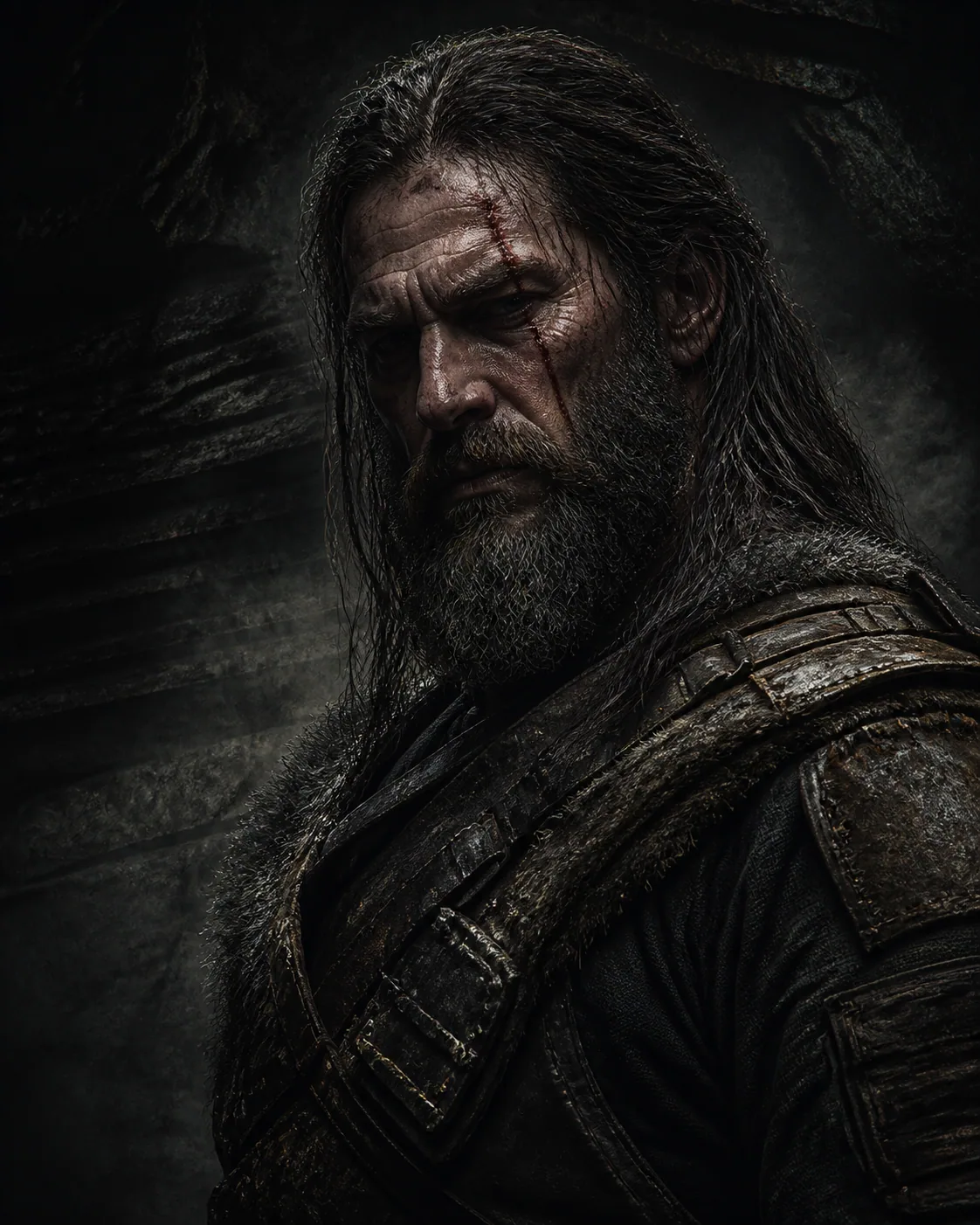
In the modern era B is depicted as an extremely fit adult man, often with dark hair and facial hair that varies with period and circumstance. His body regularly bears temporary evidence of violence, but his regeneration historically restores catastrophic damage. Ron Garney's visual storytelling emphasizes the physical cost of B's battles even when those injuries are not permanent. This prevents immortality from feeling clean or painless.
Historical stories can alter hair, clothing, armor and weaponry according to period. The character's identity should therefore be indexed through facial structure, physical build, scars when temporarily present, and recurring visual motifs rather than through one modern costume.
Original-series appearances
B appears throughout the complete twelve-issue original maxiseries:
Historical one-shots and later publications should be incorporated into the master chronology through B Through the Ages rather than inserted into the original-series biography without clear continuity labels.
Novel and adaptation continuity
The Book of Elsewhere uses a version of B inspired by the comic world but should be maintained as a separate continuity branch. Novel-exclusive terminology, relationships, chronology and cosmology must not silently overwrite this comic biography. See Comic Continuity vs. The Book of Elsewhere.
Film and anime versions should likewise receive adaptation-specific records once enough released material exists to compare characterization and history. Development announcements belong on BRZRKR Film and BRZRKR Anime, not inside comic canon.
Legacy and unresolved questions
B dies in the original-series finale after achieving mortality, but several parts of his legacy remain open. His children survive and carry altered biology into the world. Franken-B, a being assembled from leftover body parts collected from past missions, exists independently of him. The government has already used Source-derived energy to power a hypercomputer capable of contact. The final pages expand the scale of the story beyond B's individual life.
The most personal unresolved question is whether anything of B persists after death. Diana's later attempt to call out to Unute is meaningful precisely because the comic does not answer her. The wiki should list the question under Mysteries and Unanswered Questions without converting it into a resurrection claim.
B's larger legacy is also conceptual. For eighty thousand years, other people define his purpose. His ending rejects that structure. He becomes mortal, forms a family and dies on terms shaped by relationships rather than by an institution's need for an indestructible weapon. The final irony is that after B is finally freed from being an eternal instrument, his biology, descendants and the Source continue to change the world without him.
References
[1] Keanu Reeves, Matt Kindt and Ron Garney, BRZRKR #1 (BOOM! Studios, 2021), especially the modern debrief and Diana/B conversation near story p. 34. B explicitly identifies mortality as his objective and acknowledges the government's desire to build soldiers from him.
[2] Reeves, Kindt and Garney, BRZRKR #2 (BOOM! Studios, 2021), origin-memory sequence concerning B's mother, the lightning event and his accelerated infancy.
[3] Reeves, Kindt and Garney, BRZRKR #3 (BOOM! Studios, 2021), childhood memories and the modern Diana/Caldwell discussion, including anomalous amino acids, quantum molecules, lightning and the search for B's place of origin; see approximately story p. 19 for the modern discussion.
[4] Reeves, Kindt and Garney, BRZRKR #4 (BOOM! Studios, 2021), final origin sequence and regenerative rebirth, approximately story pp. 19-20; the following scene has Diana visit B without wires, drugs or laboratory protocols.
[5] Reeves, Kindt and Garney, BRZRKR #5 (BOOM! Studios, 2021), memory sequence concerning B's first love and first child, approximately story pp. 12-14.
[6] Reeves, Kindt and Garney, BRZRKR #6 (BOOM! Studios, 2021), modern war-zone recovery mission with Jim Keever.
[7] Reeves, Kindt and Garney, BRZRKR #7 (BOOM! Studios, 2022), World War I memory, B's first United States handler, the separated body fragment and Caldwell's Protocol X proposal.
[8] Reeves, Kindt and Garney, BRZRKR #8 (BOOM! Studios, 2022), Protocol X countdown, energy event, Diana's exposure and B's disappearance.
[9] Reeves, Kindt and Garney, BRZRKR #9 (BOOM! Studios, 2022), B's contact experience, Diana's altered state and B's physical return.
[10] Reeves, Kindt and Garney, BRZRKR #10 (BOOM! Studios, 2022), expedition to B's birthplace, recovery of Mother's bird-shaped gift and escalation of Source contact.
[11] Reeves, Kindt and Garney, BRZRKR #11 (BOOM! Studios, 2022), Source contact, the metaphysical Blue Plane, Caldwell's cult betrayal and power-transfer sequence.
[12] Reeves, Kindt and Garney, BRZRKR #12 (BOOM! Studios, 2023), complete finale. Key sequences include Caldwell identified as leader of a fanatical cult; Diana's explanation that she was selected to build trust and enable first contact; the Virginia HQ safehouse; Keever's execution order and refusal; the later Southwest refuge with Seline and Songaa; the twins; B's mortal death; and Diana's later attempt to contact Unute.
Collected-book references
- BRZRKR Vol. 1, collecting BRZRKR #1-4.
- BRZRKR Vol. 2, collecting BRZRKR #5-8.
- BRZRKR Vol. 3, collecting BRZRKR #9-12.
- BRZRKR Book One, collecting the complete original BRZRKR #1-12 maxiseries.