Selected scenes
BRZRKR in pictures.
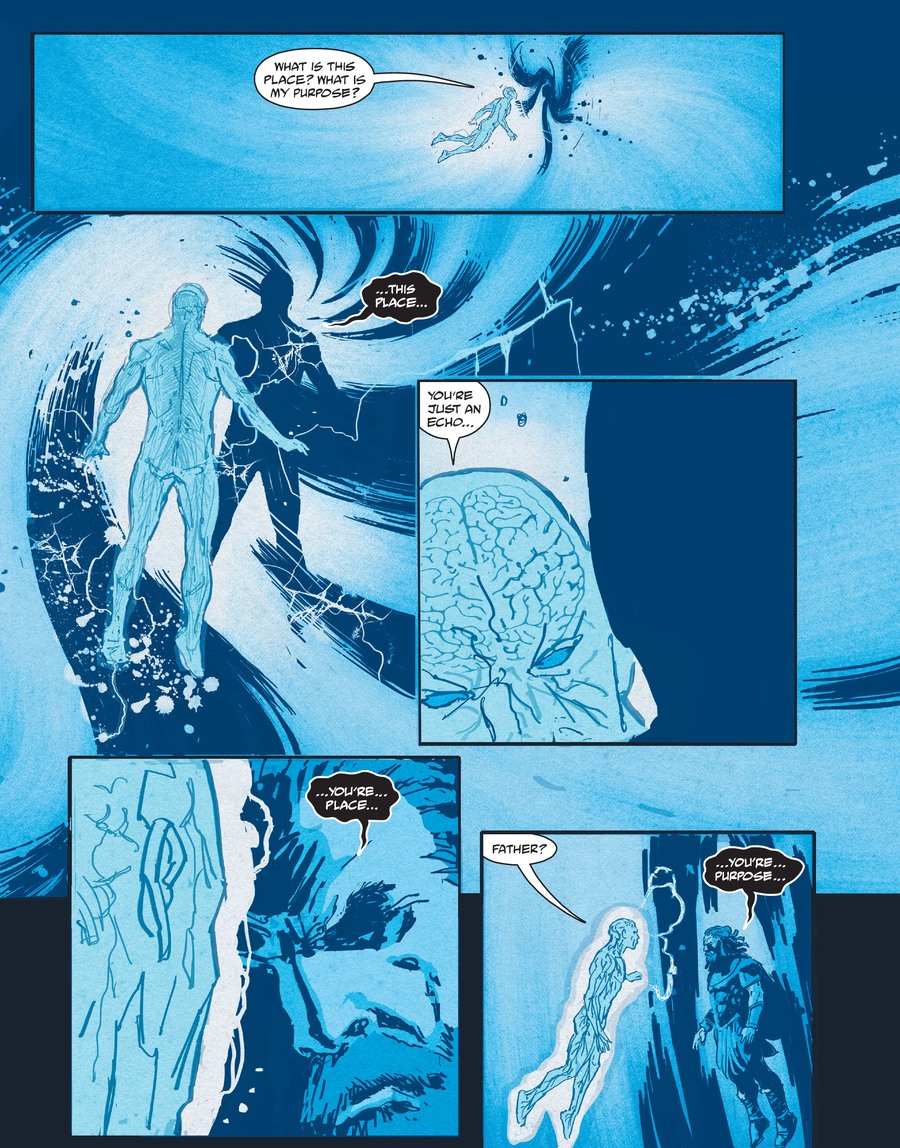
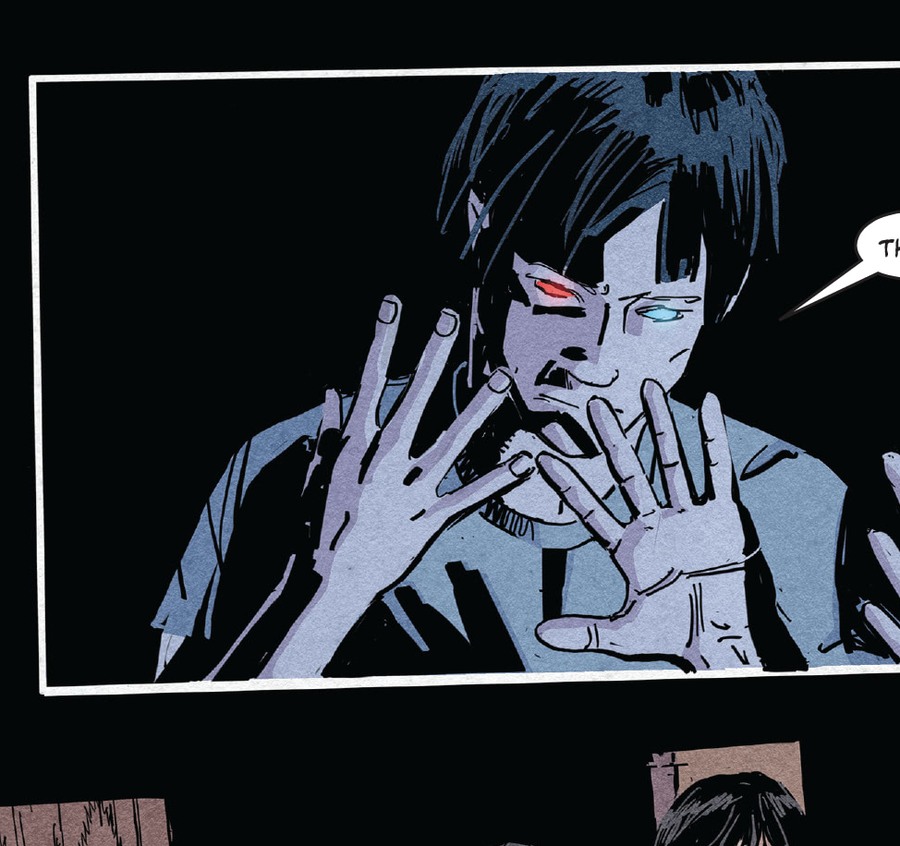
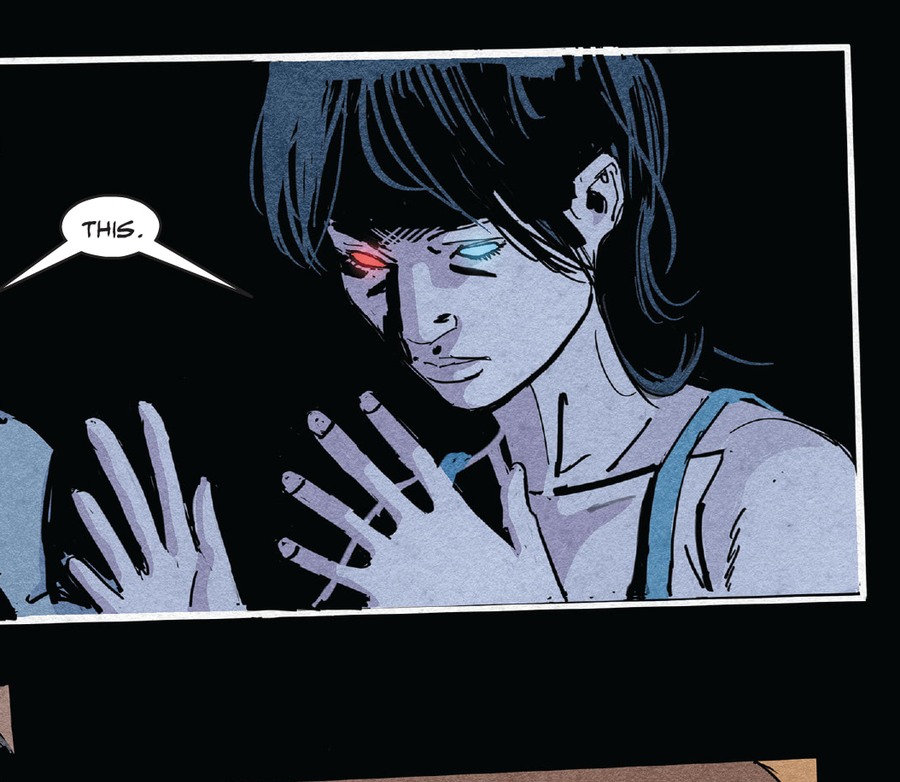
Spoilers: This article covers the Source, B's children, and the final epilogue of the original BRZRKR series.
Overview
Cosmic pollination is the name used for the process by which Source-linked life, knowledge, technology, or influence spreads through human history. The term is most strongly associated with the final pages of BRZRKR #12, where B and Diana's children leave their refuge and the epilogue connects their movement across the world with the dissemination of ideas and technological change. It also describes the larger pattern implied by B's origin: an intelligence beyond Earth or ordinary human history sends a biological and informational seed into the world, and that seed continues to produce effects long after the original contact.[1][2]
The comic does not offer a scientific definition of pollination, a complete list of seeded worlds, or a statement that every technological advance in human history comes from B. The term is a useful description of an observed pattern, not a universal explanation. B is a human–Source hybrid or human body altered by the Source, his children inherit unusual traits, and the Source's influence appears in some historical moments. The exact relationship between biological inheritance, cultural transmission, and deliberate intervention remains unresolved.
The Source as origin and transmitter
The Source, also called the Pollinator or cosmic father, is the intelligence associated with B's conception. B's recovered memories show a lightning event, a nonhuman presence, and a biological change that produces a child unlike the people around him. Diana and Caldwell later identify impossible amino acids, quantum molecules, and other evidence that B's body cannot be explained as an ordinary human mutation.[3]
The Source's role is not described through a single laboratory observation. It is reconstructed from memories, bodily evidence, the Protocol X experiment, and the final contact sequence. The evidence points to an intelligence capable of sending or altering life across extraordinary distances. It does not prove whether the Source created B from nothing, modified a human embryo, joined with a human parent, or used a process that human language cannot represent. The phrase cosmic father reflects B's relationship to the being; it does not establish a human-style family structure.
The Source also appears connected to technology and information. In the epilogue, B's descendants are associated with the spread of knowledge and innovation. Earlier historical material links B's movements with legends, objects, and sudden changes in human capability. The story invites the possibility that B has served as a carrier or catalyst, but it does not identify every object or invention as a Source artifact.[1][4]
B as the first known seed
B's life provides the clearest example of a Source-linked seed moving through the human world. He is born in a prehistoric community, develops at an accelerated rate, survives bodily destruction, and becomes an immortal fighter. His father interprets him as a tool and weapon, while his mother responds to him through prayer, fear, and protective love. The name Unute is associated with the idea of a tool or weapon, reflecting the human attempt to define an unknown child through usefulness.[5]
B's biological persistence makes him a long-term carrier. He can cross eras without aging, remember events with unusual accuracy, and encounter thousands of cultures. The story repeatedly shows him becoming a soldier, ruler's protector, legend, monster, angel, or god depending on the people around him. Those identities are not all deliberate acts of cultural transmission. Some arise from observation, some from rumor, and some from institutions that use B for their own purposes.
The historical effect is therefore mixed. B can carry an object, teach a technique, inspire a story, or leave behind a fragment of tissue. He can also bring destruction, war, and the knowledge that leads an ambitious group to imitate him. Pollination does not mean benevolent progress. A seed can produce protection, exploitation, or catastrophe depending on the environment in which it takes root.[4]
The children of B and Diana
The final issue shifts pollination from one immortal body to a family. Diana becomes pregnant after her Source-linked transformation, and the pregnancy develops at a speed that exceeds ordinary human gestation. The twins are born in the Southwest refuge and mature rapidly. Their red-and-blue heterochromia and physical development suggest a connection to B, Diana, and the Source, although the issue does not provide a full genetic explanation.[2]
The children's significance is not limited to inherited powers. They are raised in a family that includes B, Diana, Seline, and Songaa. They experience B as a parent rather than as a weapon, research subject, or religious figure. The change matters because B's earlier descendants and relationships are marked by absence: he often leaves before a child can know him, or arrives too late to share ordinary life. With the twins, he is present for birth, childhood, and the decision to leave.[6]
The twins eventually depart together. Their stated intention to plant their seeds provides the most direct in-story use of the metaphor. The words can refer to biological descendants, cultural influence, technological dissemination, or all three. The closing montage associates the next generation with movement through the world and with a pollinator role, but it does not name their destinations, partners, children, or specific inventions.[1]
The children are therefore not simply smaller versions of B. Their inherited traits include unusual eyes, rapid maturation, and Source-linked potential, but their future choices remain open. They may reproduce, teach, preserve, transform, or reject the history they inherit. The comic ends before any of those paths becomes a confirmed biography.
Cultural and technological transmission
B's historical presence creates several kinds of transmission:
Biological transmission
B's body can produce children, tissue fragments, blood, and artificial organisms. The twins are the clearest natural descendants. Franken-B and other experiments represent attempts to manufacture a similar result. These forms should not be treated as equivalent. Natural inheritance, separated fragments, and laboratory assembly follow different evidence trails.[2][7]
Material transmission
B carries or leaves behind objects, weapons, and biological matter. The primordial-ore sword, the bird-shaped relic, B's iron box, combat fragments, and later specimens all become independent historical clues. An object can outlive the person who used it, allowing a later culture to encounter a partial version of B's story.
Cultural transmission
Human groups interpret B through worship, fear, scholarship, military service, and myth. The cult that follows him across history treats accumulated stories as evidence of a path toward immortality. Atlantis places B beside Poseidon. Other communities turn him into a monster or angel. These interpretations are not reliable descriptions of the Source, but they demonstrate how a single body can generate a long cultural afterlife.
Technological transmission
The final epilogue suggests that Source-linked descendants can participate in the spread of technology and ideas. Earlier issues connect B's movements with changes that Caldwell and the cult attempt to trace. The story does not establish a one-to-one causal chain from B to a named invention. The safest claim is that BRZRKR depicts a recurring relationship between extraordinary visitors, preserved knowledge, and shifts in human capability.[4][8]
Pollination and violence
The metaphor does not erase the violence of B's life. B is repeatedly used as an engine of conquest, and the cultures that encounter him may gain protection at the price of other people's deaths. Atlantis flourishes because B destroys invaders. Genghis Khan's campaigns use B in a similar way. Government programs treat his body as a platform for research and a possible super-soldier source. The same extraordinary capacity that can protect a community can also magnify the ambitions of its rulers.[5][9]
The children inherit this history. Their departure could repeat the cycle if they become instruments for another institution, or it could break the cycle if they choose relationships and knowledge without domination. The comic leaves the moral question open. “Plant our seeds” is hopeful in tone, but the universe has already shown that seeds can be cultivated for war, worship, or control.
Inheritance is not imitation
The story repeatedly distinguishes between carrying B's material and becoming B. Caldwell's cult tries to imitate or reproduce the immortal through ritual, research, and recovered fragments. Franken-B is assembled from a different process. The twins are born from B and Diana and grow within a family. These three pathways may share Source-linked evidence, but they produce different people and different ethical problems. A tissue sample can preserve a biological property without preserving a memory. A myth can preserve a name without preserving a body. A child can inherit a potential without accepting the life that produced it. The pollination metaphor is most useful when it preserves those distinctions instead of treating every later trace as a duplicate of B.[2][7]
Relationship to mortality
Pollination gives B a different answer to the problem of immortality. For most of his life, survival means repetition. He regenerates while everyone around him ages, dies, or leaves. The Source's influence initially appears to extend his isolation. By the end of the series, the possibility of inheritance allows continuity to move beyond one body. B can die and still leave a family, memories, and future agents in the world.
This does not make B's death irrelevant. The ending emphasizes that mortality gives his final life a boundary. The children do not replace him, and they do not guarantee that his values will survive. They are independent people carrying a potential that may take forms he cannot control. Pollination is therefore a process of release as much as spread: the seed leaves the parent and enters conditions the parent cannot command.
Limits of the concept
The comic does not establish that the Source intentionally plans every human historical event, that B's descendants are immortal, or that the children can transmit abilities to every person they meet. It does not confirm the number of children B has fathered, the fate of his first child, or whether the twins' descendants will remain genetically consistent. It also does not prove that the final montage depicts literal time travel rather than a compressed account of future influence.
The term should not be applied to unrelated supernatural systems. Cthulhu's summoning, the Sorceress's magic, vampirism, and Zosimus's alchemy have separate evidence. A shared visual language of energy or transformation does not establish a shared source. Cosmic pollination is most secure when used for the Source-linked relationship among B, Diana, their children, and the spread of influence shown in the original-series ending.
Appearances
- BRZRKR #3-4 - B's anomalous biology, conception memories, and early Source clues.
- BRZRKR #8-12 - Protocol X, contact with the Source, Diana's transformation, and the final family arc.
- BRZRKR #12 - twin birth, rapid maturation, departure, and the pollinator epilogue.
See also
- The Source / Cosmic Father
- B / Unute
- B and Diana's Son
- B and Diana's Daughter
- Inherited Abilities
- Accelerated Gestation and Maturation
- Technology Migration
- B's Family Tree
References
[1] Keanu Reeves, Matt Kindt, Ron Garney, Bill Crabtree, and Clem Robins, BRZRKR #12 (BOOM! Studios, 2023), the twins' departure, “plant our seeds” language, and the closing pollinator montage, digital page images 040-046.
[2] Reeves, Kindt, Garney, Crabtree, and Robins, BRZRKR #12, Diana's pregnancy, Source-linked changes, twin birth, rapid development, and red-and-blue eye coloration, digital page images 024-031.
[3] Reeves, Kindt, Garney, Crabtree, and Clem Robins, BRZRKR #2-4 (BOOM! Studios, 2021), memory protocols, B's conception, lightning contact, impossible biology, and regeneration, digital page images 001-024 across the issues.
[4] Reeves, Kindt, Garney, Crabtree, and Robins, BRZRKR #7 (BOOM! Studios, 2022), historical cult testimony, B's technological and cultural influence, and the attempt to trace his movements, digital page images 009-010.
[5] Reeves, Kindt, Garney, Crabtree, and Clem Robins, BRZRKR #4, B's family, the meaning of Unute, his father's exploitation, his mother's prayers, and the first catastrophic regeneration, digital page images 002-024.
[6] Reeves, Kindt, Garney, Crabtree, and Robins, BRZRKR #5 and #12 (BOOM! Studios, 2021 and 2023), B's first child and the contrast with his presence during the twins' birth, digital page images 013-016 of #5 and 024-046 of #12.
[7] Reeves, Kindt, Garney, Crabtree, and Robins, BRZRKR #10-12, synthetic Unute research, Franken-B, Source-powered systems, and the laboratory aftermath, digital page images 009-020 of #10 and 002-020 of #12.
[8] Reeves, Kindt, Garney, Crabtree, and Robins, BRZRKR #10, Saudi expedition, B's birthplace, and the discovery of the bird-shaped relic, digital page images 001-024.
[9] Reeves, Kindt, Garney, Crabtree, and Robins, BRZRKR #6-7, B's use by governments and historical powers, digital page images 001-024 across both issues.