Selected scenes
BRZRKR in pictures.
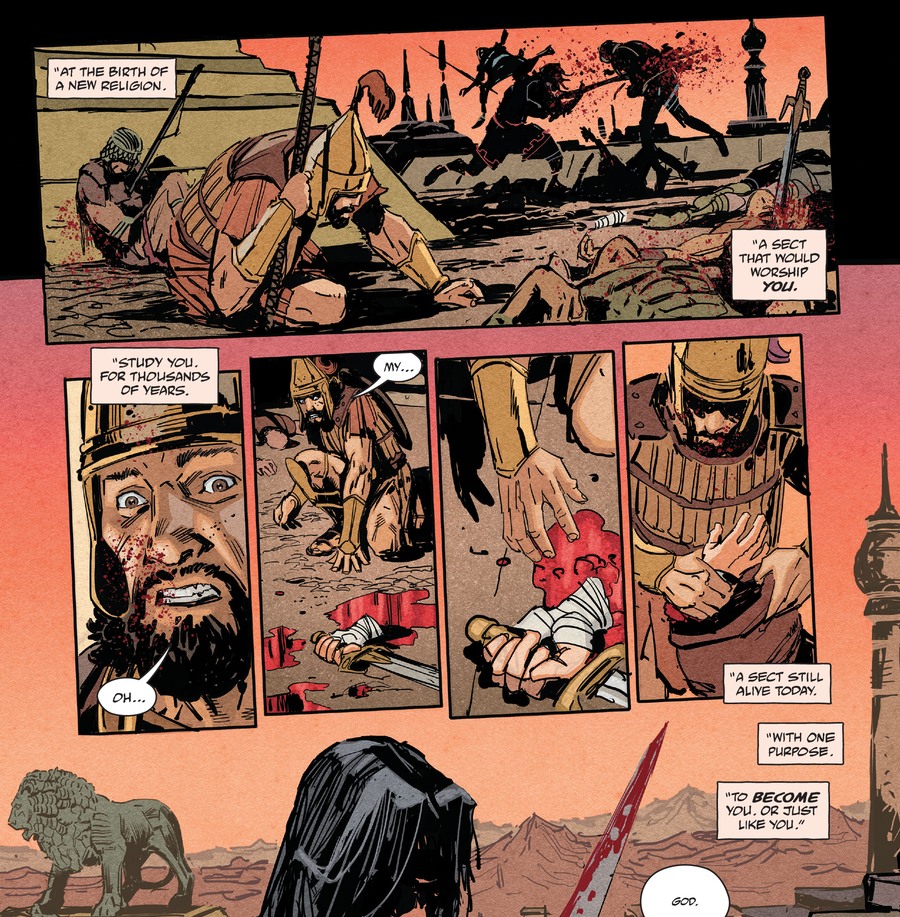
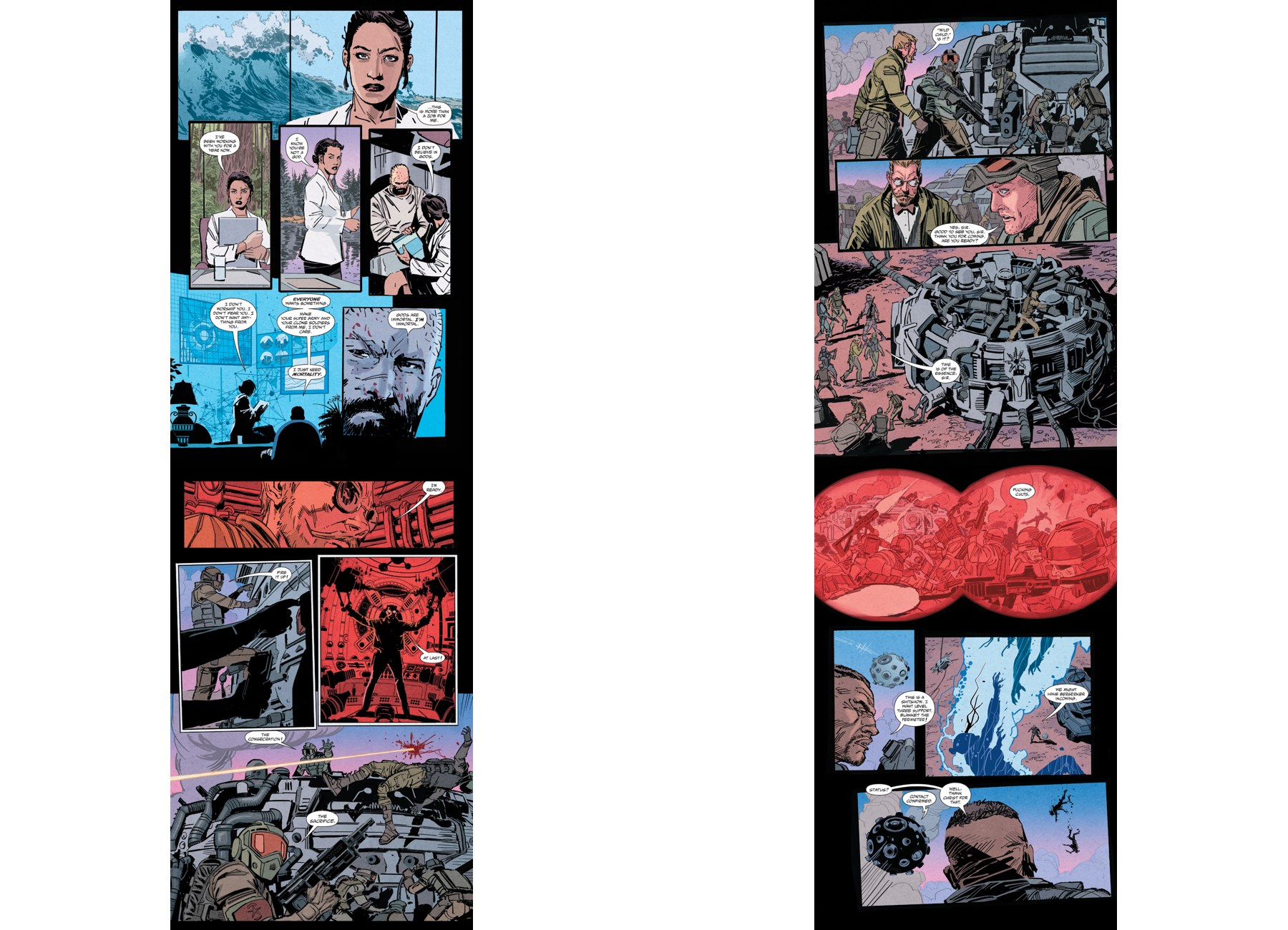
Spoilers: This article covers the historical sect connected to Dr. Stephen Caldwell in BRZRKR #7, #10, and #12.
Overview
Caldwell's Cult is the modern expression of a historical sect that studies, worships, and attempts to reproduce B / Unute across thousands of years. The original series presents the group through Caldwell's family history, the archaeological trail followed in BRZRKR #7, the laboratory and hypercomputer sequences, and the final revelation that Stephen Caldwell is the leader of a fanatical cult and one person in a long line devoted to the pursuit of B and immortality.[1][2]
The movement has no confirmed in-story proper name. “Caldwell's Cult” is a descriptive title that identifies its most recent known leader without claiming that the group itself uses that phrase. The comic depicts a succession of human institutions, records, symbols, and agents rather than a single organization with a fully listed membership. Its continuity is therefore best described as a historical network: different cells, patrons, scholars, and rulers may participate at different times while preserving a common interest in B.
The cult's central error is also its central motive. It treats B's existence as a repeatable condition rather than as the life of a person. Members seek immortality, godhood, or transformation by studying B's body, following his movements, collecting fragments, and turning his history into doctrine. The movement can preserve valuable evidence while simultaneously hiding or manipulating it. Its records are therefore important sources and unreliable testimony at the same time.
Historical origin
The cult's earliest known history is described in BRZRKR #7, when Caldwell and Diana investigate the traces left by people who have followed B through time. The sequence describes a sect that worships B, studies him, and seeks to become B or become like him. The issue does not identify the founding date, founder, original language, or first settlement. It does establish that the movement has operated across more than one generation and that its members preserve enough information to recognize B when he appears in different historical forms.[1]
The historical record is not a continuous roster. It is a trail. The sect appears through artifacts, stories, symbols, financial or archaeological activity, and references preserved by later members. The gaps may result from secrecy, destroyed archives, changes in political conditions, or the ordinary loss of records over thousands of years. A later cell may know the doctrine without knowing every earlier leader.
The movement's persistence is itself part of the mythology. B lives long enough to become a recurring figure in human history, while the cult is forced to survive through inheritance. Its members age and die; B does not. The organization therefore develops a relationship to genealogy and institutional memory that resembles a family line. Caldwell is described as one in a long line, not as the first person to seek B.[2]
Beliefs and objectives
The cult's belief system combines worship with research. Members treat B as a being who has crossed the boundary between human and divine, but they also investigate the material causes of his condition. The two approaches are not separate. The body is sacred because it is the route to transformation, and the laboratory is a ritual space because experiments are attempts to reproduce a miracle.
The movement's goal is often summarized as immortality through death or becoming B. Those phrases should be read as descriptions of the cult's aspiration, not as proof that the group has a successful method. The comic shows attempts, theories, and violence. It does not show an ordinary cult member achieving B's exact condition.[1]
The sect's doctrine also appears to include a theory of historical influence. If B has moved through thousands of years, then the tools, symbols, and technological changes associated with his movements become evidence of a cosmic process. The cult follows those traces, sometimes treating myths as encoded reports and sometimes using them to direct new searches. The resulting archive can contain genuine observations mixed with interpretation.
The group does not have a confirmed complete scripture. BRZRKR #7 shows historical material and a cult sigil or record, but the issue does not publish a full creed, liturgy, or membership oath. Later references to forgotten scripts, poems, and figurines in The Book of Elsewhere belong to the novel continuity and should be labeled separately rather than merged into the comic cult's canon.[3]
Methods and operations
The cult uses several methods to pursue B:
Historical tracking
Members compare myths, artifacts, names, and military accounts to identify appearances of B. The approach assumes that an immortal who remembers everything will leave repeated visual and narrative signatures. The same method can produce false matches, especially when communities independently describe a violent warrior as a monster, angel, or god.
Archaeological recovery
The sect seeks objects connected to B's life, including biological fragments, weapons, relics, and records. Caldwell's interest in the artifact recovered in BRZRKR #7 demonstrates that the group values material evidence as well as stories.[1]
Biological experimentation
The modern cult investigates B's tissue, DNA, blood, and regenerative behavior. Caldwell's secret laboratory and the Source-powered hypercomputer show an attempt to combine historical knowledge with contemporary technology. The work produces or contributes to Franken-B, artificial Unute research, and the attempt to generate a controllable replacement.[4]
Infiltration and institutional access
The movement does not operate only in hidden caves. Caldwell holds a senior position inside the government program that studies B. His authority gives him access to memory protocols, mission data, tissue, equipment, and personnel. The arrangement allows the cult to direct the very research that appears to be investigating it.
Manipulation of history
The cult's long-term network can preserve or suppress information according to its goals. A record may be copied because it points toward B, altered because it would expose the group, or converted into a religious story that protects a secret location. The comic does not enumerate every falsified document, but its repeated emphasis on hidden lineage and partial testimony makes the possibility unavoidable.
Caldwell's family line
Stephen Caldwell is the modern leader revealed in BRZRKR #12. His father and ancestral lineage are treated as part of the same pursuit. The father is not given a full independent biography, but the family connection explains how the cult's knowledge and purpose reach Caldwell. The line is not a simple inheritance of supernatural power. Caldwell remains human and must use institutions, science, and manipulation to approach the condition he worships.[2]
Caldwell's family history also explains the tension in his relationship with Diana. He presents himself as a scientist helping the government understand B, but his deeper objective is to reach the Source and reproduce the result. He can sincerely value evidence while treating the person who provides that evidence as material. The cult's language of reverence therefore coexists with the practical violence of experimentation.
The family line should not be expanded into an unverified genealogy. The comic confirms Caldwell, his father or ancestral predecessors, and the idea of a long line. It does not name every prior leader, give exact dates for each generation, or establish that every member was biologically related. “Line” may describe succession, doctrine, or family; the available text supports more than one possibility.[1][2]
Relationship with B
The cult worships B, but B does not consent to the role. He views the movement with contempt and recognizes the pattern of people trying to turn his life into a useable system. The difference between worship and respect is central. Members may praise him, preserve his history, or claim to understand his purpose while still treating his body as a resource.
B's response is consistent with his experience. His father calls him a weapon. Kings use him to defend cities. Governments deploy him on black operations. The cult adds religious meaning to the same instrumental relationship. It tells B that he is divine while demanding access to his blood, tissue, or origin. Worship becomes another form of control.
The cult's interest also creates a dangerous feedback loop. Because B has perfect memory and travels through history, he can become an important source of the movement's own stories. Members may claim that a myth comes from B when it is actually an interpretation made by a later generation. B's presence makes the cult's archive compelling, but it does not make the archive truthful.
Relationship with the government program
The modern government program and Caldwell's cult overlap through Caldwell himself. Diana begins by believing that the program's stated purpose is to understand B, investigate his origin, and find a way to make him mortal. She later learns that the pursuit of the Source has been part of the operation from the beginning. Caldwell's secret allegiance turns scientific infrastructure into cult infrastructure.[5]
This overlap creates several layers of responsibility. Government personnel may be unaware of the cult's control. Diana participates in research before understanding the hidden objective. B agrees to missions because he wants mortality, even though the arrangement also gives the program opportunities to study him. The cult exploits a structure that already treats B as an asset.
Protocol X is the clearest example. The experiment is presented as a controlled attempt to contact the Source. Caldwell's connection to the cult means the experiment can also be read as a ritual translated into scientific language. The comic does not state that every technician is a cultist or that the apparatus is religious in design. It shows that the same project can serve both institutional science and secret worship.[6]
Franken-B and artificial reproduction
The movement's effort to reproduce B culminates in Franken-B, an artificial assemblage associated with Source-powered animation and the modern laboratory. The creature is not B's clone and should not be described as a successful duplicate. It is a constructed organism made from research into B's biology and the forces connected to the Source.[4]
Franken-B demonstrates the limits of the cult's method. The group can collect tissue, operate machines, and activate a body, but it cannot simply reproduce B's history, memory, relationships, or choices. The result is powerful and tragic rather than a clean replacement. Caldwell's ambition turns a person into an engineering problem and produces another being who can be used.
The exact fate of Franken-B after the final conflict remains one of the original series' mysteries. The cult's broader objective therefore ends in uncertainty rather than triumph. Whether any fragment survives, whether the facility is destroyed completely, and whether later researchers continue the work are not established by the supplied comic record.
Symbols, records, and evidence
The cult's sigil, historical accounts, figurines, and forgotten-script material function as evidence but not as neutral metadata. A symbol can identify a lineage while also communicating belief. A poem can preserve a real encounter while changing its meaning. An artifact can prove that a person visited a place without proving what the person intended.
The most reliable statements about the cult are those directly depicted in the comic: its study and worship of B, its pursuit of immortality, Caldwell's leadership, its involvement in the Source investigation, and its connection to the artificial reproduction project. Claims about exact membership, hidden chapters, successful immortality, or uninterrupted institutional control remain uncertain.
Decline and current status
Caldwell's exposure and the collapse of the final laboratory operation damage the modern cult, but the original series does not announce that every branch has been eliminated. The death or destruction of one leader does not automatically end a movement described as a long line. The comic leaves open the possibility of surviving records, agents, or imitators while providing no confirmed post-#12 organization.
The cult's current status should therefore be recorded as fractured and unresolved rather than destroyed or active without qualification. The historical network is confirmed. Its future membership is unknown.
Appearances
- BRZRKR #7 - historical investigation, cult testimony, sigil, and the pursuit of B across time.
- BRZRKR #10 - Caldwell's laboratory, hypercomputer work, and artificial reproduction research.
- BRZRKR #12 - Caldwell's revelation as leader of a fanatical cult and the final laboratory conflict.
- The Book of Elsewhere - separate novel-continuity references to Caldwell's victims and related historical material.
See also
- Dr. Stephen Caldwell
- Caldwell's Father and Ancestral Cult Lineage
- Source-Powered Hypercomputer
- Franken-B
- United States B Program
- Protocol X
- Artificial Immortality
- Cult Immortality Through Time
- Comic Continuity vs. The Book of Elsewhere
References
[1] Keanu Reeves, Matt Kindt, Ron Garney, Bill Crabtree, and Clem Robins, BRZRKR #7 (BOOM! Studios, 2022), historical sequence describing the sect that worships and studies B, its goal of becoming B or becoming like him, and the use of the cult trail to locate evidence, digital page images 009-010.
[2] Reeves, Kindt, Garney, Crabtree, and Robins, BRZRKR #12 (BOOM! Studios, 2023), opening recap identifying Caldwell as leader of a fanatical cult and one in a long line connected to B, digital page image 002.
[3] Keanu Reeves and China Miéville, The Book of Elsewhere (Del Rey, 2024), Caldwell's recollections of named victims, Unute-related figurines, forgotten-script poems, and selective historical disclosure; novel continuity only.
[4] Reeves, Kindt, Garney, Crabtree, and Robins, BRZRKR #10-12, Caldwell's laboratory, Source-powered systems, artificial Unute research, Franken-B, and the laboratory aftermath, digital page images 009-020 of #10 and 002-020 of #12.
[5] Reeves, Kindt, Garney, Crabtree, and Robins, BRZRKR #1-3 and #12, government bargain, Diana's research, Caldwell's role, Source objective, and final revelation, digital page images 001-024 across #1-3 and 002-020 of #12.
[6] Reeves, Kindt, Garney, Crabtree, and Robins, BRZRKR #8-9, Protocol X apparatus, contact attempt, B's disappearance, and Diana's transformation, digital page images 001-024 across both issues.