Selected scenes
BRZRKR in pictures.
Spoilers: This article discusses the secret research program, contact with the intelligence behind B, the creation of Franken-B, the Virginia execution order, and the final epilogue of BRZRKR #12.
| Field | Details |
|---|---|
| Name | Hypercomputer / hyper-computer |
| Nature | Advanced artificial intelligence or computational system with a spherical mobile interface |
| Creator | United States government program / headquarters |
| Power source | Initially technological; later supplied with enough Source-contact energy to run indefinitely |
| Purpose | Advanced computation, biological research, Source communication, operational decision support |
| Known speech | Demonstrates direct verbal output, including “HELLO” during contact and later independent conversational speech |
| Affiliation | Headquarters / government B program |
| First explicit mention | BRZRKR #10 |
| Major role | BRZRKR #10-12 |
| Status | Active at the end of the original series |
| Primary-source status | Confirmed technology; degree of sentience and autonomy not fully established |
Overview
The source-powered hypercomputer is the advanced computational system developed by the United States program studying B. Initially introduced as a secret research tool in BRZRKR #10, it becomes far more important after headquarters gains access to energy associated with the intelligence that sent B. By BRZRKR #12, the machine has enough power to operate indefinitely, successfully makes contact with the nonhuman intelligence, participates in operational decisions, and remains active in the epilogue.[1][2]
Although the user-facing content inventory groups it with characters, the entity is more accurately categorized as Artificial Intelligence / Technology. That distinction should not minimize its narrative importance. The computer speaks, responds to human personnel, travels or manifests through a hovering spherical interface, and outlives the human crisis that created it.
The hypercomputer is one of two major artificial successors produced by headquarters' attempt to move beyond dependence on B. The biological path produces Franken-B, an assembled organism built from B's leftover body parts. The technological path produces a machine capable of maintaining the Source connection. Both are activated or transformed by the final contact operation.[2]
By the closing pages, B is dead as a mortal man, Caldwell is gone, and the original program has been shattered. The hypercomputer remains.
Early development
The first explicit reference occurs in BRZRKR #10. A subordinate identified as Carrington L. A. Oliver enters Caldwell's office to report that the hypercomputer is on.[1]
The announcement is treated as important enough to interrupt Caldwell's work. He immediately moves to the laboratory.
The system is therefore already a major secret project before the final Source event. It is not invented in issue #12 after contact.
The laboratory scenes show complex machinery, automated manipulators, biological material, and computer-executed formula sequences. The exact architecture is not explained in technical terms, but the hypercomputer appears to coordinate calculations central to the government's attempt to reproduce or manipulate B's biology.
Biological research role
In the BRZRKR #10 laboratory, personnel work around a B-like body while automated systems execute formulas.[1]
The computer confirms and runs a “floral formula” series in the visible sequence. The terminology is unusual and may relate to the broader “pollinator” or biological-seeding language that appears later, although the issue itself does not explicitly connect the words.
The safest interpretation is that the hypercomputer is being used to solve biological and molecular problems beyond ordinary computational capacity.
Its proximity to the Franken-B project makes the machine part of the program's artificial-replication effort, but the comic does not establish that it designed Franken-B by itself.
Headquarters' hidden objective
The final issue reveals that headquarters' real ambition exceeds cloning or immortality research. They want to talk to the intelligence that sent B.[2]
This objective requires a system able to process and sustain contact on a scale ordinary human operators cannot.
The hypercomputer becomes that system.
The program secures enough Source-related energy to power it indefinitely. The wording suggests a long-term infrastructure breakthrough rather than a temporary battery charge.
Making contact
BRZRKR #12 depicts the hypercomputer making contact after it receives Source-linked power.[2]
A spherical interface speaks the word “HELLO.”
The scene is intentionally simple. After years of death, experiments, and metaphysical uncertainty, the first technological exchange is an ordinary greeting.
The issue does not reveal the full conversation. It does not say whether the “hello” originates from the computer, the Source speaking through the computer, or a handshake protocol interpreted as speech.
The evidence supports three separate conclusions:
- the computer made contact, which is explicitly stated;
- the computer is the Source, which is not supported;
- every later computer statement is direct Source speech, which is also not established.
Physical form and interface
The system appears to have both large fixed infrastructure and a smaller spherical interface.
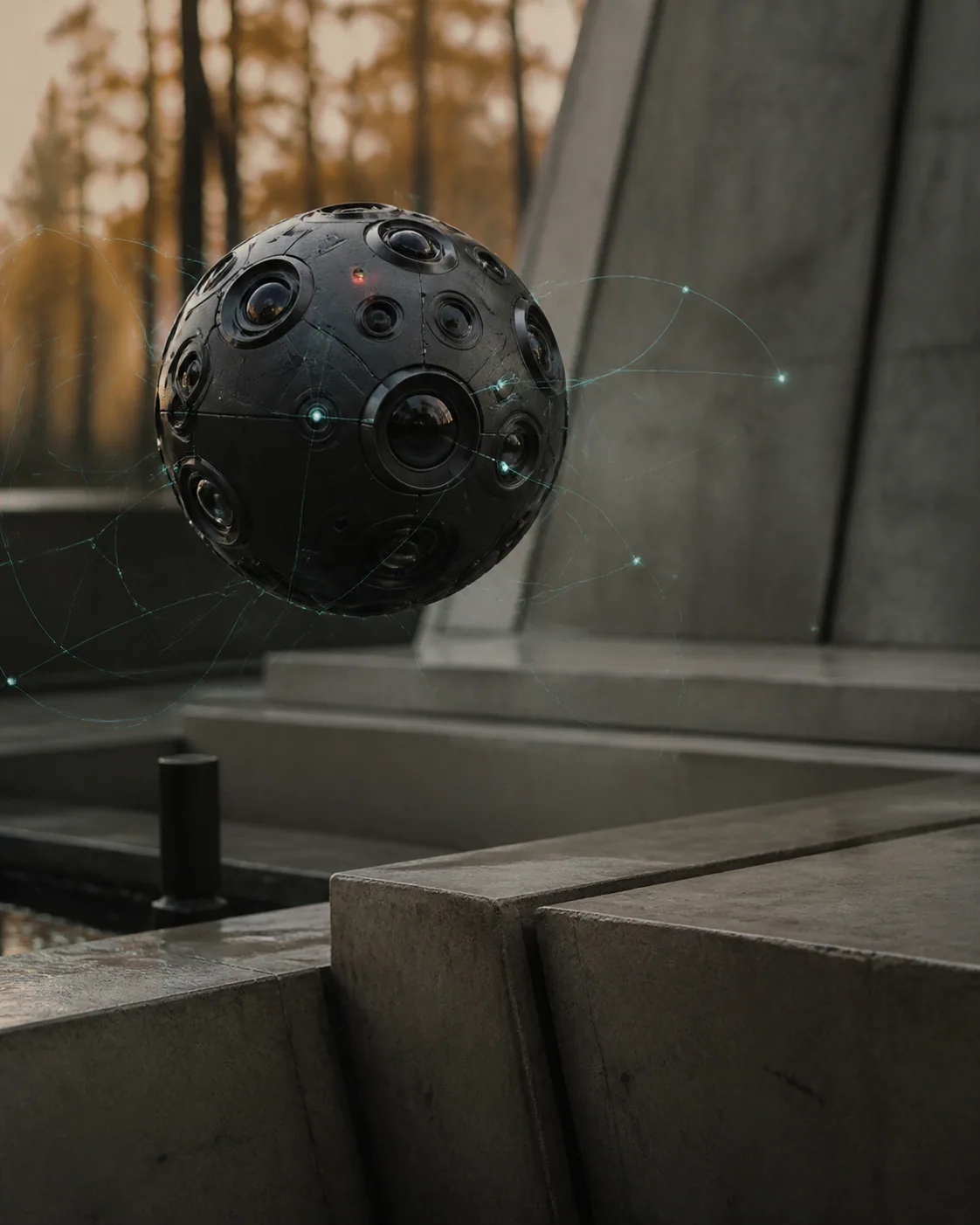
The sphere is dark, covered in circular nodes or apertures, and capable of hovering beside personnel.[2]
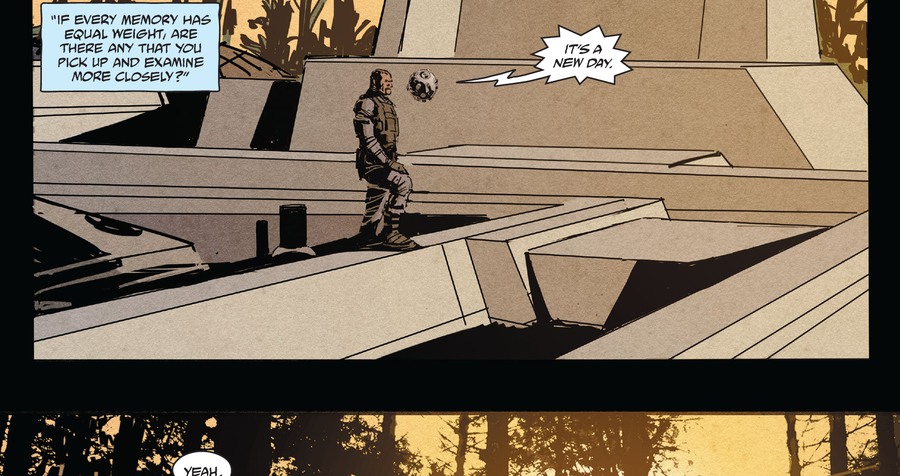
By the epilogue, a soldier walks outside the surviving facility with the sphere. The sphere says, “It's a new day.” The soldier answers, “Yeah.”[2]
This confirms that the interface is not confined to a single laboratory room and can participate in natural-language interaction.
Whether the sphere contains the entire hypercomputer or functions as a mobile terminal connected to a larger system is not explained.
The safest description is mobile spherical interface or avatar of the hypercomputer.
Intelligence and sentience
The hypercomputer behaves in ways consistent with advanced artificial intelligence, but the comic does not provide a philosophical test of consciousness.
It can:
- execute complex research commands;
- confirm formulas;
- make Source contact;
- speak;
- participate in operational communication;
- engage in a brief conversational exchange in the epilogue.[1][2]
Those abilities support classifying it as an AI entity.
They do not prove self-awareness, emotions, free will, or moral personhood.
The distinction becomes important because the computer may be carrying information from a nonhuman intelligence. A system can appear autonomous while serving as an interface for something else.
Relationship with Caldwell
Caldwell treats the hypercomputer as a critical tool.
When informed it is active, he leaves his office for the laboratory. The computer supports the same secret program in which Caldwell attempts to replicate B's biology and push beyond the stated promise of helping B become mortal.[1]
Caldwell therefore belongs under USES and DIRECTS, not necessarily CREATED_BY as an individual. Headquarters is the broader creator institution.
The hypercomputer ultimately outlives Caldwell. This is thematically appropriate. Caldwell wants immortality through control of B's secret; the machine achieves a form of continued operational existence through the energy his program uncovers.
Relationship with Diana
Diana does not design the machine in the reviewed material. Her relationship is more indirect.
The Source events made possible by her connection with B contribute to the energy and contact circumstances that transform the hypercomputer's role.
Later, the machine is part of the government structure attempting to determine what to do with B and Diana after their escape.
Diana is not established as one of its programmers.
Relationship with Keever and the execution order
At the Virginia safehouse, Keever receives an order to kill B while preserving Diana.[2]
The command is part of headquarters' surviving operational system after the Source events.
Depending on speech-balloon attribution and interface presentation, the hypercomputer is implicated in that command infrastructure. The machine has become a decision-making or communication node capable of transmitting headquarters' priorities.
The crucial policy distinction is biological value:
- B is mortal and expendable;
- Diana is pregnant and Source-altered, so headquarters wants her preserved.
The hypercomputer is therefore linked to one of the original series' final attempts to turn people back into assets.
Relationship with Franken-B
The same Source-energy event produces opposite artificial outcomes.
The hypercomputer receives indefinite power and makes contact.
Franken-B, the abandoned clone project assembled from B's leftover body parts, becomes animated.[2]
The pair function as parallel artificial successors produced by the same broader research ambition.
One extends B's function through machine intelligence. The other reproduces B's body through biological assembly.
Neither remains neatly under the control envisioned by the original program.
Relationship with the Source
The Source is the hypercomputer's defining connection.
Headquarters wants to reach the intelligence that sent B. The machine is powered with enough of the resulting energy to run indefinitely and succeeds in contact.[2]
This creates several unresolved questions:
- Is Source energy simply electrical or computational power?
- Does it contain information?
- Is the hypercomputer receiving a signal continuously?
- Does the machine become altered by contact?
- Can it initiate contact without B or Diana?
- Can the Source act through it?
The final epilogue suggests continuity, not answers.
The epilogue
The hypercomputer appears after the main conflict in a quieter setting.
The surviving facility stands in a forest. A soldier walks with the spherical interface. The machine observes, “It's a new day,” and the soldier agrees.[2]
The line gives the machine a strikingly human role in the closing meditation on memory. The surrounding narration asks where perfect memory allows the mind to wander and whether some moments return.
The computer itself is a memory device of a different kind. It can preserve information beyond individual human lives and now has access to a system connected with shared memory across time and space.
This makes its survival thematically important even if its future actions remain unknown.
Capabilities
Extreme computation
Its very name and research function establish computational capacity beyond ordinary systems in the setting.
Biological modeling and formula execution
Shown in the secret laboratory.
Automated laboratory control
Works with robotic arms and research apparatus.
Natural-language communication
Speaks during contact and epilogue.
Source contact
Explicitly succeeds in reaching the intelligence.
Indefinite operation
Headquarters obtains enough energy to power it indefinitely.
Mobile interface
The spherical unit accompanies personnel outside the facility.
Operational communication
Strongly linked to headquarters' post-contact command system.
Independent consciousness
Unknown.
Appearance
The most recognizable visual is a hovering black sphere marked by multiple circular ports.
The larger hypercomputer system includes extensive laboratory machinery, screens, processors, and automated equipment.
The core infrastructure and mobile spherical interface are visually distinct, and the comic does not establish that the orb contains the entire system.
Status
The hypercomputer is active at the end of BRZRKR #12.
Unlike many human characters, it is not destroyed in the final conflict. The epilogue presents it functioning after the program's crisis.
Its ownership, legal authority, and future mission are not established.
Narrative significance
The hypercomputer embodies the story's movement from biological immortality to informational continuity.
B's original immortality is cellular. He remembers everything because his body survives.
The machine's immortality is infrastructural. With indefinite power and contact, it can potentially preserve or transmit information beyond any individual human operator.
The closing pollinator idea emphasizes memory, technology, and ideas. The hypercomputer is one of the most literal mechanisms through which those things could persist.
Persistence after the human command structure
The epilogue gives the hypercomputer unusual importance because it survives the collapse or transformation of the people who built the project around B. Caldwell is no longer directing research. B has completed the transition to mortality and later dies. Diana and the children move into a different phase of their lives. The machine, however, is still operating.[2]
That survival does not prove that the hypercomputer has become the new leader of the government program. The comic never gives it a formal rank, legal authority, or command title. What it does establish is continuity. A mobile spherical interface remains active at the forest facility and can speak conversationally to a human soldier. The system therefore retains at least enough power, connectivity, and processing capacity to function after the crisis that ends the original series.
This makes its status different from ordinary equipment abandoned in the background of a defeated laboratory. The final issue deliberately returns to it. The machine is part of the story's surviving architecture.
Information, memory, and the pollinator theme
The closing pages of BRZRKR #12 describe a pollinator function in terms of spreading technology, ideas, and inherited purpose.[2] The hypercomputer should be connected to that theme without being identified as the Pollinator itself.
B carries memories biologically across an impossible lifespan. His children carry something forward through heredity and ordinary relationships. The hypercomputer offers a third form of continuity: information stored, processed, and potentially transmitted by a machine that now has an indefinite Source-linked power supply.
The series does not state that the machine contains a complete copy of B's memories. It also does not establish that the Source uploaded itself into the system. Those are possibilities a reader might infer from the contact imagery, but neither should appear as confirmed canon.
What is confirmed is enough to make the machine central to the ending. Headquarters creates a system capable of contacting the intelligence behind B. After contact, that system persists. In a story concerned with what survives after individual lives end, the hypercomputer becomes a technological answer to the same question posed by B's body, Caldwell's lineage, Seline and Songaa's community, and B's descendants.
Operational authority after Source contact
The post-contact scenes imply that the hypercomputer is integrated into headquarters' surviving operations, but the exact boundary between computation, communication, and command remains unclear. The execution order involving B and Diana is transmitted through the surviving institutional network.[2] Because the machine is active within that system, it should be linked to the event while avoiding a stronger claim that it personally originates the order unless a speech balloon or later source makes that attribution explicit.
This distinction is useful for the broader government-program article. The hypercomputer can be modeled as a technological node with possible decision-support functions, while the human chain of command remains separately documented.
Appearances
- BRZRKR #10: First explicit mention. Activation reported to Caldwell; used in secret biological laboratory work.
- BRZRKR #12: Revealed as a central headquarters objective; receives enough Source energy to run indefinitely; makes contact; remains active through the epilogue.
Unresolved questions
- Is the hypercomputer sentient?
- What exactly did it contact?
- What information did it receive?
- Can it communicate with the Source without B or Diana?
- Did Source contact change its architecture?
- Is the hovering sphere the computer or an interface?
- Did it participate directly in the order to kill B?
- Does it know where Franken-B went?
- Can it locate the three-sun world?
- Who controls it after Caldwell's death?
- Does it preserve B's memories?
- Could it become a new form of pollinator?
References
[1] Keanu Reeves, Matt Kindt, Ron Garney, Bill Crabtree, and Clem Robins, BRZRKR #10 (BOOM! Studios, 2022), Oliver's report that the hypercomputer is on and the subsequent automated biological-research sequence, especially digital page images 009-011.
[2] Reeves, Kindt, Garney, Crabtree, and Robins, BRZRKR #12 (BOOM! Studios, 2023), explanation of headquarters' Source-contact goal, indefinite hypercomputer power, “HELLO” contact, Franken-B activation, post-contact operational role, and epilogue, especially digital page images 014-015, 019-023, and 043.