Selected scenes
BRZRKR in pictures.
Spoilers: This article discusses the historical cult devoted to B, Caldwell's concealed role, the government's hunt for B-related material, the Source-contact program, and revelations in BRZRKR #12.
| Field | Details |
|---|---|
| Subject | Caldwell's unnamed father and the ancestral cult lineage culminating in Stephen Caldwell |
| Caldwell's father's canonical name | Not stated in the original twelve issues |
| Caldwell's father's confirmed appearance | Not established in the original twelve issues |
| Lineage type | Multigenerational family / ideological succession tied to a fanatical cult devoted to B |
| Central objective | Study B across history and become B or become like him, ultimately pursuing immortality / godlike power |
| Known modern leader | Stephen Caldwell |
| Earliest history | Cult or sect forms around B in antiquity; exact founding date and founder not established in the original series |
| Known modern connection | Caldwell and the U.S. government program |
| Major sources | BRZRKR #7, BRZRKR #12 |
| Status at end of original series | Caldwell is dead; survival of the wider cult is not resolved |
Overview
Caldwell's ancestral cult lineage is the multigenerational network of people who study B across history in pursuit of his immortality and godlike nature. The original BRZRKR limited series establishes that a sect formed around B long before the modern era, survived for thousands of years, and remained focused on a single broad objective: to become B, or at least become like him.[1] The final issue reveals that Stephen Caldwell was not merely a government scientist who discovered this tradition. He was the leader of a fanatical cult and one person in a long line connected to it.[2]
The user's character inventory includes Caldwell's father as a subject. The primary comic record requires a careful distinction. The original twelve issues do not identify Caldwell's father by name, do not clearly depict a character as his father, and do not provide an individual biography for him. What they establish is an ancestral line. The phrase “one in a long line” supports inherited succession, but it does not by itself prove that every leader was the biological child of the preceding leader or that Stephen inherited leadership directly from his father.[2]
Accordingly, the evidence separates into two levels:
- Caldwell's father as an unverified individual: a presumed family relation exists biologically, but no canon facts about his identity, cult rank, life, death, or relationship with Stephen are supplied by the original series.
- Caldwell's ancestral cult lineage as confirmed lore: a long-lived succession tied to B is explicitly established and materially drives the plot.
This distinction prevents a common encyclopedia error: turning a confirmed lineage into a fabricated father biography.
Caldwell's father: what is actually known
Stephen Caldwell necessarily has a biological father, but the original series does not identify that man.
No reviewed scene names him. No reviewed flashback labels a male figure as Caldwell's father. No dialogue gives his occupation, cult position, date of birth, date of death, or role in Stephen's upbringing.
The fact that Caldwell is “one in a long line” can reasonably suggest family inheritance, especially when read with the broader ancestral language around the cult. It cannot safely establish that Caldwell's immediate father was the previous cult leader.
His individual status is therefore:
- Name: Unknown
- Identity: Unconfirmed
- Cult membership: Possible / not individually confirmed in the original twelve issues
- Leadership role: Unknown
- Relationship to Stephen Caldwell: Biological father by definition, but no narrative detail
- Appearance: None verified
If a later spin-off, creator statement, official handbook, or adaptation names Caldwell's father, that evidence should update the record without retroactively attributing it to the original series.
Formation of the cult
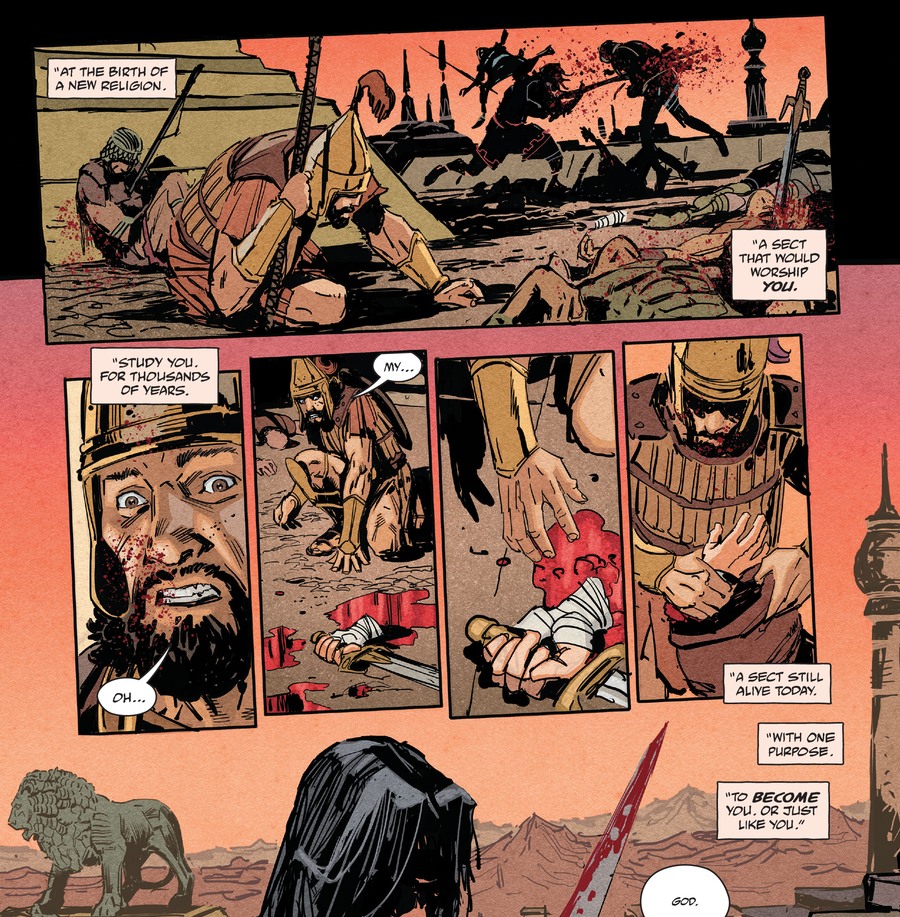
The clearest historical account appears in BRZRKR #7 during the investigation of B's past.[1]
The issue describes a religious context in which a sect forms around B. Rather than simply worshipping him as a distant supernatural figure, the group studies him. Its interest is practical and acquisitive. Across thousands of years the sect survives with an objective centered on reproducing what B is.
The exact founder is not named in the original series.
The exact date is also not established. The sequence places the cult deep in historical time and associates its development with the birth or emergence of a major religion, but the source should be cited by scene rather than converted into a false exact year unless the comic gives one.
The cult's most important characteristic is continuity. Individual members die. The organization persists.
This makes it a human parallel to B's immortality.
B's body regenerates and carries one consciousness through time. The cult survives by transmitting records, beliefs, objectives, and probably resources from one generation to the next. Its members achieve institutional persistence even while remaining mortal.
Worship and study
The cult's relationship with B combines religion and research.
The issue describes the group as worshipping B and studying him over thousands of years.[1]
Those activities are not identical. Worship gives B symbolic or divine status. Study treats his body and history as data. The fusion produces a recurring pattern later embodied by Caldwell, who combines the language of scientific investigation with an underlying desire for transcendence.
The cult should therefore be cross-classified under:
- Religious Organizations
- Secret Societies
- Historical Factions
- B Research
- Immortality Lore
- Caldwell Family / Lineage
It should not be reduced to a generic “fan club” despite B's own contemptuous reaction to cults. Its persistence materially affects how the modern program is able to reconstruct his past.
Central objective: becoming B
The historical account in BRZRKR #7 gives the cult a remarkably focused goal. Its purpose is not merely to document B. It wants to become him, or become something like him, with godhood and immortality implicit in the formulation.[1]
That objective anticipates Caldwell's later conduct.
Caldwell helps direct a program ostensibly intended to learn why B cannot die and, in exchange for B's service, help him become mortal. Behind that arrangement, Caldwell accumulates knowledge, recovers B-related material, pursues biological replication, enables Franken-B, and participates in a contact operation aimed at the intelligence behind B.[2][3]
His personal behavior is therefore not an unrelated betrayal of the government's mission. It is the modern technological expression of an inherited cult objective.
Ancestors use scripture, ritual, oral tradition, and physical traces. Caldwell uses laboratories, archives, computing power, synthetic biology, satellites, and Source energy.
The tools change. The desire remains.
Tracking B through history
One of the cult's most important functions is historical tracking.
In BRZRKR #7, Caldwell's investigation makes explicit that the cult's records or trail can be used to locate evidence of B. The logic is simple: follow the people who have spent generations following him.[1]
B has moved across cultures and eras for tens of thousands of years. Ordinary archives cannot preserve a complete continuous record of him. Governments rise and fall. Languages disappear. Landscapes change. Witnesses die.
A dedicated organization that treats B as its central subject can preserve continuity ordinary institutions cannot.
This gives the modern U.S. program a shortcut into deep history. Rather than independently rediscover every ancient encounter, it can exploit traces left by people who already spent centuries or millennia looking.
The cult is therefore both an antagonist and an archive.
B's view of cults
B responds to the subject of cults with open contempt in BRZRKR #7.[1]
His reaction implies that being worshipped, followed, or mythologized is not a unique event in his life. Over eighty thousand years he has repeatedly become a supernatural figure in the eyes of people who cannot understand his survival.
The cult connected to Caldwell is especially dangerous because it combines belief with patience. A single worshipper can die. A lineage can wait centuries for another fragment of evidence.
B's hostility also undermines any attempt to portray the cult as honoring him in a way he welcomes. Whatever reverence members feel, their project violates his autonomy by turning his existence into a resource to be inherited.
From ancient sect to modern lineage
The original series does not show every stage of the cult's history. There is no complete chain of named leaders from antiquity to Caldwell.
A definitive chronology should therefore display broad confirmed stages rather than invent missing generations:
Ancient formation
A sect forms around B, worships him, studies him, and commits itself to becoming like him.[1]
Long-term survival
The sect remains alive across thousands of years.[1]
Preservation of traces
Its activities leave a historical trail that modern researchers can follow to recover information and physical evidence connected to B.[1]
Modern culmination under Caldwell
By BRZRKR #12, Caldwell is revealed as leader of a fanatical cult and one person in a long line.[2]
Technological escalation
Caldwell turns inherited obsession into modern experimentation, cloning, Source-contact research, and an attempt to obtain what the cult has sought for generations.[2][3]
Any additional stage should require a primary source.
Stephen Caldwell as heir
Caldwell is the only clearly identified modern leader of the lineage in the original series.[2]
His public role gives him access his ancestors could not have imagined. He operates inside a government program with the resources to study B's body, memories, blood, tissue, and origin scientifically.
This dual identity is central to his biography.
On the surface, Caldwell is part of an institutional bargain: B performs dangerous missions, and the government investigates his immortality in hopes of granting his wish to become mortal.
Underneath that bargain, Caldwell belongs to a tradition that wants the opposite. B wants an end to immortality. The cult wants access to it.
The conflict is therefore not simply hero versus villain. It is a conflict between incompatible relationships to mortality.
The lineage and biological evidence
The modern research program repeatedly seeks physical evidence connected to B.
The cult's long history gives Caldwell a reason to value old fragments and records. In BRZRKR #7, the investigation turns on finding material that may preserve B's biological trace.[1]
Later experiments move beyond recovery into replication. By the final issue, the story identifies Franken-B as a misguided clone project constructed from leftover B body parts accumulated after past missions.[2]
The original series does not state that the ancient cult itself created Franken-B. It is a modern program product. However, Franken-B realizes the cult's ancient ambition in a grotesque new form: humanity literally tries to assemble another B.
The ancestral cult is best understood as an ideological precursor to the Franken-B project, not as the direct creator of Franken-B.
The lineage and the Source
The cult's original focus is B. Caldwell eventually pushes beyond B toward whatever created or sent him.
The modern program seeks contact with the intelligence behind B, the entity or intelligence best standardized as The Source / Cosmic Father / Pollinator pending exact terminology by context.[2][3]
This escalation is logical within the cult's worldview.
If B is a godlike being, the intelligence responsible for B represents an even deeper source of power. Caldwell's project therefore transforms inherited worship of B into attempted access to B's origin.
The final operation provides enough Source-related energy to power the hypercomputer indefinitely and also animates the abandoned Franken-B project.[2]
The cult's long dream of becoming B thus produces two new lines of succession at once:
- a biological imitation, Franken-B;
- a technological intelligence able to communicate beyond ordinary human limits.
Neither is securely controlled by Caldwell.
Caldwell's attempt to claim the inheritance
The final arc makes Caldwell's personal stake explicit.
He does not merely want knowledge for the institution. His cult identity means the outcome is tied to a lineage that has waited generations for access to B's secret.[2]
Caldwell's attempt to exploit the transfer event is the culmination of that inherited project.
Caldwell participates in extraordinary Source-linked events, but the original series does not clearly establish a stable permanent set of superpowers equivalent to B's. The transfer sequence therefore supports a description of the event, not a permanent catalog of abilities the source does not establish.
The important lineage fact is intent: he attempts to take hold of an inheritance his cult believes it has pursued for thousands of years.
Failure of possession
The cult's history is defined by a paradox.
Its members devote generations to becoming B, but their obsession prevents them from understanding the thing B values most.
B does not experience immortality as divine privilege. He experiences it as a burden from which he wants release.
The cult sees regeneration and persistence. B remembers endless killing, loss, exploitation, and separation.
Caldwell's project fails at the level of ethics before it fails at the level of control. It assumes that knowing the mechanisms of B's body creates a right to possess them.
Diana's relationship with B develops in the opposite direction. Her scientific interest gradually becomes personal empathy, and the final Source-linked events center on connection rather than extraction.
Diana Ahuja provides the clearest contrast to the Caldwell lineage because she develops an opposing model of what it means to study B.
Contrast with Seline and Songaa's lineage
The final issue introduces another multigenerational human community connected to B: the lineage represented by Seline and Songaa.[2]
The parallel is one of the strongest structural connections in the ending.
Both lineages remember B across generations.
Caldwell's line uses inherited knowledge to pursue control, replication, and immortality.
Seline and Songaa's people use inherited knowledge to welcome B, protect Diana, assist with childbirth, and provide a refuge.[2]
Caldwell's continuity is obsession.
Their continuity is care.
This contrast turns “lineage” into a thematic category rather than a neutral genealogy. The series asks what later generations do with what earlier generations give them.
The unidentified generations
The original series does not name Caldwell's ancestors.
A genealogy visualization should therefore use placeholders such as:
- Early cult founders, unnamed
- Intermediate cult generations, unnamed
- Later historical custodians, unnamed
- Modern Caldwell lineage, partially known
- Stephen Caldwell, confirmed leader
It should not fabricate portraits, dates, spouses, children, surnames, or leadership succession.
If visual design requires figures, original renderings should depict anonymous silhouettes or era-specific cult members rather than pretend they are named canon characters.
Was Caldwell's father a cult leader?
Unknown.
This is the clearest answer the original series permits regarding his father.
The phrase “one in a long line” strongly supports inherited continuity but does not specify the mechanism of succession.[2]
Several possibilities remain open:
- Stephen's father may have been the prior leader.
- His father may have been a cult member but not leader.
- Leadership may have passed through another relative.
- “Line” may combine biological lineage with ideological succession.
- Stephen may have inherited family knowledge without direct paternal leadership.
None can be selected as canon from the original twelve issues.
The father's individual record necessarily remains sparse until a primary source expands him.
Organization, leadership, and methods
The original series confirms the cult's persistence and purpose but does not provide a formal organizational chart.
No canonical ranks, offices, recruitment procedures, headquarters, membership totals, or funding structures are supplied.
Its known or strongly supported methods include:
- preserving knowledge of B;
- tracking B's historical appearances;
- studying him;
- maintaining devotion across generations;
- seeking physical evidence;
- pursuing the goal of becoming B or becoming like him;
- in Caldwell's era, exploiting scientific and government resources.[1][2]
Claims beyond those points should be tagged as unknown.
Relationship with the U.S. government program
Caldwell's leadership creates overlap between the cult and the official program, but the two should not be treated as identical organizations.
The government has institutional objectives related to B's military usefulness, biological potential, and Source contact.
Caldwell has an additional inherited agenda.
The extent to which other officials know about his cult identity is unclear.
and
without automatically modeling:
Fate of the cult
Caldwell's personal story ends in the final arc, but the fate of the wider cult is unresolved.[2]
A movement that survives thousands of years is unlikely to be assumed extinct solely because one modern leader dies. The comic does not show a complete destruction of the organization or identify a successor.
Therefore the status should read:
Organization status: Unknown / potentially extant after Caldwell's death.
Any statement that the cult ends with Caldwell would be unsupported.
Narrative significance
Caldwell's lineage turns his betrayal from an individual moral failure into the culmination of history.
The series repeatedly asks whether people can escape purposes assigned by others.
B's human father calls him a tool and weapon.
Governments use him as a military asset.
Cults call him god.
Caldwell's ancestors preserve a purpose for him across thousands of years: he is the secret they intend to inherit.
B's struggle for mortality is therefore also a struggle to escape other people's definitions.
The ancestral cult is one of the most persistent forms of that pressure because it survives beyond any single antagonist.
Appearances and source history
BRZRKR #7
The issue provides the central historical description of the sect devoted to B, its worship and study of him, its survival across thousands of years, and its objective of becoming B or becoming like him. It also establishes that the cult's trail can help modern investigators locate evidence connected to B.[1]
BRZRKR #12
The final issue explicitly identifies Caldwell as the leader of a fanatical cult and as one person in a long line, converting what might otherwise look like an external historical curiosity into Caldwell's personal inherited identity.[2]
The issue also reveals the modern consequences of the broader research project, including Source contact, the hypercomputer, and the activation of Franken-B.[2]
Canon limits and unresolved questions
- Who founded the cult?
- When exactly did it form?
- Was the original founder a direct ancestor of Caldwell?
- What was Caldwell's father's name?
- Was Caldwell's father a cult member?
- Was he the previous leader?
- Was succession hereditary, appointed, ritual, or mixed?
- How many generations separate the founding from Stephen Caldwell?
- Did the cult ever split into competing branches?
- How much of B's history did it accurately preserve?
- What artifacts did it possess?
- How did it finance its long-term operations?
- How much of the U.S. government program was infiltrated or influenced by cult members?
- Did members survive Caldwell's death?
- Who, if anyone, became the next leader?
- Is the lineage aware that B and Diana's descendants survived and dispersed?
These unknowns should be maintained as open continuity records rather than filled with fan reconstruction.
References
[1] Keanu Reeves, Matt Kindt, Ron Garney, Bill Crabtree, and Clem Robins, BRZRKR #7 (BOOM! Studios, 2022), historical sequence describing the sect that worships and studies B across thousands of years, its goal of becoming B or becoming like him, and the modern use of the cult's trail to locate evidence connected to B, especially digital page images 009-010.
[2] Keanu Reeves, Matt Kindt, Ron Garney, Bill Crabtree, and Clem Robins, BRZRKR #12 (BOOM! Studios, 2023), opening recap identifying Caldwell as leader of a fanatical cult and “one in a long line,” plus the final issue's Source-contact, Franken-B, and aftermath revelations, especially digital page images 002 and 014-015.
[3] Keanu Reeves, Matt Kindt, Ron Garney, Bill Crabtree, and Clem Robins, BRZRKR #10 (BOOM! Studios, 2022), Caldwell's secret laboratory, activation of the hypercomputer, and B-like biological research sequence, especially digital page images 009-011.