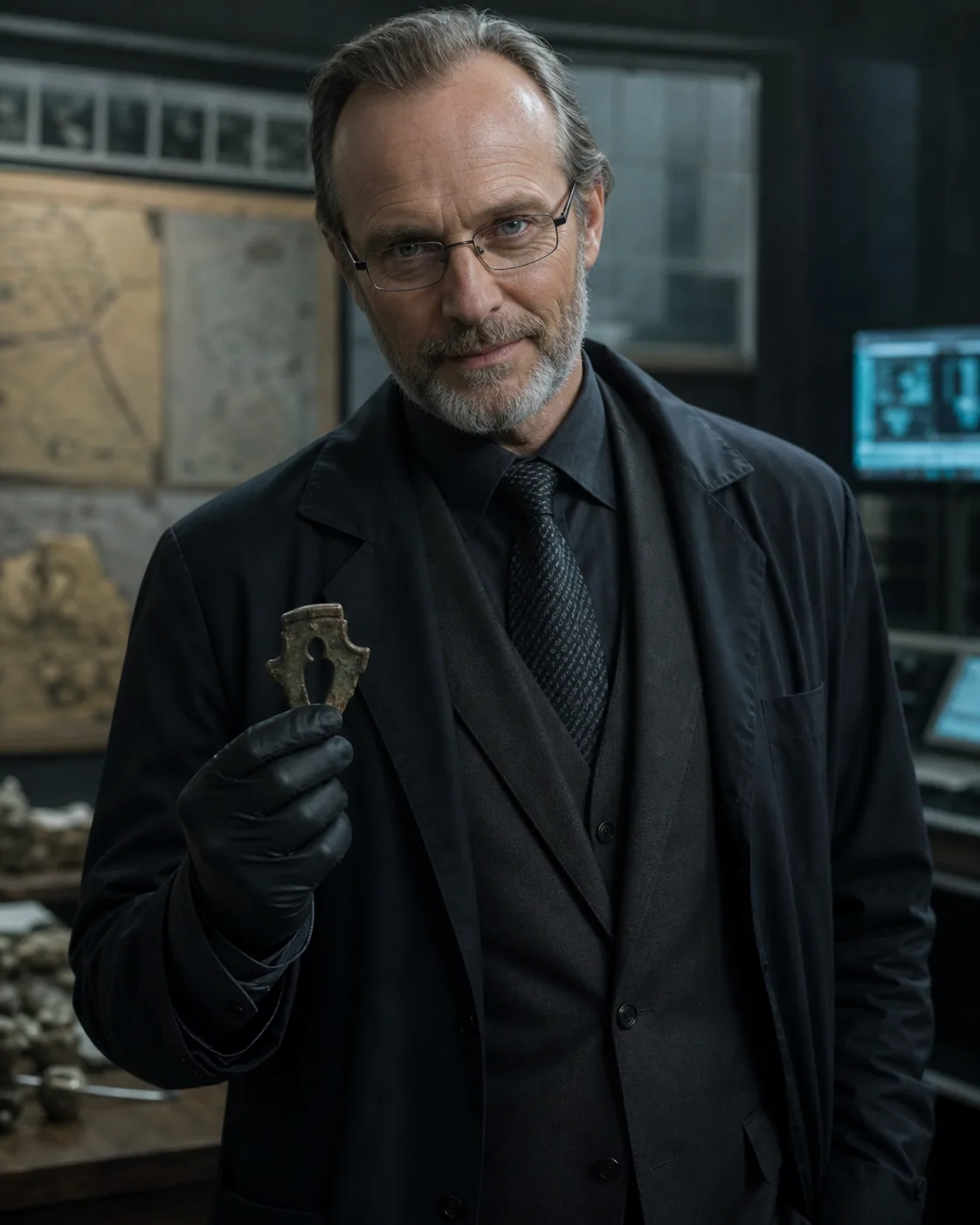
Spoilers: This article reveals Caldwell's hidden allegiance, the purpose of his research into B, Protocol X, the cult, the Source, his acquisition of B-like abilities and his fate in BRZRKR #12.
| Field | Details |
|---|---|
| Name | Stephen Caldwell |
| Common form in dialogue | Caldwell |
| Species / nature | Human; temporarily altered through Source-linked power transfer |
| Gender | Male |
| Status at end of original series | Deceased / catastrophically destroyed in the final confrontation |
| Occupation | Researcher, historian, senior figure in the government program studying B |
| Secret role | Leader of a fanatical cult in a long lineage devoted to B, immortality and the Source |
| Affiliations | United States government program; Caldwell's cult |
| Primary objectives | Locate B's origin, understand and reproduce his biology, contact the Source, acquire immortality / B-like power |
| First appearance | BRZRKR #1 |
| Latest original-series appearance | BRZRKR #12 |
| Creators | Keanu Reeves, Matt Kindt and Ron Garney |
Editorial naming note: The original comic frequently addresses the character simply as Caldwell. The name Stephen Caldwell is used in established issue indexing for the series. If a future edition or publisher character guide supplies a different full-form credit, the canonical-name field should be updated without changing the /wiki/caldwell/ URL.Overview
Stephen Caldwell is the principal human antagonist of the original BRZRKR maxiseries and one of the characters most responsible for converting B's personal search for mortality into an institutional attempt to seize the power behind his existence. He enters the story as a sophisticated researcher with access to the government's scientific program, historical archives and operational resources. Unlike personnel who see B only as an indestructible soldier, Caldwell understands that the mystery cannot be solved by tissue samples alone. B's memories, movements through history, recovered artifacts, tribal geography, biological anomalies and the lightning associated with his conception all belong to the same problem.[3]
That breadth of understanding makes Caldwell genuinely useful. He helps the program move closer to the truth than any prior handler appears to have managed. He recognizes that B contains amino acids that do not fit ordinary expectations. He treats the quantum properties found in the research as meaningful rather than as laboratory noise. He follows B's remembered geography to his prehistoric place of origin. He reconstructs historical episodes, including the World War I event in which a piece of B was separated from his body and later became a legendary artifact. He designs or champions Protocol X, the experiment that causes the largest breakthrough in the program's history.[3][7][8]
The same qualities also make him dangerous. Caldwell does not simply want to help B understand what he is. His research is embedded in a secret religious and historical agenda. By the final arc, the comic explicitly identifies him as the leader of a fanatical cult and as one in a long line connected to the pursuit of B and immortality.[12] The scientific program and the cult are not separate parts of his life. They converge around the same objective: reach the Source and turn B's condition into something that can be possessed.
Caldwell's story is therefore a distorted mirror of B's. B begins the series with immortality and wants to lose it. Caldwell begins mortal and wants access to the condition B experiences as a curse. B spends the series trying to escape being treated as a tool. Caldwell treats nearly everyone, including Diana Ahuja and the government itself, as tools in a longer project. When he finally acquires a version of B's power, he also encounters the violent instability that came with it. His apparent triumph lasts only long enough to expose the difference between wanting immortality from a distance and living inside the system of rage and compulsion that shaped B's existence.[11][12]
Role in the government program
Caldwell operates near the center of the contemporary effort to study B. The program's bargain with B is straightforward on the surface. He performs missions considered too dangerous for ordinary forces. In exchange, the government investigates the origin of his immortality and seeks a way to make him mortal. Behind that bargain lies a second objective. The program wants the military and scientific value of B's biology.
B already understands that part of the arrangement. In BRZRKR #1, he tells Diana he knows people want a super army and clone soldiers. Caldwell becomes the figure who turns that broad ambition into a systematic research agenda.[1]
The series does not present him as a conventional laboratory administrator. Caldwell's office and working environment in BRZRKR #3 are filled with books, maps, specimens and artifacts. Visually and narratively, he resembles a hybrid of scientific director, historian, archaeologist and collector. That characterization matters because B's eighty-thousand-year life cannot be understood through one discipline. Caldwell is willing to follow evidence from molecular biology into mythology and from tribal memory into geopolitics.
His access also suggests substantial institutional authority. He can influence Diana's protocols, direct the questions the program asks, participate in decisions about B's treatment and push experimental escalation. Later issues show him connected to operations large enough to involve buried facilities, satellite-scale energy systems, protected historical materials and black-operations personnel.
The scientific problem of B
One of Caldwell's clearest early scenes occurs in BRZRKR #3. Diana tells him that the team still has not unlocked B's DNA or solved the mystery of his incongruous amino acids and quantum molecules. She also confronts the apparently impossible part of B's recovered account, in which his father arrives through a lightning strike. Caldwell does not dismiss the memory. He reframes it as a reproducible pattern.[3]
The conversation moves toward the possibility of two lightning events. One might be dismissed as a singularity; two might indicate a process. Caldwell's reaction illustrates the quality that makes his work effective. He is willing to treat mythic testimony as experimental evidence without surrendering scientific method. He asks what can be repeated, mapped and correlated.
The same scene shows how he uses Diana. Caldwell tells her to keep B talking and remembering because each new tribal and geographical detail may help locate his place of origin. He adds that B trusts her. Diana agrees to continue calibrating his protocols.[3]
Caldwell therefore recognizes before most characters that trust is part of the experiment. B cannot be forced to produce eighty thousand years of useful memory simply through pain or drugs. He must disclose. Diana is the person capable of creating the relationship that makes disclosure possible, so Caldwell treats their bond as an operational resource.
B as a historical trail
Caldwell's research goes beyond the prehistoric origin story. He treats B's passage through history as a trail that can be reconstructed. The premise is powerful because an immortal person does not leave one biography. He leaves artifacts, legends, battlefield anomalies, technological echoes and stories scattered across cultures.
By BRZRKR #7, Caldwell's expertise is no longer confined to the present-day laboratory. The issue reveals a World War I episode in which B fights beside his first United States handler and an artillery strike blasts a piece from his body. The fragment survives and accumulates a history of its own. Caldwell eventually brings the artifact back into the program.[7]
For B, the object is evidence that pieces of his body can outlive the events in which they are lost. For Caldwell, it is proof that the past can supply material for present experiments. Historical scholarship becomes experimental acquisition.
This approach also helps explain the cult connection revealed later. A normal government researcher has access to archives measured in decades or centuries. Caldwell belongs to a project that thinks in lineages. His interest in B's path is not merely professional curiosity. It is a continuation of a pursuit older than his current institution.
Relationship with Diana Ahuja
Caldwell and Diana begin as colleagues working toward apparently overlapping goals. She has the trust relationship with B. He has the wider historical and scientific framework. Their collaboration is effective because each provides what the other lacks.
The imbalance becomes clearer as the series develops. Caldwell knows more about the real objective of the program than Diana initially does. He encourages deeper protocols and uses B's recovered experiences to advance the search for origin. He also participates with Diana in recording and analyzing B's behavior outside the therapy room, including field operations.[6]
Diana's ethical break from Caldwell is gradual. In BRZRKR #4, she visits B without the usual scientific apparatus and admits she has not been completely honest.[4] That choice threatens Caldwell's control because Diana is beginning to treat truth as something owed to B rather than something rationed according to experimental need.
By the final arc, their paths are irreconcilable. Diana wants B to learn the truth and choose what happens to his life. Caldwell wants the Source and the power associated with it. The person he once relied on as a trust-building instrument becomes the person who can stop him.
Relationship with B
Caldwell's relationship with B is more complex than ordinary villainy. He deceives and exploits B, but he also delivers real breakthroughs. This is one reason the betrayal is effective. B has spent tens of thousands of years being used by people who promise protection, meaning or answers. Caldwell repeats that pattern at a technological scale.
B agrees to the government's experiments because he wants mortality. Caldwell can therefore justify much of what he does as necessary research. Recover the memories. Locate the birthplace. Analyze the blood. Reconstruct the lightning event. Gather the artifacts. Increase the energy. Every step appears to move B toward an answer.
The hidden divergence lies in the desired ending. For B, success means no longer being immortal. For Caldwell, success means understanding immortality well enough to control, reproduce or receive it.
That difference is expressed with brutal symmetry in the final transfer. Caldwell gets what B has. B gets what he wants to lose. The two men cross in opposite directions.
Manipulation of the memory protocols
Caldwell repeatedly pushes the memory program because B's past contains information unavailable anywhere else. The danger is that memory recovery is not emotionally neutral. B's earliest experiences include the death of his mother, his father's exploitation, the destruction of his tribe, his first regenerative rebirth and the discovery that he cannot die.[2][3][4]
Caldwell is willing to use those memories as coordinates. If B remembers a plant, landscape, tribal pattern, ritual or astronomical condition, the program may be able to locate his birthplace. The emotional trauma matters only insofar as it affects the experiment.
This is one of the clearest differences between Caldwell and Diana. Both want the memories. Diana gradually becomes concerned with what remembering does to B. Caldwell remains concerned primarily with what the memories reveal.
BRZRKR #5 and the cost of escalation
The deeper memory work in BRZRKR #5 reveals B's first love, first child and long history of failed attachment.[5] Although Caldwell is not the emotional center of those sequences, his program creates the conditions under which they surface.
The issue matters to Caldwell's biography because it demonstrates the success of the trust strategy. Diana can now reach memories that are not merely tactical or geographical. B is exposing the private architecture of his life. From Caldwell's perspective, this confirms that the method works.
It also increases the moral stakes. The more B reveals, the more obvious it becomes that the program is not interrogating a machine. It is reopening tens of thousands of years of trauma. Caldwell continues anyway.
Observation of B and Keever in the field
In BRZRKR #6, B and Jim Keever carry out a high-risk recovery mission while Diana and Caldwell continue to observe and record.[6] The mission demonstrates that B's value cannot be reduced to raw regenerative capacity. He makes decisions, protects Keever and adapts to a battlefield in real time.
Caldwell's interest in operational behavior is consistent with his larger project. The government wants to understand not only how B's body survives but how the complete system functions: violence, memory, loyalty, rage, tactical reasoning and recovery.
The issue also helps build the triangle that will matter at the end of the series. Diana is becoming emotionally loyal to B. Keever is becoming personally loyal to B. Caldwell continues treating both relationships as inputs into the program.
The World War I artifact
The breakthrough in BRZRKR #7 gives Caldwell a physical bridge between B's modern body and a past event. During World War I, an artillery strike removes part of B. That fragment does not simply disappear into history. It survives, becomes legendary and is eventually recovered.[7]
Caldwell's presentation of the artifact reveals how far his historical investigation has progressed. He is not merely reading old records. He is acquiring matter connected to B across time.
The artifact also provides a conceptual model for later attempts to create B-derived organisms. If separated pieces can persist, then the boundary between B as one body and B as reproducible biological material becomes unstable.
Protocol X
Caldwell's most consequential scientific project is Protocol X. The experiment brings together the program's biological data, historical evidence and growing belief that B's origin can be triggered or reproduced through controlled energy.
In BRZRKR #8, B is placed inside a deeply buried experimental structure while a countdown begins. The resulting event exceeds the program's control. Energy erupts through the site. Diana is altered. B disappears from ordinary physical space.[8]
A conventional research director might treat such an outcome as catastrophic failure. Caldwell sees usable results. The experiment has produced evidence that the mystery is real, has generated new energy phenomena and has opened a route toward Source contact.
The ethical problem is stark. The casualties and instability do not stop the program. Success is redefined as anything that yields new capability.
Franken-B and artificial replication
The original series later reveals that the government pursued a clone or assemblage project built from biological material left behind by B across past missions. BRZRKR #12 supplies the program's own grotesque nickname: Franken-B, explicitly described as built from leftover body parts from past missions.[12]
The project is a direct extension of the ambition B mocked in the first issue when he referenced clone soldiers. It also demonstrates that Caldwell's research does not remain theoretical. The institution attempts to build another B.
The being ultimately disappears rather than functioning as a controllable duplicate. The failure illustrates a recurring theme in Caldwell's work: the program can reproduce fragments of the phenomenon more easily than it can reproduce B's personhood or control the consequences.
Caldwell should be linked to Franken-B as a major research-era connection, but the article should distinguish direct responsibility from general program responsibility when the comic does not assign a specific laboratory action to him.
The search for B's birthplace
The geographical work begun in issue three pays off in BRZRKR #10. The team travels to Saudi Arabia and reaches the region associated with B's prehistoric origin.[10]
For Caldwell, the expedition is the culmination of years of research. The stories Diana extracted have become coordinates. Myth has become location. The Source is no longer only a theoretical explanation for impossible amino acids and lightning. The team stands at the physical site connected to B's creation.
The recovery of the bird-shaped object associated with B's mother gives Caldwell another piece of the system. The artifact interacts with B and helps push events toward direct contact. Caldwell's patience is rewarded, but the reward is not the therapeutic answer B expects.
The cult
The cult is the key to understanding Caldwell's true biography. The original series reveals that his obsession with B does not begin with his government appointment. He stands within a much older tradition.
BRZRKR #12 identifies him as the leader of a fanatical cult and describes him as one in a long line.[12] The language strongly supports an inherited or generational structure. The exact genealogy, offices and rituals should be documented separately on Caldwell's Cult rather than invented on this character page.
What can be said confidently is that the cult's agenda overlaps with the modern research program around immortality, B and the Source. Caldwell is able to use government science as the latest instrument of a much older pursuit.
This makes his character thematically important. He embodies the continuity between ancient worship and modern technocracy. A priest wants divine power. A scientist wants reproducible power. Caldwell becomes both.
The government as Caldwell's instrument
The final issues complicate the assumption that Caldwell simply serves the United States. His access to black-operations resources, laboratories and experimental infrastructure allows him to pursue goals that exceed the public mission.
The government itself also wants the Source, as Diana explains in BRZRKR #12.[12] This means Caldwell does not need to fabricate every institutional objective. He can advance his cult agenda by pushing an existing state agenda further than colleagues understand.
The relationship is therefore mutually exploitative. The government uses Caldwell's expertise to reach B's origin. Caldwell uses government capacity to accomplish what an ancient cult could never achieve with ritual and manuscripts alone.
The Blue Plane and the final transfer
By BRZRKR #11, B and Diana reach the contact realm described by the publisher as the Blue Plane, while the hidden conflict around the program becomes open.[11] Caldwell's cult attacks and Caldwell moves to take the power he has spent the series studying.
He enters the transfer mechanism and acquires a form of B's condition. His body becomes capable of extraordinary survival and violence. The moment is the apparent fulfillment of his life's work.
It also exposes what he misunderstood.
B's immortality is not a clean upgrade. It is bound to compulsion, rage and an existence B has experienced as a curse. Caldwell wants the gift without accepting the person who lived inside it. Once empowered, his behavior becomes increasingly brutal and unstable.
The transfer simultaneously makes B mortal. Caldwell therefore succeeds in producing the result B wanted, but only by trying to steal what B hated.
Final confrontation
The opening pages of BRZRKR #12 continue the battle. Caldwell attacks with B-like power while B, now mortal, still knows how to fight. Diana is the decisive opposing force.
Narration explicitly identifies Caldwell as leader of the cult and characterizes his mission as different from the government's despite overlapping goals. He wanted what B had. Diana wanted answers for B. The government wanted the Source. Those objectives collide in the same battlefield.[12]
Diana uses her Source-linked electrical abilities against Caldwell. His empowered body is ripped apart and catastrophically destroyed. The visual language is deliberately excessive, appropriate to a series in which ordinary physical death has never been a reliable measure of finality. Even so, the original series treats Caldwell as removed from the conflict after this destruction.[12]
His status should therefore be deceased with an editorial note that future canon could revise the finality if it explicitly establishes survival or regeneration. The wiki should not preemptively call him alive simply because he briefly possessed B-like abilities.
Personality
Caldwell is patient, intellectually ambitious and unusually comfortable moving between disciplines. He is not portrayed as a loud fanatic during most of the series. His power comes from appearing reasonable.
He listens to impossible stories and asks what can be measured. He surrounds himself with evidence. He recognizes patterns other people dismiss. He understands that Diana's trust relationship with B is valuable. He is capable of waiting across multiple experimental stages rather than demanding immediate results.
Those qualities make the later cult reveal more effective. Caldwell's fanaticism does not replace rationality. It recruits rationality. His belief gives him a destination, while scientific method gives him a route.
He is also fundamentally instrumental in his relationships. B is access. Diana is trust. Historical artifacts are access. Government money and military force are access. Even his own body becomes an experimental subject when he enters the transfer process.
The contrast with Diana is especially sharp. Both are willing to cross scientific boundaries. Diana increasingly asks whether the person at the center consents to what is happening. Caldwell increasingly asks whether the experiment can be made to work.
Knowledge, expertise and capabilities
Caldwell's major abilities before the transfer are intellectual and institutional rather than superhuman.
Historical research
He reconstructs B's passage through different eras and recognizes the value of artifacts connected to B's body. His work on the World War I fragment demonstrates extensive historical reach.[7]
Scientific literacy
He understands the significance of B's anomalous amino acids, quantum effects, DNA and lightning phenomena well enough to participate in planning experiments around them.[3]
Experimental design and program influence
Caldwell is a major force behind Protocol X and the broader escalation toward Source contact. He can coordinate research, personnel and specialized infrastructure.[7][8]
Manipulation
He uses Diana's relationship with B as a research pathway and conceals his deeper cult allegiance while working inside the government.
Temporary B-like abilities
After the transfer, Caldwell demonstrates enhanced strength, durability and regenerative characteristics associated with B's condition. The exact full power set and duration are not established because the state exists only during the final conflict.[11][12]
The wiki should not create a standalone Powers of Caldwell page unless later material expands the evidence. His temporary empowered state is better documented as part of Source Power Transfer.
Relationships
B / Unute
B is the subject of Caldwell's research, the focus of his cult's history and the source of the power Caldwell ultimately attempts to acquire. Their opposing desires form one of the original series' central symmetries. See B / Unute.
Dr. Diana Ahuja
Diana begins as Caldwell's scientific collaborator and most valuable bridge to B. Their relationship collapses as she prioritizes B's autonomy and Caldwell reveals his true agenda. She destroys his empowered body in the final battle. See Diana Ahuja.
Jim Keever
Keever operates on the military side of the same government program. Caldwell's manipulation of the project eventually places Keever in the position of managing the physical consequences of experiments he did not design. See Jim Keever.
Caldwell's cult
Caldwell is identified as leader of a fanatical cult and as part of a long line. The cult requires its own institutional history, with every claim tagged by whether it comes from direct depiction, cult testimony or later historical stories. See Caldwell's Cult.
The Source
The Source is the ultimate object of Caldwell's search. His scientific and cult identities converge around the attempt to reach and appropriate its power. See The Source.
Original-series appearances
Caldwell appears across the original series, with especially important material in:
Legacy
Caldwell dies without gaining the stable immortality he sought, but his work outlives him. The government makes contact with the Source. Source-derived energy powers a hypercomputer. Franken-B exists as a consequence of the wider replication program. B and Diana's children carry extraordinary biology into the future. The final pages imply that the consequences of contact extend beyond Earth.[12]
In that sense, Caldwell fails personally while helping create the world he wanted. He cannot possess B's immortality, but the boundary between human science and the Source has been permanently breached.
His legacy also survives in the unanswered history of the cult. BRZRKR #12 calls him one in a long line, which means the organization should not be assumed to end with him. Future publications may reveal predecessors, successors or branches that reinterpret his role.
Novel and adaptation continuity
The version of Caldwell in The Book of Elsewhere must be maintained separately. The novel uses some overlapping concepts but should not be mined for details about the comic Caldwell's biography unless the comic independently confirms them. See Caldwell, novel continuity and Comic Continuity vs. The Book of Elsewhere.
Adaptation versions should receive separate character records once released material establishes their history and role.
References
[1] Keanu Reeves, Matt Kindt and Ron Garney, BRZRKR #1 (BOOM! Studios, 2021), government program and B's awareness that the institution wants to reproduce his military value.
[2] Reeves, Kindt and Garney, BRZRKR #2 (BOOM! Studios, 2021), recovered origin memory that becomes the basis of later geographical and biological research.
[3] Reeves, Kindt and Garney, BRZRKR #3 (BOOM! Studios, 2021), approximately story p. 19. Diana and Caldwell discuss B's DNA, anomalous amino acids, quantum molecules, the lightning account, reproducibility, tribal details, place of origin and B's trust in Diana.
[4] Reeves, Kindt and Garney, BRZRKR #4 (BOOM! Studios, 2021), Diana's break from purely controlled protocols and confession that she has not been completely honest with B.
[5] Reeves, Kindt and Garney, BRZRKR #5 (BOOM! Studios, 2021), deeper memory extraction concerning B's first love and child.
[6] Reeves, Kindt and Garney, BRZRKR #6 (BOOM! Studios, 2021), government observation of B and Jim Keever during the modern recovery mission.
[7] Reeves, Kindt and Garney, BRZRKR #7 (BOOM! Studios, 2022), World War I memory, B's first U.S. handler, separated fragment, historical artifact and Protocol X proposal.
[8] Reeves, Kindt and Garney, BRZRKR #8 (BOOM! Studios, 2022), Protocol X energy event, B's disappearance and Diana's transformation.
[9] Reeves, Kindt and Garney, BRZRKR #9 (BOOM! Studios, 2022), government research after Protocol X, B's return and the widening Source mystery.
[10] Reeves, Kindt and Garney, BRZRKR #10 (BOOM! Studios, 2022), expedition to B's birthplace in Saudi Arabia and recovery of Mother's bird-shaped gift.
[11] Reeves, Kindt and Garney, BRZRKR #11 (BOOM! Studios, 2022), Blue Plane / Source contact, cult attack and Caldwell's power-transfer betrayal.
[12] Reeves, Kindt and Garney, BRZRKR #12 (BOOM! Studios, 2023), complete finale. The opening narration identifies Caldwell as leader of a fanatical cult and one in a long line; Diana explains the government's Source objective; Caldwell fights in his B-like empowered state and is catastrophically destroyed; later pages identify the government's clone project as Franken-B.
Collected-book references
- BRZRKR Vol. 1, collecting BRZRKR #1-4.
- BRZRKR Vol. 2, collecting BRZRKR #5-8.
- BRZRKR Vol. 3, collecting BRZRKR #9-12.
- BRZRKR Book One, collecting the complete original BRZRKR #1-12 maxiseries.