Selected scenes
BRZRKR in pictures.
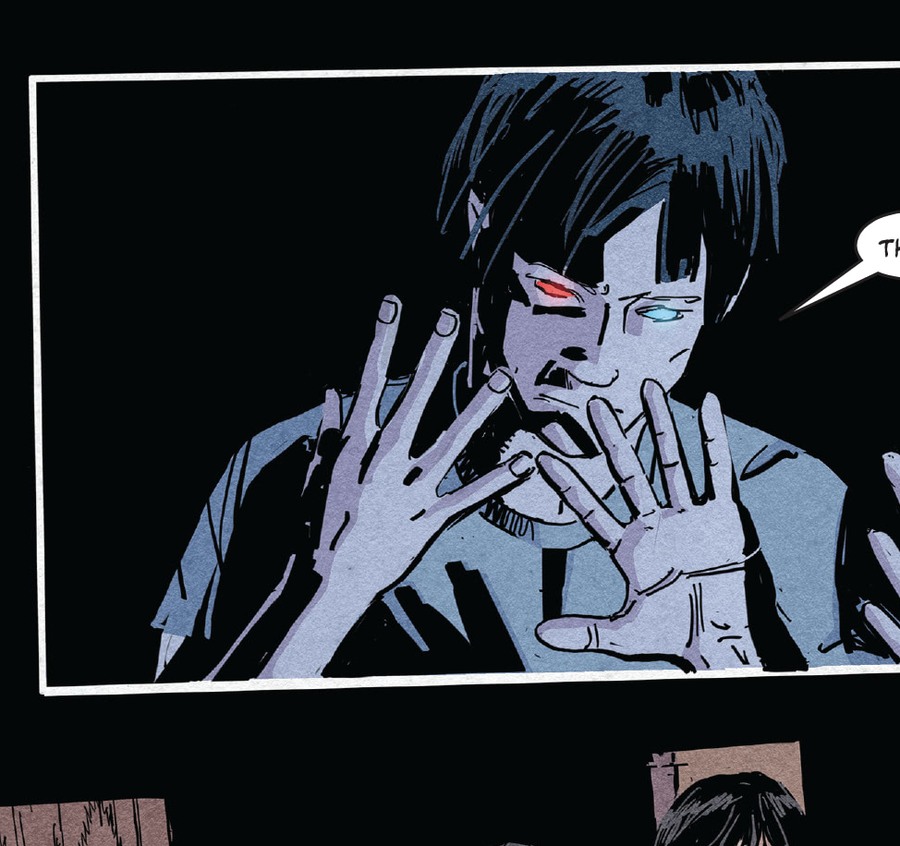
Spoilers: This article discusses B's childhood and the birth of B and Diana's children in BRZRKR #2-4 and #12.
Accelerated gestation and maturation are two related but distinct changes in BRZRKR's family history. B develops from conception into a powerful child with impossible speed, while his children with Diana pass through infancy and early development at an equally startling rate. The comic uses these events to show that extraordinary biology is never only a power. It reorganizes family life, changes what adults expect from a child, and creates the possibility that a new generation will be treated as a weapon before it has a chance to speak.
B's first acceleration
B's origin begins with a mother's prayer and a lightning contact in an ancestral cave. The event changes the circumstances of conception and is followed by a pregnancy and childhood that do not follow ordinary human timing. The community sees the result before it understands the cause: a child arrives as an answer to danger, grows rapidly, and displays strength that makes adults imagine a military future.
The speed of B's development becomes part of the argument between his parents. His mother sees a son who should be protected. His father sees proof that the child has been made for combat. Because B becomes physically capable before he becomes socially independent, the adults around him can pretend that training is natural. The acceleration gives them an excuse to skip childhood.
Training a child who looks ready
B's father and teacher teach him to fight while he is still forming an identity. The body is ready for more than the mind can understand. A successful exercise becomes evidence that the next exercise should be harder. A wound that closes becomes evidence that the child can be sent into greater danger. The speed of maturation therefore feeds the first cycle of weaponization.
The series does not say that accelerated growth automatically creates a violent personality. B's compulsion toward violence has other causes: biology, trauma, training, and the pressure of institutions. The timing matters because it lets adults make decisions for him before he can consent. A rapidly growing body is still a child's body when a parent decides what it should be for.
Diana's pregnancy
Diana's pregnancy reveals the same phenomenon in a different emotional environment. She and B are not trying to manufacture soldiers. They are building a family under impossible conditions, and the pregnancy becomes a period of fear, hope, and practical uncertainty. Diana's body carries children whose biology may be connected to B and the Source, but the story keeps the focus on the people waiting for them.
The pregnancy also changes B. He has spent centuries expecting loss and assuming that every attachment will end with someone else aging or dying. The children make him imagine a future that continues after a mission. That future is fragile because the government program and the Source-related conflict remain close, but it is real enough to alter his choices.
The birth of the children
The birth sequence in BRZRKR #12 moves rapidly from pregnancy to newborn life. The children do not remain helpless infants for long. Their bodies develop in front of the people protecting them, making the safehouse feel like a place where ordinary time has been suspended. The visual effect is wondrous and unsettling. A parent can hold a newborn and then face a child capable of leaving the room before the parent has adjusted.
The speed is not treated as a convenient shortcut. It creates grief because B and Diana lose the ordinary stages that would have let them learn who the children are gradually. They must make decisions while the children are already changing. The family receives more time together than B expected to have, but less ordinary time than a family should have.
Relation to inherited abilities
Accelerated maturation is evidence of an inherited condition, not a complete explanation of it. The children also display red-and-blue heterochromia, and the story hints that their bodies may share other traits with B. Yet rapid development does not prove that they can heal from every injury or survive for eighty thousand years. The comic carefully leaves the future open.
That restraint is important for the children's identities. If every visible difference were turned into a confirmed ability, they would become a list of powers before they became characters. The issue gives them a family and a direction, then withholds the details that a future story might explore.
The politics of unusual children
B's childhood shows what happens when adults decide that a child's difference belongs to the community. The children's accelerated growth threatens to repeat that history on a larger scale. A government could call them assets. Caldwell's surviving ideology could call them proof. A cult could call them descendants of a god. The parents understand that any of those descriptions could become a claim of ownership.
The final movement toward departure is therefore protective. B and Diana cannot promise that the children will be safe, but they can deny the program immediate control. The choice is an ethical answer to B's own upbringing. His father trained him because the body seemed ready. B and Diana try to give their children room to decide what readiness means.
What the comic leaves unknown
The issues do not provide a biological timetable, a gestational duration, or a final age at which the children's rapid development stops. They do not state whether B's own acceleration was caused entirely by the Source, by the mother's prayer, or by a combination that no human can reproduce. Nor do they establish whether every pregnancy involving B would produce the same result.
These questions remain meaningful because the family is still new. The children are not experiments waiting for a report. Their bodies have changed the rhythm of a household, and the adults must respond without a manual. The uncertainty is part of the danger and part of the freedom.
Significance
Accelerated gestation and maturation connect the prehistoric origin to the final family arc. In both cases, a body changes faster than the surrounding people can adapt. The difference is how the adults respond. B's father turns acceleration into a weapon. Diana and B try to turn it into a life, even when life moves too quickly for them to control.
The subject therefore captures BRZRKR's larger moral question. Extraordinary biology can explain why a body survives, grows, or changes, but it cannot decide what a family owes that body. The answer has to come from care, consent, and the willingness to let a child become someone other than the purpose assigned at birth.
[1] Reeves, Kindt, Garney, Crabtree, and Robins, BRZRKR #2-4, lightning contact, B's accelerated childhood, and training.
[2] Reeves, Kindt, Garney, Crabtree, and Robins, BRZRKR #12, Diana's pregnancy, birth, rapid development, and departure of the children.