Selected scenes
BRZRKR in pictures.
Spoilers: This article discusses the pregnancy, birth, accelerated development, departure, and future role of B and Diana's twins, as well as B's mortality and the ending of BRZRKR #12.
| Field | Details |
|---|---|
| Personal name | Not stated in the original series |
| Canonical designation | Son of B and Diana |
| Species / nature | Human descendant of B with Source-linked inherited traits |
| Gender | Male, based on visual presentation; no personal name is supplied |
| Status | Alive at the end of the original series |
| Parents | B / Unute and Dr. Diana Ahuja |
| Twin sibling | B and Diana's daughter |
| Half-sibling | B's first child |
| Grandparents / progenitors | B's mother, B's human father socially, the Source through B |
| Birthplace | Southwest refuge |
| First appearance | Prenatal presence in BRZRKR #12; born in BRZRKR #12 |
| Latest original-series appearance | BRZRKR #12 epilogue |
| Primary-source status | Directly depicted canon |
Overview
B and Diana's son is one of the unnamed twins born during the final issue of the original BRZRKR series. He and his sister represent the first family B is able to remain with after becoming mortal, and their existence transforms the meaning of B's eighty-thousand-year search for purpose. They inherit extraordinary traits, grow from newborns to young adults at an accelerated rate, and ultimately leave Diana's protection to “plant our seeds,” language that the ending connects to the idea of a pollinator spreading technology, ideas, and shared memory.[1]
The original comic does not provide either twin with a personal name. It also does not give them long individual biographies separate from one another. Many of their lines and actions are presented as a pair. What is directly shown about the male-presenting twin must be distinguished from actions and dialogue belonging to the twins collectively. B and Diana's Son is a descriptive title, while Son of B and Diana and Male Twin are useful aliases rather than personal names.
His birth is one of the original series' clearest inversions of B's own origin. B was created after his mother asked for a weapon and was rapidly trained into war. The twins are also born with accelerated development, but their parents recognize the danger of repeating history. When they grow quickly, B and Diana consider disappearing rather than surrendering them to the government or turning them into assets.[1]
The son does not display a berserker episode in the domestic childhood sequence. B explicitly observes that the children “don't berserker,” distinguishing their development from his own early condition.[1] Their later eyes show unusual red and blue coloration, and their language reveals a powerful inherited sense of purpose, but the exact boundaries of their physiology are left for future stories.
Conception and pregnancy
Diana becomes pregnant after the late-series Source/contact events that make B mortal and leave Diana altered by her own participation in the transfer. The pregnancy therefore occurs at a unique biological moment. B is no longer the same immortal organism that spent eighty thousand years regenerating, and Diana is no longer simply an uninvolved human researcher.[1]
The original series does not provide a conventional conception scene or laboratory analysis of the pregnancy. It establishes the pregnancy as natural within B and Diana's relationship rather than as another government experiment.
At the Southwest refuge, Diana reports that the babies are already kicking. She initially refers to the pregnancy in the plural indirectly, then says she thinks there are two. Seline, a member of a multigenerational community that has tracked B's path, examines Diana and confirms that the children are coming soon and appear healthy.[1]
The twins therefore enter the story outside headquarters' control. This is important. The government spent years trying to reproduce B's biology artificially. B and Diana produce a new Source-linked generation without institutional design.
Birth
The son and his twin sister are born at the Southwest refuge with Seline acting as midwife and Songaa assisting.[1]
The birth sequence is intimate rather than scientific. There is no government laboratory, no containment apparatus, and no experimental protocol. The people present function as family and caregivers.
For B, the scene also repairs an older wound. In BRZRKR #5, his first child is born while he is being executed elsewhere, and B says he never saw the child.[2] With the twins, he is present from the beginning.
The son is shown as an ordinary-looking newborn. The extraordinary traits become visible almost immediately through development rather than spectacular birth trauma.
Accelerated growth
The twins age at an extreme rate. One week feels like a lifetime to the adults around them, and within a very short period they progress from newborns to children and then adolescents or young adults.[1]
B recognizes the pattern because it resembles his own childhood. He says that history rhymes, or perhaps mirrors itself. The observation links the twins directly to B's origin without making them identical copies.
The accelerated development raises practical and ethical questions. Their psychological maturity appears to keep pace well enough that they can speak, make decisions, play, and later articulate a life purpose. The comic does not explain how memory, education, or cognition scale with their physical growth.
The son is shown playing outside with his sister and a dog, an intentionally ordinary image. Their childhood is compressed, but it is still presented as childhood.
“They don't berserker”
One of B's most important observations about the twins is that they do not show the berserker behavior that defined his own youth.[1]
This is a major biological and thematic distinction.
B's violent compulsion created unbearable internal pressure and became the mechanism through which his father and later institutions weaponized him. If the son does not experience that compulsion, he is not simply a second Unute.
The comic does not prove that he lacks all capacity for violence, enhanced strength, or regeneration. It proves only that the family does not observe the same berserker pattern during the time shown.
His berserker compulsion is best described as not demonstrated and explicitly contrasted with B's childhood, rather than “absent forever.”
Family life with B
The son's relationship with B is brief in calendar time but profound in B's biography.
B becomes mortal before the child's birth. That means the son grows up with a father who can now age, be injured, and die permanently. The reversal is striking. B once watched mortal families pass around him while he remained unchanged. Now his children outpace him.
B does not assign the son a mission. He watches him play, considers hiding the family, and tries to give the children room to become themselves. This is the opposite of the human father who told young B that fighting was his purpose.
The son therefore becomes evidence that B can break an inherited pattern of parenting.
Relationship with Diana
Diana is the son's mother, protector, and surviving parent after B's death.
Her role in his life is informed by everything she learned from B. She understands the damage done when an extraordinary child is treated first as an object of study or military resource. The Southwest refuge provides a setting in which the twins can develop outside that system.
After B's death, Diana remains present through the children's next stage. When they announce that it is time to leave, she asks what is happening and where they are going. The moment positions her as a parent facing the inverse of B's old problem. She is not abandoning children who age too quickly. She must allow rapidly matured children to choose a future beyond her.
Relationship with his twin sister
The son and daughter are presented as a pair through most of their appearances.
They are born together, grow together, play together, wake Diana together, reveal their unusual eyes together, and leave home together.[1]
The comic does not construct a clear hierarchy between them. Neither is identified as older, stronger, or more important. Their shared decision to “plant our seeds” is expressed collectively.
Unusual eyes
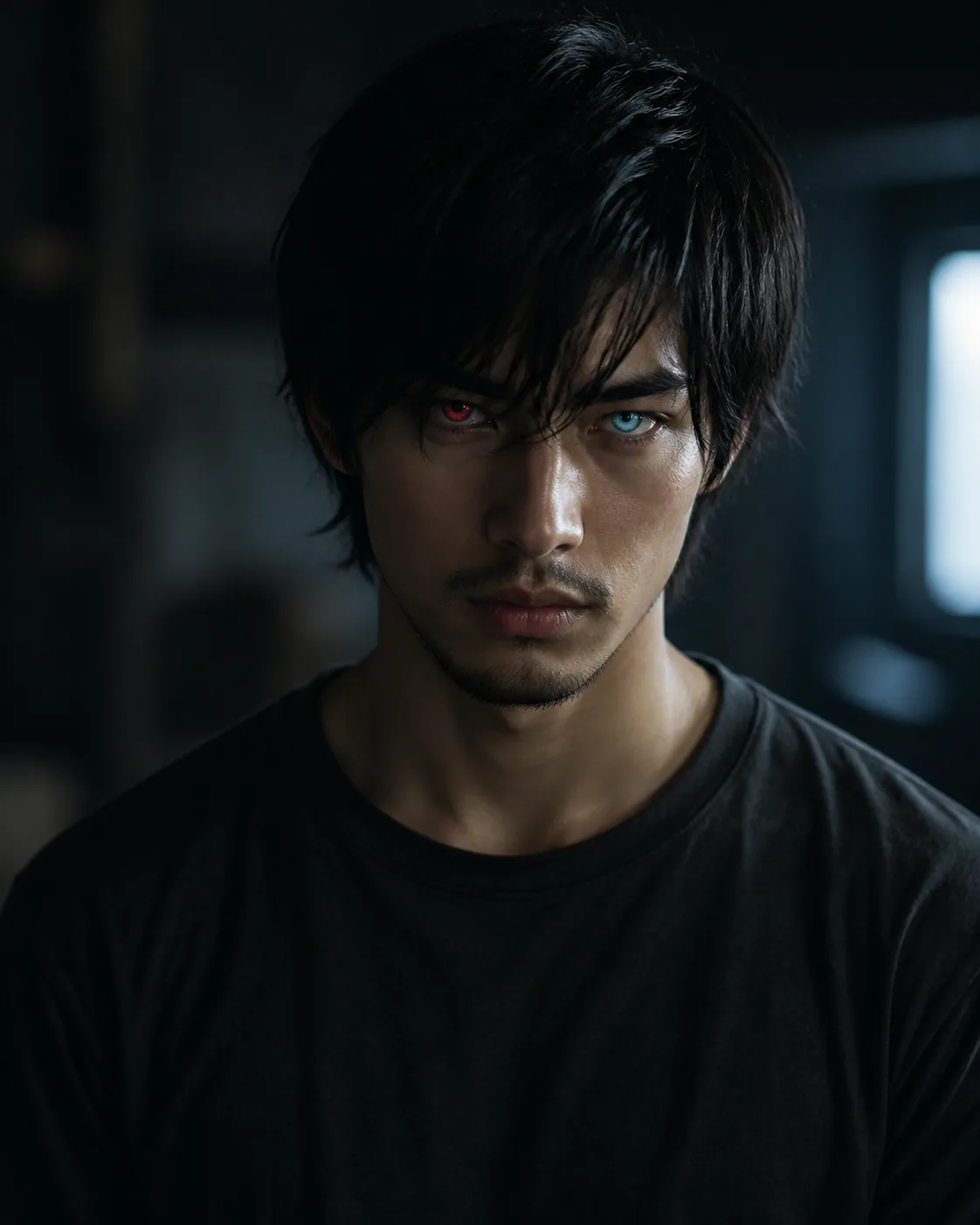
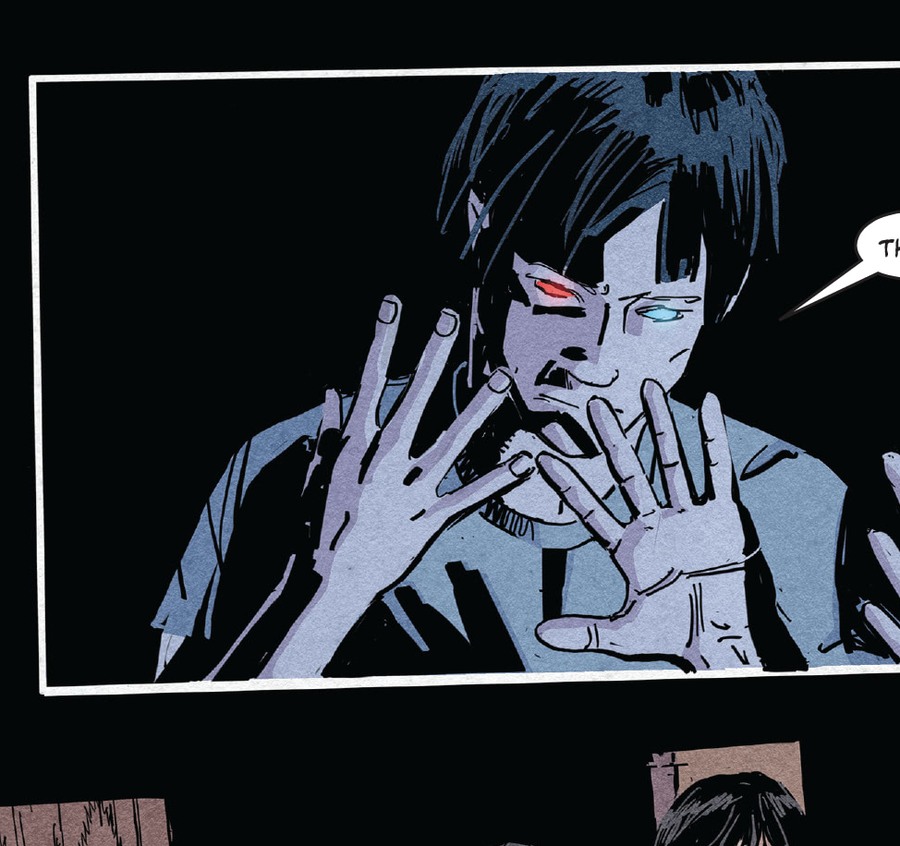
As the twins prepare to leave, their eyes display striking red and blue coloration.[1]
The visual echoes the energy language of the Source/contact sequences. It is the clearest visible sign, aside from accelerated growth, that the son's biology is not ordinary.
The comic does not explain the mechanism. The colors should not be used to invent separate red and blue powers. Nor does the scene establish that each eye corresponds to a specific parent or energy type.
The correct treatment is Source-linked heterochromia or anomalous eye coloration, function unknown.
Leaving home
Days after the family visits B's memorial or resting place, the twins wake Diana and tell her it is time.[1]
When she asks what they mean, they say they are ready to start their lives. They show their eyes and explain that they are going to grow and “plant our seeds.”
The son leaves alongside his sister. The scene is both literal and symbolic. It implies reproduction, but the subsequent montage and narration broaden the idea into cultural transmission.
They are not running from Diana in anger. Their departure is presented as purposeful and hopeful.
The pollinator role
The final pages show the twins moving through ordinary human settings as adults. The narration describes “a pollinator” spreading technology and ideas, then suggests that this function may be a general human pattern. Their purpose is linked to B's: to become a voice from the past, an echo of the forgotten, rippling into the future as shared memory.[1]
For the son, this language provides the closest thing to a stated life mission.
It should not be simplified into “his power is to invent technology.” The comic presents pollination as a broad function of transmission. The son may carry biological material, ideas, knowledge, stories, or Source influence through human relationships.
The montage also shows the children forming adult relationships. This supports a literal component to “plant our seeds,” but the series deliberately refuses to reduce the phrase to genetics alone.
Powers and abilities
The son's demonstrated or strongly supported traits are limited but significant.
Accelerated development
He matures from newborn to child and then young adult in an extremely compressed period.
Source-linked eye coloration
His eyes show anomalous red and blue coloration when he prepares to leave.
Advanced maturity
His cognitive and linguistic development appears to keep pace with physical growth, allowing complex conversation and independent decision-making.
Possible inherited Source biology
As B's biological child and Diana's child after Source contact, he clearly belongs to the Source-linked lineage. The exact molecular traits are not tested on-panel.
Berserker compulsion
Not observed. B explicitly contrasts the twins with his own berserker childhood.
Immortality and regeneration
Not demonstrated. The ending's language about immortality and lineage should not be converted into a confirmed B-level regenerative ability.
Enhanced strength or durability
Not conclusively demonstrated in the reviewed original-series material.
Personality
Because the twins have relatively little individual dialogue, the son's personality must be described conservatively.
He appears playful as a child, close to his sister, affectionate toward family, confident when leaving home, and excited about the future. His statement that beginning life is “so wonderful” gives the next generation a tone very different from B's exhaustion.
B spends much of the series longing for an end. His son approaches life as an opening.
That contrast may be the most important characterization the finale provides.
Appearance
As a young child, the son has dark hair and is shown in simple modern clothing at the rural refuge.
As a young adult, he retains dark hair and a lean human appearance. His most distinctive feature is the red-blue anomalous eye coloration revealed before he leaves.
The comic does not give him a uniform, symbol, or stable heroic costume. Public artwork should preserve the understated civilian visual identity.
Status at the end of the original series
The son is alive and active at the end of BRZRKR #12.
He leaves the refuge with his sister and is shown participating in the broader pollinator sequence. No death or final destination is established.
His exact lifespan remains unknown.
Role in B's legacy
The son changes the meaning of B's legacy from individual survival to transmission.
For most of B's life, immortality means one body refusing to end. The son represents continuity that does not require B's body to survive.
That is why the children's existence is essential to the final question of what immortality truly means. Memory, descendants, ideas, and influence can continue after the individual dies.
Relationship with the Source
The son is a descendant of the Source through B and may also inherit Source-linked effects through Diana's contact.
The final pollinator language strongly associates his future with the Source's broader purpose, but the Source never directly speaks to him on-panel.
Relationship with B's first child
B's first child is the son's much older half-sibling.
No meeting occurs and no common descendant line is established. The connection is genealogical and thematic.
The first child proves B could reproduce early in his history. The son and daughter show what happens when B becomes a present parent and when the other parent has also passed through Source-linked events.
Appearances
- BRZRKR #12: Prenatal presence, birth, accelerated development, childhood at the Southwest refuge, family scenes, B's death and memorial aftermath, departure with twin sister, and adult pollinator montage.
No earlier direct appearance exists.
Unresolved questions
- What is his personal name?
- How long will he live?
- Can he regenerate?
- Is he biologically immortal?
- Does he experience any form of violent pressure?
- What do the red and blue eyes signify?
- Did he and his sister remain together?
- Did he have children?
- What technology or ideas did he spread?
- Can he contact the Source directly?
- Did he ever encounter Franken-B or the hypercomputer?
- Does he know about B's first child?
References
[1] Keanu Reeves, Matt Kindt, Ron Garney, Bill Crabtree, and Clem Robins, BRZRKR #12 (BOOM! Studios, 2023), pregnancy, Seline and Songaa, twin birth, accelerated growth, B's death aftermath, departure, and pollinator epilogue, especially digital page images 024-027 and 040-046.
[2] Reeves, Kindt, Garney, Crabtree, and Robins, BRZRKR #5 (BOOM! Studios, 2021), B's first love and first-child sequence, digital page images 013-016.