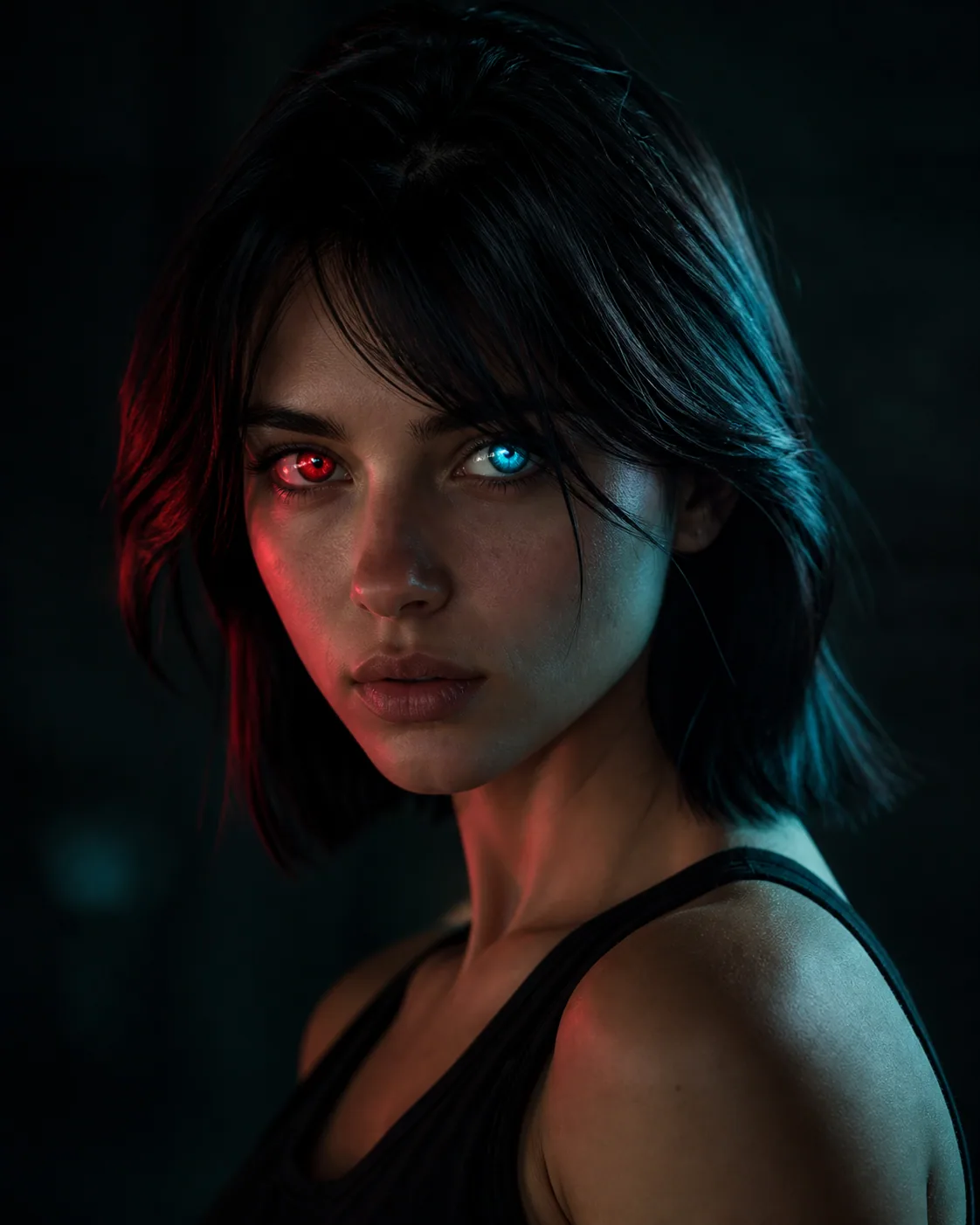
Selected scenes
BRZRKR in pictures.
Spoilers: This article discusses the complete final issue of the original BRZRKR series, including Diana's pregnancy, the twins' birth and growth, B's death, and the pollinator epilogue.
| Field | Details |
|---|---|
| Personal name | Not stated |
| Canonical designation | Daughter of B and Diana |
| Species / nature | Human descendant of B with Source-linked inherited traits |
| Gender | Female, based on visual presentation; no personal name is supplied |
| Status | Alive at the end of the original series |
| Parents | B / Unute and Dr. Diana Ahuja |
| Twin sibling | B and Diana's son |
| Half-sibling | B's first child |
| Birthplace | Southwest refuge |
| First appearance | Prenatal presence in BRZRKR #12; born in BRZRKR #12 |
| Latest original-series appearance | BRZRKR #12 epilogue |
| Primary-source status | Directly depicted canon |
Overview
B and Diana's daughter is one of the unnamed twins born in BRZRKR #12. Along with her brother, she embodies the original series' final shift from immortality as one body's endless survival to immortality as family, memory, heredity, and influence continuing after death. She grows at an extraordinary rate, does not display the same berserker pattern that dominated B's childhood, reveals Source-linked red and blue eye coloration, and leaves the Southwest refuge to “plant our seeds.” The epilogue then associates the next generation with a pollinator function that spreads technology, ideas, and shared memory.[1]
The daughter has no personal name in the original twelve-issue series. Many of her appearances are shared with her twin brother, and the comic rarely attributes a line in a way that supports building sharply separate personalities. Her biography can be documented individually without inventing distinctions the source does not make.
Her importance is nonetheless substantial. She is the first daughter B is shown raising, one of only three confirmed children in the original series, a surviving carrier of his Source-linked ancestry, and a child whose development gives B the opportunity to parent differently from the way he was parented.
B's human father called him a weapon. B and Diana do not do the same to their daughter.
Pregnancy
Diana's pregnancy follows the Source/contact events that remove B's immortality and alter Diana's relationship to the same energy system.[1]
The comic does not detail fetal testing or explain the genetic mechanism. That omission contrasts deliberately with the government's obsession with B's DNA. The pregnancy exists outside the laboratory.
At the Southwest refuge, Diana tells her hosts that the babies are already kicking and suspects there are two. Seline, the midwife, examines her and confirms that the children are coming soon and appear healthy.[1]
The daughter therefore begins as part of a family protected by people whose connection to B extends across generations, not by the institution that tried to own his biology.
Birth
The daughter and her twin brother are born at the refuge with Seline performing the midwifery and Songaa helping during the labor.[1]
The scene emphasizes physical care and family presence. B is nearby. Diana is conscious and involved. The children enter the world within a small community.
For B, being present matters. His first known child was born while he was being executed elsewhere, and he says he never saw that infant.[2] With his daughter, B witnesses the beginning.
The birth also presents the most direct generational mirror of B's own origin. A child with abnormal developmental potential has entered a family. The question is whether the adults will treat that abnormality as identity.
Accelerated development
The daughter grows with extraordinary speed. Within what appears to be a very short time she progresses through infancy, childhood, adolescence, and young adulthood.[1]
The comic uses domestic images to make the acceleration emotionally legible. She plays outside with her brother, participates in family routines, and later speaks to Diana with adult confidence.
B recognizes the resemblance to his own childhood. He describes history as rhyming or mirroring itself.
That resemblance is not exact. B's acceleration was quickly followed by weapon training and a berserker role. His daughter is given a period of ordinary play, however compressed.
Absence of observed berserker behavior
B tells Diana that the twins do not berserker.[1]
For the daughter, this is one of the most important pieces of canon.
Her body may carry Source-linked traits, but the specific violent compulsion that defined B is not shown during childhood. That difference opens the possibility that B's berserker condition was not an inevitable feature of every descendant, or that Diana's biology and Source alteration changed the inheritance.
The series does not give enough data to choose a mechanism.
The evidence supports neither extreme: she is not shown as a berserker, but the series also does not establish that berserker behavior is permanently impossible for her.
Relationship with B
The daughter's relationship with B gives the protagonist one of the few peaceful family roles of his life.
B is mortal by the time she is born. He can no longer rely on endless regeneration. His parenthood therefore occurs within the same finite vulnerability that ordinary human parents experience.
He watches her grow and plays the role of a protective rather than weaponizing father. When the children develop rapidly, B and Diana consider disappearing to keep them beyond institutional reach.
The comparison with B's human father is unavoidable. B's father looked at abnormal growth and saw strategic value. B looks at abnormal growth and sees children who may need protection from strategic value.
B's death
B dies while his children are still in the rapid period between childhood and adult independence. The final issue shows the family dealing with his permanent mortality.[1]
For the daughter, B's death establishes the most important fact of his successful transformation: her father can now truly die.
The children ask questions about absence and where he has gone. The story does not give them a direct supernatural encounter with B after death.
The later memorial or grave scene places the daughter within the family that continues without him.
Relationship with Diana
Diana is the daughter's mother and the parent who survives B.
Her knowledge of B's history makes her uniquely prepared to understand what accelerated childhood can do to identity. She has spent the original series recovering the memories of a child trained as a weapon and watching institutions try to reproduce that biology.
When her own daughter grows in days or weeks rather than years, Diana does not hand her over for study. She helps create a protected environment.
Later, when the daughter and son announce that it is time to leave, Diana reacts with confusion and concern but does not physically imprison them. The scene turns separation into a parental challenge rather than a military containment problem.
Relationship with her twin brother
The daughter and son function as partners.
They are born together, play together, make their major developmental transition together, reveal their eyes together, and choose to leave home together.[1]
Their paired presentation suggests that the next Source-linked generation begins as a cooperative unit rather than a solitary weapon.
No rivalry is shown. The comic does not establish a leader between them.
Because many speech balloons are shared across panels, the public biography should quote collective ideas without over-assigning exact sentences to one twin unless the balloon tail is unambiguous.
Red and blue eyes
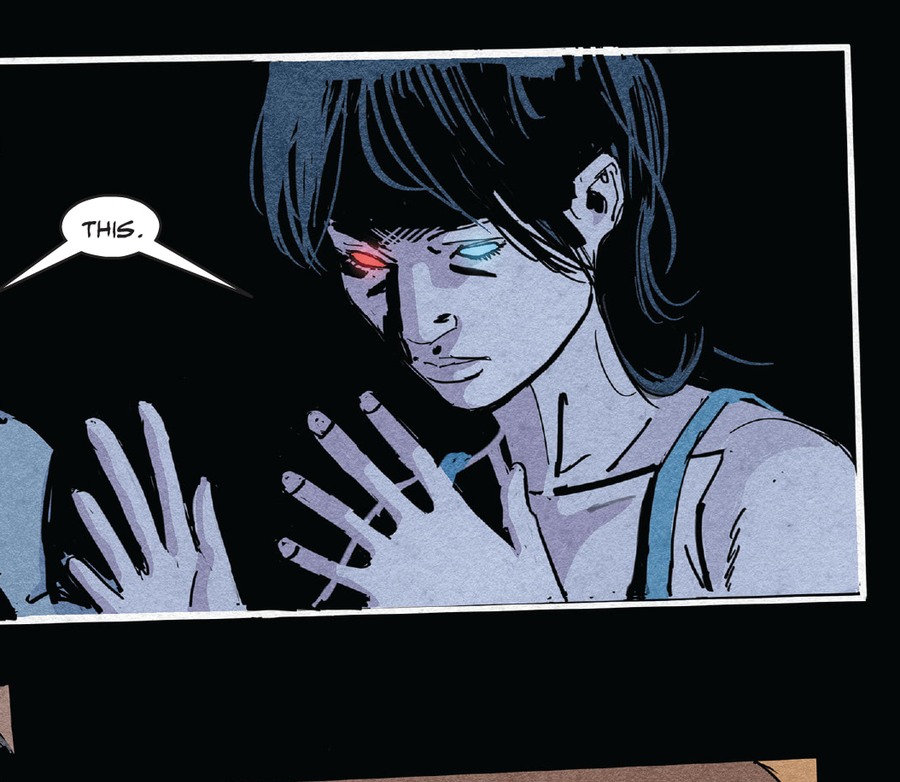
When the twins reveal what they mean by starting their lives, the daughter's eyes show extraordinary red and blue coloration.[1]
The image provides a visual link to the energy language of the Source-contact sequences.
There is no explanation of whether the coloration is permanent, activated by emotion, a sign of power, or simply the visible mark of inherited biology.
The daughter is therefore best classified as having Source-linked heterochromia / anomalous eye coloration, function unknown.
“To plant our seeds”
The twins tell Diana they intend to grow and plant their seeds.[1]
The daughter's participation in this statement makes reproduction and transmission part of her self-chosen purpose. Unlike B, whose earliest purpose was defined for him by adults, she articulates her own direction.
The phrase is intentionally broader than reproduction. The following montage describes a pollinator spreading technology and ideas, and the narration connects the children's purpose to a voice from the past entering future shared memory.[1]
For the daughter, this means the franchise's concept of inheritance is simultaneously biological and cultural.
Adult life in the epilogue
The closing montage places the grown twins in ordinary modern social environments. They interact with other people and form relationships.[1]
The daughter is shown as an adult woman rather than as a costumed super-soldier or laboratory subject. That presentation matters. Her future unfolds through participation in human society.
The comic does not identify the people she meets, specify marriages or children, or trace a complete genealogical line. It also does not establish where she travels.
The montage is function rather than conventional biography.
Pollinator and shared memory
The daughter belongs to the final conceptual answer about B's purpose.
A pollinator spreads technology and ideas. The narration asks whether all people do something similar and describes B's purpose as surviving through a voice from the past, an echo of forgotten things, rippling into future shared memory.[1]
This redefines immortality.
B's daughter does not need to survive forever in one unchanged body for B's life to continue through her. She carries family, memory, biology, and influence.
The original series closes by making those forms of continuity as important as regeneration.
Powers and abilities
Accelerated development
Confirmed. She matures extraordinarily quickly from infancy to adulthood.
Anomalous eye coloration
Confirmed. Red and blue eye colors are shown before departure.
Cognitive acceleration
Strongly supported. She communicates at age-appropriate levels despite compressed physical development.
Source-linked inheritance
Confirmed in genealogical and visual terms. Exact molecular mechanics unknown.
Berserker compulsion
Not observed and explicitly contrasted with B's behavior as part of the twins.
Regeneration
Not demonstrated.
Immortality
Not proven. The closing meditation on immortality is philosophical and genealogical as well as biological.
Enhanced strength
Not conclusively established by the reviewed original-series pages.
Direct Source communication
Not shown.
Personality
The daughter appears playful in childhood, close to her brother, curious, confident, and hopeful about the future.
The most revealing moment is the departure. She does not frame leaving as escape, revenge, or duty. The twins describe starting life as wonderful.
That optimism sharply contrasts with B's exhaustion. B has spent eighty thousand years searching for an ending. His daughter approaches existence as possibility.
The difference suggests that the conditions surrounding extraordinary biology matter as much as the biology itself.
Appearance
The daughter is depicted with dark hair.
As a child she wears ordinary contemporary clothing at the rural refuge. As a young adult she has a simple civilian appearance and later appears in urban social settings.
Her red-blue eyes are her primary distinctive Source-linked visual trait.
Her original-series appearance is contemporary and ordinary rather than costumed or superheroic.
Status
She is alive at the end of the original series.
No death, disappearance, or endpoint is shown. She leaves with her twin and participates in the pollinator montage.
Her lifespan and later descendants are unknown.
Legacy and thematic role
The daughter completes a chain that begins with B's mother.
B's mother asks for a weapon and later tries to undo the curse created by that request. B grows up believing extraordinary children inevitably become tools. Diana helps him become mortal. B and Diana then raise extraordinary children without assigning them a military purpose.
The daughter inherits power without inheriting the same social definition.
That makes her one of the clearest signs that the cycle can change.
Relationship with B's first child
B's first child is her much older half-sibling.
No direct connection is shown. The first child is born in antiquity and has an unresolved fate. The daughter is born after B's mortality transition and displays visible Source-linked traits.
Together, they form the two confirmed reproductive periods in B's original-series life.
Relationship with Seline and Songaa
Seline acts as midwife and directly helps bring the daughter into the world. Songaa is part of the same refuge and family-support network.[1]
The women's presence connects the daughter's birth to a human lineage that has tracked B across generations. The twins are therefore born not in total isolation but into a community with historical memory of their father.
Appearances
- BRZRKR #12: Prenatal presence, birth, rapid childhood, family life, B's death aftermath, departure, adult life, and pollinator epilogue.
Unresolved questions
- What is her personal name?
- How long does she live?
- Can she regenerate?
- Does she become biologically immortal?
- Does she have descendants?
- What exactly do her red and blue eyes signify?
- What ideas or technologies does she spread?
- Does she ever communicate with the Source?
- Does she remain with her twin brother?
- Does she know the full history of B's first child?
- Do later cultures recognize her as part of B's lineage?
References
[1] Keanu Reeves, Matt Kindt, Ron Garney, Bill Crabtree, and Clem Robins, BRZRKR #12 (BOOM! Studios, 2023), Southwest refuge, pregnancy, Seline and Songaa, twin birth, accelerated development, family aftermath, departure, and pollinator epilogue, especially digital page images 024-027 and 040-046.
[2] Reeves, Kindt, Garney, Crabtree, and Robins, BRZRKR #5 (BOOM! Studios, 2021), B's first love and first child, digital page images 013-016.