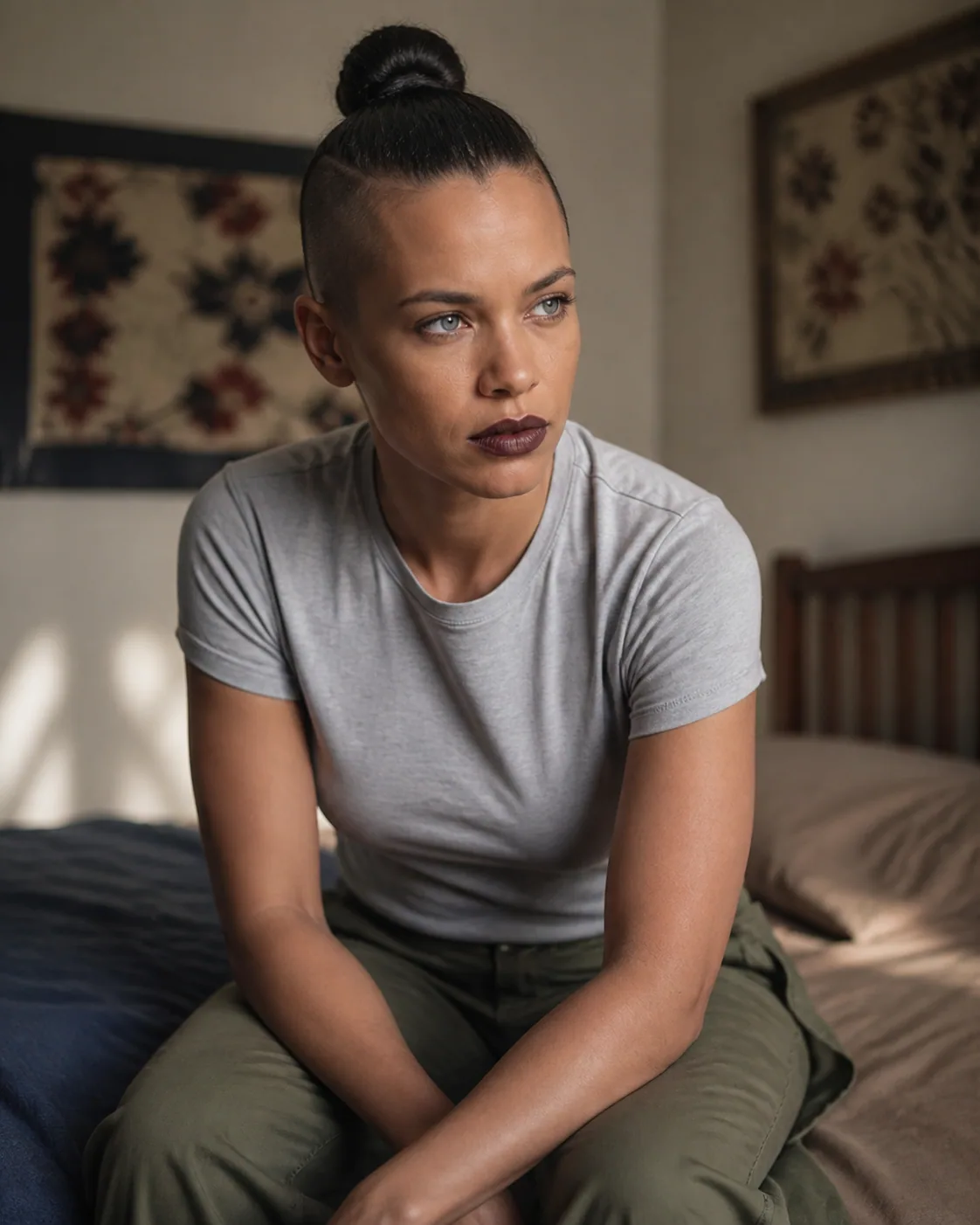
Seline is a figure who appears in the concluding phase of the original BRZRKR comic series and speaks with B about a recovered head, ancient activity and the whereabouts of Caldwell. Her conversation in issue #12 is important because it introduces a fragment of history without resolving every identity attached to it. Seline describes people she calls the ancients, who recovered a head they initially thought belonged to B. She then says that the head belonged to another man, and the exchange names Caldwell. The people following that trail lost track of him around Malta. These statements do not establish that the head belonged to Franken-B, a separate modern laboratory creation.
The conversation in the final issue
By the time Seline enters the narrative, the United States investigation has already moved far beyond an ordinary study of regeneration. Diana Ahuja, B and Caldwell have been involved in events that expose the existence of forces outside accepted scientific explanations. Seline's remarks are presented against that closing sequence, when information about the past must be weighed alongside immediate questions of survival. Her conversation supplies names and a route rather than a comprehensive flashback showing the head's recovery from beginning to end. That form matters. It gives the reader testimony from someone with access to a separate chain of knowledge, not an unrestricted view of everything the ancients knew.
The recovered head
Seline explains that the ancients recovered a head and at first believed it was B's. The mistake is plausible within a world where B's apparent deaths, lost limbs and rapid regeneration have left traces across civilizations. The severed hand recovered by Caldwell in issue #7 provides a documented example of a piece of B surviving centuries after separation from his body. But the recovered head Seline describes belongs to a different line of evidence. The comic does not provide a dated ownership chain for it equivalent to the hand's account of Babylonia, Napata, markets and wartime looting. Treating the two artifacts as the same object, or assuming identical histories, would erase what the final issue actually tells us.
Why the identity matters
The significance of the head depends on the distinction between resemblance and identification. Seline's people initially associate it with B but change their conclusion. In a story where imitation, regeneration and physical duplication can occur, outward similarity does not guarantee a single identity. The subsequent mention of Caldwell is the strongest name provided by the dialogue. That does not establish every intermediate transformation or explain when Caldwell might have been present in the ancient period under discussion. The scene leaves room for unanswered questions rather than presenting a complete diagram of bodily continuity. An encyclopedia account must preserve those limits instead of resolving them through a preferred theory.
The reference to Malta
Seline says her people lost track of the person around Malta. The geographical reference places the inquiry within the Mediterranean world but does not supply a numbered year, a named Maltese settlement or an illustrated episode showing precisely what occurred there. Malta can therefore be included as the last reported place in a trail, not treated as a confirmed setting for an unshown battle or ritual. The exchange also suggests the existence of investigators or custodians operating over time, since a head was recovered, an identification attempted and a person traced. Yet the comic does not give every member of that group an individual biography. Seline is a witness to a limited body of information, not proof of an entire invented institution.
Distinction from Franken-B
Franken-B originates in the modern scientific program's attempt to reproduce or manipulate the exceptional properties of B. A head found by the ancients is an awkward fit for such a recent creation. That chronological problem is decisive when assessing the earlier site's claim that Seline's story concerns Franken-B. Similar imagery or a shared association with B cannot override the explicit reference to an ancient recovery. The correct description is therefore cautious: Seline mentions a recovered head, a mistaken identification, Caldwell and a trail that ends near Malta. The precise relationship among those facts remains only as established by the issue's words and images. Any stronger connection to Franken-B belongs to speculation, not to a canonical identification.
B's response to incomplete knowledge
For B, the conversation belongs to a much longer pattern of encounters with people who seem to know fragments of his past. He has lived through events that later generations preserve as stories, rituals and artifacts. Some accounts about him are mistaken; others contain information he himself has not connected to present events. Seline's testimony illustrates that tension. The ancients misidentified an object, then corrected themselves, and the later chain becomes uncertain. B cannot derive his entire history from a single witness. The exchange therefore has an epistemic significance alongside its plot role: it shows how even apparently extraordinary repositories of knowledge contain errors and unfinished trails.
Caldwell as a continuing problem
Caldwell's body is severely damaged during the climax of issue #12, but the epilogue returns to a Tuscany church where worshippers tend living flesh and an eye opens. Seline's reference to Caldwell exists within a story that has deliberately complicated simple declarations of his death. The Malta remark is not direct proof of an escape from the Tuscany site, nor does it place him in two locations at once in the present. It instead points to another part of the larger mystery around who he is, what others know of him and how his history might extend beyond the confines of the government laboratory. Separating the chronological questions prevents the scene from being made to explain more than it does.
Role in the ending
The original series closes several immediate conflicts while leaving important questions unresolved. B appears to die as a mortal, yet the epilogue shows him re-forming on another world; Caldwell appears destroyed, yet living flesh is worshipped in Tuscany. Seline's exchange fits this pattern without becoming identical to it. She contributes a distinct unresolved historical lead. Her role is not the same as Diana's scientific inquiry or Keever's military decisions. She supplies testimony from outside the program's familiar channels, suggesting that its researchers never possessed the complete record of B and the forces around him.
Appearance and limits of the record
Seline's known role is grounded in her on-panel conversation rather than in an independently established childhood, profession, full organization or verified sequence of earlier adventures. The comic does not justify inventing parents, dates of birth or a connection to every Mediterranean supernatural tradition. Her character matters because of what she knows, how she frames it and what she does not claim to know. The head, Caldwell and Malta should remain linked in summaries of issue #12, but the missing steps should remain missing. That restraint preserves the mystery that makes the dialogue narratively important and avoids carrying a demonstrably erroneous Franken-B theory into other character and storyline pages.
References
- BRZRKR #12 (2023), digital image 24: Seline's account of the recovered head, Caldwell and Malta.
- BRZRKR #7 (2022), digital images 03–10: separate provenance of B's severed hand.
- BRZRKR #12 (2023), images 43–45: Tuscany church epilogue.