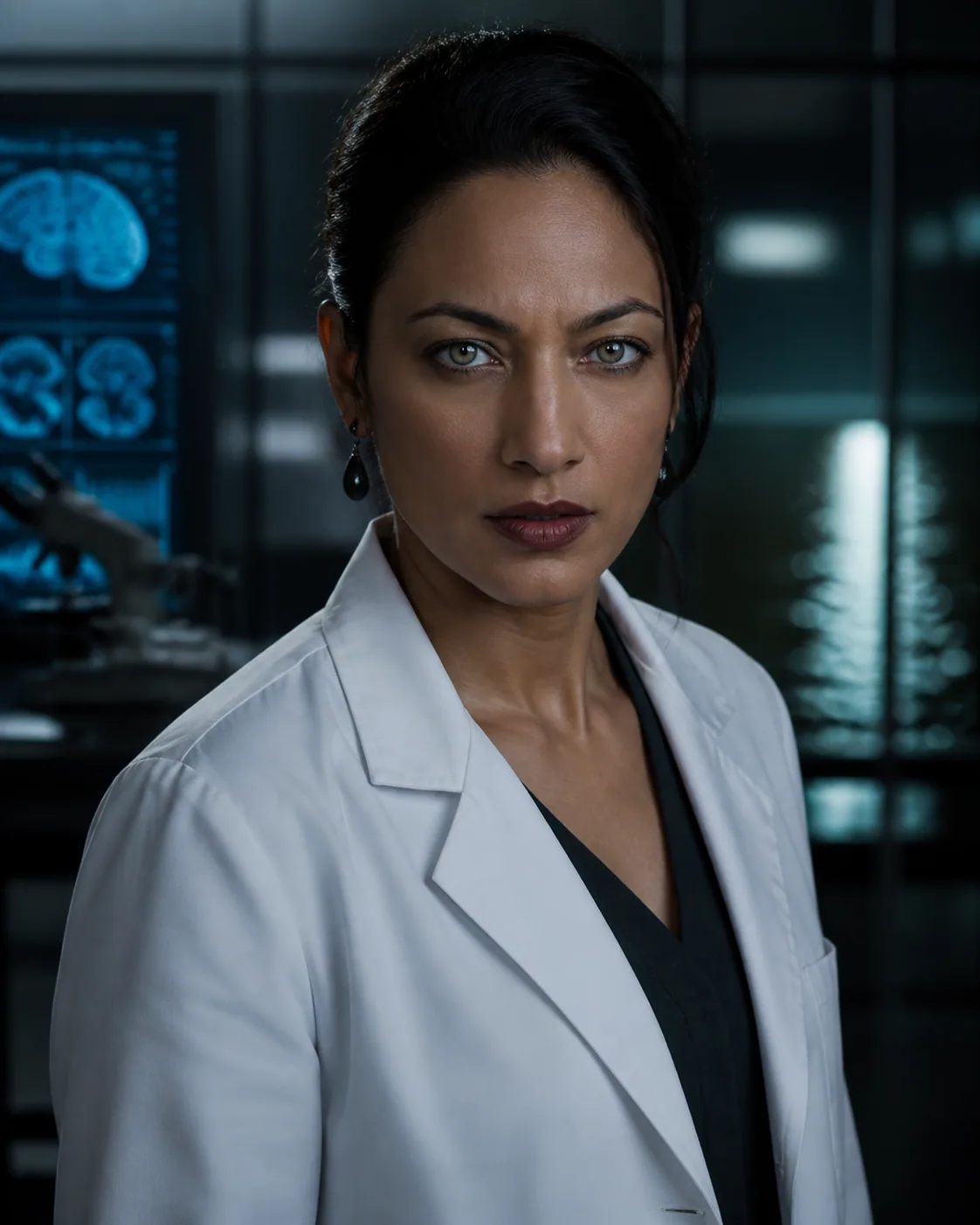
Dr. Diana Ahuja is a scientist working with the government program that studies B, the immortal protagonist of BRZRKR. Her expertise encompasses physics, behavioral neural science and experimental quantum mechanics. She is central to the program's attempts to understand B's memories, regeneration and the forces connected to his origins. Her work eventually becomes inseparable from a personal relationship with B, and by the conclusion of the original series she is the mother of his children. The final issue also depicts her continuing to communicate with B after his apparent mortal death.
An unusually accomplished researcher
Diana's credentials are not left entirely unspecified in the original comics. In issue #5, she states that she has PhDs in physics and behavioral neural science and describes an experimental quantum mechanics degree that she devised herself. She also says that she declined two Nobel Prizes because she did not want publicity directed toward her research. These extraordinary claims are part of her own account, and the article's characterization should preserve that distinction rather than replacing them with a statement that her professional background is unknown.
She says she built a research department of fifty people around B. That detail situates her as an organizer of science, not simply an interviewer assigned to take notes. A large specialist team would require a structure capable of coordinating multiple kinds of investigation, and the program is described elsewhere as possessing departments concerned with biometric mapping, cognition, regenerative analysis and quantum phenomena. Diana's role sits among those disciplines while reaching beyond any one of them.
The study of B's memory
B's extraordinary life presents a scientific problem distinct from his ability to survive injury. He recalls experiences separated by tens of thousands of years, and those memories include violence, relationships and periods of human history that have left few external records. Diana's conversations with him make memory a living source of evidence. Her task is not merely to confirm whether he can recite dates, but to understand how an individual consciousness bears events that would normally be distributed across countless generations.
The inquiry also carries ethical consequences. B has been used as a combatant and subjected to government procedures because his body can recover. His mind is not therefore a limitless archive to which investigators are automatically entitled. His refusal to answer certain historical questions, as seen in conversations with Caldwell, demonstrates the persistence of personal choice. Diana's scientific interest operates in a field where consent, disclosure and the psychological costs of remembering cannot be separated from the facts being investigated.
Regeneration and the scope of the program
The program seeks explanations for how B's body repairs damage that would permanently disable or kill another human being. Diana works within a setting that includes regenerative biology and increasingly ambitious experiments involving quantum contact. The distinction between observing a result and explaining its cause becomes central as researchers attempt to reproduce or control elements of B's condition. B's endurance can be demonstrated repeatedly; the complete mechanism behind it remains elusive.
Diana is significant because her work extends toward the relationship between B's body and the extraordinary source associated with his origin. The laboratory's apparatus, calculations and specialized staff do not keep the research entirely within conventional biology. The later issues show that the attempt to reach beyond observable regeneration exposes investigators to powers they only partly understand, culminating in dangerous consequences at the facility.
Contact, the mother's gift and the Saudi expedition
In issue #10, Diana identifies the Nefud Desert in Saudi Arabia as the location associated with a bird, B's mother's gift and red lightning. The expedition seeks a point of contact with an intelligence connected to B's condition. The research involves a powerful hypercomputer and preparations designed to handle a hazardous event. Diana's role here is active and interpretive: she is trying to translate B's memories and the expedition's findings into an experiment that can produce a comprehensible result.
The encounter is not simply a field trip from a laboratory into the desert. It joins B's distant personal history to a modern technical infrastructure capable of endangering a wide population. The computer's activation and the preparations at headquarters reveal the scale of the apparatus built around the experiment. Diana approaches that uncertainty as a scientist but cannot isolate herself from its personal significance for B, whose entire search has been directed toward understanding the force that changed his life.
A relationship beyond observation
Diana and B's relationship develops beyond the distance ordinarily separating a scientific investigator and a subject. For B, personal connection is difficult because he has repeatedly outlived people and because violence has shaped so many of his memories. Diana sees him both as an extraordinary case and as an individual seeking release from an existence he experiences as a burden. Their partnership changes the meaning of his search for mortality, giving it a possible future beyond the end of violence.
This change should not erase the professional and institutional conflict that initially brought them together. Diana's department was assembled around the study of B, and the government's interests remain powerful even after personal attachments develop. She must navigate the consequences of knowledge she helped pursue. By the closing issues, her loyalties are tested against an organization that increasingly responds to B as a threat rather than as someone whose wishes deserve consideration.
The confrontation with Caldwell
In issue #12, Diana faces Caldwell after his pursuit of regenerative power has produced a dangerous transformation. She electrocutes him, and his body is torn apart. The scene demonstrates her willingness to intervene directly rather than remain a remote researcher interpreting results after the fact. It also shows the limits of judging the consequences by appearances alone: the Tuscany epilogue later depicts mutilated living flesh associated with Caldwell, whose complete fate remains uncertain.
Diana's action contributes to the immediate survival of those threatened by Caldwell, but it does not resolve the larger struggle with the government. The state's own response continues, including a lethal order carried by Keever. Diana's trajectory in the final issue is therefore not an uncomplicated departure from one villainous individual. She is confronting overlapping systems of control, one driven by religious and personal ambition and another by military authority.
Virginia, the children and the refuge
At the Virginia safehouse, Keever arrives under orders to kill B. Diana cuts the power and threatens his heart, and the confrontation ends when Keever lets them leave. The scene is not the location of the subsequent helicopter attack. Diana and B later have children, and the armed assault occurs at the Southwest refuge after their birth. Preserving that sequence is essential to understanding how their family life develops before the final military violence.
B is mortally wounded in the attack, and Diana faces the loss of someone whose long history had previously made physical death appear impossible. Yet the last pages show her making contact with him as he begins to re-form on a world beneath multiple suns. She asks where he is and whether he can return. His answer establishes that communication survives the apparent end and that he intends to find a way back. The final image of their relationship is therefore neither a routine reunion nor an unqualified severance.
Scientific and personal legacy
Diana stands at the point where the series' intellectual questions become human consequences. She helps organize the study of an immortal body, probes memory and quantum phenomena, challenges Caldwell and protects a family threatened by the state. Her credentials and department-building achievements matter because they establish the scale of her responsibility; her relationship with B matters because it changes what those investigations mean to her.
At the close of the original series, Diana remains connected to B across a distance the comics do not fully explain. The scene presents an unanswered question of travel and return rather than proof that a final permanent separation has occurred. Her story connects B's mortality, the government program and the aftermath of issue #12, each of which bears consequences that extend beyond the conclusion of the immediate conflict.
References
- BRZRKR #5 (2021), digital image 03, Diana's degrees, Nobel Prize statement and research-department claim.
- BRZRKR #10 (2022), images 02–21, Nefud Desert expedition, mother's gift and quantum contact.
- BRZRKR #12 (2023), images 07–08, 16–22, 28–36 and 47–50, Caldwell, Virginia, children and epilogue.