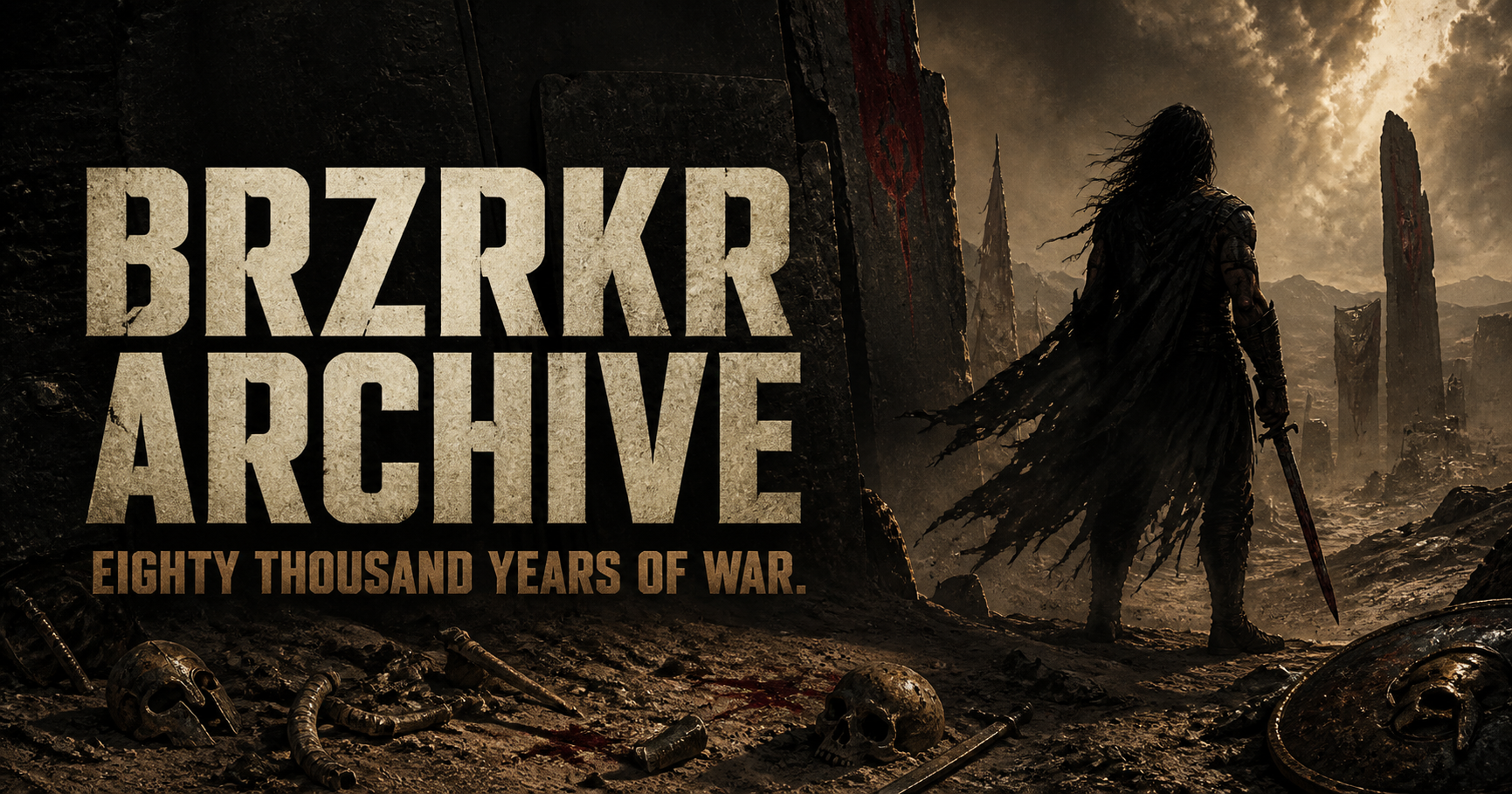
BRZRKR began as a story about an immortal warrior who wants to become mortal and grew into a franchise that moves through comics, historical one-shots, collections, prose, and adaptation development. The publication history matters because each format reveals a different part of B's life. The original twelve issues build a modern mystery. The one-shots visit eras that the core story can only remember. Collections change how the material is read without changing the events. The novel creates a separate prose continuity.
The original twelve issues
The core comic is BRZRKR #1-12, created by Keanu Reeves and Matt Kindt with the principal visual team of Ron Garney, Bill Crabtree, and Clem Robins. The first issue introduces B's government bargain, Diana's memory work, Keever's field relationship, and Caldwell's interest in B's biology. It promises an answer to the question B has carried for eighty thousand years: how can he become mortal?
Issues #2-4 move into the prehistoric origin. B's mother prays for protection, the lightning contact alters the conditions of his conception, and his father turns the child called Unute into a weapon. Mother's Gift and the mother's death give B's desire for mortality its emotional beginning.
Issue #5 shows B's first love and first child, while #6 gives the modern partnership with Keever a field mission. Issue #7 connects a First World War memory and a separated body fragment to Caldwell's research. Issues #8-9 turn the research into Protocol X, B's disappearance, and Diana's contact with him. Issues #10-11 return to the birthplace, recover Mother's Gift, reach the Source, and transfer B's power. Issue #12 makes B mortal, introduces the twins, and ends with B's death protecting his family.
The numbered series is therefore a carefully staged movement from body to origin, from institution to family, and from survival to choice. Reading the issues in publication order preserves the way each revelation changes the meaning of the previous one.
The historical one-shots
The first major expansion is BRZRKR: Poetry of Madness #1, which sends B to Atlantis. Zubatai records B's protection of King Azaes, Vizane's gateway ritual, Cthulhu's arrival, and the city's destruction. The issue shows that B's legendary identities existed long before the modern government and that the BRZRKR universe contains supernatural systems separate from the Source.
Fallen Empire #1 moves to Olos and Washukanni. Queen Asana's account shows B captured, displayed, loved, manipulated, and finally turned against a kingdom. The Acastan frame makes the one-shot a story about survivors and the danger of letting the person responsible control the record.
The Lost Book of B. #1 follows the cult's preparation of B, Genghis Khan's recruitment, the siege of Beijing, and the creation of Lugalṭur. It expands the historical and alchemical branches while asking whether a person made from B's material can become independent.
The later Bloodlines specials add A Faceful of Bullets, The Bleeding Tide, and Light Draws Breath. The Western one-shot places B in 1800s America between a land baron and a runaway daughter. The maritime story begins when a pirate captain finds B's reconfiguring body in a chained box below the ocean. Light Draws Breath returns to the Bronze Age, where rogue scientists siphon B's protoplasm and create a new being.
Collections and reading experience
Volumes 1-3 gather the twelve core issues into larger reading units. The first volume contains the origin of the bargain and the beginning of B's historical memory. The second moves through the first love, Keever, the First World War fragment, and Protocol X. The third carries the reader through contact, the birthplace, the transfer, and the ending.
The Deluxe Edition and later Book One presentations offer the core story in formats designed for readers who want the complete arc in fewer objects. The story does not become a new continuity when the page size, binding, or cover changes. Collections can alter the rhythm of reading, however. A reader who encounters #1-12 in a single sitting experiences the echoes among the origin, the memory room, and the final family differently from a reader who waits between monthly issues.
Bloodlines collections gather the historical one-shots. They make Atlantis, Olos, Washukanni, Lugalṭur, and later eras appear beside one another, which emphasizes the range of B's life while preserving each story's narrator and continuity. Pen & Ink editions present alternate visual treatments of existing material rather than new events.
Kickstarter and special editions
Kickstarter editions belong to the publishing history because they helped establish the audience and visual identity of BRZRKR. Signed copies, foil or virgin covers, retailer exclusives, convention editions, and graded copies can matter to collectors, but they do not create new plot events merely by changing the cover or packaging.
The distinction is useful for readers and collectors. A cover can depict B, Diana, Atlantis, Cthulhu, or a historical weapon without proving that the interior story contains a new appearance. An edition can be rare without being a separate chapter. The publication history keeps the object and the story related but not confused.
Creators across the franchise
The core team changes as the franchise expands. Reeves and Kindt define the core concept and writing. Garney, Crabtree, and Robins establish the visual language of the original twelve issues. Historical stories bring in collaborators such as Steve Skroce, Mattson Tomlin, Rebekah Isaacs, Jason Aaron, Salvador Larroca, Marjorie Liu, Garry Brown, Season Butler, China Miéville, and Alessio Avallone.
Each publication has its own credit history. A creator's work on one one-shot does not imply work on every issue, and a cover artist's image does not establish interior authorship. The franchise becomes richer when the distinct voices remain visible. Atlantis, Olos, the Western, the sea, and the Bronze Age all interpret B through different visual and narrative traditions.
Prose and the novel branch
The Book of Elsewhere moves BRZRKR into prose and creates a novel continuity. It shares the premise of B's long life and the relationships among B, Diana, Caldwell, and Keever, but it introduces novel-specific characters and events. Dr. Shur, Stonier, Thakka, Jon Ulafson, Weatherly Knighton, and the other novel figures belong to the prose branch unless a comic later gives them a direct appearance.
The separation is not a rejection of the novel. It respects what prose can do. The novel can stay inside a witness's memory, explore the moral effect of a death, and let a character who never appears in the comics shape the reader's understanding of Caldwell. The comic and novel should be read as connected branches rather than a single page-by-page continuity.
Adaptation development
Film, television, and animation announcements belong to development history until an adaptation is released. A cast announcement, producer attachment, or script report can explain how the franchise is being developed without becoming evidence that a comic event will occur on screen. The publication history keeps adaptation news separate from B's printed biography.
This separation protects both media. The comic remains a complete story with its own ending. An adaptation can change structure, emphasis, or chronology without rewriting the issue pages. If a future film or series introduces a new interpretation, it can receive its own continuity and creator records.
How to read the expanded franchise
Readers who want the central arc should begin with BRZRKR #1-12 or the three core volumes. Readers who want the ancient history can add Poetry of Madness, Fallen Empire, and The Lost Book of B. Readers interested in later historical experiments can read A Faceful of Bullets, The Bleeding Tide, and Light Draws Breath. Readers who want a prose variation should approach The Book of Elsewhere as its own branch.
Publication order and story chronology are different experiences. The core series reveals B's origin gradually, while the one-shots often visit earlier eras after readers already know the modern ending. A chronological reread can place the historical stories before the government plot, but publication order preserves the intended expansion of the mystery.
What the history preserves
The most important fact in BRZRKR's publication history is that expansion never stops being about B's humanity. A new format can show a different weapon, civilization, or supernatural tradition, but the question returns: what happens when an institution discovers a body that refuses ordinary death? The core series answers through mortality. The one-shots test the answer in other eras. The novel asks how memory changes when the witness has more room to speak.
The franchise is complete enough to show a pattern and open enough to invite new chapters. Collections preserve the original arc. One-shots add lost histories. Prose widens the interior life. Future publications can extend B's family and the Source without erasing what the first twelve issues established.
Why the expansions matter
The later stories do not merely add more fights to B's life. They change the scale at which the reader understands him. Atlantis shows a city trying to interpret a guardian. Olos shows a kingdom trying to own one. Genghis's campaign shows an empire turning B into a legend. The Western asks whether a local rescue can avoid becoming a private war. The sea story asks whether a crew can shelter a body no one can explain. The Bronze Age story asks what a new person owes the body from which it came.
Those changes make the franchise feel historical rather than repetitive. B does not simply appear in new costumes. He enters different social arrangements, and each arrangement tests a different part of his character. A publication can therefore matter even when it does not move the modern plot forward. It can reveal another way that people respond to an immortal.
The rhythm of release
The original twelve issues were released as a continuing mystery. Readers met B in a mission, then waited for the next memory, relationship, or revelation. The historical one-shots arrived later and made the remembered past tangible. Collections let readers experience those stories in a continuous sitting, while the novel opened a branch that can slow down and inhabit a witness's interior life.
That rhythm changes how revelations feel. A reader who starts with the core issues sees Atlantis and Olos as later expansions of B's legend. A reader who begins with a historical one-shot encounters B as a protector, captive, or weapon before knowing the modern promise of mortality. Both routes are valid because the publications are designed to echo one another without becoming the same story.
A living body of stories
BRZRKR's publication history remains open because B's life is open to new historical chapters. A future one-shot can visit an era that the core series names only in passing. A new novel can focus on a character the comics never name. A collection can preserve an earlier story in a new format. The important continuity is the distinction between what the story shows and what the format suggests.
The franchise can grow without erasing the ending of #12. B's death remains the conclusion of the original arc. New publications can explore earlier eras, derived beings, descendants, or separate continuities. Growth becomes meaningful when it adds a new question rather than pretending the old ones were never answered.
A history of changing forms
The shape of a BRZRKR story changes with its format. The core issues use repeated images, abrupt memories, and the physical shock of regeneration to make B's long life feel compressed and overwhelming. The historical one-shots can linger on a city, a witness, or a single moral decision. The novel can move through thought and conversation in ways a monthly comic cannot. The difference is not a competition between media. It is why the same premise can reveal new parts of B without being repeated.
The publishing history also records a change in who gets to speak. The core series gives B and Diana the central voice. Atlantis gives Zubatai a chronicle. Olos gives Asana a confession that B interrupts. The Lost Book gives Layo and the historical witnesses a frame. The later specials place B beside a runaway, a pirate crew, or a new being learning to breathe. Each form expands the universe by changing the witness.
The expanding circle of witnesses
The most important pattern in the release history is the widening circle of witnesses. The first twelve issues keep B and Diana close, so the reader learns the past through a relationship built in the present. The one-shots move outward. A city, a queen, a chronicler, a crew, or a scientist can carry an entire story without becoming part of the original cast. This method preserves B's mystery while making the consequences of his life more visible.
The later publications also change the moral distance between reader and subject. A core issue can make a regeneration look immediate and physical. A historical special can leave the reader with the people who cannot regenerate. The Book of Elsewhere can stay with a victim after Caldwell leaves the room. The publication history is therefore a history of attention: each new form asks the reader to look at a different person who has been forced to live near B's legend.
Why collections matter emotionally
Collections are not only convenient containers. They alter how echoes arrive. In a monthly release, the first prayer and the final mortality transfer may be separated by years of publication time. In a collected volume, the reader can move from one to the other in an afternoon and feel the family argument tightening across the whole arc. A Bloodlines volume can place Atlantis, Olos, and the Mongol campaign together, making the repetition of captivity and political use impossible to miss.
References
[1] BRZRKR #1-12, core publication and story sequence.
[2] Poetry of Madness, Fallen Empire, The Lost Book of B., A Faceful of Bullets, The Bleeding Tide, and Light Draws Breath, historical and expanded branches.
[3] Official BOOM! Studios and Penguin Random House publication information for core volumes, Bloodlines collections, and The Book of Elsewhere.