Selected scenes
BRZRKR in pictures.
Spoilers: This article covers the prehistoric origin sequence and the Source-related revelations in the original comic series.
Overview
The origin of B is not a single laboratory explanation. It is a chain of human decisions, a lightning event, an accelerated pregnancy, and a later revelation that the energy in the ancestral cave is connected to the being called the Source or Pollinator. The comic presents the chain through B's recovered memories, Diana Ahuja's questioning, Caldwell's research, and the final contact sequence. Some parts are directly shown; others remain hypotheses because the narrator never provides a complete scientific account.
B begins life in a prehistoric community that is already under pressure from hunger, territorial violence, and the need for a protector. His mother wants a child. Her first prayer is an appeal for help and companionship, not a request for a weapon. A lightning-like contact answers the prayer. The resulting pregnancy does not follow ordinary human time. B develops rapidly, is born as an unusually large and vigorous infant, and soon displays the physical properties that later cultures will call immortality. His father interprets the result through the needs of the tribe. The child becomes Unute, a tool to be trained and pointed at enemies.
The story therefore begins with a conflict between two explanations. The mother sees a life that has been given to the community and fears that it has also been cursed. The father sees proof that the tribe has received an advantage. B's later search for mortality returns to this conflict. He is not only trying to stop regeneration; he is trying to decide whether his life belongs to the people who use him, the cosmic presence that altered him, or himself.
The first prayer
The first prayer is shown in the prehistoric origin flashbacks associated with B's mother and the ancestral cave. The comic does not record a formal name for the deity she addresses. It shows a desperate human appeal followed by an extraordinary atmospheric event. Lightning enters the cave or strikes in its vicinity, and B's mother experiences a moment of contact that is visually unlike ordinary weather. The sequence is intentionally open to religious and scientific readings. It can be understood as a miracle by the tribe, an intervention by the Source, or a transmission event that human language turns into prayer.
The prayer matters because it establishes the first human intention in B's story. His mother is not asking for conquest. She is asking for a child who can share the burdens of an exposed life. Later characters repeatedly convert that intention into a justification for control, but the original scene does not support the idea that she wished to create an army. When B remembers her, the emotional fact of the prayer is more stable than the cosmology around it.
Lightning contact and conception
The lightning contact is the earliest recorded interaction between B's family and the Source-linked phenomenon. The energy appears to alter the conditions of conception. The series later uses terms such as impossible amino acids, quantum molecules, and Pollination to describe what happened, but none of those terms is presented as a complete medical report. They are attempts by modern characters to translate a prehistoric experience into the vocabulary of genetics, physics, and cosmology.
The conception event creates a body that can survive catastrophic injury and rebuild itself. B's cells are not simply resistant to damage; they behave as if a pattern remains available after the body has been torn apart. That pattern is the basis for regeneration and for the later experiments that produce fragments, artificial blood, and Franken-B. It is also the reason the government believes B could reveal a path to mortality. If the mechanism was introduced from outside ordinary human biology, then contact with the source of the mechanism might be able to reverse it.
The comic never states whether the Source supplied a complete genome, edited an existing human embryo, or used a process that does not resemble genetics. B is therefore best described as human–Source hybrid in the site's taxonomy, with the caveat that hybrid is an explanatory label rather than a confirmed in-story species name.
Accelerated development
B's mother experiences a shortened pregnancy and an accelerated birth. His growth continues at an unnatural rate. The child becomes capable of physical training while other children are still dependent, and his father treats that speed as evidence that the tribe has received a weapon. The narrative links accelerated maturation to the same origin system that produces regeneration, but it does not prove that every Source-influenced being develops in the same way.
Accelerated development has a social cost. B does not have time to form an ordinary childhood identity before the tribe gives him a military role. He learns to interpret pain, obedience, and victory as the conditions of belonging. His mother's objections are therefore not abstract. She sees a son being turned into a function before he can decide what he wants. The later memory of the childhood teacher and the first battles shows how quickly instruction replaces play.
The name Unute
The name Unute is introduced by B's human father and is explained as a word associated with a tool or weapon. Different translations and later titles surround it, but the central meaning is consistent: the father names B according to what he can do for the tribe. B's later names—Berserker, monster, angel, god, and the Man in the Tree—are layered onto that first act of classification.
The name is not a neutral alias. It is an instruction. It tells B what the community expects him to become. When he fights, the name appears to be confirmed. When he tries to protect a child or remain with a lover, the name becomes a constraint. The origin page must therefore connect the terminology to the politics of the family rather than treating Unute as a trivia entry.
The father's interpretation
B's human father is a tribal chief facing repeated threats. He does not need to understand the Source to exploit the result. The father's training program includes weapons practice, survival, and direct exposure to combat. He praises the child's victories and uses the child's body as a deterrent. The comic shows this as an act of exploitation even when the father frames it as protection.
The father also establishes the pattern that later institutions repeat. Kings, generals, governments, cult leaders, and scientists each claim that using B is necessary for a larger goal. The scale changes, but the argument remains the same: one immortal body can be spent to protect many ordinary lives. B's origin is therefore the first version of the government bargain and the first example of a community treating his consent as secondary.
The second prayer and Mother's Gift
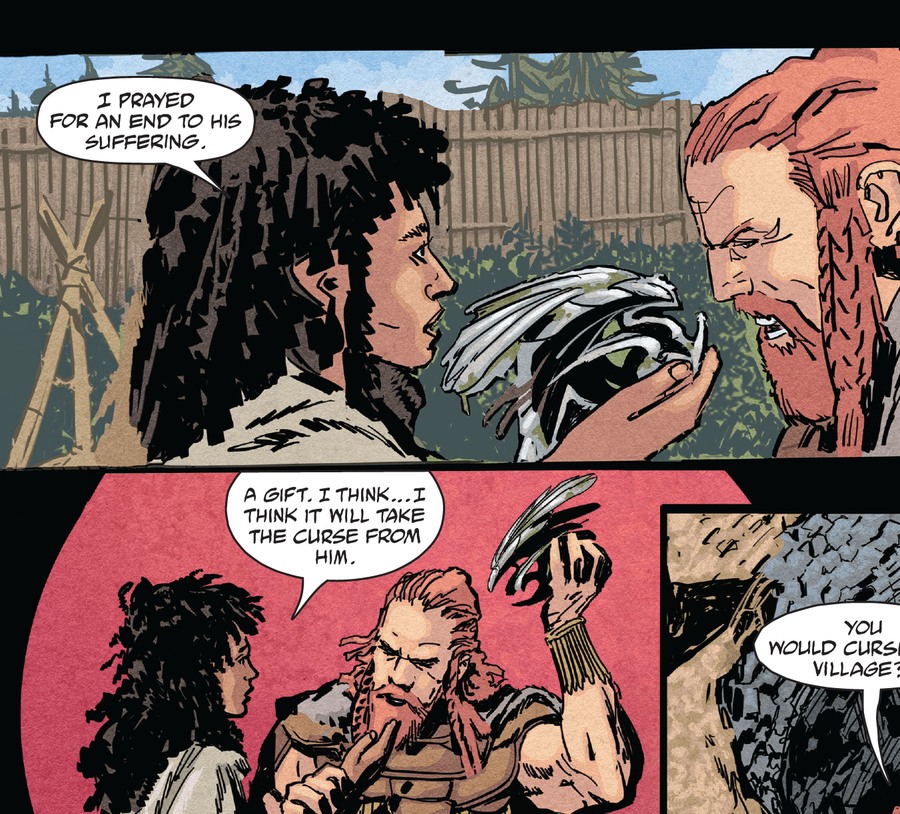
When B's mother understands that the condition is not ordinary strength, she prays again. This second prayer asks for release from the curse. A pale, bird-shaped relic appears or is recovered in connection with the prayer. The object becomes known on this site as Mother's Gift. Its exact material and mechanism are unknown, but its narrative function is clear: it is an attempt to give B a choice that the father and the tribe refuse to give him.
The gift does not immediately remove B's powers. The family conflict interrupts the intended act, and the relic survives into the modern expedition. The object's survival lets the comic connect the emotional memory of the childhood cave to a physical recovery in the Nefud Desert. It also prevents the origin from being reduced to a flashback. B's beginning remains present as evidence that can be handled, photographed, and placed beside Source-linked machinery.
Death of the mother and collapse of the family
B's mother dies after trying to protect him from the role his father has assigned. The scene fixes the emotional cost of the origin. B does not remember the birth of his powers as a gift without qualification. He remembers a mother who called the condition a curse, a father who called it an advantage, and a community that accepted the father's interpretation because it needed a fighter.
After the mother's death, B's original family and village cease to be a home. He remains useful to the tribe, but usefulness is not belonging. The pattern of leaving, losing, and seeking another relationship begins here and repeats across the historical vignettes. The origin page should include the death as a turning point rather than placing it in a separate biography with no connection to B's cosmology.
Modern reconstruction
Diana's memory protocols allow B to revisit the origin in controlled sessions. The process is not a neutral playback. B has buried some memories, and the questions create emotional and physiological stress. Caldwell treats the memories as clues to a biological and geographic origin. Diana treats them as both evidence and trauma. Their different purposes shape what the modern team believes it knows.
The Saudi expedition provides the strongest physical corroboration. The team reaches the prehistoric valley and recovers Mother's Gift at or near the ancestral cave. The discovery confirms that at least some of B's recurring images correspond to surviving objects and locations. It does not prove that every remembered detail is literally accurate. The comic continues to distinguish between a memory, a narrator's interpretation, and a machine's output.
Source, Pollinator, and parentage
The Source appears in the final arc as a cosmic intelligence or field capable of communicating with B and affecting the conditions of his life. B calls it Father in the context of contact, while other language names it the Pollinator. These names suggest a relationship, but they do not establish a human family structure. The Source may seed life, alter organisms, or use a process that creates many kinds of descendants.
The origin therefore has two parents in different senses. B's mother supplies human birth, care, and the intention that he be free. The Source supplies the intervention that changes his biology. His human father supplies the social role that turns the result into a weapon. The conflict among these three forces is more useful than a simple parentage diagram because it explains both B's abilities and his identity.
What remains unknown
The comic does not reveal the Source's original location, the full reason it answered the prayer, the exact composition of Mother's Gift, or whether B was the first human affected by the phenomenon. It does not identify a complete species of Source hybrids or prove that B's children inherit the same condition in the same form. It also leaves open whether the lightning was deliberate communication, a side effect of a larger process, or a local event that the Source later recognizes.
These unknowns are not errors in the record. They are part of the origin's design. B wants a scientific answer because he hopes an answer will provide a cure. The story gives him evidence, contact, and a chance at mortality without turning the mystery into a solved laboratory formula.
An origin made from competing meanings
B's beginning is told by people who want different things from the same event. His mother sees a child who has been placed under a curse and tries to protect him from the role the tribe assigns. His father sees a providential weapon and interprets every impossible recovery as confirmation that the boy belongs in battle. Much later, Caldwell sees a biological problem that might be solved, while Diana sees a frightened person trying to remember the first moment at which his life stopped being his own. The Source, when B finally encounters it, supplies a perspective older and larger than all of them, but its presence does not erase the human meanings attached to B before he could speak.
That conflict explains why the origin cannot be reduced to the lightning strike. The lightning changes the conditions of B's existence, yet the tribe turns that change into a social identity. The name Unute, the training, the praise after violence, and the expectation that he will stand between the community and its enemies all come after the cosmic event. A different family might have interpreted the same child differently. The story leaves open what B would have become without a father who needed a champion, but it makes clear what he became under that pressure.
The early chapters establish the pattern that governs the series: other people repeatedly claim that B's body belongs to a larger cause. A village claims him for defense. A king claims him for conquest. A cult claims him for prophecy. A government claims him for research and national security. Even the modern promise of a cure contains a bargain, because the people who can help B expect access to the thing that makes him unique. The origin is the first version of the consent problem that drives the contemporary plot.
The mother's resistance
B's mother is the first person in the story to insist that survival is not the same as blessing. She recognizes the danger in the way the tribe looks at her son. The accelerated birth and rapid growth make him extraordinary, but they also make it easy for adults to stop treating him as a child. Her second prayer is an attempt to return choice to him before the tribe's expectations become permanent. Mother's Gift matters because it is an act of care, not because the comic supplies a technical explanation for its power.
Her resistance gives B's later wish for mortality an emotional origin. He does not begin wanting an ordinary death after a scientific briefing. He inherits the desire from a mother who believes an endless life imposed on a person is a curse. When B reaches the Source, he is not merely asking how his cells work. He is asking whether the interpretation placed on him at birth can finally be refused.
The body as inherited evidence
The origin is visible in the body long before anyone understands it. B heals from wounds that should be fatal, grows with impossible speed, and survives conditions that would destroy a normal human organism. Later experiments isolate pieces of this condition in blood, tissue, and engineered bodies. Franken-B demonstrates the horror of treating that evidence as a transferable material: a body assembled from B's biology can be made to move, but it does not possess the history, agency, or consent that make B a person.
Diana's children complicate the idea of inheritance. Their accelerated development and unusual eyes suggest that the Source-linked condition can pass into a new generation, but the comic does not state that they are simply smaller versions of B. Their existence shifts the origin from a single ancient accident toward a continuing family history. B's fear is no longer only that he cannot die; it is that the thing he never chose might be carried by people he loves.
The beginning of B's life remains active in the final pages. The modern family, the Source encounter, and the possibility of mortality all return to the same unresolved question: can a person escape the meaning others gave to his body? BRZRKR answers with choices—B's mother's attempt to protect him, Diana's decision to stand beside him, and B's refusal to let survival remain the only definition of his life.
Appearances
- BRZRKR #2-4 - first prayer, lightning contact, accelerated birth, Unute's childhood, the father's training, second prayer, Mother's Gift, and the mother's death.
- BRZRKR #1-7 - Diana's memory protocols and Caldwell's historical reconstruction of B's origin.
- BRZRKR #10 - expedition to the prehistoric valley and recovery of Mother's Gift.
- BRZRKR #11-12 - Source contact, Pollinator language, and the final movement toward mortality.
See also
- B / Unute
- B's Mother
- B's Human Father
- B's Conception
- Lightning Contact
- Mother's Bird-Shaped Gift
- Quantum / Contact Realm
- Saudi Expedition
References
[1] Keanu Reeves, Matt Kindt, Ron Garney, Bill Crabtree, and Clem Robins, BRZRKR #2-4 (BOOM! Studios, 2021), prehistoric prayer, lightning contact, accelerated pregnancy, B's childhood, and the family's collapse, digital page images 001-024 across the issues.
[2] Reeves, Kindt, Garney, Crabtree, and Robins, BRZRKR #1-7, Diana's memory protocols, B's testimony, Caldwell's research, and the government's search for an origin and cure.
[3] Reeves, Kindt, Garney, Crabtree, and Robins, BRZRKR #4, Mother's Gift, the argument over B's condition, and the death of B's mother, digital page images 002-024.
[4] Reeves, Kindt, Garney, Crabtree, and Robins, BRZRKR #10, Saudi expedition, ancestral cave, recovered relic, and the physical corroboration of B's memory, digital page images 001-024.
[5] Reeves, Kindt, Garney, Crabtree, and Robins, BRZRKR #11-12, Source contact, Pollinator language, B's cosmic parentage, and the mortality sequence, digital page images 001-046 across both issues.