Selected scenes
BRZRKR in pictures.
Spoilers: This article discusses B's prehistoric childhood, the origin of the name Unute, the wars fought by B's tribe, the death of B's mother, and the collapse of B's first family.
| Field | Details |
|---|---|
| Name | Not stated |
| Common designation | B's human father; tribal chief |
| Species | Human |
| Gender | Male |
| Status | Fate after B abandons him is not established in the original series |
| Era | Approximately 80,000 years before the modern storyline |
| Home | Prehistoric valley settlement |
| Family | B's mother; B / Unute as social and presumed son before cosmic parentage is understood |
| Position | Tribal chief and military leader |
| Affiliation | B's prehistoric tribe |
| First appearance | BRZRKR #2 |
| Major appearances | BRZRKR #2-4 |
| Primary-source status | Directly depicted canon |
Overview
B's human father is the tribal chief who raises Unute as his son and becomes the first authority figure to convert B's impossible body into an instrument of organized violence. He is not B's biological progenitor in the cosmic sense revealed later in the series, but he is B's father socially, culturally, and psychologically. His decisions create the template that kings, armies, cults, governments, and scientists will repeat for the next eighty thousand years: identify B's extraordinary capabilities, define a collective emergency, and persuade or compel him to solve it through violence.
The original series never states his personal name. A definitive encyclopedia should therefore resist secondary labels and use B's Human Father or Tribal Chief. The term “human father” is useful because later issues establish a second paternal dimension, the nonhuman Source that B addresses as “Father” during the quantum/contact sequence.[4] The prehistoric chief nevertheless remains the father who shaped B's first understanding of purpose, duty, approval, and exploitation.
He is more complex than a simple abusive patriarch. At the beginning, his community is genuinely vulnerable. Neighboring groups raid the valley, steal food, and abduct people. He lacks sufficient weapons and manpower to stop them. When B's mother proposes appealing to ancestral gods for a weapon, the chief initially doubts that help will come. When the cave event is followed by pregnancy, however, he accepts the child and helps raise him.[1]
The tragedy begins when B's abilities become visible. The chief recognizes that B heals quickly, matures at an accelerated rate, and can concentrate extraordinary physical force. He arranges training, encourages the boy to focus his energy, and increasingly defines him by a mission. In BRZRKR #3, the chief explains the term Unute as a word that carries the meanings of tool and weapon. The name is not merely affectionate. It makes B's utility into identity.[2]
What begins as defense expands into conquest. Each victory produces another rationale for war. The mother's growing concern is answered with promises that the conflict is almost over. B eventually recognizes the pattern and tells the chief directly that he is not being treated as a son but as a weapon used to make the chief's fortune.[3]
Tribal leadership before B
The chief is introduced in a community under sustained pressure. BRZRKR #2 depicts a valley settlement that experiences recurring raids. The attackers take harvests and people, leaving the chief to confront a basic political failure: he cannot guarantee the safety of those he leads.[1]
His initial response is pragmatic and pessimistic. He knows the tribe lacks superior weapons, numbers, or resources. When B's mother proposes asking the gods for intervention, he questions whether divine aid has ever meaningfully favored them. His skepticism makes the later exploitation of B more revealing. He is not initially portrayed as a religious fanatic. He becomes convinced by results.
The mother's first prayer is not solely an individual act detached from the household. The chief participates by allowing and protecting her entry into the ancestral cave. After the encounter, he comforts her. When pregnancy follows, the two interpret it as the answer they sought. The child enters the family as both son and hoped-for solution to a communal crisis.[1]
Fatherhood and the discovery of B's abilities
B's extraordinary development quickly changes the family's balance. His body heals almost immediately after injury. He grows rapidly. His emotional regulation, however, does not advance at the same speed.
The chief begins to shape that power. BRZRKR #2 indicates that B is trained by an older teacher who gives him a way to focus his violent pressure into hunting and combat. B's narration also states that his father teaches him how to focus his energy. After the teacher dies, the chief tells B that the time for learning is over, effectively moving him from training into active war.[1]
This moment is essential to understanding the chief. He does not merely react to a child who happens to fight. He oversees a program of weaponization. B is trained, given targets, and taught to interpret his internal compulsion as a resource that can be directed toward the tribe's enemies.
At the same time, the chief can display paternal warmth. In early scenes he comforts B, reassures him, and expresses pride. The problem is not that affection is completely absent. It is that affection becomes inseparable from usefulness. B learns to ask whether he has done well after killing. Approval follows successful violence.
That mixture is psychologically more consequential than open hatred would have been. B spends millennia encountering rulers and handlers who repeat the same structure, praising him as long as his violence serves their purposes.
The meaning of Unute
In BRZRKR #3, the father explains that the people call B Unute, a term carrying the meanings of tool and weapon.[2] The name crystallizes the father's worldview.
For the chief, the designation can be understood as praise. B is the means by which the settlement survives. He is what the gods provided when ordinary tools were insufficient. Yet the word erases distinctions between person, instrument, and mission.
B's mother recognizes the danger. She tells B that he is a gift, but B asks whether she prayed for a son or for Unute. The question also implicates the father. He has increasingly taken the answer to the prayer and defined its value through military function.
The name later becomes complicated by B's own use of it. Diana calls him Unute, and the Source-contact sequences use it as a meaningful identity. It is therefore not accurate to say the father permanently reduces the word to an insult. The original context, however, is undeniably instrumental. B's earliest understanding of the name is bound to being a weapon.
From defense to conquest
The chief's strongest possible defense is that B's first campaigns protect a vulnerable population. The comic does not erase the raids or pretend that the tribe faced no danger. What condemns the chief is the expansion of the mission after immediate defense becomes possible.
Once B's power changes the balance, the tribe prospers. The father begins planning attacks beyond direct retaliation. He argues that security requires eliminating threats before they can return. The mother's questions reveal how the logic expands: how many villages must be destroyed before enough is enough?[2]
The father's answers rely on temporariness. The fighting is almost finished. The valley will soon be safe. One more action will secure the future. This rhetorical pattern becomes one of the series' most persistent structures. Modern government handlers likewise promise B that cooperation will eventually produce the answer he wants.
B's father is therefore not important merely as a historical character. He establishes the original model of the bargain: serve our purpose now, and afterward you may have peace.
Conflict with B's mother
The relationship between B's parents deteriorates as their interpretations of the child diverge. Both participated in the first appeal for help. After B's birth, however, the mother increasingly sees his condition as suffering while the father sees it as a strategic gift.[2][3]
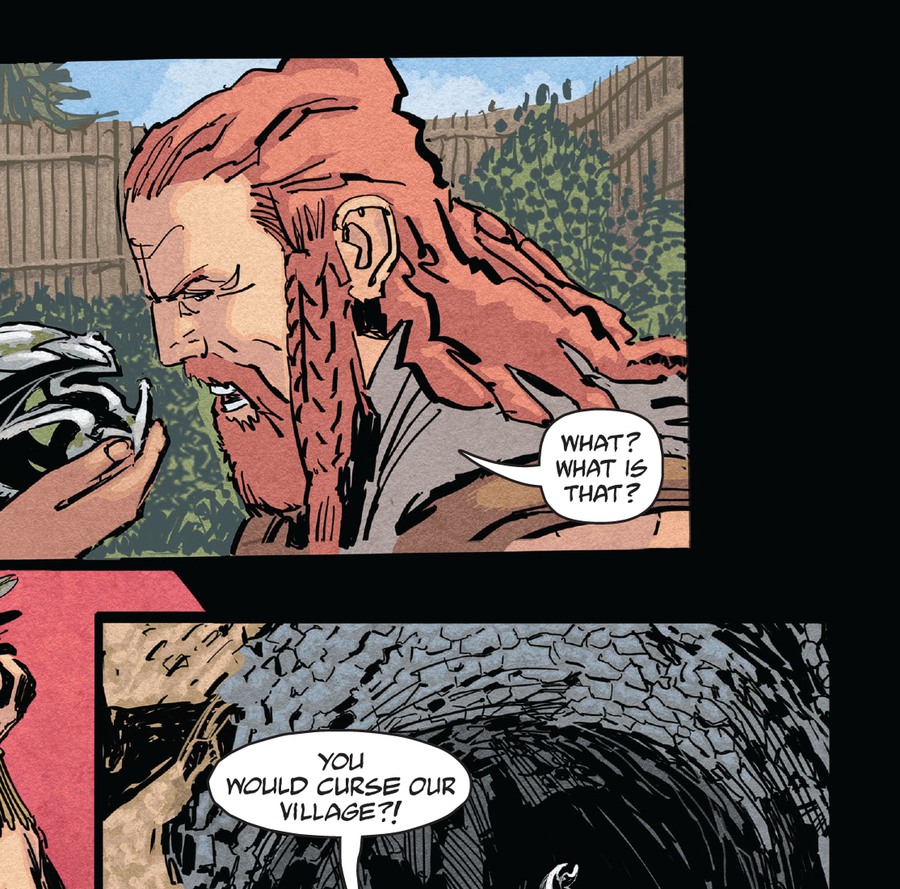
She tells the chief that the killing is wearing on B. He answers that B is capable and that the campaign is nearly complete. She returns to the ancestral cave and asks for an end to B's suffering. When she emerges with the bird-shaped relic that she believes can take the curse from their son, the father rejects the premise. From his perspective, the condition is not a curse. It is the foundation of the tribe's power.[3]
The disagreement is fundamentally political. If B becomes ordinary, the father's military order collapses. The mother's attempt to free her son threatens not only a supernatural condition but the chief's authority and the security system built around it.
When B approaches, the mother begins to explain what she has done. The chief cuts the exchange short as reports of another threat arrive. Whether he intends permanently to prevent her from using the relic is not stated, but his behavior preserves B's weaponized status at the decisive moment.
“I am the weapon you use to make your fortune”
B ultimately names the dynamic himself. Before the catastrophic final battle, he tells the chief that he is not his son. He is the weapon the man uses to make his fortune.[3]
The line is important because it rejects the chief's ability to hide exploitation inside family language. The father can genuinely love B and still exploit him. He can genuinely fear for the tribe and still transform defensive necessity into ambition. B's accusation holds both truths at once.
The chief responds that B is the only thing standing between their people and ruin. This is the argument authority figures will make throughout B's history. His capabilities create responsibility. If he can prevent disaster, refusing to fight becomes difficult to distinguish from causing the disaster.
B's mother answers differently. She tells him he does not have to go. He asks whether he will always be her son, and she confirms that he will. The juxtaposition is deliberate: one parent defines B by utility, the other by relationship.
Collapse of the tribe and death of B's mother
The wars culminate in catastrophe. B returns to find the settlement devastated and his mother dying. The father survives the immediate destruction and describes the event as a trap.[3]
B says his mother did not deserve what happened. The father answers that “we” deserve it, acknowledging at least some causal relationship between the tribe's aggressive expansion and the retaliation that destroys them. This is one of the few moments in which the chief appears to confront the consequences of his strategy without qualification.
B rejects shared guilt. He tells the father that he deserves the consequences. The distinction protects the mother's moral status and places responsibility on the man who turned B's power into an engine of conquest.
B then leaves. The original series does not show him killing the chief, nor does it establish the chief's later fate. Claims that B murders his human father at this moment should therefore be excluded unless a later primary source explicitly supplies that event.
Later legacy
The father's importance extends far beyond his limited chronological appearances. B's psychological relationship to orders, handlers, and institutional bargains can be traced back to this childhood. The chief teaches him that approval follows usefulness and that peace is always deferred until after the next violent task.
Historical rulers repeat the pattern. Modern government officials repeat it with more sophisticated language. Caldwell converts it into a scientific program. Even well-intentioned allies must work against B's learned assumption that his value lies in what he can destroy.
The father's influence also shapes the final issue by contrast. B and Diana become parents to twins whose development mirrors B's accelerated childhood. B observes that history rhymes or mirrors itself. The difference is that the children are not immediately assigned a military mission. Their parents confront the possibility of disappearance rather than surrendering them to an institution.[5]
The original series therefore gives B an opportunity to break the father's cycle. His children inherit extraordinary traits, but B does not call them weapons.
Relationship with B
B's relationship with the chief begins as ordinary dependence and evolves into profound alienation. The father is a source of instruction, approval, discipline, and social identity. He teaches B to focus his energy and places him inside a larger communal purpose.
For a child with accelerated growth and abnormal violent pressure, that guidance initially provides structure. The problem is that the structure is not designed to help B discover his own purpose. It channels him into the father's.
B later remembers the relationship with enough pain to use it as the template for understanding exploitation. When he says “I am the weapon,” he is articulating the first version of a conflict he will repeat for millennia.
Relationship with B's mother
The chief's partnership with B's mother begins in shared concern for the tribe. Their first prayer belongs to a common crisis. Their later conflict grows from different responses to the answer.
He sees B's immortality and power as a gift to their people. She sees the same condition becoming a curse to their son. The conflict demonstrates that the original request contained incompatible goals: save the community and preserve the child's personhood.
The series does not establish whether the chief deliberately causes the mother's death. He says the final attack was a trap, and B's accusation is moral rather than a specific charge of murder. The family conflict does not support an additional homicide claim.
Relationship with the Source
The chief is not shown making direct contact with the Source. He witnesses the aftermath of B's mother's cave encounter, accepts the pregnancy as an answer from the gods, and later benefits from the child produced by that event.[1]
His importance to Source mythology is indirect. He supplies the human social system that turns cosmic intervention into military function. The Source may provide potential, but the chief defines the first purpose imposed on that potential.
This becomes especially relevant in the ending, when “pollination” is associated not simply with violence but with spreading technology, ideas, and memory. The chief's interpretation of B's purpose is therefore narrower than the cosmic function eventually suggested by the series.
Personality and leadership
The chief is pragmatic, ambitious, paternal, controlling, and capable of self-justification. He responds to real threats and demonstrates the qualities needed to lead a threatened community. He also becomes intoxicated by the strategic possibilities B creates.
He is not depicted as sadistic for its own sake. His violence has political logic. That logic is what makes him dangerous. Every escalation can be explained as necessary for security, and every conquest makes the next conquest easier to rationalize.
His later statement that “we deserve this” suggests the capacity for remorse or recognition. Whether that recognition changes him is unknown because B leaves and the narrative follows the son rather than the father.
Skills and abilities
The chief has no supernatural abilities. He appears physically capable, understands tribal warfare, directs scouts and fighters, and possesses enough martial knowledge to teach B how to focus his energy. He also arranges or supervises training through B's childhood teacher.[1]
His most significant ability is organizational rather than physical. He turns B from an extraordinary child into the central strategic asset of a community. That organizational weaponization is the model later institutions refine.
Appearance
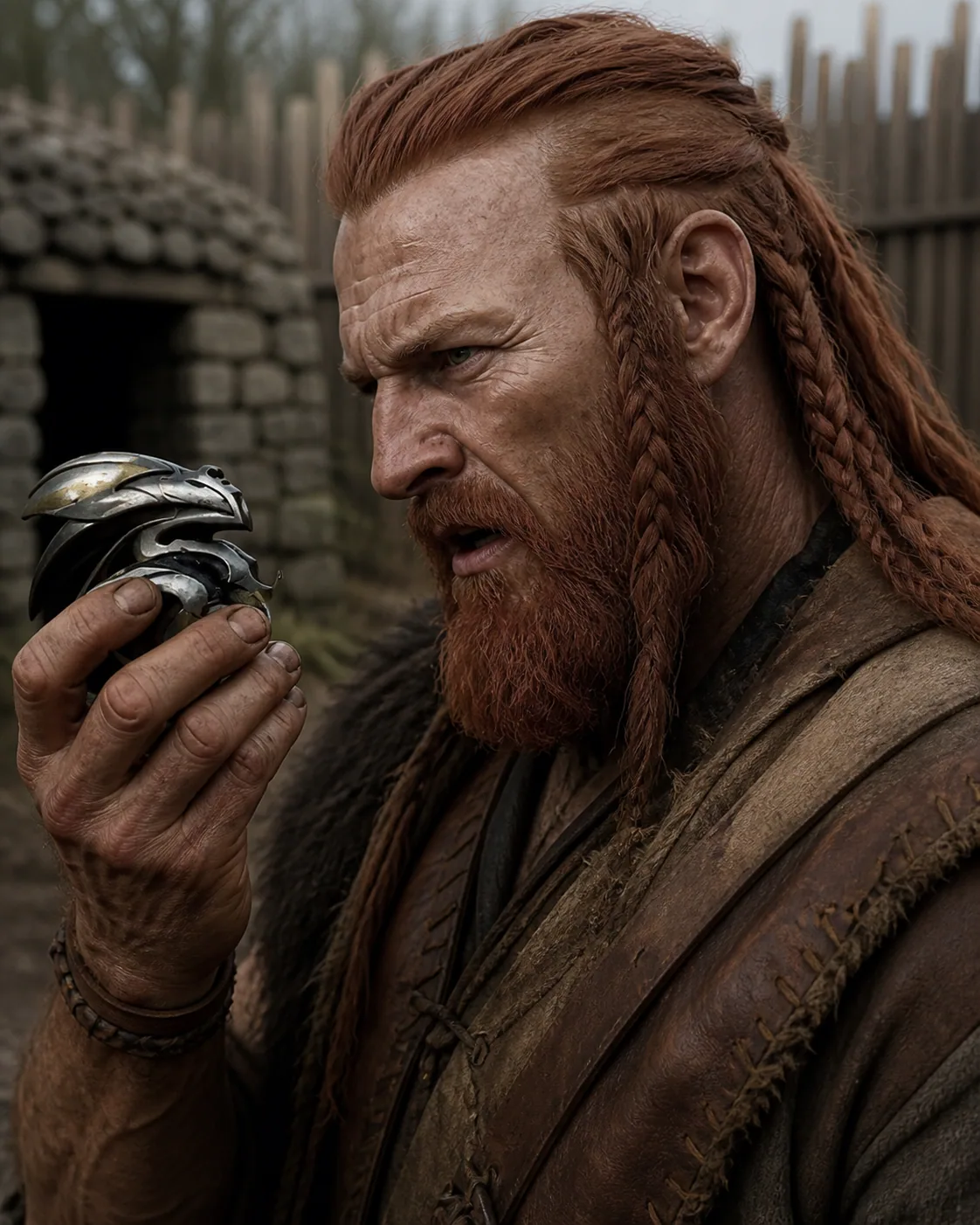
The chief is depicted as a tall, muscular prehistoric man with reddish or light hair and beard, usually wearing simple wrapped or hide-based clothing. His visual contrast with B's dark hair helps distinguish the social father from the later cosmic explanation of B's origin without requiring the comic to state biological doubt during the childhood sequences.
Appearances
- BRZRKR #2: Introduced during the village crisis, participates in the first prayer, raises B, oversees his training, and transitions him into war.
- BRZRKR #3: Explains the name Unute, expands the tribe's conquests, and clashes with B's mother over the continued use of their son.
- BRZRKR #4: Opposes the mother's attempt to remove B's curse, calls B back into battle, survives the destruction of the settlement, and is abandoned by B after the mother's death.
- BRZRKR #12: His influence is echoed thematically when B becomes the father of rapidly developing children and refuses to repeat the same weaponizing pattern.
Fate and unresolved questions
The chief's ultimate fate is unknown. B leaves him after the destruction of the settlement, and the original twelve-issue series does not return to him as an older man or corpse. It is reasonable to assume he eventually died as an ordinary human, but the manner, timing, and circumstances are not established and should not be presented as canon.
The series also does not state whether he ever understood that B's biological father was nonhuman, whether he knew what Mother's Gift could do, or whether he regretted weaponizing B after the catastrophe.
References
[1] Keanu Reeves, Matt Kindt, Ron Garney, Bill Crabtree, and Clem Robins, BRZRKR #2 (BOOM! Studios, 2021), prehistoric origin and training sequence, digital page images 004-013.
[2] Reeves, Kindt, Garney, Crabtree, and Robins, BRZRKR #3 (BOOM! Studios, 2021), Unute naming, expanding conquests, and parental conflict, especially digital page images 004-008.
[3] Reeves, Kindt, Garney, Crabtree, and Robins, BRZRKR #4 (BOOM! Studios, 2021), second prayer, Mother's Gift, family confrontation, destruction of settlement, and B's abandonment of his father, especially digital page images 003-014.
[4] Reeves, Kindt, Garney, Crabtree, and Robins, BRZRKR #9 (BOOM! Studios, 2022), quantum/contact sequence in which B addresses the nonhuman entity as “Father.”
[5] Reeves, Kindt, Garney, Crabtree, and Robins, BRZRKR #12 (BOOM! Studios, 2023), birth and accelerated development of B and Diana's twins.