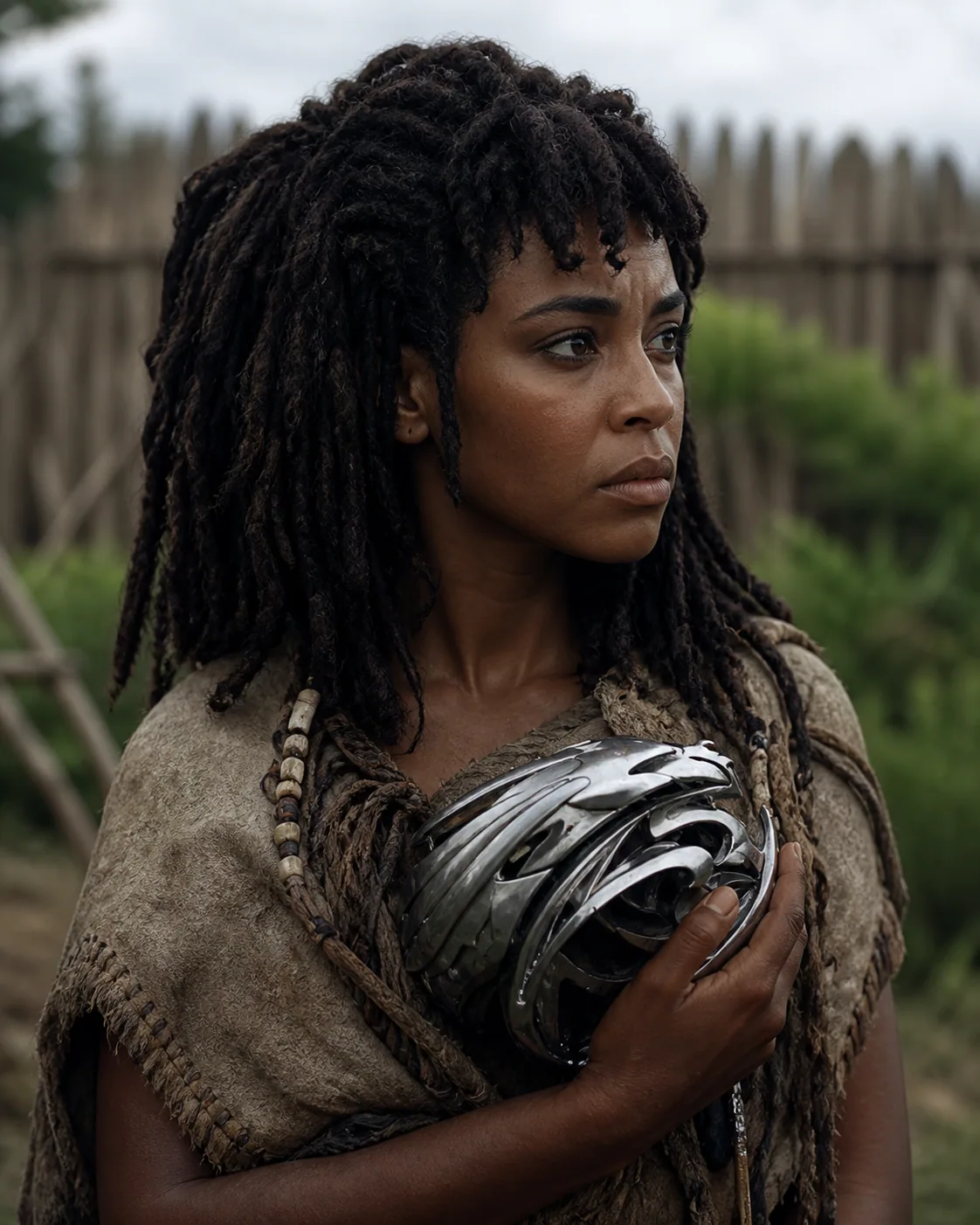
Selected scenes
BRZRKR in pictures.
Spoilers: This article discusses B's prehistoric origin, the prayers that led to his conception, the bird-shaped relic associated with his mortality, the destruction of his first home, and the circumstances of his mother's death.
| Field | Details |
|---|---|
| Name | Not stated in the original twelve-issue series |
| Common designation | B's mother |
| Species | Human |
| Gender | Female |
| Status | Deceased |
| Era | Approximately 80,000 years before the modern storyline |
| Home | B's prehistoric valley settlement |
| Family | B's human father, B / Unute |
| Role | Mother of B; petitioner whose prayers precede B's conception; moral counterweight to B's weaponization |
| Affiliation | B's prehistoric tribe |
| First appearance | BRZRKR #2 |
| Major appearances | BRZRKR #2-4 |
| Primary-source status | Directly depicted canon |
Overview
B's mother is one of the most important figures in the mythology of BRZRKR despite appearing only in the early prehistoric flashbacks. She is the human parent whose attempt to save a vulnerable community begins the chain of events that produces B, and she is also the first person shown trying to separate the child from the function others impose on him. Her story establishes nearly every moral tension that follows B across eighty thousand years: protection becoming conquest, love becoming possession, miraculous power becoming military utility, and the difference between a person and the purpose assigned to that person.
The original series never supplies her personal name. That absence is significant for an encyclopedia entry because later characters repeatedly identify B through titles, functions, programs, and theories while his mother is remembered primarily through his relationship to her. The safest canonical title is therefore B's Mother rather than assigning a speculative prehistoric name. The comic does, however, give her a distinct personality, a clear role in B's conception, and a decisive place in his psychological development.[1]
When her village is repeatedly raided by surrounding groups, she refuses to accept the cycle as inevitable. In BRZRKR #2, she tells B's human father that their people cannot continue living under seasonal attack. Women and children are taken, food stores are stolen, and the community lacks the weapons, numbers, and resources to impose security by conventional means. The father sees those limitations as facts. B's mother looks elsewhere. She turns to the ancestral cave and the gods of her people, asking for something capable of changing the balance of power.[1]
The answer does not remain confined to religion. The series later reframes the event through science and first-contact imagery. Her prayer is followed by an encounter presented through lightning, altered perception, cosmic imagery, and conception. B is born soon afterward. By the end of the series, the intelligence connected to that contact is understood as a nonhuman Source or progenitor associated with a wider process of seeding, contact, memory, and technological propagation. B's mother therefore stands at the meeting point of prehistoric faith and cosmic intervention. She experiences the event as an answer from the gods, while modern researchers eventually interpret the same event as contact with an intelligence operating according to principles they only partly understand.[1][7]
Her importance extends beyond B's birth. Once B's human father recognizes what the child can do, he begins turning him into a weapon. B's mother resists that transformation more consistently than anyone else in the prehistoric household. She insists that he is still a boy, worries about the psychological effect of repeated killing, and finally returns to the ancestral cave to ask for an end to his suffering. Her second prayer produces the bird-shaped object often referred to in planning material as Mother's Gift. In the comic itself, the object is shown and described as a gift that she believes can take the curse from her son. It becomes a crucial link between B's prehistoric origin and the modern effort to make him mortal.[3][6]
Life before B
Very little is established about B's mother's life before the raids shown in BRZRKR #2. The comic does not identify her parents, birthplace, age, social rank, or occupation. It does establish that she belongs to a settled or semi-settled prehistoric community living in a valley vulnerable to organized predation. The community grows food, stores harvests, raises families, and suffers recurring attacks from neighboring groups that are militarily stronger.[1]
Her dialogue suggests that she is not passive within the household. She argues directly with the tribal chief, who is also her partner and B's social father. She challenges his assumptions about what can be done, questions the continuation of war once immediate survival has been secured, and later confronts him over his treatment of their son. These exchanges establish a relationship in which the chief possesses political and military authority, but she retains enough standing to oppose him openly.[1][2][3]
The first origin sequence is structured around a practical crisis rather than abstract religious devotion. The village has been attacked repeatedly. B's mother does not pray because she seeks personal status, wealth, or immortality. She wants a means of protection. Her initial request is therefore rooted in care for a community, but the wording and consequences create an ambiguity that defines the series. She asks for a weapon powerful enough to stop the raids. What arrives is a child.
The first prayer
In BRZRKR #2, B's mother tells the tribal chief that they need to seek help beyond their existing resources. The father is skeptical. From his perspective, the gods have not intervened for them before, and the gods of their enemies appear no less distant. She argues that the gifts they need may lie elsewhere and insists that if the gods grant them a weapon, he must be strong enough to wield it.[1]
She enters the ancestral cave alone. The father promises to watch and allow her safe passage. What happens inside is shown through fragmented, visionary imagery rather than explained in conventional terms. There is contact, light, a violent electrical phenomenon, and imagery that modern observers would interpret differently from the prehistoric participants. The sequence is deliberately positioned between miracle and first contact. The mother herself does not have the vocabulary to distinguish extraterrestrial, quantum, divine, or technological agency. To her, the answer belongs to the gods.[1]
The comic later emphasizes this interpretive gap. Modern science can describe impossible amino acids, quantum behavior, and energetic phenomena in B's body, but those descriptions do not invalidate what his mother experienced. The prehistoric religious account and the modern scientific account are two cultural frames placed around the same unexplained encounter. This makes B's mother the first human witness to the Source event in the comic chronology.
After the cave episode, the father comforts her and tells her to be patient, that the gods work in varied ways. Soon afterward she is pregnant. She interprets the pregnancy as the answer to their prayer. The father eventually does the same, but his understanding of what has been granted differs sharply from hers. For the mother, the child is a gift. For the father, the child's abilities become a strategic resource.[1]
Pregnancy, birth, and B's accelerated development
The series does not present a conventional birth sequence or establish the exact length of the pregnancy. It does make clear that B's development is abnormal from the beginning. His body matures with extraordinary speed, and injuries heal almost immediately. When the young B is hurt, his mother witnesses wounds closing with a speed that confirms he is unlike any ordinary child.[1]
Her response is maternal rather than experimental. She holds him, worries about him, and reacts to his pain. That distinction matters because later institutions repeatedly study B as a biological event. His mother is the first person to encounter the impossible body and still frame it as the body of her son.
The father quickly moves in the opposite direction. As raids continue, he tells B that defending the settlement is his mission and purpose. B's mother objects that he is not ready. Her objection is not presented as disbelief in his strength. She has already seen him heal. Her concern is that physical capability is not the same as emotional readiness. The boy may be able to kill, but she understands that he is still a child.[1]
This becomes a recurring theme throughout the series. B's body matures faster than his social and emotional life. Other people use the maturity of his body as permission to give him adult or superhuman responsibilities. His mother is one of the few characters who distinguishes what he can do from what should be demanded of him.
The child as gift and weapon
By BRZRKR #3, the tribe has begun using B as the decisive force in its wars. His father calls him Unute, a word the story associates with both a tool and a weapon. The village prospers under B's protection and conquest, but the original defensive purpose expands. B is no longer merely preventing raids. His father begins pursuing continued dominance over neighboring communities.[2]
B's mother sees the shift. She tells B that he is a gift and explains that she prayed to the gods before his birth. B's response cuts directly to the question that will define his identity: did she pray for a son, or did she pray for Unute?[2] The question exposes the moral danger inside the original prayer. Even his mother, who loves him most clearly as a child, participated in asking for a weapon. B's existence is therefore inseparable from a request that instrumentalized him before he was conceived.
Her later actions can be read as an attempt to repair that original mistake. She cannot undo his birth, nor does she wish that he did not exist. What she tries to undo is the condition that makes him endlessly available as a weapon.
Her conflict with the tribal chief intensifies. She asks how many villages must be destroyed before he considers their people safe. She tells him that the killing is wearing on B and reminds him that B is only a boy. The father answers with promises that the fighting is nearly over and that the valley will be secure. The pattern resembles later governments and rulers who tell B that one more campaign, one more mission, or one more experiment will finally produce the desired end.[2]
The second prayer and Mother's Gift
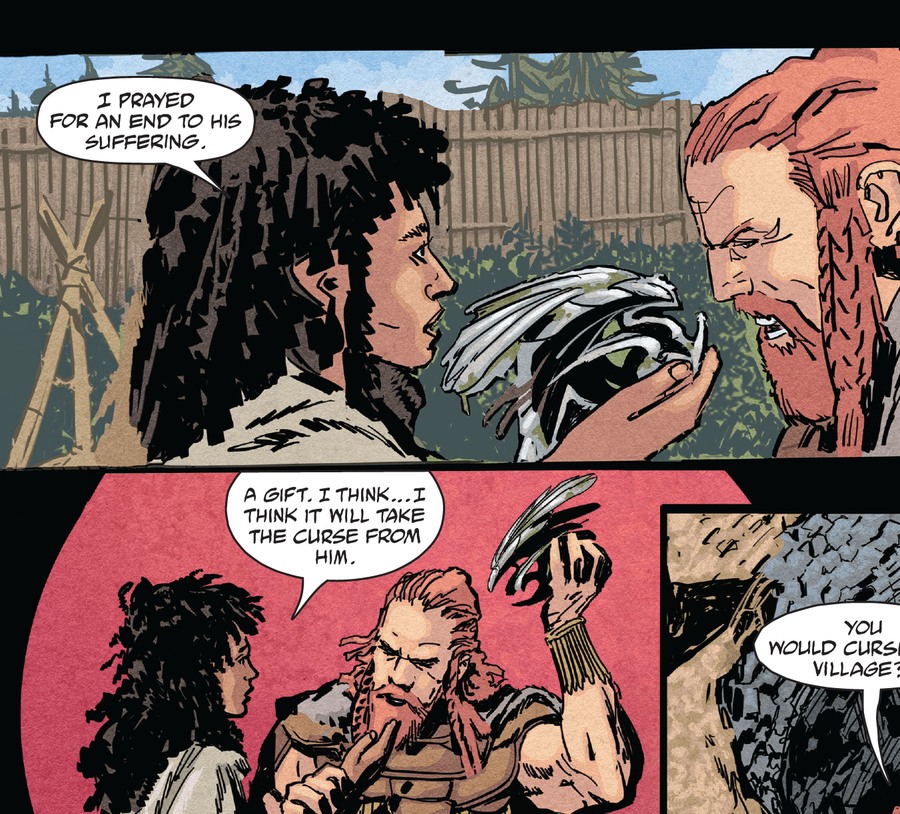
BRZRKR #4 reveals that B's mother returns to the ancestral cave. This second visit is not a repetition of the first request. She no longer asks for a weapon. She asks for an end to her son's suffering.[3]
The resulting object is a pale, bird-shaped or feather-like relic. She tells the father that it is a gift and believes it can take the curse from B. The comic does not clearly give the object a formal name in the original series. Mother's Gift or bird-shaped relic are therefore descriptive terms, while “the Bird” remains an alias rather than an unquestioned canonical proper noun.[3]
The father's reaction reveals how far the parents' purposes have diverged. He sees B's condition as a gift to the village. She sees the same condition as a curse experienced by their son. The disagreement is not about whether B is extraordinary. It is about who has the right to define the meaning of that extraordinary nature.
When B arrives, his mother tries to tell him that she has prayed on his behalf. The father cuts the conversation short as scouts report another threat. The moment prevents her from fully explaining the relic or giving B the choice she intended. Thousands of years later, the modern storyline returns to the site of his origin and recovers the object, allowing her unfinished act to influence the conclusion of his life.[3][6]
“You are my son”
As the final prehistoric battle begins, B rejects the father's language of family. He tells the tribal chief that he is not his son, but the weapon the man uses to make his fortune. The line makes explicit what the series has been showing: B has learned to interpret his father's affection through exploitation.[3]
His exchange with his mother is different. She tells him he does not have to fight and reminds him that he is her son. B asks whether he will always be her son. Her answer is affirmative. The scene gives B a form of identity not dependent on military usefulness. Whatever he does, and whatever he becomes, she claims him as family rather than as an asset.[3]
That assurance echoes through later relationships. Diana's eventual ability to treat B as a person rather than a specimen resembles the role his mother once occupied. The closing arc, in which B becomes a parent, also gives him the chance to respond differently to children who develop extraordinary abilities.
Death
The destruction of the prehistoric community culminates in the death of B's mother. B returns to the settlement and finds her mortally wounded. The father describes what happened as a trap. The scene is deliberately painful because B has perfect memory but has buried or repressed this particular event for tens of thousands of years. When the memory returns, so does the first great personal loss of his life.[3]
B says that she did not deserve what happened. The father answers that “we” deserve it, linking the disaster to the violence and conquests that preceded it. B separates his mother from that collective guilt. He tells the father that he deserves the consequences and walks away.[3]
The comic does not depict B killing his father in this scene. Nor does it establish that his mother's death permanently destroyed the community in one single event. What it does establish is that B leaves the family structure that made him a weapon. The mother's death marks the emotional end of his childhood and the beginning of the long solitary history that follows.
Legacy in B's memory
B's mother survives in the series through memory, unfinished intention, and the recovered relic. She is one of the earliest memories that Diana helps him reach, and the fact that he had buried her death despite otherwise extraordinary recall indicates the depth of the trauma.[3]
Her influence becomes especially important when the series asks whether B's violent purpose is intrinsic or imposed. His father and later institutions repeatedly define him through what he can do. His mother repeatedly insists on what he is to her. She does not deny his power, but she refuses to make power the entire definition of the child.
Her second prayer also changes the meaning of the first. The same person who asked for the weapon later asks for release from weaponhood. In narrative terms, the original series can be understood as B finally completing the request his mother was unable to complete during his childhood. He reaches the truth of his origin, reconnects with the Source, and becomes mortal.
Relationship with B
B's relationship with his mother is the earliest unconditional familial bond shown in the original series. It is not uncomplicated. B knows that his existence follows directly from her request for a weapon, and BRZRKR #3 allows him to confront her with that fact. Yet the story distinguishes her intention from the uses to which B is later put.
She provides care when he is injured, resists the acceleration of his military training, tries to halt the expanding wars, and seeks a means to relieve his condition. Her love is therefore expressed not by denying the violence around them but by repeatedly trying to remove B from it.
B's later choice to become mortal is deeply consistent with the wish she expresses in the second prayer. His final family life with Diana and their children also gives him a form of belonging that his mother wanted for him but could not protect.
Relationship with B's human father
B's parents begin from a shared crisis. Both want their people to survive. The first prayer is presented as a joint household decision even though the mother is the one who enters the cave and undergoes contact.[1]
Their priorities diverge after B's abilities become clear. The father increasingly identifies B with security, conquest, and prosperity. The mother increasingly identifies him with suffering, childhood, and the right to a life beyond fighting. Their marriage therefore becomes an early dramatization of the series' larger conflict between utility and personhood.
The story does not present the father as incapable of affection. He comforts his partner after the cave event, shares her belief that the pregnancy may be an answer, and at times promises that violence will end. The tragedy is that he repeatedly permits political need and ambition to outweigh the personhood of his son.
Relationship with the Source
B's mother is the first human in the original chronology shown initiating the contact that leads to B. The exact mechanics remain partly unknown. She experiences a prayer, a cave, lightning, and conception. Later science identifies impossible properties in B and eventually reaches an intelligence associated with his origin.[1][4][5]
The comic does not establish that she understood the Source as extraterrestrial or technological, nor that she had an ongoing relationship with it after conception. Her second prayer nevertheless appears to produce another intervention, Mother's Gift, suggesting that whatever channel of contact existed in the cave could be accessed more than once.[3]
Personality
B's mother is portrayed as determined, compassionate, practical, and morally forceful. She is willing to challenge both social limits and her partner's authority when survival is at stake. Her first prayer reveals desperation and boldness. Her later resistance to conquest reveals that she does not confuse survival with domination.
She also demonstrates the ability to revise her own understanding. The request that produces B solves one problem but creates another. Rather than insisting that the original miracle must remain good because she asked for it, she recognizes B's suffering and seeks a remedy. That willingness to reconsider is one of her defining traits.
Her fear for B does not make her powerless. She repeatedly argues against the chief, enters the cave twice, and attempts to secure a future for her son that the existing social order cannot provide.
Abilities and knowledge
B's mother has no confirmed supernatural powers of her own. She performs or participates in ritual prayer and survives direct contact with the phenomenon associated with B's conception, but the series does not depict her controlling the Source or possessing lasting altered abilities.
Her most important form of knowledge is cultural. She knows the ancestral cave, the traditions through which her people seek divine help, and the ritual context that allows her to frame the encounter. Whether those traditions were themselves influenced by earlier Source contact is not established.
Appearance
She is depicted as a prehistoric woman with dark, curly hair, practical clothing appropriate to the settlement, and a physically active presence within the village. Her appearance remains consistent across the flashbacks in BRZRKR #2-4. Because the series spans memories reconstructed through B, an encyclopedia should avoid treating minor differences in coloring or panel style as evidence of changing costume or chronology unless explicitly stated.
Appearances
- BRZRKR #2: First major origin sequence. The village crisis, first prayer, cave contact, pregnancy, B's early healing, and her objection to his premature use as a weapon.
- BRZRKR #3: Tells B that he is a gift, confronts the widening war, and questions the cost of the father's plans.
- BRZRKR #4: Reveals the second prayer, produces Mother's Gift, affirms B as her son, and dies during the destruction of the prehistoric community.
- BRZRKR #10-12: Her influence returns indirectly through the expedition to B's birthplace, recovery of Mother's Gift, and B's eventual mortality.
Status and unresolved questions
Her death is unambiguous within the original series. What remains unresolved is the full nature of her contact with the Source. The story does not specify what she consumed or used during the original ritual, whether the cave had been a prior contact site, whether her people possessed inherited knowledge of the Source, or how the second prayer produced the bird-shaped relic.
The most important unanswered question is therefore not whether she loved B, which the comic makes clear, but how much she understood about the force she contacted. The Source's later “pollinator” function suggests a much larger system than she could have conceived, yet her actions become the point at which that cosmic process intersects a particular human family.
References
[1] Keanu Reeves, Matt Kindt, Ron Garney, Bill Crabtree, and Clem Robins, BRZRKR #2 (BOOM! Studios, 2021), prehistoric origin flashback, digital edition page images 004-013.
[2] Reeves, Kindt, Garney, Crabtree, and Robins, BRZRKR #3 (BOOM! Studios, 2021), family and tribal-conquest flashbacks, especially digital page images 004-008.
[3] Reeves, Kindt, Garney, Crabtree, and Robins, BRZRKR #4 (BOOM! Studios, 2021), second-prayer, Mother's Gift, final battle, and death-of-mother sequences, especially digital page images 003-014.
[4] Reeves, Kindt, Garney, Crabtree, and Robins, BRZRKR #9 (BOOM! Studios, 2022), B's contact with the entity he addresses as “Father.”
[5] Reeves, Kindt, Garney, Crabtree, and Robins, BRZRKR #10 (BOOM! Studios, 2022), government research, origin-location work, and hypercomputer program.
[6] Reeves, Kindt, Garney, Crabtree, and Robins, BRZRKR #10-11 (BOOM! Studios, 2022), expedition to the region of B's birth and use of the bird-shaped relic in the mortality/contact operation.
[7] Reeves, Kindt, Garney, Crabtree, and Robins, BRZRKR #12 (BOOM! Studios, 2023), retrospective explanation of the intelligence that sent B and the “pollinator” purpose.