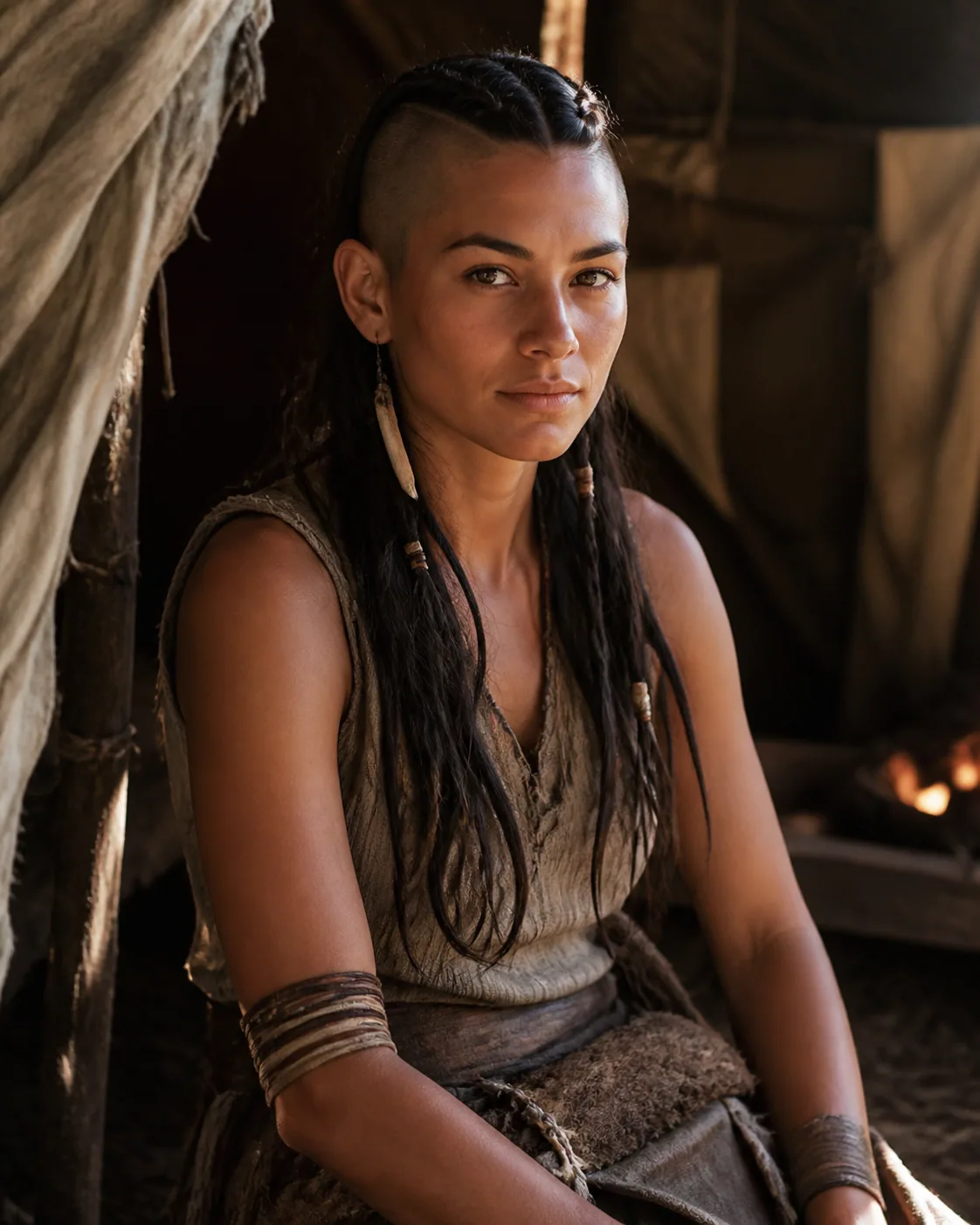
Selected scenes
BRZRKR in pictures.
Spoilers: This article discusses B's first known romantic relationship, the birth of his first child, his execution during that period, and the later original-series ending involving Diana and their twins.
| Field | Details |
|---|---|
| Name | Not stated |
| Common designation | B's first love |
| Species | Human |
| Gender | Female |
| Status | Deceased by the modern era; exact circumstances of death are not stated |
| Era | Early in B's post-prehistoric wandering, many thousands of years before the modern storyline |
| Partner | B / Unute |
| Children | B's first known child |
| First appearance | BRZRKR #5 |
| Primary-source status | Directly depicted canon, limited biographical data |
Overview
B's first love is the unnamed woman whom B identifies in BRZRKR #5 as his earliest known romantic partner. Her brief appearance is one of the most important expansions of B's biography beyond warfare because it establishes that his first attempts at building a human life begin very early in his long existence. Before governments, laboratories, modern therapy, or Diana Ahuja, B already tries to form a relationship, becomes a father, and discovers that immortality makes ordinary continuity almost impossible.
The comic does not name the woman, identify her people, specify a geographic location, or provide an exact date. B remembers the period only as a time when he was young, far from home, and years removed from the prehistoric family he abandoned. Those limits should remain visible in a comprehensive reference entry rather than being replaced with unsupported historical labeling.[1]
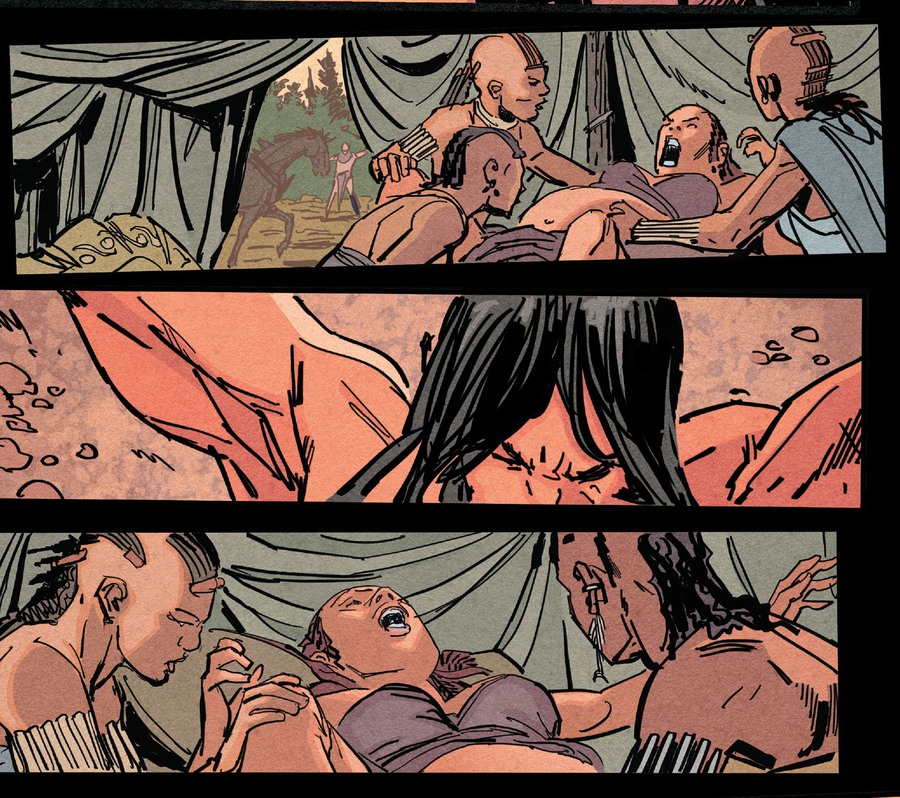
She enters B's recovered memory during a sequence in which Diana is asking him about relationships, attachment, and the possibility of family. The memory begins with B among people who do not receive him well. His violent nature remains difficult to contain, but within the same setting a woman gives birth to a child he fathered. B identifies her in narration as “my first love.”[1]
The birth and B's violent death are intercut. He is captured and executed with extreme brutality while the woman labors. The sequence makes the central problem of his early relationships literal: ordinary human milestones and B's endless cycle of violence occur simultaneously. He can father a child, love a woman, and imagine a future, but he also remains a being whose body draws fear, exploitation, retaliation, and repeated death.
B later says he never saw the child and only learned the child's fate afterward. The comic does not reveal that fate in the original twelve-issue run.[1] The first love is therefore central to two major unresolved areas in the chronology: the identity and later life of B's first child, and the circumstances that separated B permanently from this earliest family.
Meeting B
The memory in BRZRKR #5 occurs after B has left the prehistoric home where his mother died and where his father used him as a tribal weapon. B describes himself as young and far from home.[1]
“Young” is relative for an immortal who has already undergone accelerated development and survived the destruction of his first family. The comic does not give an exact number of years since the events of BRZRKR #4. What matters is psychological chronology. B has not yet developed the later habit of assuming that intimacy is doomed.
The woman encounters a version of B who is still capable of believing that a relationship can become a future. That makes her position different from many later partners shown in montage. She is not simply another example in an established pattern. She is the relationship from which the pattern is learned.
The story does not show the first meeting or courtship. It also does not establish whether B disclosed his immortality, his past, or the nature of his violent compulsion before they became partners. Any reconstruction of a conventional romance would therefore exceed the source.
Relationship with B
B's narration calls her his first love rather than merely the mother of his first child. The wording establishes emotional attachment from B's point of view.[1]
That distinction is important because B's relationships are frequently framed by utility. His father treats him as a weapon, governments treat him as an asset, rulers use him as military force, and scientists study him as a biological anomaly. The first love belongs to a different category. She is remembered through affection.
The comic gives no dialogue between them in the preserved sequence, so the exact nature of their relationship must remain partly unknown. We do not know how long they were together, whether they married by the customs of her people, whether she knew he intended to remain, or whether conflict had already begun before the child's birth.
What the sequence does establish is that B retrospectively understands the relationship as the first time love produced a family connection he could not keep.
Pregnancy and the first child
The woman becomes pregnant with B's first known child. BRZRKR #5 depicts her in labor surrounded by other members of her community.[1]
The pregnancy is especially important in light of the series finale. For much of BRZRKR, B later comes to believe that propagation and an ordinary future are impossible for him. He watches mortal partners age, suffers the repeated collapse of relationships, and concludes that permanence is unavailable.
The first child proves that B is biologically capable of reproduction long before the modern storyline. What is unclear is what the child inherited. The original issue does not show accelerated growth, regeneration, glowing eyes, or any other B-like trait in the newborn.
This distinction matters when comparing the first child with the twins born to Diana in BRZRKR #12. The twins visibly develop at an accelerated rate and display unusual Source-linked features. The first child's biology remains unknown. It is possible the child inherited something from B, but the original series does not provide evidence strong enough to define the child as immortal or superhuman.
B's execution
While the woman gives birth, B is subjected to a brutal execution. Mounted figures pull his body apart, leaving him catastrophically dismembered.[1]
B narrates that the relationship “ended painfully,” and that although it was not the last such death, the first hurt the most. The pain operates on multiple levels. There is the physical agony of the execution, the emotional separation from his partner, and the permanent loss of the chance to witness the birth of his child.
The exact political reason for the execution is not supplied. B says he sometimes showed his true nature and was not well received. That suggests fear or hostility toward what he was, but it does not establish a specific charge, war, culture, or religious judgment.
A definitive biography should therefore describe the event as a hostile execution during the period of the birth, not as a confirmed punishment for immortality or berserker violence unless a future issue provides that explanation.
Separation from B
The first love survives at least long enough to give birth. What happens immediately afterward is not shown.
B says he never saw his child. That statement implies that the execution and subsequent regeneration separated him from the family before he could return to the newborn, or that circumstances later prevented reunion.[1]
The comic does not explicitly say whether B ever saw the mother again after the execution. His narration moves from the newborn to the broader lesson he learns over years of repeating similar mistakes. The safest reading is that this relationship does not become a lasting reunion.
The phrase “first love” also implies later partners. The issue presents a montage of women aging while B remains physically unchanged, followed by later relationships in different historical periods. The first love begins a pattern B needs years to understand.
Mortality and asymmetry
The first love is the earliest romantic character through whom the comic dramatizes the asymmetry of B's immortality.
Ordinary relationships assume shared time. Partners expect to age together, witness children grow, and move toward death on roughly compatible human scales. B cannot participate in that structure. Even when he is killed, he returns. Even when a relationship survives violence, his partner continues aging while he does not.
BRZRKR #5 depicts aging female faces around the first-family memory and then moves into later relationships. B says it takes years of making the same mistake before he realizes that a future available to others is impossible for him.[1]
The first love is therefore not only a lost person. She becomes part of the evidence from which B constructs his philosophy of isolation.
What B learns from the relationship
B's response to the loss is not immediate wisdom. He says it takes years and repeated relationships before he understands the pattern.[1]
That detail is important because it prevents the relationship from becoming a simple tragedy that instantly transforms him. B continues trying. He loves again. He watches partners age. He leaves later relationships more slowly and sometimes delays entering them because he already anticipates the ending.
The first love thus marks the beginning of a long education in impermanence.
The lesson B eventually extracts is that an ordinary future is possible for everyone but him. He stops asking the question “why?” in the same way and begins withholding himself from the normal cycle of family and propagation.
That conclusion shapes the emotional significance of Diana. Diana does not merely become another partner. The end of the original series overturns the rule B learned from his first love.
Comparison with Diana Ahuja
Diana and B's relationship occurs tens of thousands of years after the first love and develops under completely different circumstances. Diana knows from the beginning that B is abnormal. She studies his memories, physiology, and desire for mortality. Their bond grows out of disclosure rather than concealment.
The first love shows B before he has accepted that he cannot remain. Diana meets B after he has built much of his identity around that impossibility.
The decisive difference is mortality. With the first love, B remains immortal and cannot share the same temporal future. With Diana, the Source-transfer process eventually makes B mortal. He can therefore become a husband-like partner and father inside a finite life rather than standing outside the family's aging process.[2]
The twins born to Diana also demonstrate Source-linked accelerated development, which gives them a relationship to time closer to B's than the original first child is shown to have.
Comparison with B's mother
There is a structural parallel between B's mother and his first love. Both are unnamed women whose relationships with B anchor major transitions in his understanding of family.
His mother insists that he is her son rather than a weapon. His first love gives him the first opportunity to become a partner and parent rather than a weapon.
Both relationships are destroyed in environments of violence. B's mother dies during the collapse of the prehistoric wars. B's first love is separated from B by his own brutal execution during the child's birth.
The repetition helps explain why B comes to treat attachment as dangerous. Love does not merely end because mortals age. In his experience, violence repeatedly invades the spaces where family should exist.
Personality and characterization
The comic gives the first love very little direct dialogue, so personality claims must remain modest.
Her most significant characterization comes through context. She forms a relationship with B despite his outsider status, carries his child, and survives the birth sequence. She appears within a community that is suspicious or hostile toward B, creating a possible tension between her attachment to him and the surrounding culture.
Because B narrates from memory, the surviving account privileges his emotional experience over her independent biography. That limitation should be acknowledged. She is important to B's story, but the comic does not give enough evidence to claim her private motivations, beliefs, or later decisions.
Appearance
The first love is depicted as a dark-haired woman from an ancient, unspecified culture. During the birth sequence she wears clothing and hairstyle consistent with the generalized early historical setting of the memory.
The series does not identify the culture, and the visual design alone should not be used to assign a precise ethnicity, kingdom, or archaeological period.
The fate of the first love
Unlike the first child's fate, B does not explicitly say that he later learns what happened to the woman. She is mortal and would necessarily be deceased by the modern era, but her age at death, cause of death, and later life are not shown.
Her status can be summarized as deceased by the modern era; exact fate unknown.
It should not claim that she was killed by the people who executed B, died in childbirth, lived to old age, or raised the child alone. Each of those possibilities is compatible with the fragmentary sequence, but none is confirmed.
Legacy
Her legacy is enormous relative to her page count.
She is the first person B identifies as a romantic love. She is the mother of his first known child. Her relationship teaches him that emotional attachment cannot solve the temporal problem created by immortality.
The closing issue deliberately revisits those subjects. B becomes mortal, fathers twins with Diana, watches them grow rapidly, and eventually dies. The man who once believed a future was impossible finally participates in one, even if only briefly.[2]
The first love therefore belongs in the master pages for B's Relationships, Family of B, Children and Descendants of B, Immortality, and B Through the Ages. She is not a minor footnote simply because her name is unknown.
Appearances
- BRZRKR #5: Sole direct appearance. Identified by B as his first love during a recovered memory involving his early wandering, the birth of his first child, and B's execution.
- BRZRKR #12: No physical appearance, but the birth of B and Diana's twins and the family ending create a deliberate thematic contrast with the earlier failed family.
Canon limitations and unresolved questions
The original series does not establish:
- her name;
- exact date or era;
- exact location;
- ethnicity or political affiliation;
- how she met B;
- length of relationship;
- whether she knew B was immortal;
- whether she witnessed his regeneration;
- whether she saw B after his execution;
- her later life or death;
- the fate of the child she bore.
These are not deficiencies to be repaired with speculation. They are part of the surviving record of B's fragmented early history.
References
[1] Keanu Reeves, Matt Kindt, Ron Garney, Bill Crabtree, and Clem Robins, BRZRKR #5 (BOOM! Studios, 2021), first-love, execution, first-child, and relationship-montage sequence, especially digital page images 012-016.
[2] Reeves, Kindt, Garney, Crabtree, and Robins, BRZRKR #12 (BOOM! Studios, 2023), pregnancy, twins, accelerated development, B's mortality, and family epilogue.