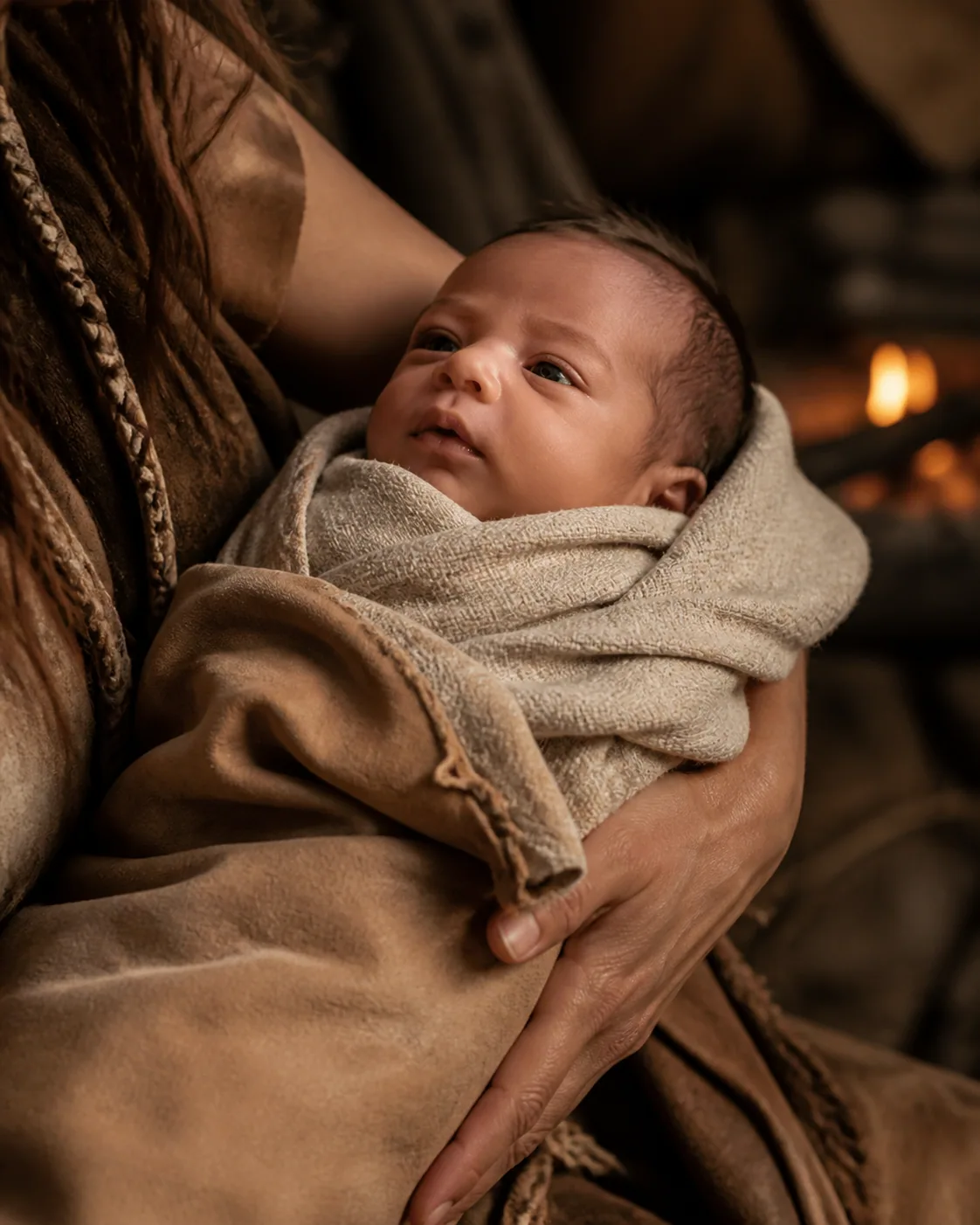
Selected scenes
BRZRKR in pictures.
Spoilers: This article discusses B's first known child, the circumstances of the child's birth in BRZRKR #5, the unresolved fate of this early family line, and the later children born to B and Diana in BRZRKR #12.
| Field | Details |
|---|---|
| Name | Not stated |
| Canonical designation | B's first child |
| Species / nature | Human child of B and an unnamed human woman; inherited traits unknown |
| Gender | Not established in the original series |
| Status | Unknown |
| Era | Early in B's post-prehistoric wandering |
| Parents | B / Unute; B's first love |
| Siblings / half-siblings | B and Diana's son; B and Diana's daughter |
| First appearance | BRZRKR #5 |
| Primary-source status | Directly depicted canon, extremely limited biography |
Overview
B's first child is the unnamed infant born to B and the woman he identifies as his first love in BRZRKR #5. The child appears for only a few panels, yet the birth is one of the most consequential facts in B's eighty-thousand-year biography because it establishes that B was capable of fathering a child long before the modern storyline and that his later belief that he could not have a future was psychological and experiential rather than simple biological sterility.
The original series does not reveal the child's name, gender, adult appearance, lifespan, powers, descendants, or ultimate fate. B states that he never saw the child and only later learned what happened.[1] The issue does not then disclose the information he learned. A definitive encyclopedia must therefore make the unresolved status central rather than filling the gap with family-tree speculation.
The child is born while B is being violently executed by members of the surrounding community. The panels intercut new life and catastrophic death. B's body is torn apart at the moment his first family is beginning. The juxtaposition captures the central paradox of his existence: his body can return from almost any death, but that does not mean his relationships can be restored.
The first child also becomes much more significant retroactively after BRZRKR #12. In the finale, Diana gives birth to twins fathered by B. Those children develop at an accelerated rate, display unusual eye coloration and Source-linked qualities, and eventually leave to “plant our seeds.”[2] Their existence raises unavoidable questions about whether the first child carried any of the same inheritance. The original series does not answer them.
Birth
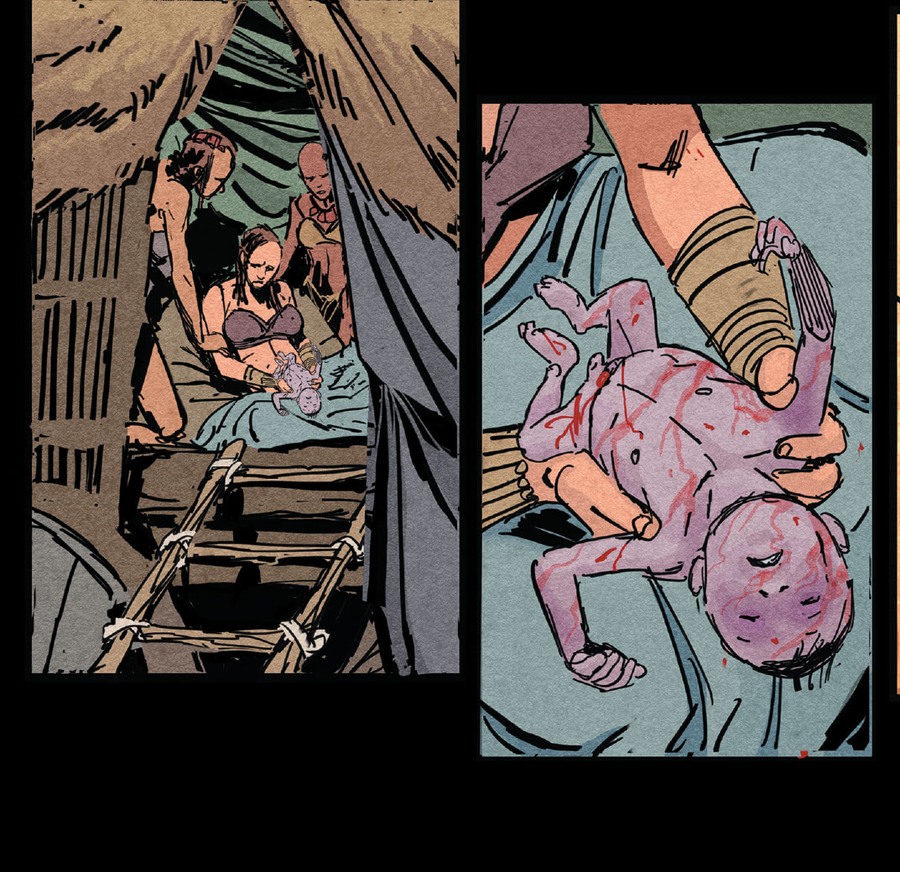
The child's only direct appearance occurs in a recovered memory in BRZRKR #5. B is living far from the prehistoric home he abandoned. He has formed a relationship with an unnamed woman whom he calls his first love.[1]
The woman goes into labor while B is in the custody of hostile people. The comic cuts between the birth and B's execution. The child is delivered alive and is shown being held shortly after birth.
There is no indication of obvious physical abnormality in the newborn. Unlike the twins in BRZRKR #12, the infant is not shown growing rapidly within the sequence, displaying glowing eyes, healing from injury, or exerting supernatural force.
This absence does not prove the child was biologically ordinary. The sequence ends before any long-term development is shown. It does mean that the encyclopedia should mark inherited powers as unknown, not assumed.
B never sees the child
B's most important statement about the infant is direct: he never saw his child.[1]
The line occurs after his execution and alongside the image of the newborn. It establishes a complete separation between biological fatherhood and lived fatherhood. B participates in the child's creation but not, so far as the original series shows, in the child's upbringing.
That loss helps explain why his later self-conception excludes propagation. B eventually tells Diana that a future is possible for others but not for him. The first child is evidence of what “future” means in this context. B can create life, but he cannot remain inside the ordinary social process that follows.
The reason for the separation is not explained in detail. B's execution, regeneration, outsider status, and hostility of the local community are all relevant, but the source does not specify whether he attempted to return, was prevented from returning, or deliberately stayed away once he understood the danger.
“Only later would I know its fate”
The most important unresolved statement is B's narration that only later would he know the child's fate.[1]
This confirms that information eventually reaches B. It does not tell the reader what the information is.
The line has sometimes invited speculation that the child died young, inherited B's condition, founded a bloodline, or became the origin of a later group. None of those possibilities is established in the original twelve issues.
The correct encyclopedia treatment is to preserve the wording as an unresolved canonical fact:
- B did not see the child at birth.
- At some later point, B learned what happened to the child.
- The original series does not reveal that fate.
If a later Bloodlines or other canonical publication returns to this family branch, that later evidence would need explicit continuity separation and a primary-source citation.
Parentage
The child's mother is the woman B calls his first love. No other parentage is suggested.[1]
B is the biological father. The series later reveals that B himself is a hybrid product of a human mother and a nonhuman Source or progenitor. That makes the child at least genealogically connected to the Source, but the biological consequences are unknown.
This point must be handled carefully. It is accurate to say the child is a descendant of B and therefore belongs to the Source-linked family line. It is not accurate to say the child inherited immortality, regeneration, or a specific percentage of Source biology.
Biological inheritance
The first child becomes an important test case for the franchise's hereditary logic.
B's body contains impossible characteristics investigated by the modern program. Later, B and Diana's twins clearly inherit unusual traits. Their growth is extremely fast, and their eyes display a red-and-blue difference associated visually with the Source-linked events of the finale.[2]
The first child is shown only as a newborn. No equivalent test is possible.
Several interpretations remain open:
- B's traits may have been inheritable all along.
- Diana's Source alteration may be necessary for the twins' visible inheritance.
- The first child may have inherited subtler traits not visible in infancy.
- The first child may have been ordinary despite B's biology.
- The later “pollinator” purpose may operate through culture and ideas as much as heredity.
The comic does not choose among these explanations for the first child.
Relationship with B
There is no lived relationship shown between B and his first child. That absence is the relationship's defining fact.
B knows he is a father. He remembers the circumstances. He later learns the child's fate. But he does not share the ordinary experiences of parenting.
This makes the child central to B's later emotional withdrawal. He does not merely fear watching lovers age. He has already experienced biological parenthood without access to the child.
When he becomes a father again in BRZRKR #12, the contrast is deliberate. B is present for Diana's pregnancy, the birth of the twins, their accelerated childhood, and their decision to leave. He gets to witness the family life denied to him the first time.[2]
Relationship with B's first love
The child's mother gives birth while surrounded by members of her community. The comic does not show her raising the child afterward, but she is the only confirmed caregiver present at the birth.
Her later fate is unknown. The original series does not establish whether she dies in childbirth, survives to raise the child, remarries, leaves the community, or communicates with B.
For family-tree purposes, the link should be simple and certain: child of B and B's first love.
Relationship with B and Diana's twins
The son and daughter born to B and Diana are the first child's much later half-siblings.
The original series never depicts contact between these branches. Given the enormous time separating them, the first child would be long dead if ordinarily human. If the first child inherited unusual longevity, the possibility changes, but that remains speculative.
The siblings are nevertheless linked thematically. Together they demonstrate that B's legacy is not confined to violence. He can produce descendants, and the final issue makes propagation part of the broader “pollinator” idea.[2]
The first child is the earliest confirmed branch of B's descendants, while the twins are the later confirmed branch; the evidence available for the two generations differs enormously.
Historical significance
The child's birth predates almost all of B's documented historical identities. It belongs to the early period after he leaves his prehistoric family.
That placement makes the child potentially important to any future story exploring B's ancient descendants. Even without later revelation, the event changes the interpretation of B's wandering. He is not merely an isolated immortal moving from battlefield to battlefield. At least once very early, he creates a human family line.
The series does not say whether he ever fathers other children between this first child and the twins. His later relationships are shown in montage, but no additional births are confirmed in the original twelve issues.
The correct count for original-series canon is therefore at least three confirmed children: the first child and the two twins.
Gender
The first child's gender is not clearly established in the reviewed primary-source sequence. The newborn is depicted visually but is not named or referred to with a gendered pronoun in the key narration.
The child's gender is unknown / not established unless a later primary source supplies a pronoun or identity.
Visual inference from an infant panel is not sufficient evidence.
Name
No name is provided.
Do not create a fan name.
Status
The child's ultimate status is unknown.
The child is born alive. B later learns the child's fate, but the reader is not told what it is. Because the birth occurs tens of thousands of years before the modern storyline, an ordinarily aging human would be deceased. However, because inherited longevity is unresolved, even the most obvious assumption should be separated from confirmed fact.
Recommended infobox language:
Status: Unknown; would be deceased by the modern era if ordinarily human.
This conveys chronology without converting an assumption into canon.
Appearance
The child appears only as a newborn, shown immediately after birth. The infant has no distinctive costume, weapon, or later design.
For an original illustration, the visual should focus on the birth and the unresolved family line rather than attempting to invent an adult form.
Narrative function
The child serves several functions in B's story.
First, the birth proves reproduction is possible.
Second, the separation establishes parenthood as another human experience immortality disrupts.
Third, the unresolved fate creates one of the oldest open genealogical questions in the franchise.
Fourth, the child becomes a retrospective mirror for the twins in issue #12.
Fifth, the child complicates the final “pollinator” interpretation. If B's deeper purpose involves spreading memory, ideas, technology, or life, the first confirmed descendant appears very early in his wandering, long before B understands any such purpose.
Comparison with the twins
The first child and the twins should not be treated as biologically identical without evidence.
First child:
- human mother not known to be Source-altered;
- newborn shown;
- no confirmed accelerated growth;
- no confirmed powers;
- fate withheld.
Twins:
- mother is Diana after direct Source/contact events;
- accelerated growth shown;
- unusual eyes shown;
- articulate a drive to “plant our seeds”;
- later montage links them to pollination, ideas, and future propagation.[2]
This contrast is central to the broader history of B's Descendants.
Unresolved lineage
Because the child's fate is unknown, the existence of descendants is also unknown.
No connection to Seline, Songaa, Caldwell's cult, or any other historical bloodline is established for this child.
The temptation is understandable because the franchise contains groups that track B across generations. Genealogical proximity, however, is not evidence of descent.
Legacy
The first child is one of the franchise's most important minor characters precisely because the comic withholds the answer.
For B, the child represents a future he could create but could not inhabit. For the wider mythology, the child proves that Source-linked biology can enter human genealogy at least through B's reproduction, even if the inherited effects remain unknown.
The finale turns that private loss into a larger question about continuity. B's later children deliberately leave to continue the line. The first child may have done so unknowingly thousands of years earlier.
Appearances
- BRZRKR #5: Birth, B's statement that he never saw the child, and the unresolved comment that he later learned the child's fate.
- BRZRKR #12: No direct appearance. The twins provide the primary comparative evidence for later Source-linked inheritance and descendants.
Questions requiring future canon
- What was the child's name?
- What was the child's gender?
- What fate did B later learn?
- Did the child inherit regeneration or longevity?
- Did B ever make contact later?
- Did the child have descendants?
- Is any later lineage in the franchise connected to this branch?
- Did the mother survive to raise the child?
- Was the first child's existence ever known to B's later cults or governments?
References
[1] Keanu Reeves, Matt Kindt, Ron Garney, Bill Crabtree, and Clem Robins, BRZRKR #5 (BOOM! Studios, 2021), first love, execution, birth, and unresolved fate sequence, especially digital page images 013-016.
[2] Reeves, Kindt, Garney, Crabtree, and Clem Robins, BRZRKR #12 (BOOM! Studios, 2023), twin pregnancy and birth, accelerated development, departure, and “pollinator” epilogue, especially digital page images 024-027 and 040-046.