Selected scenes
BRZRKR in pictures.
Scope: This page follows B's changing identities across the eras shown or narrated in the comic continuity.
The same body, different lives
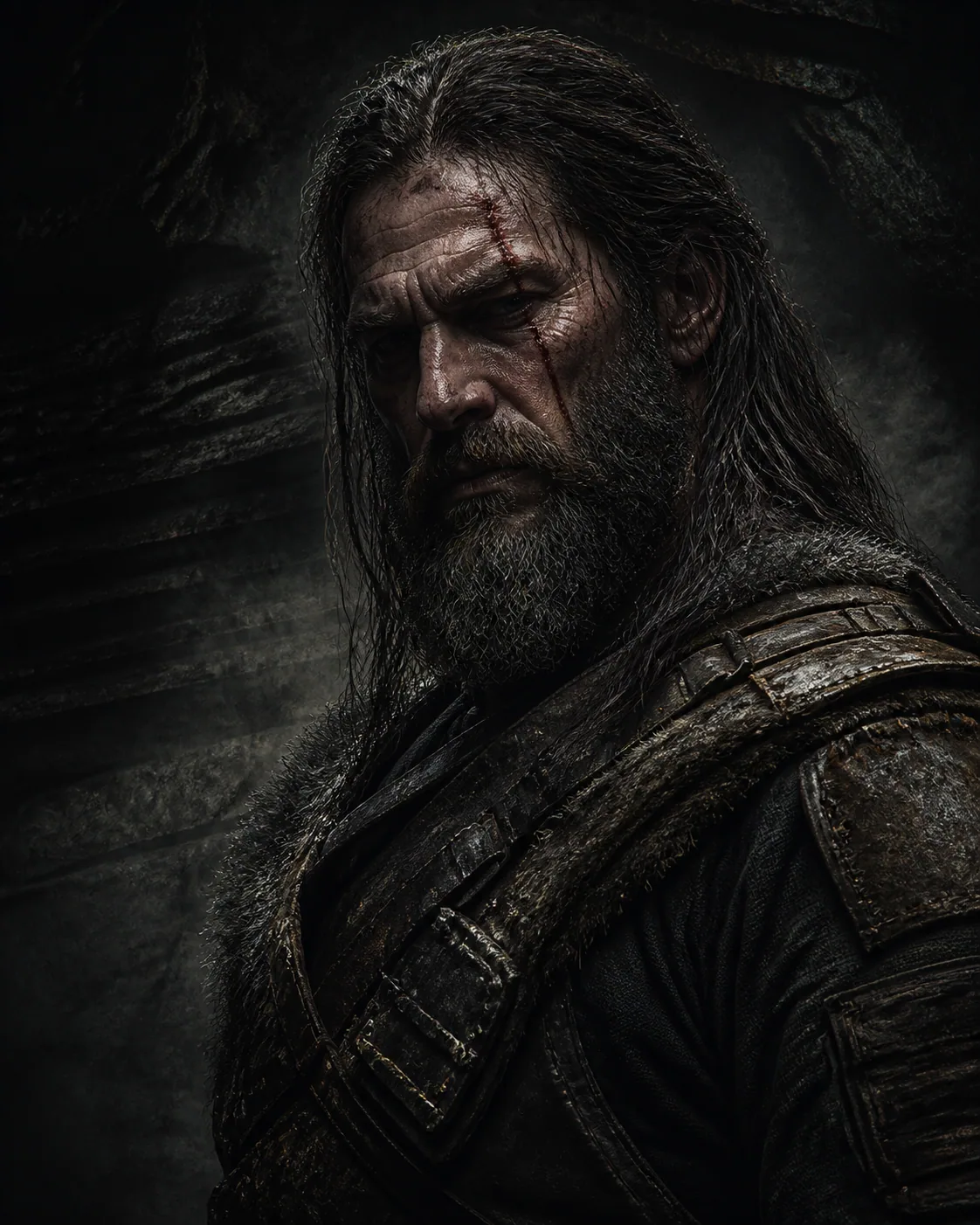
B lives for roughly eighty thousand years, but the person called B is not a single social role repeated unchanged. His body remains capable of regeneration while his names, loyalties, languages, relationships, and moral choices change. A prehistoric tribe calls him Unute. Atlantis treats him as a protector. Olos turns him into a captive spectacle. Genghis Khan's system uses him as an instrument. The modern government bargains with him. Diana asks him to remember. His children leave with a future he cannot control.
Placed beside one another, these identities show more than a change of costume. Each era asks what a community wants from an immortal and what B wants from the community in return. The same life can be a weapon in one chapter, a protector in another, and a father confronting the consequences of both roles.
Origin and Unute
The first identity is imposed by B's human father. After the lightning-linked conception and accelerated birth, the father names the child Unute, a word associated with a tool or weapon. B's mother sees a son whose condition may be a curse. The tribe sees a protector. B grows into a fighter before he has a chance to define himself.
Unute is therefore both name and training program. It says that B's body exists for collective security. The childhood teacher, first battles, and mother's death establish the emotional pattern that lasts for millennia: B is praised when he is useful and feared when he acts outside the role. The lightning and the cave explain where his condition begins; the name explains what the tribe expects him to become.
Prehistoric lover and parent
B's first love and first child reveal a life beyond the weapon. He experiences attachment, vulnerability, and the possibility of a home. The relationship ends in loss, and B returns to the movement of wars and conquests. The exact dates are approximate, but the emotional sequence is confirmed in the memory material.
The first family becomes a template for later relationships. B wants connection and expects it to be temporary. He protects people while believing that his survival guarantees their death. The pattern is not a biological law. It is a learned response to an immortal body surrounded by mortal lives.
Protector of Atlantis
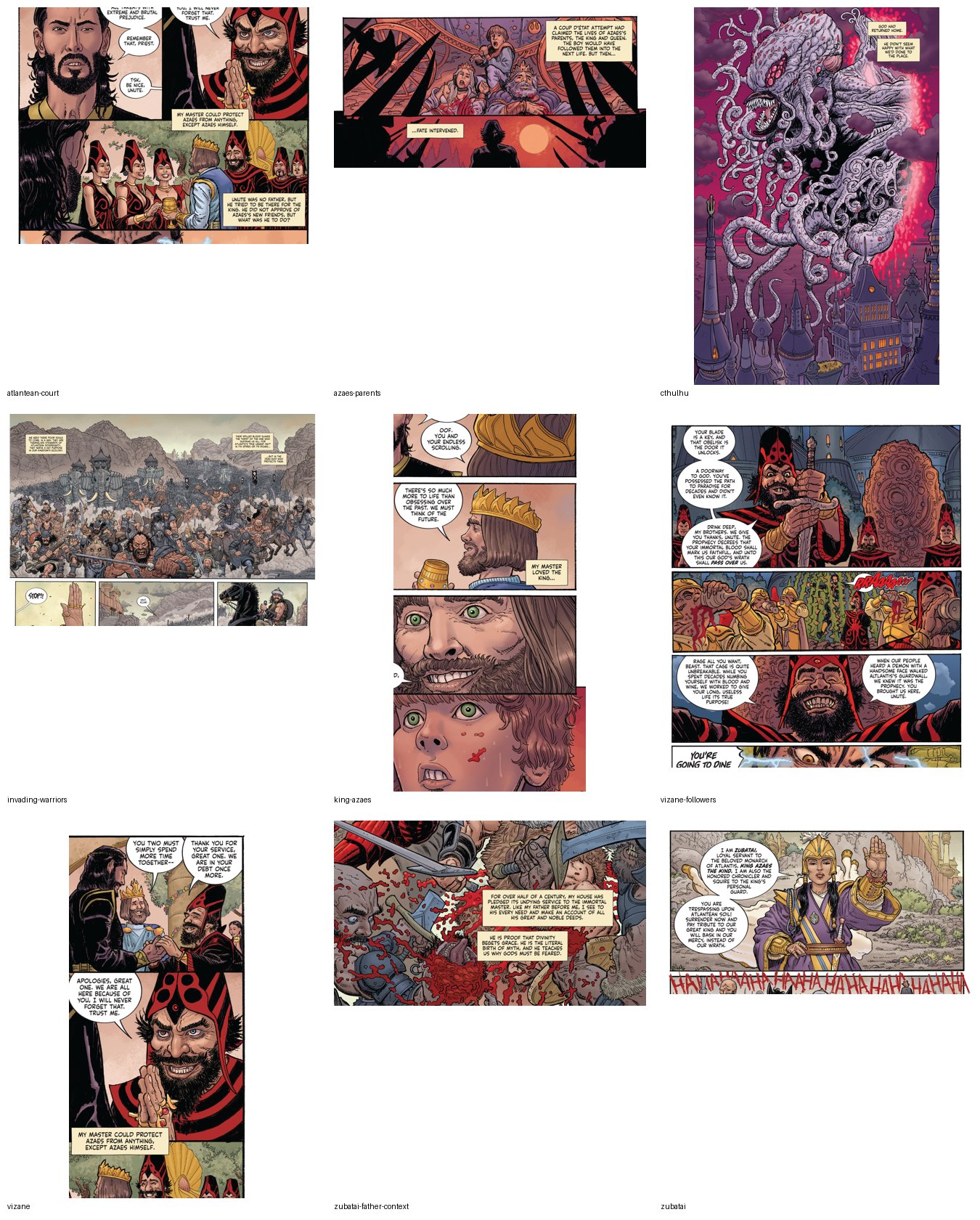
In Atlantis, B is Unute the Berserker and a public protector of King Azaes. The city welcomes him, celebrates victories, and compares his presence to divine protection. For a time, B has something resembling civic belonging. He walks among citizens rather than living only on a battlefield.
The identity fails when the court allows Vizane's ritual to use B's blood. Atlantis turns the protector into a component. B's assault on Cthulhu saves the city from the entity but cannot prevent the dying body from dissolving Atlantis. The era teaches B that a court can honor him and still treat him as property.
Captive of Olos and witness of Washukanni
Olos gives B a different role: prisoner, arena spectacle, and political possession. Asana sees his humanity, but the palace and military system continue to control him. Washukanni and the surrounding campaigns show the wider cost of that system. Cities fall, rulers change, and B survives with the memories.
The Olos identity is not “the lover” alone. B is a captive inside a structure that turns intimacy into another means of control. Asana's confession and death become part of the cycle that began with his mother and first love.
Historical weapon and myth
Across Babylonia, Mediterranean routes, late antiquity, and medieval campaigns, B appears as a weapon, monster, angel, god, or protector depending on the witness. The cult's network preserves and manipulates those titles. Technology, tactics, and stories migrate with him, but the comic leaves open how much is deliberate teaching and how much is later myth.
Zosimus's alchemical operation and Lugalṭur's inspiration show two responses to B's presence. One tries to reproduce his life through machinery and substances. The other turns a derived child into a source of historical stories. B's identity changes the world even when he is not consciously founding an institution.
Servant of Genghis Khan
B's association with Genghis Khan places him inside an empire whose scale makes individual violence strategic. He fights, travels, and uses opium to suppress pain and violent compulsion. The drug offers relief but also deepens dependency and reduces agency.
When B breaks from Genghis, he rejects a political identity that has made his body an imperial resource. The break does not erase the battles or the people killed. It is an act of refusal that anticipates the modern government's promise of mortality and the later decision to release Lugalṭur.
The Man in the Tree and American identities
The Man in the Tree is a name generated by a historical encounter rather than a title B chooses. Maybell, Winston Tunt, border ruffians, trappers, traders, and Civil War soldiers interpret him through local fears and stories. B becomes an apparition, a gunfighter, or an angel depending on who is speaking.
These identities show how quickly a community turns an unexplained survivor into a legend. The real Kansas–Missouri conflict and Mine Creek battlefield provide historical anchors, but the fictional B remains a separate layer. The Real History page explains the boundary.
Government asset
The modern United States B Program gives B a bureaucratic identity: asset, operative, subject, and bargaining partner. Keever handles missions. Diana works with memory and trauma. Caldwell studies biology and history while serving a cult agenda. B accepts operations because the program promises to pursue mortality, but the bargain is never equal.
The government identity exposes the continuity between ancient and modern exploitation. The tools are guns, laboratories, surveillance, and Protocol X instead of chains and arenas. The question remains whether B is allowed to choose what his body is for.
Subject, contact partner, and mortal
Protocol X changes B from research subject into contact partner. He disappears into the quantum/contact realm, communicates with Diana, and confronts the Source. The later expedition to his birthplace turns his memories into physical evidence. When B becomes mortal, he acquires a future that includes ordinary vulnerability and family responsibility.
Mortality does not erase the old identities. B remains the child called Unute, the protector of Atlantis, the prisoner of Olos, the weapon of empires, and the government asset in his memory. The final arc asks whether he can live as a person rather than a record of what others needed.
Father and ancestor
B becomes a father to children with Diana and a possible ancestor to a larger lineage. The children leave to propagate their seeds, and the relationship to the Source raises a cosmic as well as family meaning. B cannot command the future without repeating the control he suffered from his own father.
The final identity is therefore unfinished. He is a parent whose children may outlive him, a mortal who may or may not be finally dead, and a historical figure whose descendants can choose a different relationship to power.
The cost of accumulated identity
Each new title gives B a way to survive an era, but each title also leaves a burden. Unute makes childhood into training. Protector of Atlantis makes civic belonging dependent on military usefulness. Prisoner of Olos makes intimacy feel like another chain. The Man in the Tree turns a private encounter into a local legend. Government asset makes a contract look like consent. Mortal father and ancestor finally give B a role whose future depends on people he cannot command.
The identities overlap rather than replacing one another. B can be a soldier who remembers being a child, a father who fears becoming his own father, and a mortal who still feels the pressure of the berserker state. His perfect memory makes the overlaps unavoidable; no new title erases the wounds or obligations of the earlier one.
The names remain useful because each one carries a different memory. “Berserker” recalls the warrior seen by the modern program, “Man in the Tree” belongs to the American legend, and “Unute” reaches back to the child shaped by his tribe and the protector celebrated by Atlantis. None of the names proves that B's personality is unchanged; each preserves how another community understood him.
Historical identity and memory
The series does not give B a neutral camera archive of every age. It gives him memories shaped by trauma, repression, language, and the stories people tell about him. Diana's protocols can recover a scene without guaranteeing that B understands its cause. Caldwell's research can connect an artifact to a valley without proving the cult's interpretation. A later narrator can call B an angel because the community needs a moral category.
Identity stays tied to memory. In Atlantis, B's public title reflects the city's civic needs. In Olos, the same body is a captive spectacle. In the American episodes, a stranger becomes the Man in the Tree because witnesses lack another explanation. In the modern program, a classified asset becomes a person again through Diana's questions. These are facts about how communities relate to B, not proof that his inner self changes into each label.
The pattern of weaponization
Across the eras, the vocabulary changes while the structure remains. A tribe calls B a tool. A king calls him a protector. An arena calls him a spectacle. An emperor calls him an asset. A cult calls him a path to immortality. A government calls him a program. Each name makes a claim about who may direct his body. B's resistance is therefore not only a refusal to fight; it is a refusal to let a title define his purpose.
Diana's work matters because she asks for memories rather than simply issuing orders, although the program's power imbalance remains real. B's relationship with his children and the release of Lugalṭur offer the possibility of a different inheritance: skill and history can be shared without turning a person into equipment. Those choices are the emotional counterweight to the empires and laboratories that claim him.
The historical record as a relationship map
B's history is best understood as a map of relationships. The mother and first love define what he loses. Rulers and empires define what they want from him. Diana defines a form of inquiry that can become mutual contact. The Source defines an origin that resists ordinary parentage. Lugalṭur and the children define futures B cannot fully own.
Every era is bound to people, objects, and places. The protector of Atlantis belongs to Azaes, Vizane, the gateway, and Cthulhu; the captive of Olos belongs to Asana, the arena, and the destruction of two cities; the government asset belongs to Diana, Caldwell, Protocol X, and the final bargain. Seen together, those relationships turn a list of aliases into a life.
The arc from weapon to ancestor
The broad movement of B's history is from being defined by others to becoming responsible for a future he cannot command. Unute is a weapon name. The modern bargain is a negotiated weapon role. Mortality makes ordinary responsibility possible. Fatherhood and the children's departure make legacy unavoidable. The arc is not a guarantee that B becomes wise; it is a record of the choices the story gives him.
What perfect memory does to a life
Perfect memory changes the shape of every identity B carries. For most people, an earlier name can fade into family stories, a war can become a paragraph, and the face of someone lost can be softened by time. B does not receive that mercy. The village where he was trained, the first body he failed to save, the arena at Olos, the court of Atlantis, the campaigns of Genghis Khan, and the modern rooms where scientists question him remain available to his mind. The memories do not arrive as a clean chronology. They return as sensations, languages, flashes of violence, and emotional weight that can collapse centuries into one moment.
That persistence explains why a new identity never completely replaces an old one. The government can call him an asset, but the word is heard by the child whose father treated him as a tool. A ruler can call him protector, but B remembers the instant protection became captivity. A scientist can ask for a tissue sample, and B can remember every earlier person who wanted a piece of him. Memory gives him knowledge that no human opponent can match, yet it also keeps every bargain and betrayal alive. His problem is not remembering what happened; it is deciding what the memories mean and how much authority they should have over the next choice.
Diana's work is therefore more than a technique for finding useful history. When she asks B to return to a scene, she is asking him to risk the present by opening the past. A recovered memory can identify a place or explain a relationship, but it can also expose grief that B has survived only by refusing to touch it. The conversations around those memories create a rare setting in which B can be more than the sum of his former titles. He can tell Diana what the warrior, prisoner, lover, and father felt, rather than allowing the institution to decide what those roles mean.
The series also keeps memory fallible in a human sense. B may retain the detail of a face while misunderstanding the motive behind a betrayal. A later narrator may describe a city as a sacred kingdom while B remembers hunger and fear. The perfect memory ability preserves experience, not an all-knowing explanation. It is one reason the story can place a remembered image beside a competing account without reducing either to a simple error. B's life is long enough to contain contradictions, and his ability to recall them does not automatically resolve them.
Seen across the eras, perfect memory is both a weapon and a moral burden. It lets B recognize a fighting style, a language, or a recurring symbol after thousands of years. It also prevents him from pretending that violence disappears when a battle ends. The final movement toward family and mortality depends on that burden. B cannot become a different person by deleting Unute, the berserker, the captive, or the government asset. He can only decide whether the inherited pressure will dictate what he does to the people who come after him.
See also
- Complete BRZRKR Timeline
- Origin of B
- B's Family Tree
- Olos and Washukanni
- B's Cycle of Love and Loss
- Ending and Aftermath
References
[1] Reeves, Matt Kindt, Ron Garney, Bill Crabtree, and Clem Robins, BRZRKR #2-5, origin, Unute, first love, first child, and family loss.
[2] Reeves, Kindt, Garney, Crabtree, and Robins, BRZRKR: Poetry of Madness #1, Atlantis, protector identity, Vizane's ritual, and Cthulhu.
[3] Reeves, Kindt, Garney, Crabtree, and Clem Robins, BRZRKR: Fallen Empire #1 and The Lost Book of B. #1, Olos, Washukanni, alchemy, Genghis-era, American, and Lugalṭur histories.
[4] Reeves, Kindt, Garney, Crabtree, and Robins, BRZRKR #1 and #7-12, government bargain, cult, Protocol X, Source contact, mortality, children, and aftermath.