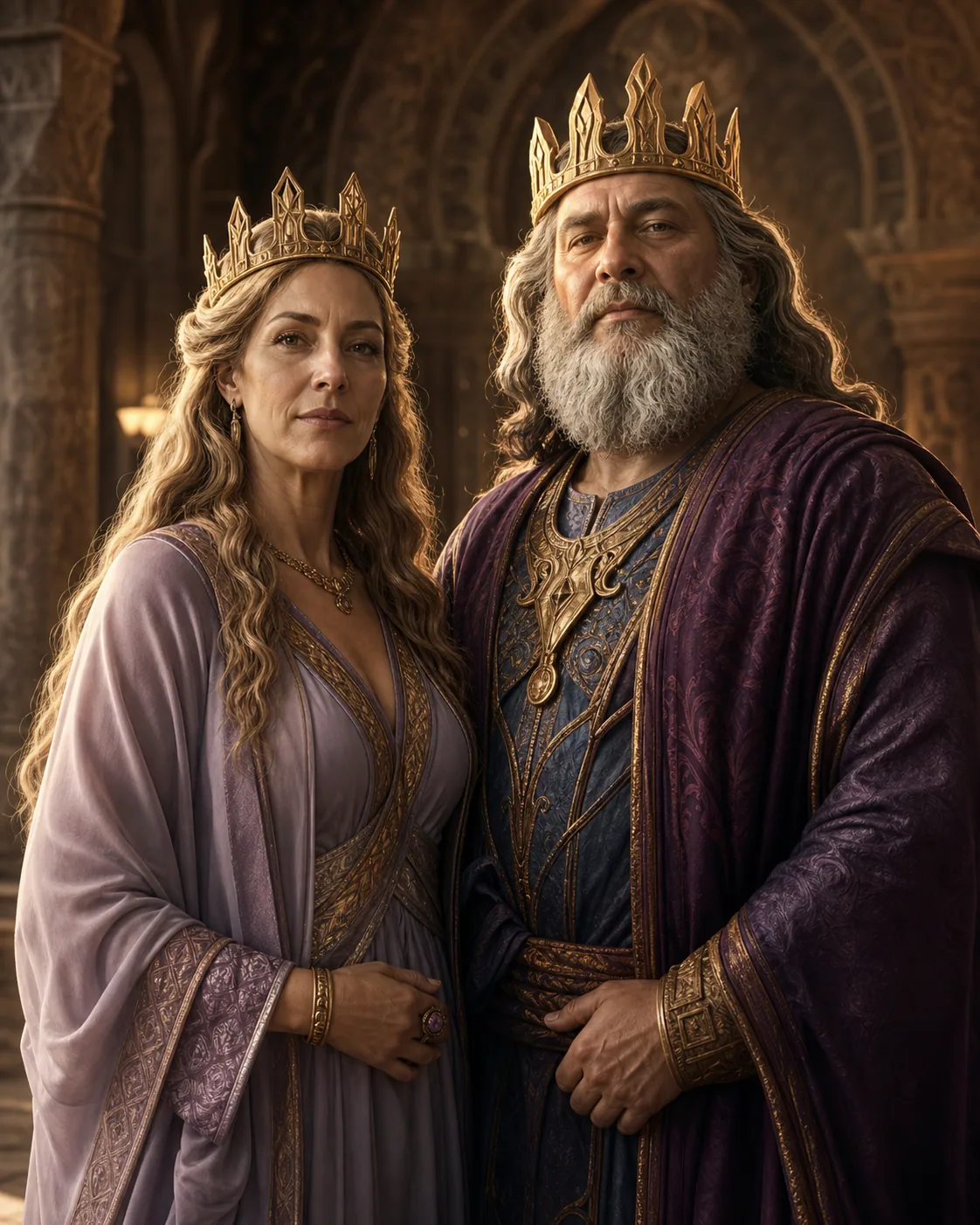
The unnamed parents of King Azaes are members of the Atlantean royal family whose deaths in an attempted coup shape the childhood of the king in BRZRKR: Poetry of Madness. Their identities are not supplied by personal names, nor does the surviving account assign the coup to a fully documented political faction. Their importance lies in the peril that B witnesses and in the guardianship that follows. Zubatai, the account's chronicler, recalls a child whose future might have ended with that of his parents. B's intervention keeps the boy alive and establishes an unusually protective relationship between the immortal warrior and an Atlantean ruler.
The royal household before the coup
Atlantis is depicted as a prosperous ancient city governed by a king whose power depends in part on B, the extraordinary guardian of its defense. The court contains guards, ceremonial offices, political insiders, and religious or occult actors. Azaes's parents belonged to this political world before their deaths, but the comic gives little detail about their reign or domestic lives. There is no secure basis for reconstructing a family tree beyond the immediate parent-child relation. The gaps are important: a chronicle that remembers B's intervention does not automatically preserve the biographies of those he could not save.
The attempted seizure of power
Zubatai states that an attempted coup took the lives of Azaes's parents. A coup is distinct from a foreign invasion. The danger comes from within the political order rather than from an army approaching the city walls. The comic does not provide an exhaustive sequence of palace conspirators, dates, weapons, or places where each parent died. The defensible description is that a contest over the throne left the young Azaes exposed to death and created an opportunity for B to decide whether the boy would survive.
B intervenes for a child
The immortal's decision is an unusually revealing moment in his long history. Most accounts place B in the path of violence because others need a battlefield cleared, a ruler protected, or a threat destroyed. Here the beneficiary of his strength is a child who cannot direct an army and has no assured capacity to reward the warrior. The incident provides a different emotional point of departure for B's service to Atlantis. The relationship that grows from the rescue cannot simply be reduced to military employment.
Azaes inherits a precarious crown
Azaes becomes king while still shaped by the murder of his parents. Zubatai's account emphasizes both the inheritance of the throne and the vulnerability of the person who occupies it. B's strength makes it possible for the royal household to survive an immediate crisis, but not for the city to become free of danger. The monarch's dependence on one apparently indestructible defender helps explain why later characters believe that acquiring control of B, his blood, or his weapons would transform political power.
The limits of protection
Protection from assassins cannot recreate a lost family. It also cannot guarantee that Azaes will understand the politics that surrounded the failed coup. The story draws a distinction between the body's survival and the social damage left after violence. This parallels B's own recurrent predicament: he can recover from catastrophic injuries but cannot restore the people whom he outlives. The royal parents have lasting narrative importance precisely because B's intervention comes too late to prevent their deaths.
Zubatai as the source
The account of Azaes's parents reaches the reader through Zubatai, who has served beside B and describes events from a personal position. She is a witness and storyteller, not an omniscient archive of Atlantean politics. Her testimony establishes the coup and B's involvement but does not specify every motive or participant. The absence of personal names is therefore not a reason to invent them. It marks the boundary of what this narrative preserves.
The legacy of the coup
The event helps establish the conditions under which Azaes rules. He owes his survival to a being whose destructive reputation protects the city but also invites attempts to harness him. By the time Vizane's followers exploit a stolen obelisk and B's blood, the palace has become a setting where the belief in supernatural invulnerability coexists with corrupt political ambition. The early coup and the later catastrophe are different events, yet together they show that no royal family can govern simply by possessing the strongest warrior.
Sources and related entries
- BRZRKR: Poetry of Madness #1, digital pages 14-17
- King Azaes
- Zubatai
- Fall Of Atlantis