Selected scenes
BRZRKR in pictures.
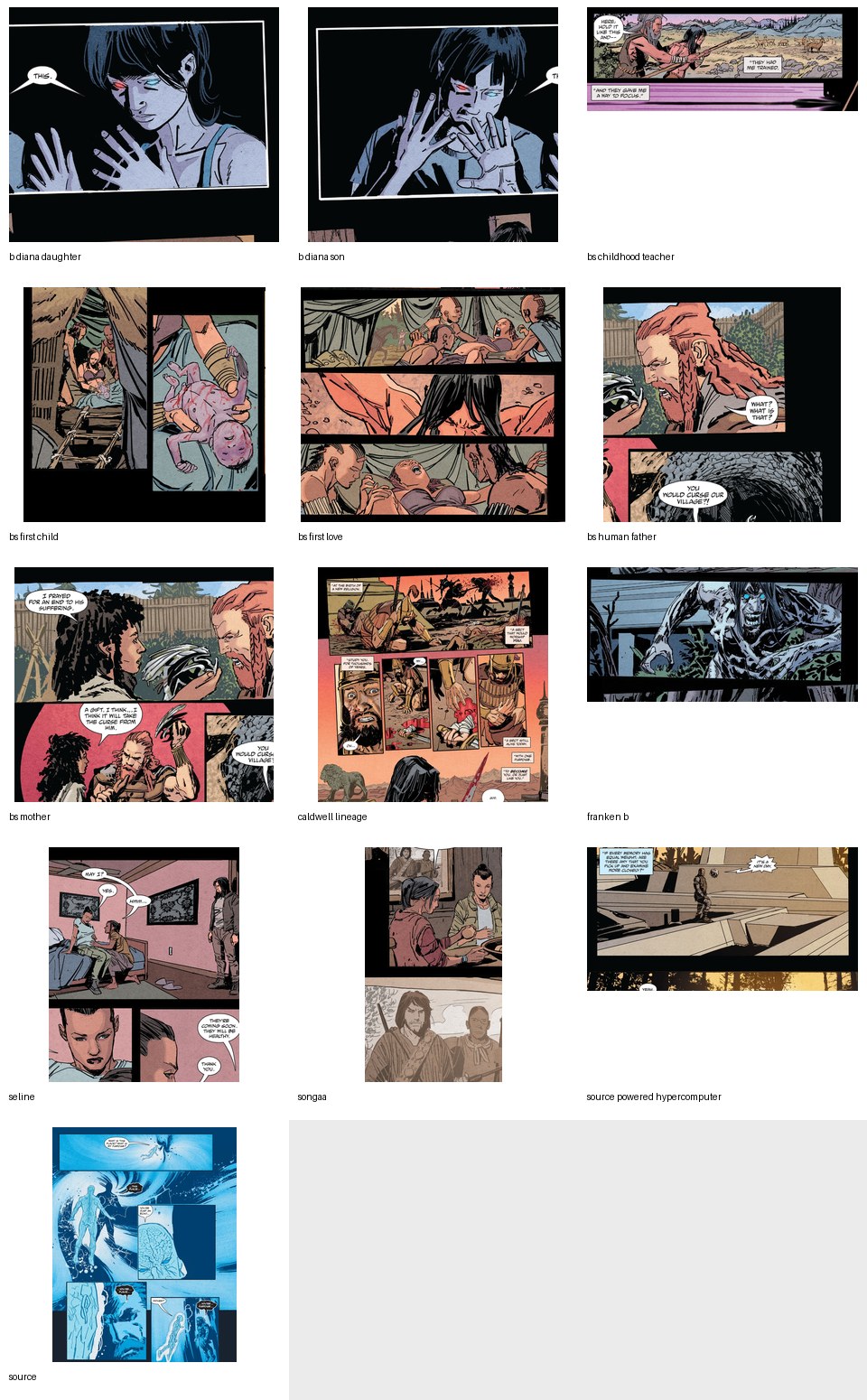
Spoilers: This timeline follows the comic continuity first and labels historical narration, memory, and unresolved dates separately.
How to read this timeline
The BRZRKR timeline is not a straight list of publication dates. B has lived for roughly eighty thousand years, while the original series reveals his life through therapy sessions, flashbacks, one-shot histories, and a present-day investigation. An event can therefore have two dates: an in-universe estimate and the issue in which readers see it. The timeline records both when the source provides them and avoids inventing exact years for scenes that remain approximate.
Each entry uses five questions. What happened? Where did it happen? Who is speaking or remembering it? Is the event directly depicted, narrated by a witness, or inferred from several scenes? What changes afterward? The distinction prevents a later legend from appearing as a camera-confirmed fact and keeps the novel and adaptation branches separate from the comic record.
Approximately 80,000 years ago: origin
B's mother prays for a child. Lightning or Source-linked energy reaches the ancestral cave, and the conception that follows produces an accelerated pregnancy and a child whose body can regenerate. B's father names him Unute and trains him as a weapon for the prehistoric tribe. The first entry is secure as a narrated comic event; the exact calendar date is approximate and tied to B's statement about the length of his life.[1]
The mother prays again after seeing the cost of the condition. Mother's bird-shaped gift appears as a possible release from the curse. The father prevents the intended use, B's mother dies, and B's village collapses as a home. The consequence is not only personal grief. It establishes the pattern in which B is valued for survival and violence while the people who love him try, and often fail, to give him another future.
Prehistoric campaigns
B grows into an adult fighter and leads or participates in conquests. His regenerative body makes him a decisive force, but the timeline does not claim that every ancient battle was personally fought by him. The comic presents a sequence of memories and later titles—Berserker, monster, angel, god—that compress many cultures into a mythic history. Dates remain unknown except where a later narrator offers an estimate.
The first love and first child belong to this broad prehistoric period, roughly 74,490 years ago in the series' approximate chronology. B experiences intimacy, parenthood, and loss, then returns to war. The event is important because it shows that the cycle of love and abandonment predates modern government service. B's later children do not begin the pattern; they inherit a problem that has been running for millennia.
Ancient kingdoms and Atlantis
The Poetry of Madness branch places B in Atlantis as Unute. He protects King Azaes, serves as a visible defense of the city, and is welcomed into the court. Vizane's movement steals an obelisk and Aklo texts from the reliquary, then uses B's blood and a primordial-ore sword to open a gateway. Cthulhu arrives, B attacks it, and the dying entity dissolves Atlantis. Because this history is narrated within a one-shot, the event is tagged narrator claim even though its scenes are canonical to that continuity.
The Atlantis sequence is followed by the Olos and Washukanni material, in which B is captured, Asana becomes associated with him, and ancient cities are destroyed through war and political failure. The exact order of every city and the relation to real-world chronology are not fixed. The timeline therefore gives the one-shot sequence a relative position rather than claiming a specific year.
Babylonia, late antiquity, and alchemical histories
Later historical stories move B through Babylonia, Mediterranean routes, Alexandria, and the accounts associated with Zosimus, Theosebeia, and Hermeias of Oxyrhynchus. These locations connect B's movements to alchemy, water of life, prima materia, and the idea that his body can be studied as a path to artificial immortality.
The timeline records Zosimus's operation as a historical attempt to extend life, not as proof that alchemy reproduces B. The story also introduces Lugalṭur, a regenerative offcut who becomes a person and later inspires historical figures. His creation and Theosebeia's rescue belong to the same broad late-antique branch, but exact dates are not supplied.
Medieval movement and the Mongol era
B appears in Bulgar territory, on routes associated with the Mongol Empire, and in the campaign around Beijing or Zhongdu. The cult's historical network manipulates conflicts and uses B's reputation to influence rulers. Genghis Khan's encampments and the siege of Beijing are therefore entries in both the event timeline and the cult-history timeline.
B's opium dependence suppresses some of the violent compulsion and pain associated with his condition. The relief is temporary and destructive. When he breaks from Genghis Khan, the event is a separation from a political system that has turned his body into an instrument. The timeline should not simplify it into a modern recovery story; the historical account includes addiction, exploitation, and the continuing difficulty of choosing nonviolence.
Early modern and American episodes
The story places B near the American Revolution in the background of the government relationship, then in Missouri and Kansas during the nineteenth century. The Man in the Tree incident, the Winston Tunt confrontation, and Maybell's escape occur in this broad American section. The exact dates of every vignette are not equally certain.
The 1855-1856 Kansas–Missouri conflict and the 1864 Battle of Mine Creek provide the clearest Civil War-era anchors in the current inventory. B's appearance at Mine Creek is treated as a historical one-shot event; the timeline identifies the real conflict while keeping B's participation inside the fictional record. BRZRKR #7 also shows a World War I memory involving B, his first United States handler, and the artillery fragment that later becomes part of Caldwell's research. The comic supports the general episode; it does not establish an exact battle or calendar date for B's role.[1]
The modern government program
The modern phase begins with the United States B Program and the bargain that brings B into black-operations service. Dr. Diana Ahuja works with him through memory and therapy protocols. Dr. Stephen Caldwell investigates B's biology and the historical cult. Jim Keever represents the operational side of a program that needs B's combat ability while promising to pursue mortality.
The opening black operation introduces the present-day B as a weapon whose regeneration is observed by handlers and soldiers. The government does not know the full origin, but it knows enough to believe that B's blood, tissue, and memory can lead to a cure. The bargain is therefore both transactional and coercive: B receives missions and research, while the state receives access to an immortal asset.
Protocol X and the contact interval
Protocol X is the major modern turning point. The apparatus creates a Source-linked event, B disappears from ordinary space, and Diana is transformed by exposure. Issues #8-9 depict the in-between or quantum/contact realm and the first attempts to reconnect. The timeline records B's disappearance as displacement rather than a confirmed death because no ordinary corpse or regeneration sequence occurs.
The event changes the relationship between research and cosmology. The government has opened a channel it cannot control. Caldwell's cult interests and the official program become increasingly difficult to separate. The later expedition is not a new mystery unrelated to Protocol X; it follows the information and anomalies the experiment produces.
Birthplace expedition and Mother's Gift
The team travels to the Saudi site associated with B's childhood memories. They recover the bird-shaped relic, confirm that the ancestral cave and valley correspond to physical locations, and approach the Source through a combination of memory, equipment, and contact. The expedition provides evidence for B's origin without answering every scientific question. The relic is a material trace of the mother's intention, not a complete instruction manual for mortality.
Source manifestation and mortality
Issues #11-12 show the Source manifestation, Diana's expanded contact abilities, the fate of Franken-B, and the transfer that allows B to become mortal. The exact mechanism remains partly ambiguous. B's mortality is not simply a machine setting; it depends on contact, choice, Diana's role, and the wider family arc. The timeline records the result as confirmed within the original-series ending and the mechanism as partially unresolved.
Pregnancy, children, and the final attack
Diana's pregnancy and the birth of B and Diana's children extend the timeline beyond the cure question. The children mature rapidly and inherit a relationship to B's biology and the Source that the comic does not fully classify. After the Virginia safehouse sequence, the story moves to a Southwest refuge with Seline and Songaa. B's mortal death is depicted there, while Diana remains alive and makes a final attempt to contact Unute. The children leave to propagate their lineage, while the hypercomputer and three-sun-world signal leave the future open.[4]
Post-series questions
The timeline ends with uncertainty rather than a false final date. The fate of Franken-B, the exact status of the children, the extent of Diana's Source-linked contact, and the identity of the final extraterrestrial figure remain open. Later publications may add history, but the current comic record does not justify a large World War I branch or an exact calendar for Atlantis, Olos, or the Bleeding Tide.
Reading dates, eras, and confidence together
An era label answers where an event belongs in B's long life; it does not necessarily provide a year. “Late antiquity,” “Mongol era,” and “Civil War period” are useful anchors because they connect the fictional scene to a recognizable world. They are not substitutes for an issue's own narration. When the source says approximately, the timeline preserves approximately. When a narrator supplies a date that conflicts with a later panel, both claims remain visible with a contradiction note.
Publication date is a second clock. Poetry of Madness can be published after the core series while showing an ancient Atlantis episode. The Lost Book of B. can introduce Lugalṭur after readers already know B's modern children. The timeline links chronological first appearance and publication first appearance separately. This is why the appearance database includes flashback, memory, vision, mentioned-only, and cover fields.
The timeline also uses event boundaries. B's first prayer, conception, accelerated birth, first injury, mother's death, first love, and first child are connected but not collapsed into one origin entry. Protocol X's countdown, disappearance, contact, re-entry, expedition, Source manifestation, mortality, pregnancy, birth, safehouse attack, and signal are similarly distinct. Separating them makes it possible to ask whether an object appears before or after a death, whether a relationship exists during a particular era, and which publication first reveals a fact.
Finally, the timeline records consequences that outlast an era. The mother's relic survives into the modern expedition. The Atlantis gateway becomes evidence for B's history. Olos's captivity anticipates government containment. The cult's technology-migration theory links ancient and modern artifacts. B's children carry the final unanswered question into the future. A complete timeline is therefore not only a sequence; it is a network of causes, memories, and inherited effects.
Event records and revision history
Every timeline entry carries an evidence note that can be revised without changing the event's page title. If a future issue supplies a calendar date, the approximate era can be narrowed. If a narrator is contradicted, the old account remains in the references with its speaker and publication. If an adaptation reuses an event, it receives a parallel-continuity relation rather than a replacement date.
The revision history is important because BRZRKR's long chronology invites false precision. A reader may know the year of a real battle but not the year B appears in it. The timeline keeps the historical anchor, fictional participation, and confidence level in separate fields. This makes the page useful for research and for reading without pretending that a story built from memory has the same calendar as an archive.
The timeline as B experiences it
For B, chronology is not a neutral sequence. A childhood moment can return with the force of a present wound. A city he thought he had forgotten can reappear when a modern object carries the same shape as an ancient one. Diana's work matters because she helps him move through that pressure without treating every memory as a command. The reader experiences the long life in a similar way: the past arrives when the story needs its emotional meaning, not only when a calendar would place it.
The timeline therefore has two kinds of movement. One movement carries B forward through human eras. The other moves backward and sideways through memory, rumor, and inherited objects. Mother's Gift travels from a prayer in the cave to a modern expedition. The cult's ideas travel from ancient manipulation into Caldwell's research. The children carry a question from the final safehouse into whatever future follows. Causes do not remain in the period that created them.
This is why a useful chronology leaves room for silence. The comic does not show every century, every name, or every journey between its major scenes. Those gaps are the lived texture of an eighty-thousand-year life. B may remember an emotion without a date or a place without a complete route. The absence is not permission to invent. It is an invitation to notice which moments the story chooses to preserve and why.
See also
- Origin of B
- B Through History
- BRZRKR Reading Order
- Deaths and Regenerations Database
- Ending and Aftermath
- Comic Continuity vs. The Book of Elsewhere
References
[1] Reeves, Matt Kindt, Ron Garney, Bill Crabtree, and Clem Robins, BRZRKR #1-12, B's stated lifespan, memory protocols, origin, government program, Protocol X, Source contact, and ending.
[2] Reeves, Kindt, Garney, Crabtree, and Robins, BRZRKR: Poetry of Madness #1, Atlantis, Vizane, Cthulhu, and the destruction of the city.
[3] Reeves, Kindt, Garney, Crabtree, and Robins, BRZRKR: Fallen Empire #1 and The Lost Book of B. #1, Olos, Washukanni, Lugalṭur, alchemy, and ancient historical narration.
[4] Reeves, Kindt, Garney, Crabtree, and Robins, BRZRKR #8-12, Protocol X, birthplace expedition, Mother's Gift, Source manifestation, mortality, children, and aftermath.