Selected scenes
BRZRKR in pictures.
Spoilers: This guide discusses the ending of the original twelve-issue BRZRKR comic series, especially BRZRKR #11–12.
BRZRKR ends with B becoming mortal, protecting the family he and Diana have made, and dying at the Southwest refuge after the Virginia safehouse attack. The conclusion is a real loss for the characters who remain. It also leaves several Source-related questions unanswered. The clearest way to understand the finale is to keep the depicted events separate from the possibilities the last pages leave open.
The short answer
B receives mortality through the Source-linked chain of events involving Diana, the contact system, and the final conflict. After the family leaves the Virginia safehouse, B, Diana, and the children reach a Southwest refuge. B dies there as a mortal. Diana survives the immediate aftermath, tries to reach Unute through her new Source-linked connection, and the children eventually leave to continue their own path.[1]
That is what the original series shows. It does not identify a confirmed afterlife, name a destination for B after death, or state that his consciousness continues somewhere else. The three-sun image and Diana's final attempt at contact keep the larger cosmology open; they do not undo the death that the issue depicts.
What happens to B in the final issue
The finale resolves the question that has followed B through the series: whether a being who has survived for roughly eighty thousand years can become vulnerable to ordinary death. By the final movement, he is no longer relying on his familiar pattern of catastrophic injury followed by regeneration. Mortality changes the stakes of every choice he makes around Diana and their children.
The Virginia safehouse gives B and Diana a brief domestic life beyond the government program. Its attack makes clear that the systems which treated B as an asset have not simply disappeared. The survivors move to a Southwest refuge with Seline and Songaa. There, with the children present and Diana alive, B dies.[1]
The comic treats the event as a death, not as another routine battlefield recovery. That emotional fact matters even though BRZRKR's larger mythology continues to raise questions about contact, memory, and the Source.
Why the finality remains unresolved
“Depicted death / finality unresolved” is a precise description, not a hedge. The original series confirms the death scene but also contains a cosmology in which regeneration, displacement, memory, and Source contact do not fit ordinary biological categories. A later story could address those questions. No later story should be assumed before it does.
The distinction is straightforward:
- Confirmed: B becomes mortal and dies at the Southwest refuge.
- Confirmed: Diana remains alive in the immediate aftermath and makes a final attempt to contact Unute.
- Unresolved: What, if anything, that contact reaches after B's death.
- Unresolved: Whether the final three-sun image is a destination, a message, a symbol, or another Source-linked event.
This leaves room for interpretation without presenting an interpretation as a settled fact.
Protocol X is not the same as the ending
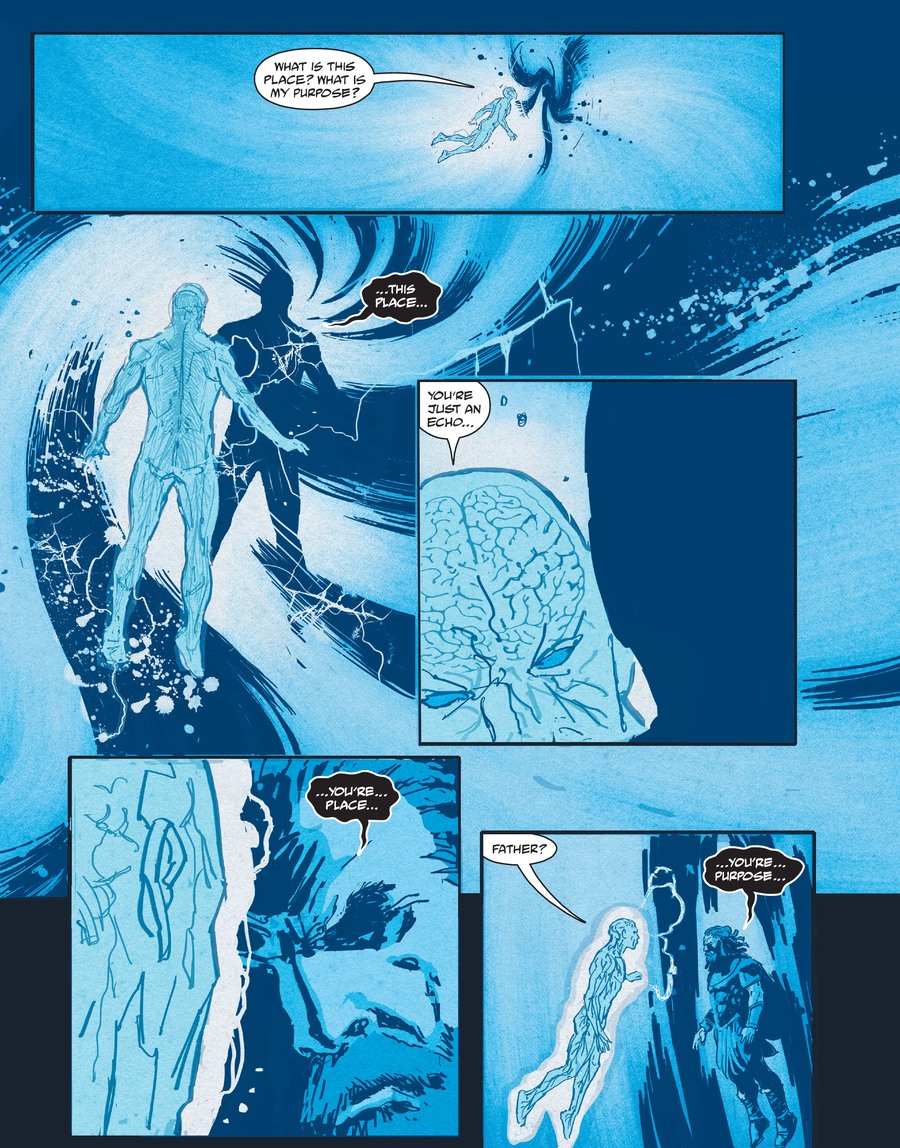
Earlier issues show B conscious during the Protocol X and contact-realm material. Those scenes establish that B can experience a Source-linked environment beyond an ordinary room or battlefield, and that he can return from that temporary displacement.[2]
They do not prove that the final death in BRZRKR #12 places B permanently in that realm, on another planet, or in a confirmed afterlife. The earlier event and the ending use related imagery, but they are different moments with different outcomes. Treating them as one continuous, confirmed destination would add a conclusion that the comic does not state.
Diana, the children, and the aftermath
Diana begins the series as the researcher asked to draw out B's memories. By the final arc, Source contact has changed her relationship to him and to the phenomena surrounding his origin. The comic shows that change as real, but it does not give a complete rulebook for her abilities or make her a replacement for B.
The children carry the story forward in a different way. They mature rapidly, display Source-linked traits, and leave after the refuge sequence. Their future is intentionally not reduced to a simple answer about immortality. They represent inheritance, risk, and a future that does not belong to the government program or to B's old role as a weapon.[1]
The ending therefore closes B's immediate arc while leaving consequences for Diana, the children, and the people who tried to control his condition.
Caldwell, the program, and Franken-B
Caldwell's project tries to turn B's extraordinary biology and Source-linked phenomena into something human institutions can measure and control. The final arc demonstrates the limits of that ambition. B's condition is not reduced to a stable military product, and the modern bargain that placed him in the program cannot continue unchanged.
Franken-B is part of that failure. The artificial being is tied to B-derived material and the program's attempt to instrumentalize it. The ending leaves Franken-B's fate unresolved rather than supplying a complete inventory of what survives. That uncertainty is meaningful because the program's harm is not limited to an experiment going wrong; it also concerns a life or near-life created without consent.[1]
The three-sun signal
The final material associates a three-sun image or signal with the children, the hypercomputer, and the wider Source mystery. It suggests a larger horizon beyond B's life, but it does not supply a map, a species name, a transmission transcript, or a confirmed destination.
Several readings remain possible. The image may be a Source-linked communication, a place, a symbol of inherited possibility, or an invitation whose meaning has not yet been disclosed. The important boundary is that the image belongs to the open questions of the finale. It is not proof that B is awake beneath those suns or that a future story has already occurred.[1]
Does *The Book of Elsewhere* change this ending?
No. The Book of Elsewhere is an alternate prose version of BRZRKR, not a direct continuation that rewrites the ending of the original comic series. Its ideas can be compared with the comics, but its events should not be used to settle the fate of B, Diana, or the children in issues #1–12.
What the ending means
For most of the series, B's problem is an endless cycle: violence, injury, regeneration, and another person or institution deciding what he is for. The ending changes that pattern by making mortality possible and giving his final choices permanent weight. His death is not a technical failure of the story's mythology. It is the personal cost of the freedom he has sought.
The unresolved material does not erase that resolution. Diana's final reach, the children's departure, Franken-B's uncertain status, and the three-sun signal all keep the world larger than one answer. They make the aftermath a story of memory, inheritance, and responsibility rather than a guarantee of resurrection.
Related reading
- Mortality Transfer
- Quantum / Contact Realm
- Known Deaths and Regenerations
- Mysteries and Unanswered Questions
- B's Family Tree
- The Three-Sun Signal
Sources
[1] Keanu Reeves, Matt Kindt, Ron Garney, Bill Crabtree, and Clem Robins, BRZRKR #12 (BOOM! Studios): the Virginia safehouse, Southwest refuge, B's death, Diana's final contact attempt, the children, Franken-B, the hypercomputer, and the three-sun image.
[2] Reeves, Kindt, Garney, Crabtree, and Robins, BRZRKR #8–9 (BOOM! Studios): Protocol X, the contact sequence, B's temporary displacement, and return.