Selected scenes
BRZRKR in pictures.
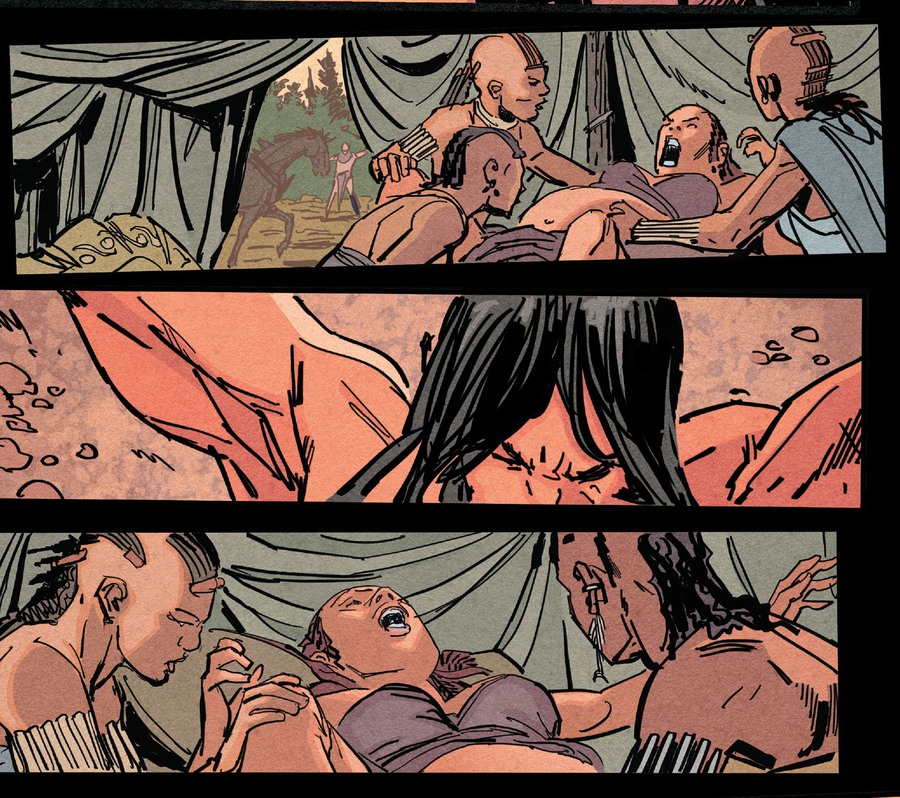
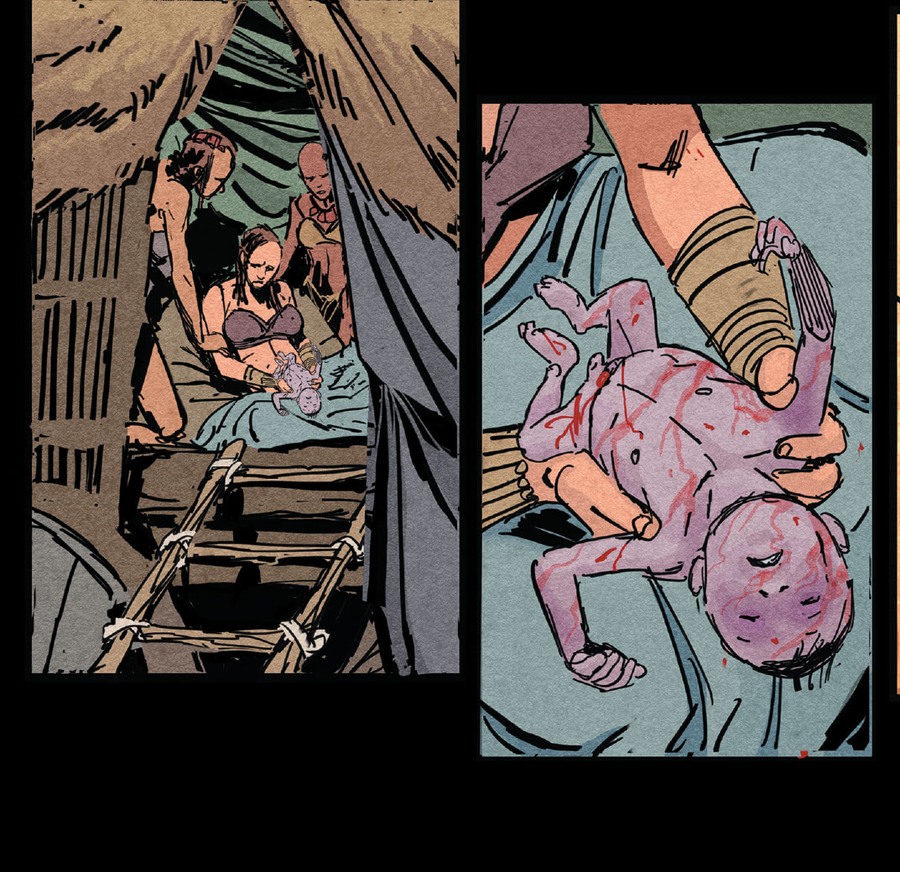
Spoilers: This article covers B's earliest family losses in BRZRKR #5 and the surrounding origin memories.
B's first love and B's first child are the earliest stories in which immortality becomes a problem of ordinary family time. Before this period, B is defined by birth, training, and battle. The relationship gives him a life that is not organized around a ruler's command. The child gives him a future that should continue beyond a single encounter. Both are lost because B's body does not share the mortality of the people he loves, and because his violent history keeps pulling him away from the possibility of home.
A life outside the battlefield
B meets his first love after the childhood training has already made combat feel like a duty. The relationship offers a different rhythm. Conversation, intimacy, and shared domestic time ask B to be present without performing. He can still be dangerous, but danger is not the reason he is wanted. That distinction matters because B has rarely been valued outside his strength.
The story does not turn the first love into a perfect refuge. B carries the habits of a person who expects loss and who has been taught to leave before an institution can claim him. The relationship is real because it includes uncertainty. B wants a life he does not know how to sustain, and the person beside him cannot erase the history inside his body.
The birth of the first child
The pregnancy and birth place B beside a different kind of crisis. A battlefield asks whether he can survive. Childbirth asks whether he can remain present for another person. His body gives him no ordinary answer. The child arrives while B is absent or under a sentence of death, and the event becomes one of the clearest examples of immortality's cruelty.
B can return from an execution, but he cannot return to the exact moment he missed. The first child is born into a life that begins without the father who will remember it forever. The loss is not only that B does not see the newborn. It is that the family begins with an absence that B's regeneration cannot repair.
Mortality as an unequal future
B's first love knows that time will not treat them equally. The partner will age, change, and eventually die while B remains physically capable of continuing. The relationship therefore carries a grief that begins before the loss. B can be devoted and still be aware that devotion cannot make a mortal body share his duration.
That knowledge changes how he behaves. He may leave to spare the partner the danger around him, or remain and risk making the person a target. Neither choice is clean. Immortality turns ordinary decisions into questions of unequal future. A promise to stay can become a promise to watch someone die. A promise to leave can become another abandonment.
The child as a second chance
The first child gives B a chance to imagine continuity. A child can outlive a battle, carry a family name, and create a future that is not measured by B's wounds. Yet the birth also exposes the limits of that hope. B's body cannot guarantee that he will be present, and his enemies and obligations make ordinary parenthood difficult.
The child is not a failed experiment or an extension of B's powers. The story treats the birth as a family event before it treats it as a clue about inheritance. That distinction becomes important when B and Diana later have children. The first child is the memory of what B lost when he was unable to turn survival into care.
The cycle of love and loss
The first relationship establishes a pattern that repeats through B's history. He loves someone, protects them as long as he can, and then remains after the other person is gone. A city can take the place of a partner; a child can take the place of a kingdom; the emotional structure remains. B is always the survivor who remembers what the other person cannot.
Perfect memory prevents the pattern from becoming a vague legend. B carries specific details of the first love and first child into later centuries. The memories are not valuable because they solve a mystery. They are valuable because they prove that B's long life contains ordinary attachments, not only battles and titles.
How the loss changes B
B's first family loss teaches him that regeneration cannot protect a relationship from time. He becomes more guarded, more willing to leave, and more likely to accept a ruler's purpose because a mission has a clear beginning and end. Love does not offer that clarity. It requires B to imagine a future he cannot guarantee.
The lesson is painful but incomplete. B continues to seek connection, and his later relationship with Diana shows that he has not become incapable of trust. The difference is that Diana understands the danger before she chooses him. Their family is built with knowledge of B's history, not with the hope that the history can be ignored.
Echoes in the final family
The final arc deliberately echoes the first child. B and Diana's children are born in a moment of crisis, and B faces the possibility that his family will again begin with absence. This time he and Diana have tried to prepare for the danger. The children are protected, their unusual biology is recognized, and the adults make decisions with the future in mind.
The contrast does not erase the first loss. It shows that B has learned from it. He cannot make the past return, but he can refuse to repeat every part of it. His mortality and the children's departure make family time finite, which is frightening and also more equal than the endless future B once imposed on every relationship.
Open questions
The comic does not give the first love a complete name or chronology, identify the child's later life, or explain every circumstance of B's absence at the birth. Those omissions are part of the memory's emotional force. B knows what happened, but the reader receives only the pieces necessary to understand the wound.
Significance
The first love and first child make B's desire for mortality understandable before the modern program offers a technical route. He does not want to die because he has no attachment to life. He wants to live in the same time as the people he loves and to accept consequences that cannot be undone by regeneration. The storyline turns an immortal warrior into a father who learns that surviving is not the same as being there.
[1] Reeves, Kindt, Garney, Crabtree, and Robins, BRZRKR #5, B's first love, childbirth, first child, and the cycle of loss.