Selected scenes
BRZRKR in pictures.
Spoilers: This article covers B's childhood and the prehistoric origin material in BRZRKR #2-4.
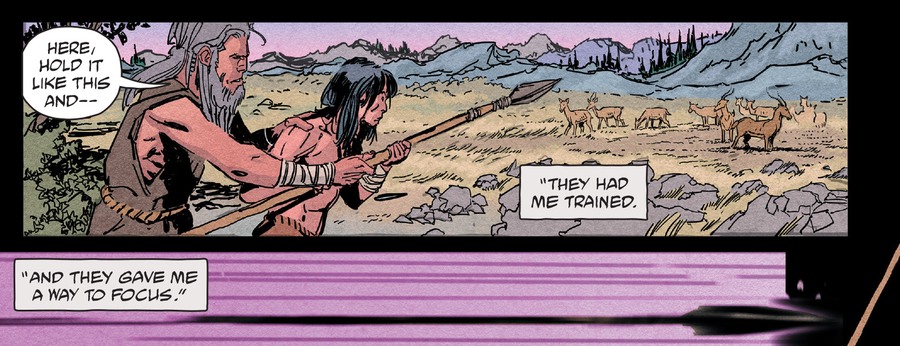
Training Unute as a weapon is the first major storyline in B's life. It begins before B can choose a name, a language, or a future. After the lightning contact changes the circumstances of his birth, his father interprets the child as an answer to the tribe's danger. The training that follows is not presented as a neutral education. It is the moment when an extraordinary body is assigned a military purpose and a family becomes the first institution to claim it.
The prayer and the answer
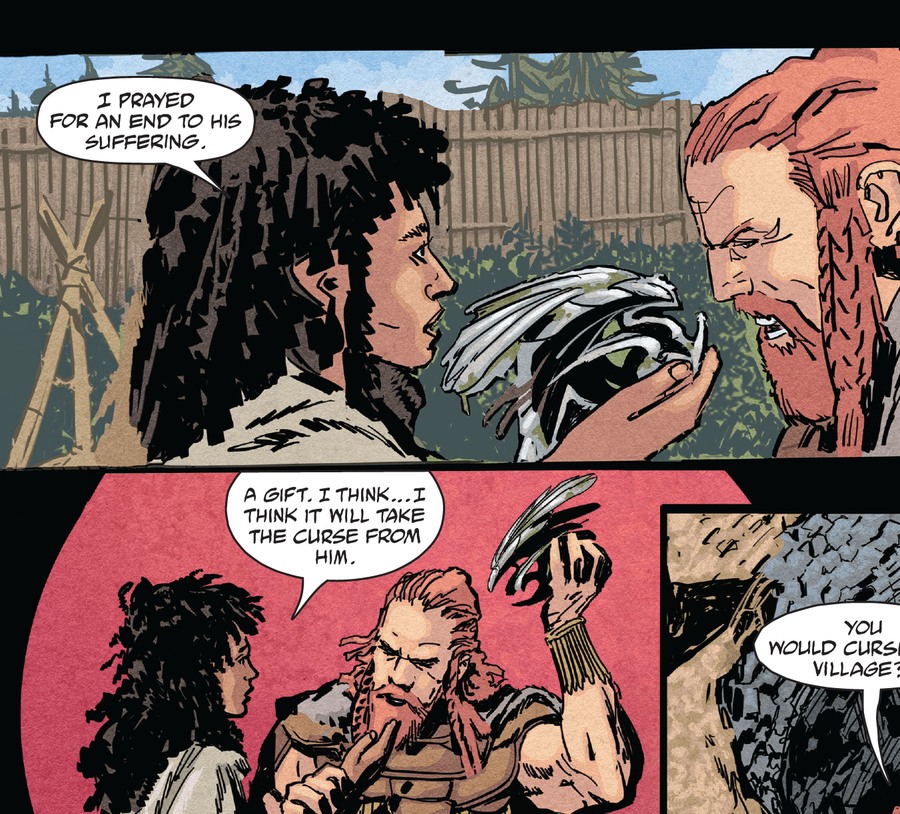
B's mother prays because the tribe is threatened and ordinary strength is not enough. Her hope is protective. She wants the violence around the village to stop and imagines a child who can defend the people she loves. The lightning event that follows gives the prayer a terrible ambiguity. Something answers, but the answer does not arrive with instructions about how a child should be raised.
B's father fills that silence. He sees accelerated growth, strength, and recovery and concludes that the child has been made for war. The interpretation changes the family's future. A mother who wanted safety has a son treated as a weapon. A father who wants victory finds evidence in every successful exercise. The story never says that the father feels no love. It shows how love can become possession when fear decides what a child is for.
Childhood without an ordinary childhood
B develops faster than the people around him can adapt. He can perform tasks associated with an older fighter before he has the emotional distance to understand the consequences. The training ground becomes a substitute for school, play, and ordinary exploration. Adults speak about the tribe's survival while B learns that his body is valuable when it hurts other people.
B's childhood teacher makes the process visible. Instruction gives B technique, language, and discipline, but it also teaches him to treat pain as information and violence as a solution. The teacher may be less ideologically committed than the father, yet the lessons still prepare B to be used by anyone who can place him near a battle.
The meaning of Unute
The name Unute carries the tribe's attempt to describe what B has become. Later titles translate him into a berserker or a storm, but the first name is tied to the community that witnessed his origin. Naming gives the tribe a way to acknowledge the change; it also makes the change public. Once the child has a name associated with power, every enemy becomes a reason to send him forward.
B's identity remains more complicated than the name. He is a son, a student, and a frightened child before he is a champion. The training storyline shows the pressure of that difference. The adults speak about Unute as if the title explains the person, while B experiences the title as an expectation that he must satisfy.
Violence as inheritance
The father passes down more than technique. He passes down a theory of duty. If B can survive, then B must fight. If B can win, then refusal looks like betrayal. The theory becomes an inheritance that follows B through later eras. Kings, empires, cults, and governments repeat the same argument with different language: extraordinary survival creates an obligation to serve.
The prehistoric setting makes the argument intimate. There is no distant state, contract, or laboratory to blame. The first demand comes from family. That origin explains why B's later resistance is so difficult. Leaving a ruler can look like political rebellion. Rejecting a parent feels like rejecting the first person who taught him how to live.
Regeneration and the training cycle
B's recovery from injury makes the training more severe. A normal child requires protection after a wound. B closes the wound and is sent back to the exercise. The body teaches the adults the wrong lesson. Healing is interpreted as proof that the injury was acceptable, rather than as evidence that the child has suffered.
The cycle continues in every institution that uses B. A battlefield injury becomes a reason to deploy him again. A modern mission turns his ability to return into permission to spend him recklessly. The first training ground is therefore the template for the entire series. B's body can resist damage, but it cannot stop other people from deciding that damage is the price of usefulness.
The mother and the limits of protection
B's mother remains the emotional counterweight to the weapon program. Her prayer creates the conditions of B's origin, but her intention is not to create an army. She wants her son to live in a safer world. The conflict between her hope and the father's interpretation grows until the family can no longer contain it.
Her eventual death gives the training storyline its deepest consequence. B loses the person who saw him as a child rather than as an answer. The loss does not immediately free him. It removes the witness who could have challenged the weapon's purpose. B carries her memory through later centuries, and the question she represents—what if survival were allowed to be a life instead of a duty—returns whenever he chooses to protect someone without strategic value.
The first conquests
The training prepares B for prehistoric conquests and later campaigns. Once he is skilled enough to defeat enemies, the tribe's fears become proof that the father's decision was correct. Success hides the moral cost. The village survives a battle, so the adults ask for another. B's body becomes the visible boundary between the tribe and destruction, and his private exhaustion disappears behind the public victory.
The story does not romanticize the victories. B's compulsion toward violence and his memories of the people he kills remain part of the result. Training gives him ability, but it also narrows the range of choices that feel possible. The berserker state is reinforced by command and repetition rather than appearing as a separate personality that excuses responsibility.
The modern echo
The government bargain in the opening issues is a direct echo of the prehistoric training. The language becomes professional: mission, asset, handler, contract. The assumption remains that B's body should be directed by people who claim to know what the world needs. Diana's work begins when she recognizes that the weapon has a history and that the history includes a child who never consented to the role.
B's search for mortality is therefore also a search for an end to training. He wants a body that cannot be sent back into the fire simply because it returned. He wants the right to make a decision that cannot be corrected by another command. The final family arc gives that desire a new dimension: he wants his children to inherit possibilities rather than orders.
Significance
Training Unute as a Weapon is the origin of BRZRKR's moral conflict. B is not born evil, and he is not born eager to serve. He is shaped by fear, love, accelerated growth, and adults who confuse survival with obligation. Every later institution that claims him repeats the first family argument.
The storyline matters because B's freedom cannot be reduced to leaving one employer. He has to unlearn the idea that his body exists to answer other people's danger. The first step is remembering the child beneath the title. The series' violence is spectacular, but its central struggle begins with a father placing a weapon in a child's hands and calling that act protection.
[1] Reeves, Kindt, Garney, Crabtree, and Robins, BRZRKR #2-4, B's birth, accelerated childhood, family conflict, training, and death of B's mother.