Selected scenes
BRZRKR in pictures.
Spoilers: This article discusses B's early training, his first use as the tribe's “dog of war,” and the teacher's death during B's prehistoric childhood.
| Field | Details |
|---|---|
| Name | Not stated |
| Canonical designation | Teacher |
| Species | Human |
| Gender | Male |
| Status | Deceased |
| Era | B's prehistoric childhood |
| Affiliation | B's prehistoric tribe |
| Occupation / role | Trainer and mentor assigned to young B |
| Student | B / Unute |
| First appearance | BRZRKR #2 |
| Death | BRZRKR #2 |
| Primary-source status | Directly depicted canon, limited biographical information |
Overview
B's childhood teacher is the unnamed older man responsible for giving the young Unute a structured outlet for the violent pressure already developing inside him. He appears only briefly in BRZRKR #2, but the episode is crucial because it shows that B's transformation into a weapon is not a single command from his father. It is a process of training, socialization, praise, and purposeful redirection.
The comic identifies him only as Teacher. No personal name, family, birthplace, or formal title is supplied. The ambiguity is part of the canon: no personal name should be inferred from fan material. B's Childhood Teacher, Teacher, and Unute's Teacher are descriptive labels rather than established personal names.
The teacher's most important contribution is summarized by B himself. B says that his parents could not help him “rein in” the internal drive, but they could help him find an outlet. The teacher trains him to hold and use a spear, directs him toward hunting, and praises the role he believes B is destined to fulfill. After B kills a large animal, the teacher tells him that he is destined to be the tribe's “dog of war.”[1]
The phrase is among the earliest explicit examples of adults translating B's uncontrollable inner experience into a social identity. B's violent pressure is not treated as a condition requiring relief. It is treated as capacity requiring direction.
The teacher dies soon afterward during the violence surrounding the tribe. B looks at his body and states simply, “Teacher is dead.” The father then tells B that the time for learning is over. The transition is symbolic as well as practical. With the teacher gone, B moves from supervised training to active deployment.[1]
Place in B's childhood
By the time the teacher appears, B's parents already know that their son is physically extraordinary. His wounds heal with unnatural speed, his body develops rapidly, and he experiences an escalating internal pressure that can erupt into violence.[1]
B's mother worries about him. His father increasingly understands the strategic value of the condition. Between those two responses, the teacher occupies a third role: he makes the condition usable.
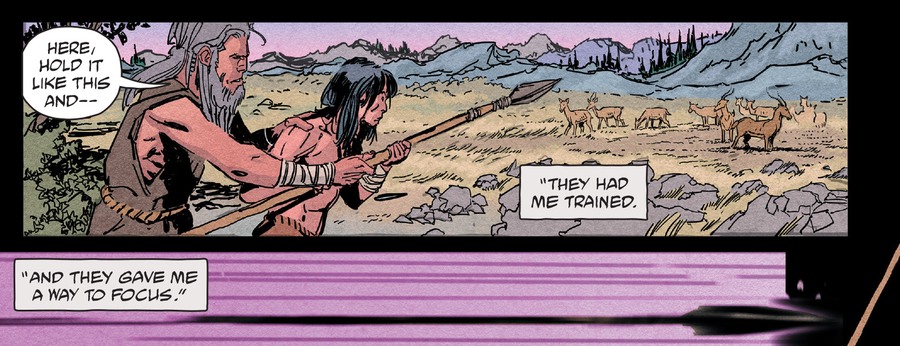
The story does not establish who selected him, but B says that his parents “had me trained,” indicating that his training is a deliberate family or tribal decision. His father also says he taught B how to focus his energy. It is therefore most accurate to describe the teacher as part of a larger training process supervised by B's family rather than as the sole architect of B's combat development.
The teacher's presence shows that B's childhood contains something resembling apprenticeship even though his growth is abnormal. He is not simply thrown into battle the moment his abilities appear. Adults attempt to build technique, focus, and target selection around the power.
Teaching focus
The central problem is described by B in language of containment. His parents cannot remove the pressure inside him. They can help him find somewhere to put it. The teacher becomes the human mechanism for that redirection.[1]
A panel shows the older man standing behind the young B and helping him position a spear. The image is almost ordinary in isolation, resembling a parent or elder teaching a child to hunt. That familiarity makes the later context more disturbing. The training is not simply subsistence hunting. It is preparation for a future in which the child will be the tribe's decisive weapon.
The teacher therefore occupies an ambiguous moral position. Nothing in his limited dialogue establishes cruelty toward B. He appears patient enough to instruct him physically and to give him a target that can absorb the violent impulse. Yet he also celebrates B's ability through explicitly militarizing language.
Both elements remain important. The teacher may have believed he was helping an abnormal child control a dangerous condition. The method he chooses also normalizes the idea that B's value lies in killing efficiently.
Hunting and the first controlled outlet
The hunting sequence provides one of the first examples of B directing the berserker pressure toward a chosen target. The teacher helps him hold the spear and hunt a large animal. B succeeds with extreme violence.[1]
The event matters because it differs from the later battlefield scenes. Hunting gives the child a bounded target and an immediate practical function. It is a controlled environment compared with war. B's narration explicitly says that his parents could help him find an outlet.
The problem is that control quickly becomes proof of military usefulness. Once B can focus the pressure, the tribe no longer needs to ask whether he should be exposed to violence. It begins asking how that violence can be deployed.
The teacher's praise accelerates that shift. By calling B a future dog of war, he interprets successful regulation not as personal progress but as evidence of destiny.
“Dog of war”
The exact phrase attached to the teacher is central to his role. He tells B that he is “truly destined to be our dog of war.”[1]
The wording contains possession. B is not merely destined to be a warrior. He is destined to be our weapon. This is the same possessive logic later used by rulers, governments, and programs that regard B's capabilities as belonging to a larger cause.
It also introduces the language of destiny before B has any meaningful ability to choose. His violent compulsion is interpreted as purpose. The teacher therefore participates in the earliest version of the question B later asks the Source directly: What is my purpose?
The final series answer complicates the teacher's assumption. The closing pages associate B's deeper function with pollination, memory, ideas, technology, and propagation across time and space, not simply warfare.[3] The teacher's “dog of war” reading is therefore one human culture's interpretation of a much larger phenomenon.
Relationship with B's human father
The teacher operates within the political order led by B's father. The father has the authority to define B's mission, direct campaigns, and announce when training is complete.
B's narration says his father taught him to focus his energy, while the visual memory shows the teacher giving hands-on instruction. These sources are complementary rather than contradictory. The father is responsible for the program and its purpose; the teacher provides practical training.
After the teacher dies, the father tells B that the time for learning is over. The teacher's death therefore removes one intermediary between the child and the father's military demands.
Whether the teacher would have resisted sending B into full-scale war is never established. His “dog of war” statement suggests that he expected military use, but the comic does not give him enough later dialogue to know how he would have reacted to the expanding conquests of BRZRKR #3.[2]
Relationship with B's mother
The comic never gives the teacher and B's mother a direct conversation. Their roles nevertheless intersect.
B's mother argues that B is not ready and later says the killing is wearing on him. The teacher is part of the system intended to make him ready. If the mother's concern is personhood, the training program addresses capability.
It would be inaccurate to classify the teacher as her ideological enemy. She and the father both participate in having B trained because his internal pressure is dangerous and the tribe remains under threat. The division becomes clearer only as B moves from training into repeated warfare.
Death
The teacher is killed during the next major outbreak of tribal violence. BRZRKR #2 shows his body among the dead. B's reaction is concise: “Teacher is dead.”[1]
The lack of extended mourning is consistent with the compressed, traumatic nature of B's prehistoric memories. It also reflects the accelerating pace at which adults around him disappear. The people who teach him, love him, praise him, or depend on him are mortal. B is not.
Immediately after the discovery, B's father announces that the time for learning is over. The teacher's death thus becomes a transition point. The protected or supervised phase of B's weaponization ends, and active service begins.
The comic does not identify who killed the teacher, the specific weapon used, or whether he died defending the settlement or participating in an offensive battle. The body is shown in a battlefield environment, but an encyclopedia should not assign a killer or precise tactical context that the source does not establish.
Effect on B
Although the teacher's page time is limited, his influence can be traced through B's later behavior.
B becomes extraordinarily skilled at directing his violent impulse toward targets. He is capable of using almost any weapon, adapting to different historical forms of combat, and functioning within military teams. None of that can be credited solely to one prehistoric instructor, especially across eighty thousand years, but the teacher represents the beginning of conscious technique.
More important is the psychological lesson: pressure can be relieved through killing, and society will reward the relief if the target is socially approved.
That pattern becomes self-reinforcing. B experiences unbearable internal buildup, institutions provide enemies, violence produces temporary release, and the institution interprets the result as successful service. The teacher's hunting lesson is the earliest small-scale version of that cycle.
Teacher, mentor, or handler?
The title “Teacher” is canonical because B uses it. Modern readers might also describe the man as a mentor, trainer, combat instructor, or early handler. Each term captures part of the function but carries assumptions.
Mentor can imply broader emotional guidance not shown in the comic. Combat instructor may be too narrow because the depicted lesson includes hunting and focus. Handler creates a useful parallel with later government personnel but is an anachronistic institutional label.
The most accurate description is therefore childhood teacher and trainer. His resemblance to B's later handlers is thematic interpretation rather than a formal title.
Personality
The teacher is depicted as calm, approving, and confident in the tribe's interpretation of B. He does not appear frightened by the boy's abnormal abilities. He stands close enough to guide B's hands and speaks to him as someone capable of learning.
His praise reveals a militarized worldview. He believes B's power has collective meaning and apparently accepts the idea that the child is destined for war.
Because he appears in only a few panels, claims about his private morality, family life, political ambitions, or affection for B would be speculative. The strongest canon-supported description is that he is a trusted older trainer who helps B focus his violent pressure and endorses the tribe's plan to use that ability in war.
Skills and knowledge
The teacher demonstrates knowledge of spear use, hunting, and practical instruction. He appears comfortable teaching physical technique and target focus.
He has no supernatural abilities. He does not display knowledge of B's cosmic origin. Whatever he understands about B comes from observing the child's abnormal development and from the tribe's religious or political interpretation of him.
His ability to work safely with B is itself notable. B's pressure can produce catastrophic violence, yet the teacher is able to stand beside him during training. This implies trust and a period in which B can regulate himself sufficiently to learn.
Appearance
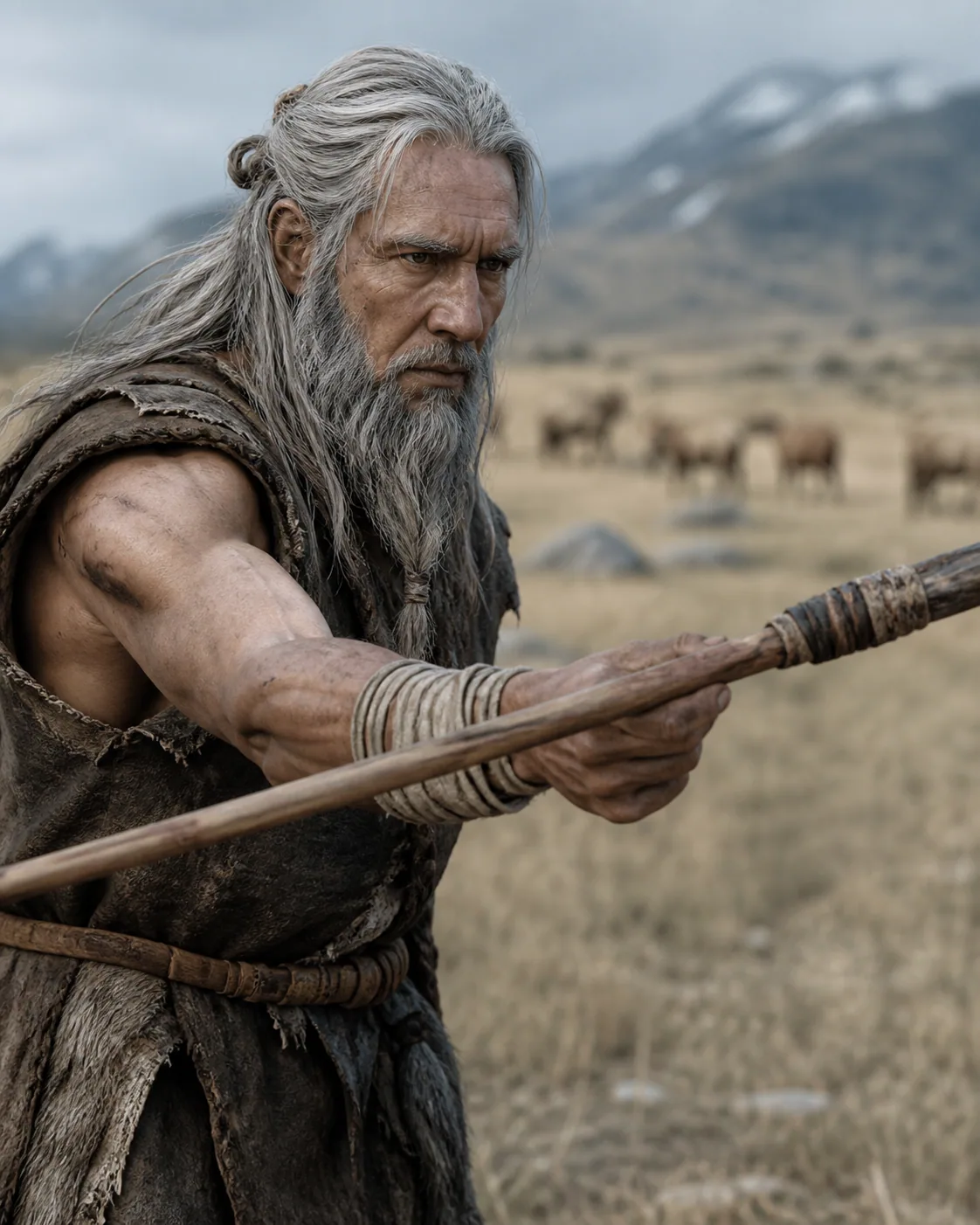
The teacher is depicted as an older man with long gray or white hair and facial hair, wearing simple prehistoric clothing. He carries or uses a spear during instruction.
His body shown after death is consistent with the same older male figure. There is no costume change or later historical version because his entire life in the series belongs to B's childhood flashback.
First appearance and chronological placement
The teacher appears in BRZRKR #2 during B's early childhood, after B's abnormal healing has become apparent but before the father declares the child ready for war.
The precise number of seasons or years between B's birth and the training sequence is not stated. Because B develops abnormally fast, ordinary age estimates based on appearance should be avoided.
Themes and narrative significance
The teacher belongs to one of the original series' most important themes: weaponization begins long before the modern government.
Headquarters, Caldwell, and military handlers may possess laboratories, satellites, and biometric systems, but their basic relationship to B is ancient. Someone recognizes his abnormality, someone trains it, someone defines a purpose, and someone points him at a threat.
The teacher is the first specialist in that chain.
He also complicates the idea that all structure is harmful. B genuinely needs a method for controlling the violent pressure. The tragedy is that the only method his society can imagine is directed violence. The lesson helps him survive, but it also narrows his identity.
Legacy
No later issue names the teacher or reveals descendants. His legacy is carried through B's embodied skill and memory.
When B later undergoes therapy with Diana, he is not simply recovering battles. He is recovering the process by which he learned what to do with himself. The teacher belongs to that process.
The closing “pollinator” idea in BRZRKR #12 retroactively makes the teacher's definition of destiny look incomplete. B's effect on history includes war, but it also includes technology, ideas, memory, family, and transmission. The first teacher saw the weapon. The series ultimately asks readers to see the person and the wider consequences.
Appearances
- BRZRKR #2: Trains young B in spear use and hunting, tells him he is destined to be the tribe's dog of war, and is later found dead during tribal violence.
- Later issues: Does not reappear physically in the original series. His role remains part of B's recovered childhood history.
Canon limitations
The comic does not provide:
- a personal name;
- an exact age;
- a family;
- a formal rank;
- the precise duration of his training relationship with B;
- the identity of his killer;
- the exact circumstances of his death;
- any evidence that he knew B's true cosmic parentage.
These gaps should remain explicit rather than being filled from visual inference or fan terminology.
References
[1] Keanu Reeves, Matt Kindt, Ron Garney, Bill Crabtree, and Clem Robins, BRZRKR #2 (BOOM! Studios, 2021), training and teacher-death sequence, especially digital page images 011-013.
[2] Reeves, Kindt, Garney, Crabtree, and Robins, BRZRKR #3 (BOOM! Studios, 2021), expansion of B's military use and explanation of “Unute.”
[3] Reeves, Kindt, Garney, Crabtree, and Robins, BRZRKR #12 (BOOM! Studios, 2023), closing “pollinator” and shared-memory sequence that broadens the series' idea of B's purpose.