Selected scenes
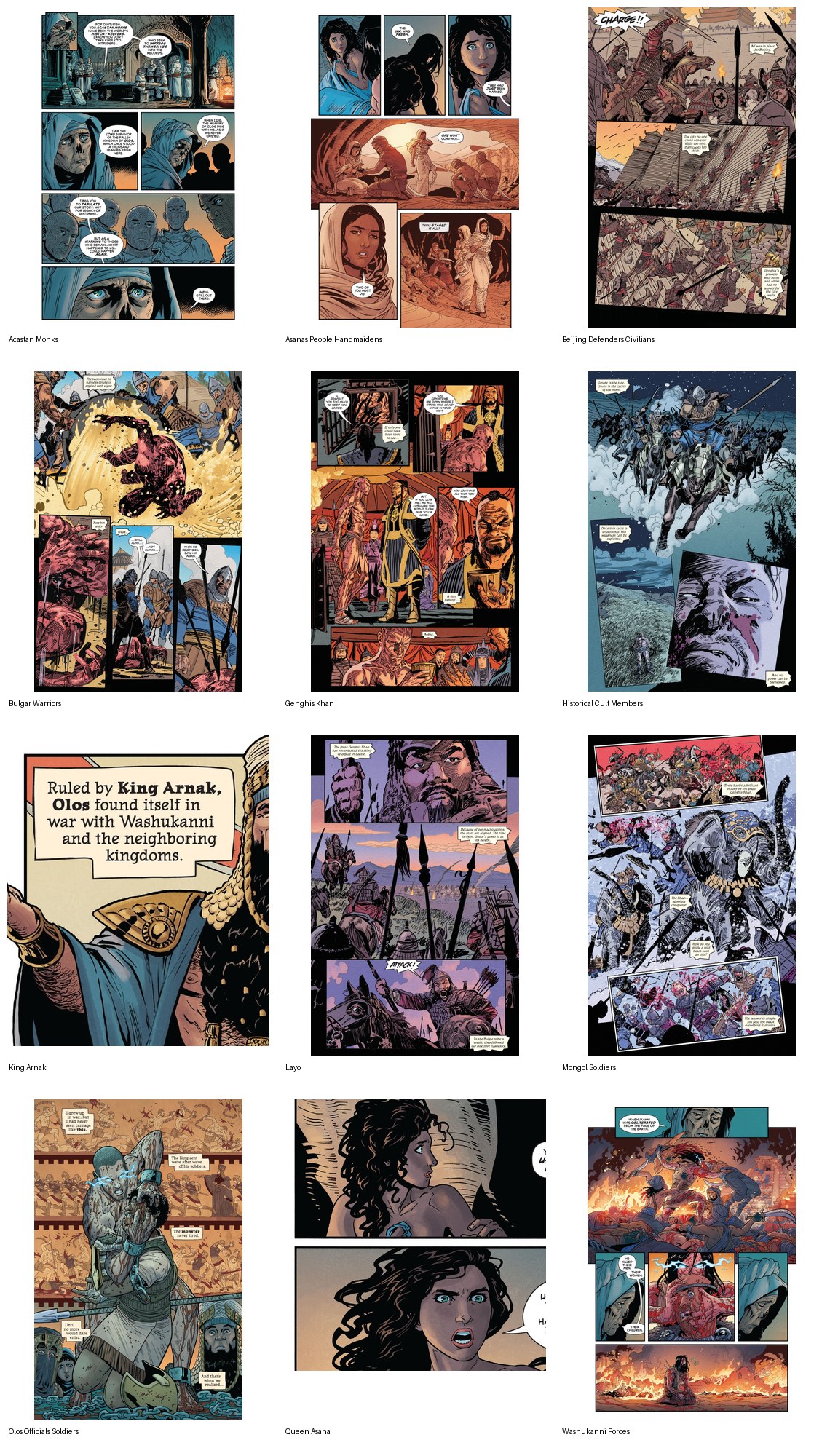
BRZRKR in pictures.
Spoilers: This article covers the late-antique material in BRZRKR: The Lost Book of B. #1.
Alchemy is the language through which late-antique characters try to understand and reproduce the impossible life associated with B. In The Lost Book of B., it is not a collection of real-world recipes inserted unchanged into a superhero story. It is a dramatic practice of experiment, translation, and desire. Zosimus, Theosebeia, Hermeias, Domitianus, and Lugalṭur approach B's body from different positions, and each reveals a different danger in trying to defeat death.
B as an alchemical problem
B's survival has always invited explanations. A village calls him a gift or a weapon. Atlantis surrounds him with prophecy. The modern program studies molecules, tissue, and quantum behavior. The late-antique characters use the vocabulary available to them: prima materia, Azoth, the Water of Life, distillation, and machines that treat the body as a substance capable of transformation.
Alchemy gives the mystery a human scale. The practitioners are not cosmic beings. They are people who read, test, fail, and argue while bodies and lives are at stake. Their work is intellectually ambitious and morally compromised because the object of study is a person who cannot be reduced to a formula.
Zosimus's operation
Zosimus is the central experimenter. His laboratory joins texts, vessels, heat, liquid, and machinery in an attempt to extend life or approach B's condition. The story does not provide a complete recipe or state that the operation succeeds in a universal sense. What it shows is a process that can create consequences beyond the intention of the person who begins it.
Zosimus's interest in B is partly scientific and partly philosophical. B's body appears to answer a question that the alchemist has spent a lifetime asking: can life be transformed without accepting ordinary decay? The desire is understandable. The method becomes troubling when the living person is treated as the missing ingredient in someone else's argument.
Theosebeia and protection
Theosebeia offers a counterpoint to the laboratory. She recognizes that Lugalṭur is becoming a person and protects him from those who would return him to the apparatus or treat him as a vessel. Her care is not passive. She makes space for development, hides the vulnerable being from pursuit, and refuses to describe protection as ownership.
The contrast between Zosimus and Theosebeia gives alchemy its emotional structure. The question is not whether knowledge should be pursued. It is whether the pursuit can make room for the life it creates. Theosebeia's decision to protect Lugalṭur anticipates B's later decision to release him. Both reject the idea that creation gives the creator a permanent claim.
Prima materia, Azoth, and Water of Life
These terms belong to the symbolic and material vocabulary of the operation. Prima materia names the raw substance from which transformation begins. Azoth functions as a concentrated image of the universal agent or solvent sought by the alchemical tradition. The Water of Life represents the promise that a prepared substance can restore or extend vitality. In BRZRKR, none of these terms is a guaranteed cure.
They organize the characters' hopes. A substance can be pure, a vessel can be prepared, and a machine can be tuned, yet a person's identity does not emerge automatically from the process. Lugalṭur's existence proves that a new life can arise from the attempt, not that the alchemists have solved death.
The laboratory and the battlefield
The late-antique story moves between controlled spaces and violent public spaces. A laboratory promises privacy and repeatability. A battlefield offers neither. Bodies, texts, and equipment travel through routes around Alexandria, Oxyrhynchus, and other historical settings. Knowledge is vulnerable to war, theft, mistranslation, and the ambitions of people who encounter it after the original experiment.
Domitianus's battlefield and Hermeias's connection to Oxyrhynchus give the practice a social context. Alchemy does not happen outside history. It depends on patrons, assistants, supply routes, and the survival of written records. The fragments that reach later generations may preserve a result while losing the ethical argument around it.
The creation of Lugalṭur
Lugalṭur is the most important consequence of the alchemical branch. He is related to B through material and process, but he is not B's replacement. His title and identity emerge through experience rather than through a complete transfer of B's self. The people around him must decide whether to call him a vessel, a child, a weapon, or a person.
B's eventual release of Lugalṭur gives the story its answer. Origin is not ownership. The fact that B's material helped make Lugalṭur does not grant B authority over the new being's future. The choice is a correction to the way B himself was raised. His father treated an extraordinary child as a resource; B refuses to repeat that pattern.
Alchemy and modern science
The modern program and the late-antique laboratory use different equipment and vocabularies, but their ethical pressure is similar. Both are tempted to turn B's survival into a reproducible method. Modern science can measure molecules that alchemy describes symbolically; neither can guarantee that a body made from B-related material will have B's identity or consent.
BRZRKR does not say that alchemy secretly was modern physics. It lets the traditions remain distinct while showing how a human desire travels across time. Each era invents a new explanation for the same question: can death be defeated, and what would that victory cost?
Open questions
The story does not reveal the complete apparatus, the exact formulas, the final fate of every participant, or the historical accuracy of each name and route. It does not establish that the real-world figures associated with alchemy experienced the fictional events exactly as shown. The one-shot's power comes from the relationship between history and invention, not from pretending that the two are identical.
Significance
Alchemy gives BRZRKR a story about making life rather than merely surviving it. The experimenters want an answer to death, but the most important result is a person who must be allowed to become more than the answer. Lugalṭur's freedom turns the alchemical plot into a moral one. The work matters not because it discovers a perfect elixir, but because it forces B and the people around him to decide whether a created life can belong to itself.
[1] Reeves, Kindt, Garney, Crabtree, and Robins, BRZRKR: The Lost Book of B. #1, Zosimus, Theosebeia, Lugalṭur, alchemical apparatus, and derived life.