Selected scenes
BRZRKR in pictures.
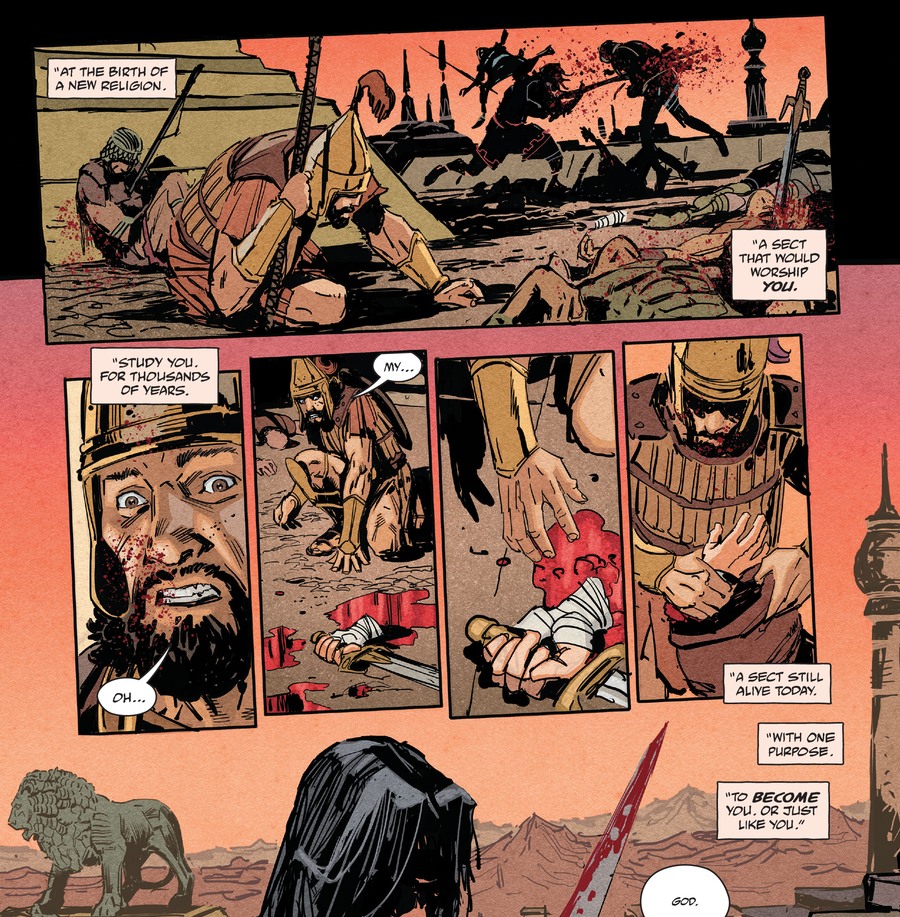
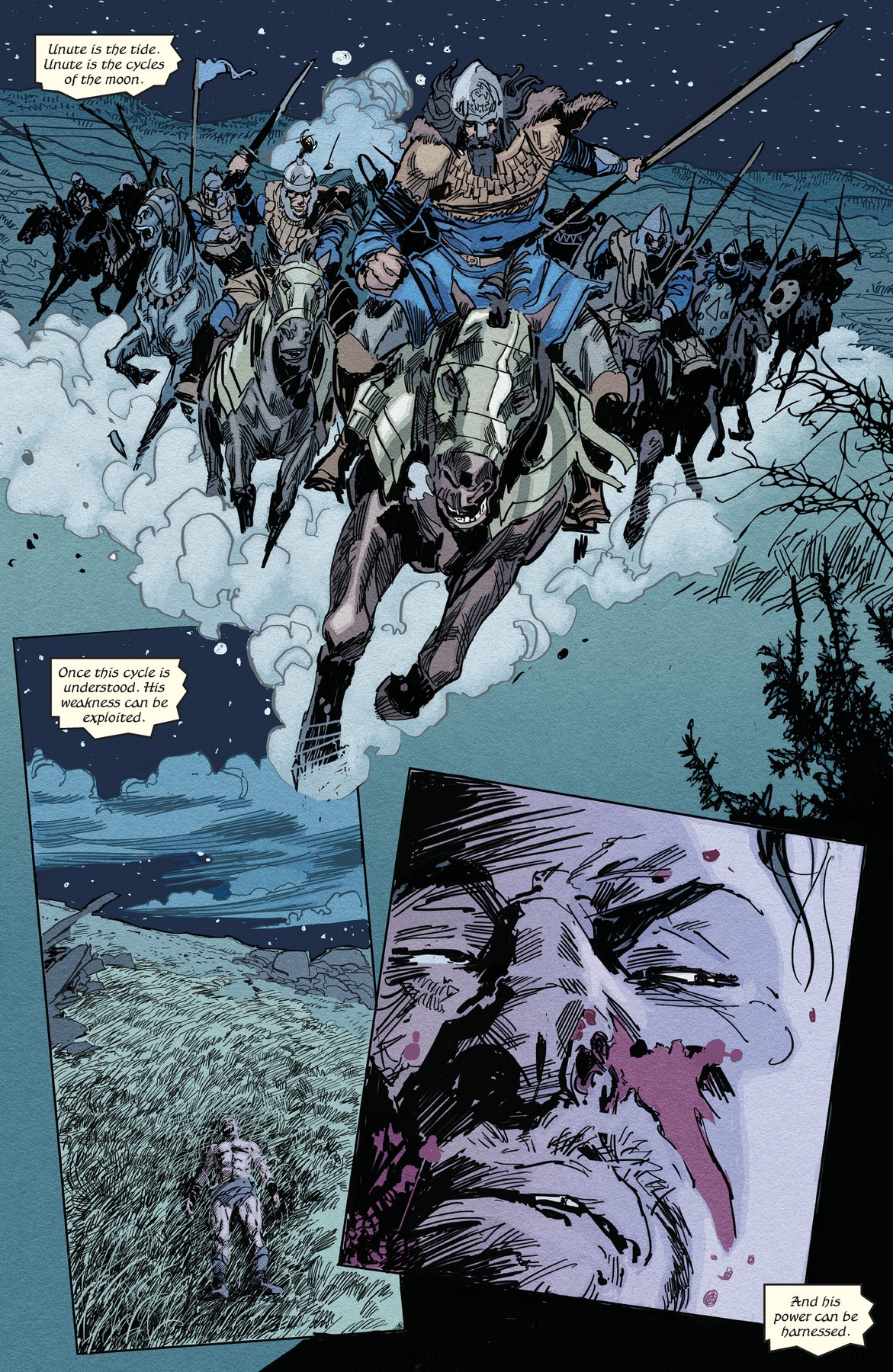
Spoilers: This article covers the cult history surrounding B and Caldwell in the original series and historical material.
The formation of the ancient cult is the long human attempt to turn B's existence into a religion, a program of preservation, and a route toward power. The cult is not born from one revelation or led by one unchanged organization across eighty thousand years. Its members inherit fragments of stories, objects, symbols, and practices. What remains consistent is the desire to possess an explanation for B and to make that explanation useful.
From witness to doctrine
B's earliest communities see a child altered by lightning, rapid growth, and regeneration. A witness can call that event a miracle without creating a permanent institution. The cult begins when people preserve the interpretation, attach it to objects and rituals, and pass it to others who did not see the origin directly. Memory becomes doctrine as soon as the first generation decides what later generations are allowed to believe.
The process is not entirely malicious. A community may use a sacred story to protect an extraordinary person or to make sense of a disaster. The danger appears when doctrine turns the person into evidence for its own authority. B becomes a sign that validates the leaders who claim to understand him.
Caldwell's lineage
The modern Caldwell inherits a hidden lineage that has followed B through history. His father and predecessors collect information, objects, and accounts that official institutions do not possess. Caldwell presents himself as a government scientist and handler, but his interest in B is also personal and ancestral. He believes that the cult has been waiting for a moment when modern technology can complete the old pursuit.
The lineage gives Caldwell a second chain of command. He can work inside the government program while deciding what his superiors are allowed to know. The cult's history therefore survives by entering institutions rather than remaining outside them. Its members do not need a temple in every era if they can carry the doctrine into a court, laboratory, army, or intelligence service.
Objects that preserve belief
Cult continuity is carried by material things: relics, blood, tissue, texts, tattoos, tablets, and records of B's appearances. An object can outlast the person who owned it and can be interpreted by people who never met B. The chain is powerful because material evidence feels more authoritative than a story, even when the object's purpose has been forgotten.
This is why Caldwell is interested in recovered artifacts and separated fragments. The cult has always wanted more than belief. It wants proof that can be tested, displayed, or used. Modern equipment gives that desire a new scale, while the underlying claim remains ancient: if the cult can possess the right piece of B's history, it can possess the future.
Cults in different eras
The historical one-shots show that B is interpreted differently across civilizations. Atlantis uses prophecy and Aklo. Olos treats B as a political possession. The alchemical branch treats him as material for life extension. The Mongol-era story places him inside imperial conquest. These settings may share motifs, but they do not prove that one uninterrupted organization commands every event.
The cult's continuity is better understood as a network of inherited ideas and personal lines than as a uniform army. A later member can preserve a symbol while changing its meaning. A ruler can cooperate with a hidden group without knowing its complete history. The resulting contradictions are part of the cult's danger: it can adapt to the institution around it.
Belief and control
The cult's theology gives its members a reason to control B. If B is a chosen being, then his resistance can be called ignorance. If his body is a path to immortality, then his consent can be dismissed as an obstacle. If his blood is sacred, then taking it can be treated as worship rather than theft.
Caldwell's actions expose the political result. He keeps information from the government, recovers artifacts for private use, and supports experiments that turn B-derived material into another body. The cult's language may be spiritual, but its behavior is administrative. It stores, moves, tests, and controls.
The cult and the government
The government program does not simply discover the cult. It becomes one of the environments in which the cult can operate. Caldwell uses state resources to pursue a private history, while other personnel believe they are working toward a national security objective or a cure for B. The overlap creates conflict when Diana recognizes that the program's scientific goals can serve Caldwell's inherited purpose.
The opening black operation and Protocol X are therefore part of the cult's story even when the word “cult” is not spoken in the room. A contract can conceal theology. A laboratory can conceal devotion. The institution's technology does not make its motives neutral.
B's resistance
B resists the cult in ways that are both physical and interpretive. He fights its agents, rejects its titles, and refuses to treat its stories as commands. His long memory lets him recognize patterns that younger members mistake for destiny. He knows that a group can preserve a fact and still distort the person the fact concerns.
His decision to release Lugalṭur is especially important. The cult's logic says that creation or inheritance creates a claim. B rejects that claim and allows a derived life to become independent. The choice does not undo the cult's history, but it offers a different way to use knowledge of B: protect a person rather than possess him.
What the cult cannot control
The cult can preserve records, objects, and interpretations, but it cannot control every consequence. Atlantis falls despite the prophecy. Olos is destroyed despite its possession of B. Experiments produce beings whose choices exceed their creators. Caldwell's knowledge increases his power and isolates him from the people who might challenge his assumptions.
The pattern reveals the limit of doctrine. A belief system can assign B a purpose, but B remains capable of refusing it. The cult's history survives because people keep adapting it; that same adaptability prevents it from becoming a single total explanation.
Open questions
The comic does not identify every historical member, specify when the lineage begins, or prove that all groups using B's symbols belong to the same organization. It does not provide a complete list of rituals, ranks, or surviving cells. The strongest claims concern Caldwell's inherited network and the repeated human effort to preserve and exploit knowledge of B.
Significance
The formation of the ancient cult gives BRZRKR a human antagonist that can outlive any one villain. It shows how a person becomes a doctrine and how doctrine becomes a system of possession. Caldwell is dangerous not only because he wants power, but because he has inherited a story that tells him power is his duty.
[1] Reeves, Kindt, Garney, Crabtree, and Robins, BRZRKR #7-12 and historical one-shots concerning Caldwell, B's relics, cult lineage, and artificial immortality.