Selected scenes
BRZRKR in pictures.
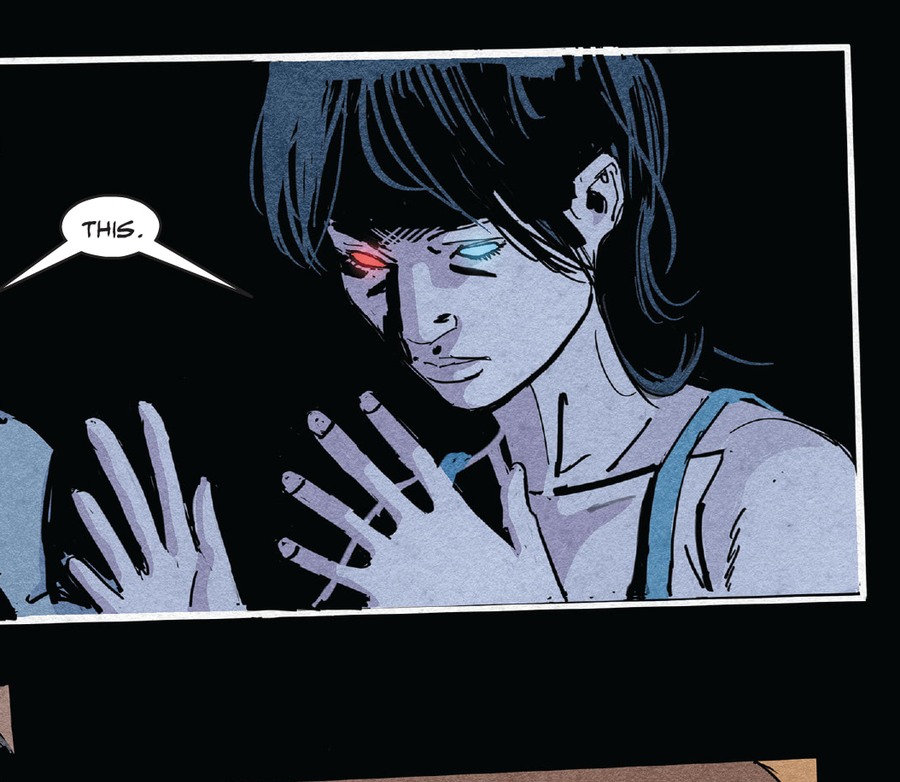
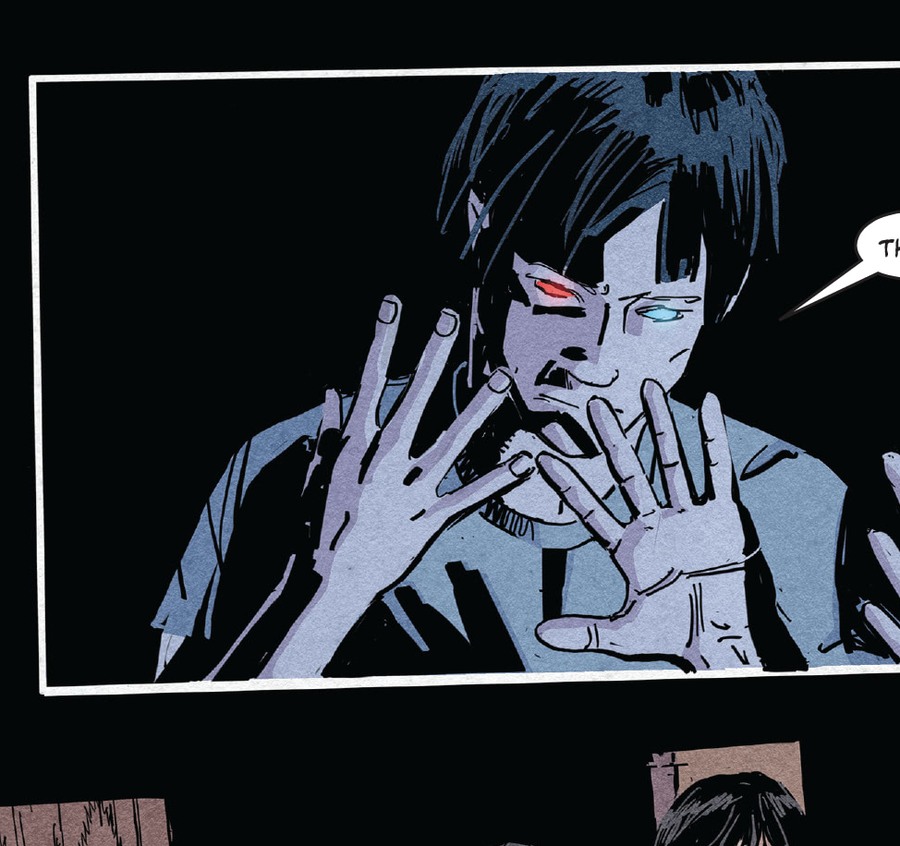
Spoilers: This article covers Diana's pregnancy and the family arc in BRZRKR #11-12.
Diana's pregnancy changes the final movement of BRZRKR from a search for mortality into a story about what B and Diana can protect after the search is over. The pregnancy occurs alongside Source contact, artificial research, and the government's attempt to alter B's condition. It is therefore both intimate and exposed. Diana's body becomes the place where a future family develops while institutions around her continue to treat unusual biology as a problem to solve.
A family inside a crisis
Diana and B do not enter the pregnancy with the safety ordinary parents expect. The program is unstable, Caldwell's plans are dangerous, and the Source has already changed the conditions of both lives. Their relationship has grown through memory sessions and contact, but pregnancy asks for a different kind of commitment. It requires them to imagine a future that cannot be completed inside the next mission.
B's response is shaped by his first child and first love. He has already learned that regeneration cannot guarantee presence. The pregnancy gives him a chance to remain with the family while also reminding him that the future may still be taken away. His desire for mortality becomes connected to fatherhood: he wants a finite life in which being present has the same weight for him as it does for Diana.
Diana as more than a researcher
Diana begins the series as the person who studies B's memory and helps him recover the past. Pregnancy makes her role impossible to separate from her own body. She is not only interpreting the consequences of B's biology; she is carrying them. The program's language of samples and results becomes ethically inadequate when the subject is a living family.
Her scientific knowledge remains important. She understands the risks better than anyone and can recognize that the children may develop differently. But knowledge does not make the pregnancy controllable. Diana must make choices under uncertainty, balancing the hope of a future with the knowledge that every institution around her may want access to it.
The children as persons
The pregnancy is not presented as a plan to create successors or new operatives. The children are wanted as children. Their inherited biology matters, but it does not define the reason they exist. This distinction separates Diana and B's family from the artificial-immortality projects that assemble bodies for a purpose.
The final issue emphasizes their individuality even before the children can speak. They develop rapidly, display unusual eyes, and leave the safehouse as separate people rather than as one biological result. The pregnancy has produced a family, not a program outcome.
Danger from the program
The government has every reason to fear a second generation connected to B. The children could possess abilities that change military power, Source contact, or the future of the program. Caldwell's history makes the danger more than theoretical. A person who has spent centuries trying to possess B will not necessarily respect the boundaries around B's children.
Diana's pregnancy therefore creates a protective urgency. B can fight attackers, but fighting is not enough. The family needs distance, secrecy, and a chance to make decisions outside the institution that has already taken pieces of B's body. The pregnancy turns escape from an abstract desire into an immediate parental obligation.
The connection to mortality
B's mortality transfer occurs in the same broad arc as Diana's pregnancy. The two developments answer different needs. Mortality gives B the possibility of a finite life; pregnancy gives that life a future relationship. Together they change the meaning of his body. He is no longer only asking whether he can stop regenerating. He is asking what kind of father he can be while time finally applies to him.
Diana's pregnancy also makes the transfer risky. A change in B's condition can affect the family, the children, and the safety of the refuge. The story does not turn the pregnancy into a technical lever. It remains a human event that the cosmic and scientific plots threaten to overwhelm.
Birth and accelerated development
The children are born in BRZRKR #12 and develop rapidly. The speed is wondrous and frightening. Diana and B receive less ordinary infancy than they expected, and the safehouse becomes a place of constant adjustment. The children are already moving toward independence while the adults are still trying to understand what their bodies can do.
The visual pace echoes B's own childhood but reverses the emotional conditions. B was accelerated into training. The children are accelerated inside a family trying to protect them. The difference does not eliminate danger, but it shows that biology alone does not decide the meaning of an event. Adults' choices matter.
The safehouse attack
The attack on the Virginia safehouse interrupts the family's brief period of protection. Diana's pregnancy has made the refuge a target because the children represent the next stage of B's history. The violence forces the parents to make decisions under pressure and demonstrates that no building can guarantee safety while the institutions surrounding them remain interested.
The attack also changes the emotional meaning of the birth. The children arrive into a world that is already trying to claim them. Their departure is therefore not abandonment. It is a protective act made necessary by the danger that follows the family wherever B is known.
Open questions
The comic does not give the pregnancy's complete medical timetable, the children's names, or a final account of their abilities. It does not specify how Diana's transformed biology interacts with B's condition or whether later pregnancies would develop the same way. The story supplies emotional and visual evidence rather than a complete clinical explanation.
Significance
Diana's pregnancy is the bridge between BRZRKR's mystery and its hope. It shows that B's life can produce more than battles, experiments, and legends. It can produce a family. The pregnancy also proves that the old systems have not disappeared; they now have a new generation to pursue. Diana and B's task is not to make the children ordinary. It is to make sure extraordinary biology does not become another person's property.
[1] Reeves, Kindt, Garney, Crabtree, and Robins, BRZRKR #11-12, Diana's pregnancy, mortality transfer, birth, accelerated development, and safehouse attack.