Selected scenes
BRZRKR in pictures.
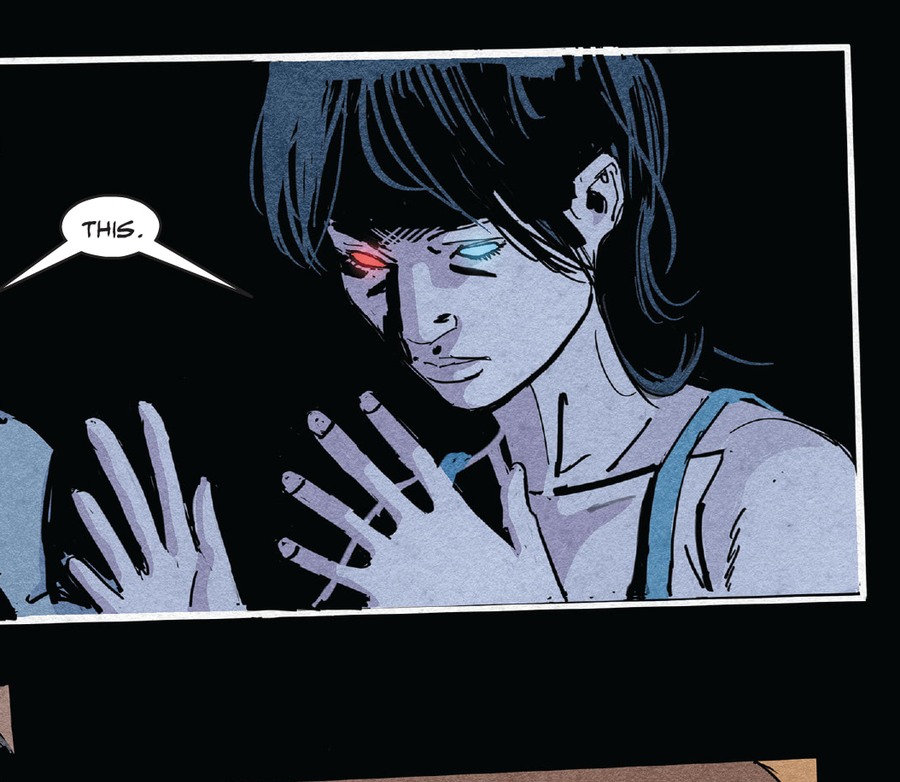
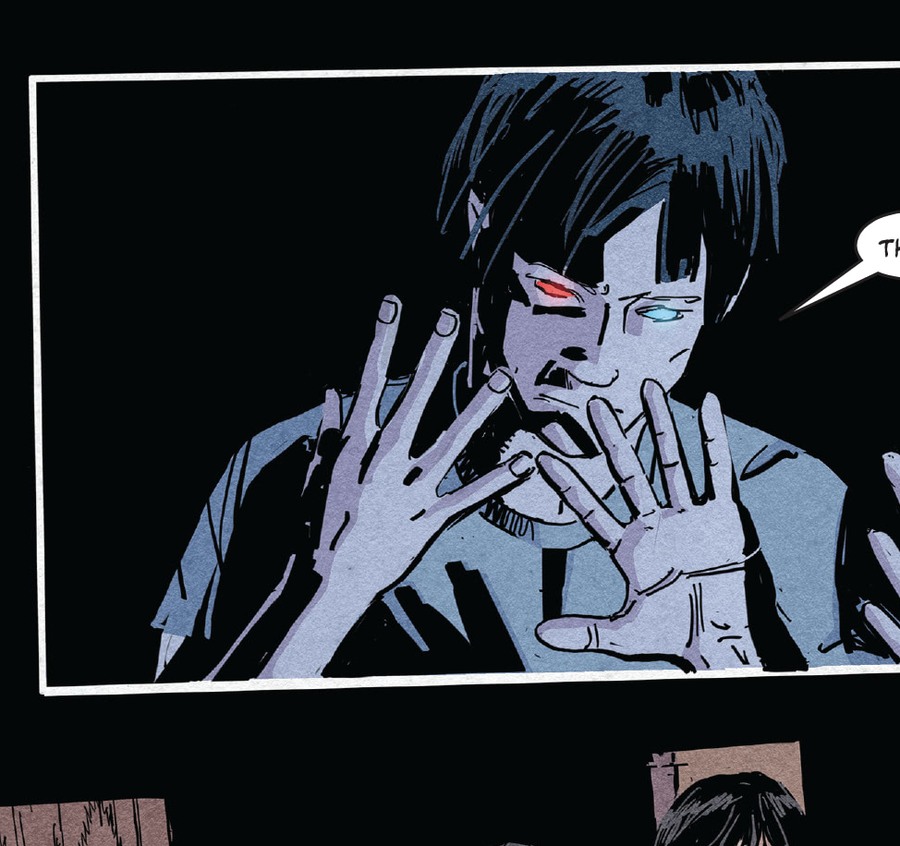
Spoilers: This article covers the final family movement in BRZRKR #12.
The children leave at the end of the original BRZRKR series after the attack that destroys the family's temporary refuge, the move to a Southwest refuge, and B's death. Their departure is one of the quietest events in the finale, yet it carries the largest future consequence. B's children are the first people in his line to leave an extraordinary childhood with the possibility of choosing what their inherited biology means.
A departure shaped by danger
The children do not leave because the family has stopped caring for them. They leave because remaining in the same place would make them easy to find and because the family has already been targeted by powerful institutions. The safehouse has become a target and a memory. Its walls cannot protect a future that powerful institutions already want to control.
The departure is therefore both grief and strategy. The adults must accept that protection can require distance. B has spent centuries leaving people because he expected loss. The children leave under circumstances he never wanted, but the meaning is different: their movement is intended to create a chance for independent life rather than to abandon them to danger.
B's final act as a father
B's death changes the way the children inherit him. They will know him through memory, stories, and the people who carry his history, not through an endless physical presence. That is a painful reversal of the pattern that defined B's own life. He was always the survivor left to remember. His children become the ones who must remember him.
His final protection of the family is not a promise that he will always return. It is a finite choice made after mortality has become possible. B's body no longer guarantees that he can correct every danger. The children leave with the knowledge that their father chose them even when he could not remain beside them.
Diana's continuing role
Diana has been the person who translated B's memories, challenged the program, and insisted that science remain connected to care. The children inherit not only B's biology but Diana's way of asking what knowledge is for. The ending leaves the extent of her Source-linked contact open, but it does not establish her death.
The children may therefore grow up with two kinds of story. B's history contains conquest, captivity, and survival. Diana's history contains research, trust, and resistance to possession. Their future will be shaped by which parts of those stories they are allowed to hear and which institutions try to replace them with propaganda.
The children as separate people
The final issue does not present the children as one successor to B. Their different appearances and movement establish two developing identities. Their inherited traits may connect them, but their lives will not be identical. The departure gives them the physical and narrative space to become separate from the legend of their parents.
That separation matters because every earlier institution has collapsed individuals into a role. B is the berserker, the protector, the asset, or the source of material. The children leave before a new institution can assign them a comparable title. Their freedom begins as the absence of a public name.
The echoes of B's childhood
B was accelerated into training and taken away from ordinary family life. His children also experience accelerated development, but their movement is directed away from a battlefield. The parallel shows what the parents have tried to change. They cannot control the biology, yet they can refuse to interpret rapid growth as a demand for military usefulness.
The children also echo B's first child, whose birth occurred while B was absent and whose later life remains unknown. The final departure does not erase that earlier loss. It gives B a chance to make a different choice before the same absence becomes the only story the next generation knows.
What they carry
The children carry inherited abilities, unusual eyes, family memory, and the consequences of the Source contact. They may also carry objects or instructions connected to the safehouse, though the comic does not inventory what leaves with them. Their most important inheritance is less tangible: the knowledge that their parents fought to keep them from becoming tools.
They also carry danger. Caldwell's work, surviving government interests, cult history, and the wider supernatural world have reasons to find them. The children cannot simply return to ordinary society without deciding how much of their identity to reveal. The departure begins a story about secrecy, trust, and the right to define oneself.
The future beyond the ending
The original series ends without naming the children's destination or showing their adult lives. That open future is not a failure to finish the family story. It is the point at which the children stop being consequences of B's history and become the people who will make new history.
Their future could include further contact with the Source, conflict with institutions, or a refusal to enter the old struggle at all. The ending supports possibility without promising that inherited power will be easy. B's body survived everything; the children may need to learn that survival is only the beginning of freedom.
Open questions
The comic does not name the children, specify who travels with them, or establish whether they age normally after the first acceleration. It does not confirm their final powers, their relationship to the Source, or the exact level of danger that follows them. Those questions belong to the future rather than to an invented conclusion.
Significance
The children leave so that BRZRKR can end on a movement away from possession. B's story has been a long record of people trying to decide where his body belongs. The children depart before that decision can be made for them. Their future is uncertain, but uncertainty is preferable to a life already assigned by a king, cult, government, or creator.
[1] Reeves, Kindt, Garney, Crabtree, and Robins, BRZRKR #12, safehouse attack, Southwest refuge, B's death, Diana's final contact attempt, children's rapid development, and departure.