Selected scenes
BRZRKR in pictures.
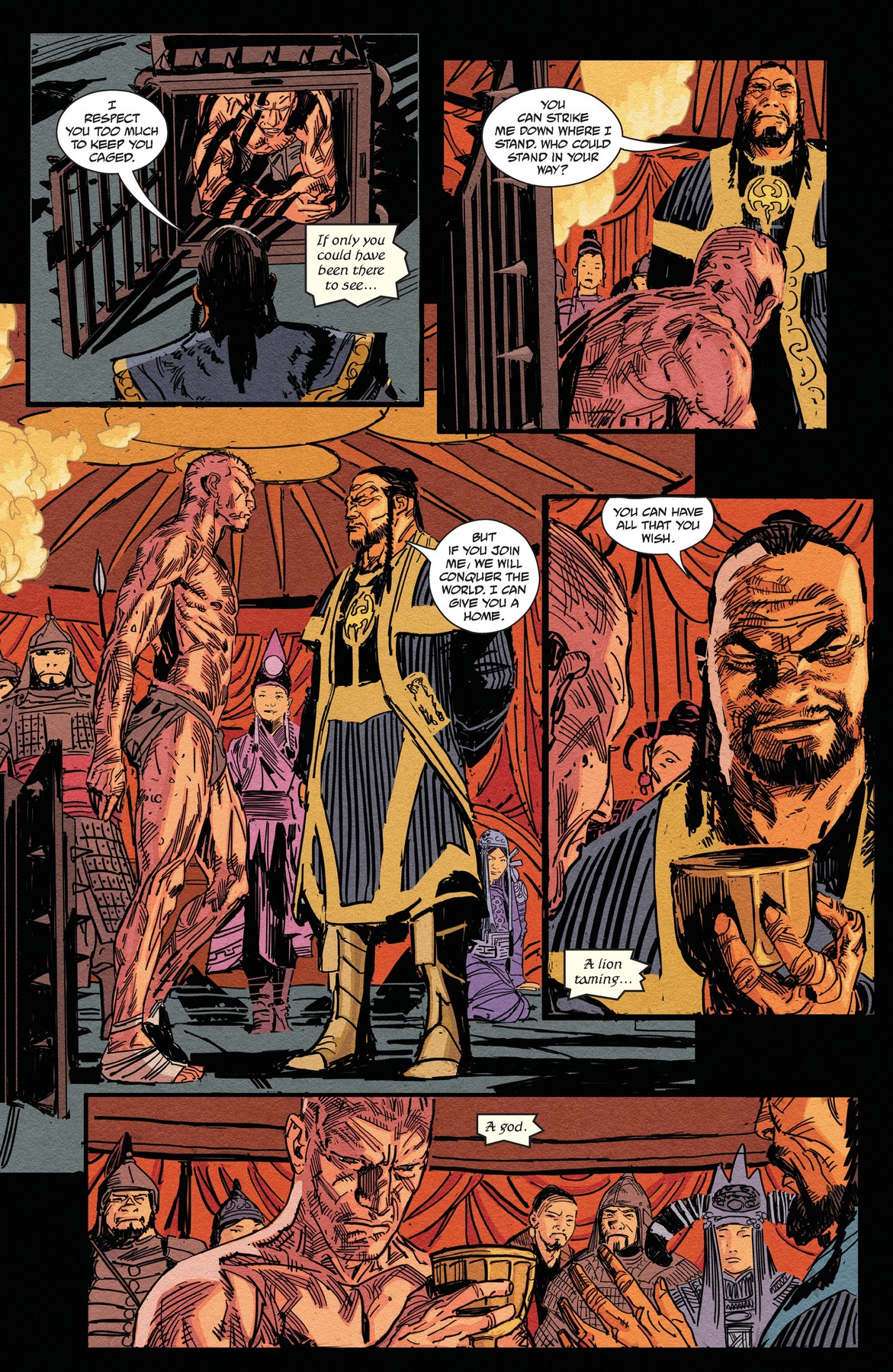
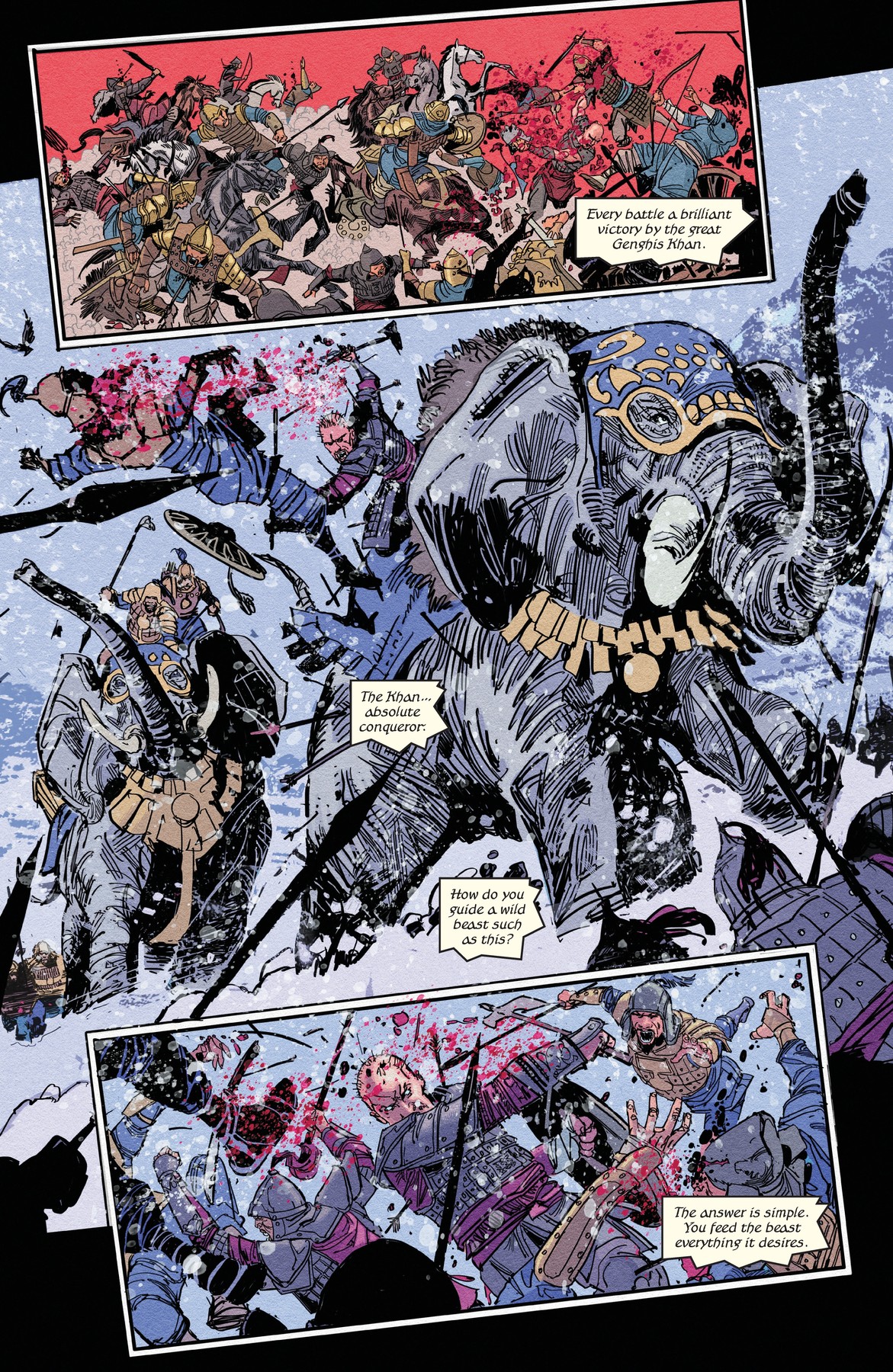
Spoilers: This article covers B's departure from Genghis Khan's imperial system in the historical BRZRKR material.
B's break from Genghis Khan is the moment when an immortal soldier rejects an empire's attempt to make military service his permanent identity. Genghis recognizes B's value and places him inside organized conquest, where an operative who can survive catastrophic violence becomes a strategic advantage. Opium reduces pain and some of B's violent compulsion, making service possible. The departure begins when B decides that relief and usefulness are not the same as freedom.
B inside the empire
B enters the Mongol-era story after centuries of other roles. He has been a protector, captive, and legend. Genghis offers a different structure: a vast military system with routes, encampments, advisers, and a clear purpose. The empire can give B food, command, and a place to direct his strength. It can also make the strength impossible to refuse.
The arrangement is attractive because it offers order. B's life has often been defined by demands from individual rulers or local communities. An empire promises a larger explanation. Campaigns have objectives, enemies have names, and victory can look like a form of belonging. The cost is that B becomes one instrument inside an expansion whose human consequences exceed his understanding.
Opium and control
Opium suppresses pain and part of the violent pressure that drives B toward combat. The relief lets him remain in the field, but it also makes him dependent on the system that supplies it. A commander can call the substance medicine while using the improvement to justify sending B into more dangerous situations.
The drug changes B's experience without changing the empire's claim. He is calmer or less overwhelmed, but he is still expected to obey. The distinction explains why the eventual break is not a medical failure. B leaves because the condition of service has become another form of captivity.
The siege and imperial purpose
The Mongol-era material connects B to campaigns, Bulgar territory, the Silk Road, and the siege of Beijing or Zhongdu. The exact fictional chronology remains approximate, but the political pattern is clear. B's survival is translated into military strategy. He can enter positions where ordinary soldiers cannot and return to report what he has seen.
The siege also reveals the difference between serving an empire and belonging to a city. B may help win a battle, but the people inside the walls do not become his family. Victory carries the empire forward while leaving civilians, defenders, and soldiers to absorb the cost. B's perfect memory prevents the strategic language from erasing those individuals.
The moment of refusal
B's break is a refusal of the empire's definition rather than a single dramatic escape with a complete explanation. He recognizes that every victory makes the next command easier to give. The more valuable he becomes, the less room remains for him to choose a different life. Leaving is therefore dangerous because the empire has invested in the idea that B will always return.
The decision does not erase what B has done. He has participated in conquest and carries responsibility for the people killed under the imperial banner. The break is not absolution. It is the first step toward accepting that survival cannot be the excuse for permanent service.
B and Genghis
Genghis is not portrayed as a simple sorcerer or cult caricature. He is a ruler who understands institutions and recognizes an advantage. His relationship with B is political. He can respect B's strength while still treating B as a resource. The distance between those positions is where the conflict grows.
B's departure challenges Genghis's assumption that a useful body can be kept through reward, drug, and command. The emperor may control armies, routes, and cities, but he cannot control the meaning B gives to his own survival. The break is a small refusal against a vast system, which is why it matters.
What B carries away
B leaves with memories of campaigns, people, and the effects of imperial expansion. He also carries the knowledge that temporary relief can be used to prolong a life he does not want. The experience becomes part of the pattern he recognizes in the modern government program: a contract, a cure, and a body sent into danger.
The Mongol-era story therefore influences B's later search for mortality. He has already learned that a ruler can make service feel like shelter. The modern program offers a more sophisticated version, but B can see the structure beneath the language. Freedom will require more than changing employers.
Historical memory
The real historical Genghis Khan and the Mongol Empire provide the setting's anchors. The fictional B events belong to BRZRKR's narrative. The series places B near major historical movements without claiming that he caused every conquest or that the empire's history can be explained through his presence.
That boundary gives the break its proper scale. B is important to the characters who meet him, but the empire remains larger than one immortal. His departure changes his life and the local chain of events; it does not erase the history that continues after he leaves.
Open questions
The story does not give the precise date, complete campaign list, or every conversation between B and Genghis. It leaves the cult's influence within the imperial network narrator-specific and does not state where B goes immediately after the break. The confirmed event is a refusal of permanent service within the Mongol system.
Significance
B breaks from Genghis Khan because he finally distinguishes survival from obedience. The empire can numb his pain, organize his violence, and give him a purpose, but it cannot make that purpose his own. The departure echoes every later refusal in the series. B will continue to fight, protect, and remember, yet the imperial claim that an immortal belongs wherever he is most useful no longer has his consent.
The break is not presented as a simple conversion from soldier to pacifist. B remains capable of violence and continues to carry the habits of a warrior. What changes is the source of authority. He no longer accepts that a ruler's need, even a ruler who offers relief and companionship, is enough to determine his next battle. That distinction follows him through later relationships with governments, scientists, and Diana. Each asks what B can do; B's long struggle is to make the answer depend on what he chooses to protect.
[1] Supplied BRZRKR historical material concerning B, Genghis Khan, opium, the Mongol campaigns, Beijing/Zhongdu, the Silk Road, and B's departure from the empire.