Selected scenes
BRZRKR in pictures.
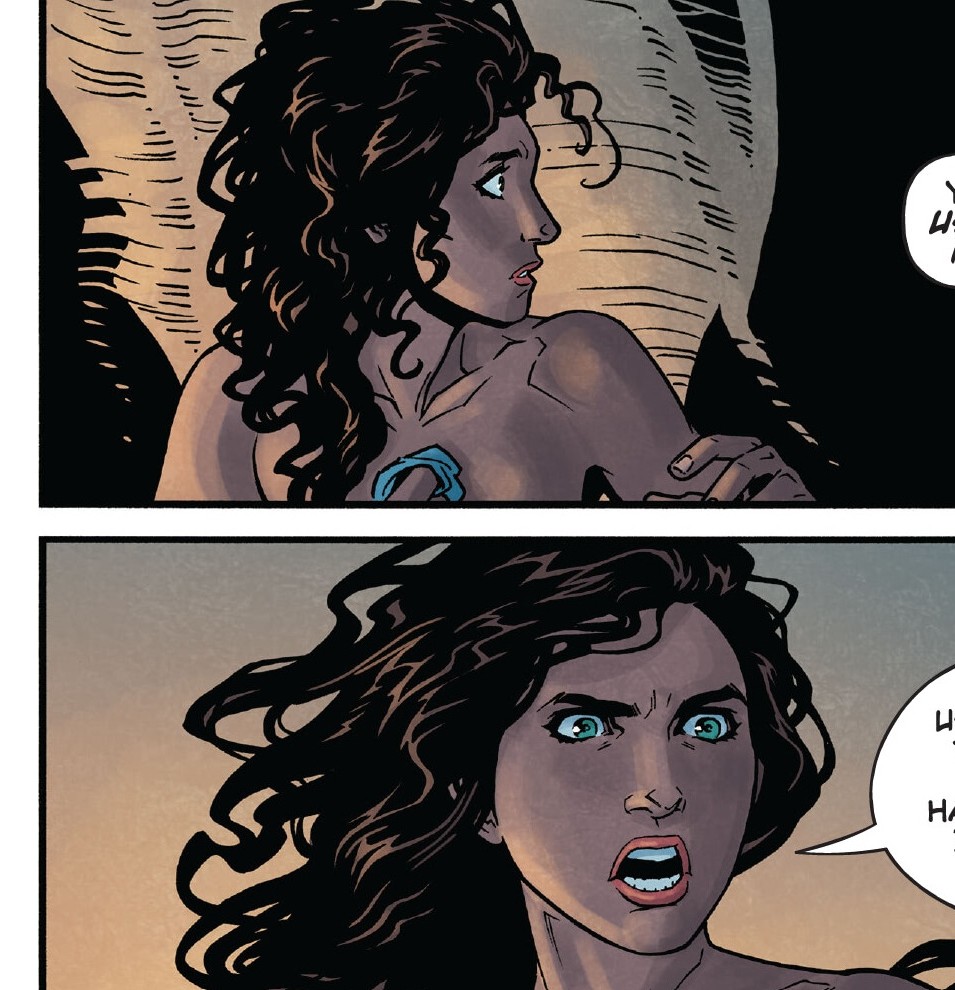
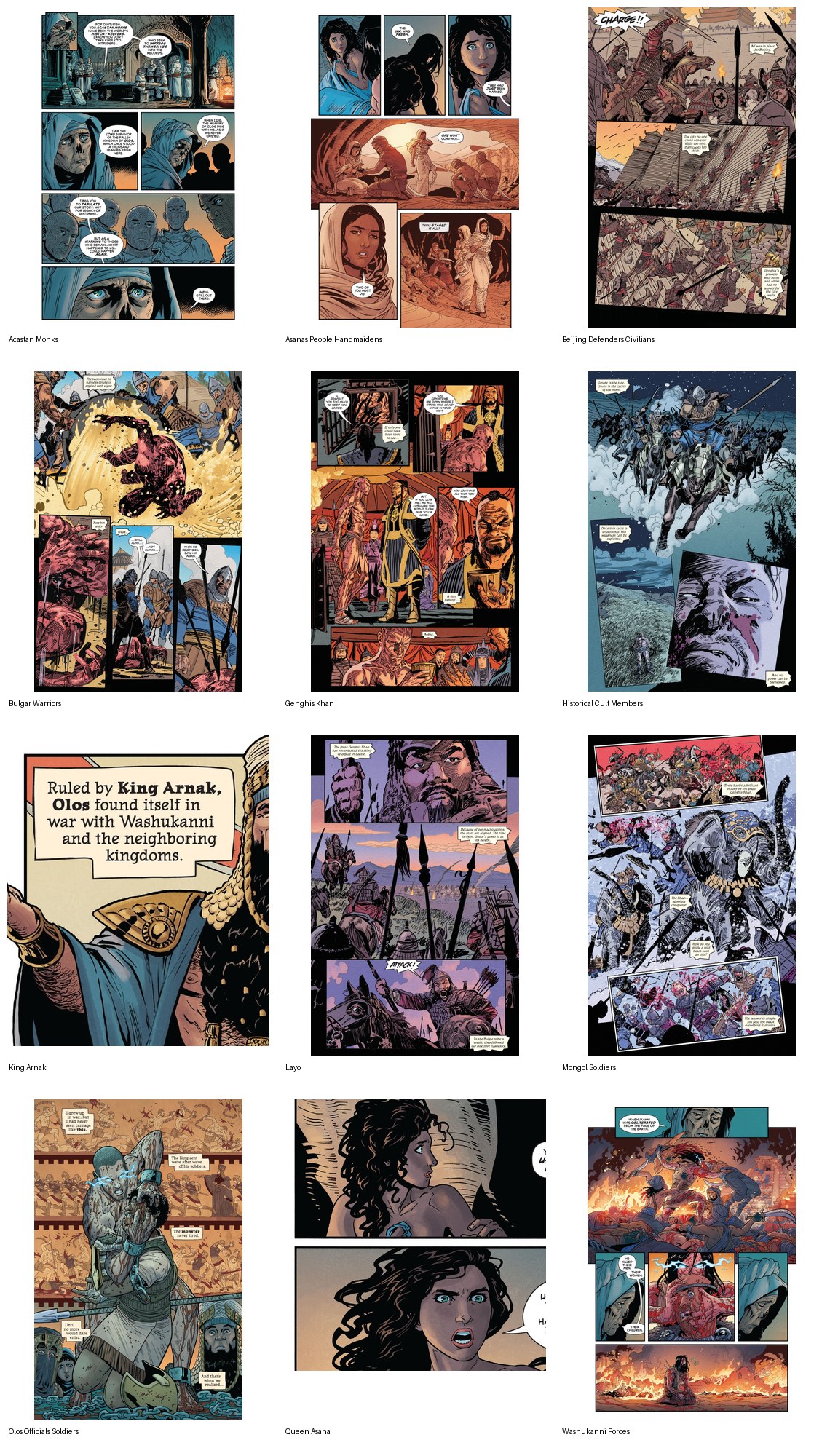
Spoilers: This article covers the relationship between B and Queen Asana in BRZRKR: Fallen Empire #1.
B and Asana's relationship is the emotional center of Fallen Empire. It develops inside a political system that captures B, displays him, and uses his body for the security of Olos. Asana can see the person beneath the spectacle, but she cannot simply step outside the court that gives her position meaning. Their intimacy is therefore real and compromised at the same time.
Meeting inside captivity
B arrives in Olos as a captive whose value is obvious to King Arnak and the city's officials. The palace, prison, and arena turn his survival into a public resource. Asana encounters him within that system rather than in a private world untouched by it. Her first knowledge of B is shaped by restraints, ceremony, and the assumptions of the court.
That beginning makes their relationship difficult. Asana may feel sympathy or attraction, but B remains confined. A private conversation cannot erase the political fact that the kingdom has decided where he belongs. The story refuses to turn romance into a magical key that opens the prison.
Asana's recognition
Asana learns that B is not an ordinary captive or a beast to be displayed. He remembers, speaks, and carries a history that exceeds Olos. Her recognition is important because the court's language reduces him to usefulness. She gives him a human response without pretending that her response has already made him free.
The relationship also changes Asana. She must see the cost of a kingdom that treats a person's extraordinary body as public property. Her proximity to B makes the court's violence impossible to keep abstract. She can understand him and still be entangled in the structures that benefit from his captivity.
The palace and the arena
The relationship moves between the palace's private rooms, the prison's control, and the arena's spectacle. Each space changes the terms of the interaction. In the palace, Asana can speak with B as a person while officials remain near. In the prison, the restraints make the imbalance visible. In the arena, the kingdom turns B's body into entertainment and military proof.
B's ability to survive does not make the arena harmless. He feels the injuries, and the spectators' expectations encourage the court to ask for more. Asana's presence cannot prevent every use. Her relationship with B is therefore part of the story's larger question about whether care can exist inside a system that profits from harm.
A different view of power
Asana's position gives her access but not unlimited authority. She can move through the palace, speak to B, and understand the political stakes, yet King Arnak and the military structure remain powerful. The relationship exposes the difference between proximity to power and control over power.
B recognizes that difference. He does not mistake Asana's affection for a promise that she can change the kingdom. His long history has taught him that rulers and courtiers can mean well while still treating him as an object. The trust between them grows because neither pretends the contradiction is gone.
B's history inside the relationship
B brings the memory of other institutions to Olos. He has been trained by a father, used by armies, and celebrated as a protector in Atlantis. The palace repeats the pattern in a new language. Asana's attention is meaningful because it reaches the person beneath those roles, but it also reminds B how often intimacy has been offered by people whose society still wants his strength.
The relationship asks whether B can accept affection without accepting the political purpose attached to it. He wants connection, yet he knows that every connection can make him vulnerable. Asana's presence does not remove that fear; it gives him a reason to remain visible within it.
War and the destruction of Olos
The conflict with Washukanni and the surrounding forces places the relationship inside a larger war. Olos's leaders can claim that B's captivity is necessary for survival. Military danger makes the court's control look temporary and reasonable. Asana sees the people and relationships hidden by that argument.
The destruction of Olos and Washukanni reveals the limit of political possession. A kingdom can hold B for a time and still lose its city, palace, and future. B's survival does not save the people who built their safety around him. Asana's relationship with B becomes a memory of a political order that believed ownership could defeat history.
Asana's death
Asana's death gives the storyline its emotional finality. B survives, but the relationship does not continue into an ordinary future. Her loss repeats the pattern that has defined B's life: a mortal person becomes part of his memory while he remains. The difference is that Asana understood the inequality before she died.
Her death also changes how B remembers Olos. The city is not only a kingdom that imprisoned him. It is the place where Asana tried to see him clearly. That complexity prevents the historical story from collapsing into a simple judgment of good and evil. B can condemn the system and still grieve the person inside it.
What the relationship changes in B
B and Asana's relationship reinforces B's desire for a life that can be shared in equal time. He does not want to watch another person age and die while he continues unchanged. The relationship makes mortality a relational need rather than an abstract escape. B wants a future in which love is not automatically a prelude to memory.
The experience also affects his later choices. When B releases Lugalṭur and protects Diana and the children, he is trying to refuse the forms of possession that destroyed Asana's world. He cannot save every person he loves, but he can recognize that a kingdom's claim is not the same as a person's choice.
Open questions
The one-shot leaves Asana's full biography, exact title, family history, and political authority incomplete. It does not give every conversation with B or specify all of her actions during the fall of Olos. The relationship is confirmed through the scenes and emotional consequences shown, while the details of her earlier life remain open.
Significance
B and Asana matter because the relationship makes captivity intimate without making intimacy a cure. Asana sees B as a person, but she is still part of a court that treats him as property. B loves her without pretending that Olos is safe. Their story gives Fallen Empire its moral center: a kingdom can lose a war, but the deeper tragedy is that it never learned the difference between protecting a person and owning him.
[1] Reeves, Kindt, Garney, Crabtree, and Robins, BRZRKR: Fallen Empire #1, B's capture, Asana, King Arnak, Olos palace, prison, arena, war, and destruction.