Selected scenes
BRZRKR in pictures.
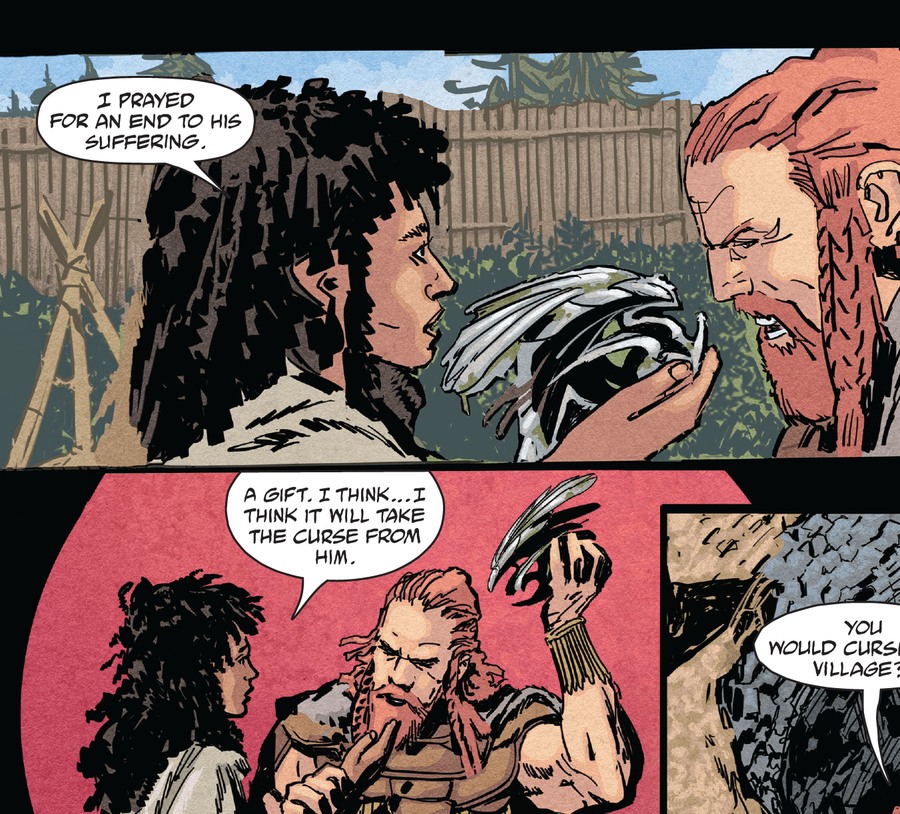
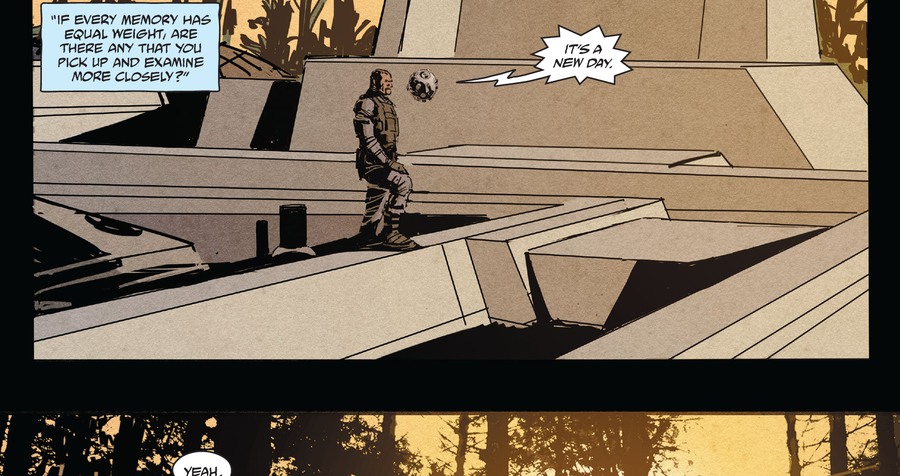
Weapons in BRZRKR are never only equipment. A weapon can be a name, a body, a relic, a memory, or a machine built to turn one person's survival into another person's power. B uses spears, swords, firearms, explosives, restraints, and his own hands across eighty thousand years, but the objects that matter most are the ones that reveal why people keep trying to control him.
B's body as the first weapon
B's body is the oldest and most important weapon in the series. His strength, endurance, regeneration, and combat knowledge allow ordinary communities and empires to solve military problems by sending him into the place where other bodies would die. His human father names him Unute in the language of a tool or weapon, and the name becomes a social command.
The body is also a prison. B feels every wound before the regeneration completes. He remembers every person killed around him. A king can claim the weapon, but cannot claim the memories that remain after the battle. The series' later artifacts—blood, fragments, machines, and relics—are attempts to separate the useful property from the person who has endured it.
Mother's Gift
Mother's Gift is the pale bird-shaped relic connected to B's mother's second prayer. She asks for release after the tribe turns B's extraordinary body into a weapon. The object survives the destruction of the prehistoric village and is recovered thousands of years later in the ancestral cave.
The relic is not given a complete technical explanation. It may be Source-linked technology, a ritual object, or an interface whose meaning depends on the person who activates it. Its narrative role is certain: it carries the mother's desire for B to have a choice. Caldwell sees a route to contact. B sees the last surviving act of a mother trying to save her son.
The World War fragment
During B's First World War service, a piece of his body is separated and left behind. The fragment becomes valuable because it remains connected to the regenerative pattern outside B's complete body. Researchers can study it, store it, and imagine using it to create new organisms.
The fragment introduces the difference between biological material and personal identity. A piece of B can be held without containing the whole person. Later Franken-B and Lugalṭur extend the question. The material can become active, but activity does not erase the right of the resulting person to choose.
Guns and military arms
Modern firearms define the opening operation and later missions. B uses rifles, pistols, explosives, and close-quarters weapons because he can survive the damage and continue. The guns make his regeneration visible. Bullets tear through the body, and the body rebuilds while the mission continues.
In A Faceful of Bullets, firearms become the language of 1800s America. A land baron uses armed authority to pursue a runaway daughter, and B must decide whether to become a private army or a protector. The weapons are historically specific, but the moral question is the same as in Olos and the modern program: who gets to decide where B's strength is pointed?
Primitive weapons and training
B learns blades, spears, clubs, bows, and survival techniques in the prehistoric village. His father uses training to turn accelerated growth into military capability. The weapons are not magical. Their importance comes from the body that wields them and the institutions that decide what the body is for.
Across later eras, B's mastery of weapons becomes part of his legend. Soldiers remember the impossible fighter rather than the child whose mother feared the role. The tools change with history, but the public interpretation remains stable: a weapon is admired for what it can do, not asked what it wants.
Olos restraints and arena equipment
Olos uses chains, gates, prison fixtures, and arena weapons to contain and display B. The restraints cannot kill him, so their purpose is delay and spectacle. Guards control access, food, movement, and the timing of the fights. The arena turns regeneration into public entertainment and political proof.
These objects reveal that captivity can be built from routine rather than one perfect chain. The prison works because many people perform small tasks that keep B in place. Asana's visits show that a system designed to control an immortal can still be crossed by trust and deception.
The primordial-ore sword
The primordial-ore sword appears in Poetry of Madness as one component of Vizane's Atlantis gateway ritual. Its material, maker, and earlier history are not fully explained. The sword matters because it is used with B's blood, the Atlantean obelisk, Aklo material, and ritual space to open a passage for Cthulhu.
The weapon is not established as a universal anti-immortal blade. Its function in the issue is ritual and symbolic as much as martial. Vizane turns a tool associated with primordial power into a key, demonstrating how artifacts can change meaning when a political or religious movement uses them for a new purpose.
The Atlantean obelisk and reliquary
The obelisk is stolen from an Atlantean reliquary and moved to the northeastern tower. Its theft turns a place of preservation into the source of catastrophe. The object may contain inscriptions or energy associated with the gateway, but the comic does not provide a construction history or universal rule for its power.
The reliquary itself is important because it shows Atlantis treating the past as a material responsibility. Vizane's theft is therefore not only a magical crime. It is an attack on the institution that keeps the city's memory safe. The same pattern appears later when B attacks the Acastan archive after Asana's testimony.
Aklo texts and ritual vessels
Aklo texts, cups, blood, and other ritual materials complete the gateway environment in Atlantis. They should be understood as a set whose effects depend on arrangement, participants, and place. The issue does not establish that any single scroll or cup can open a gateway independently.
The materials also connect language to violence. Vizane's followers read or invoke words that make an impossible event possible, while B's blood supplies a living component. The ritual is an attempt to make the immortal body answer a question the city cannot answer through politics alone.
B's blood and tissue
B's blood is used in research, experiments, and the Atlantis ritual. It is a physical expression of the condition that makes him valuable. The government sees blood as a sample. Vizane sees it as a key. Later scientists siphon protoplasm from B to create a new being. In every case, the material is connected to a living person who has not automatically surrendered ownership.
Blood does not explain the entire mechanism of regeneration. The series connects B's biology to the Source, but it does not provide a complete formula. Similar use of blood in Atlantis, Protocol X, or vampire stories does not make the supernatural systems identical.
Protocol X machinery
Protocol X is a machine-built attempt to reach the phenomenon behind B's origin. The apparatus uses containment, energy, monitoring, and B's body as the route to contact. It succeeds in opening a connection, but the result is B's disappearance and Diana's alteration rather than a controllable signal.
The machinery demonstrates the limits of human tools. A monitor can record a surge, but it cannot decide what the Source is. A restraint can hold B in a room, but it cannot hold the contact environment. The equipment is powerful because it opens the door and dangerous because the people using it believe the door belongs to them.
The Source-powered hypercomputer
The hypercomputer is a later attempt to exploit Source-linked information and energy. Its interface blurs technology and contact, making it difficult to say whether the machine merely computes or also participates in the Source network. Caldwell's use of the apparatus leads toward the transfer of B's power.
The hypercomputer should not be treated as the Source itself. It is a human-built interface or tool that depends on phenomena humans do not understand. Its danger comes from the same assumption as Protocol X: that access can become ownership through enough hardware.
Weapons of the historical armies
The Mongol campaign uses bows, cavalry, siege engines, and corpse-based disease tactics. The Beijing defenders rely on walls and fortifications. Olos uses palace guards, prison restraints, and arena weapons. Washukanni mobilizes defenders who eventually release Asana in an attempt to stop B. These are collective military systems rather than a list of named artifacts.
The weapons matter because they reveal what B changes in a battlefield. A wall can stop an army but not necessarily B. A bow can wound him but not end the attack. A siege engine can weaponize the dead. The presence of B makes ordinary tools more desperate, not obsolete.
The chained box and the sea
In The Bleeding Tide, the chained box is both container and mystery. The Captain finds B's reconfiguring body in the ocean after following a heartbeat. The box keeps the body hidden while the regeneration continues, but it also turns B into cargo. Once aboard ship, he has to reclaim his identity from the object's implication that someone can transport him as property.
The ship itself is a weapon and a refuge. Its deck, rigging, and weapons shape the ambush. The sea creates danger that regeneration cannot simply solve. B can return from wounds, but drowning, confinement, and supernatural pursuit make the environment unpredictable.
Artifacts and the ethics of use
The central question is never whether an object is powerful. It is who gets to decide what the power is for. Mother's Gift is a plea for freedom. The obelisk and sword become tools for a gateway. The fragment becomes scientific material. The hypercomputer becomes a path to transfer. A gun becomes either a baron's instrument or a guardian's warning.
B's own body remains the standard by which the artifacts are judged. If an object helps someone treat a person as property, it repeats the original harm. If it gives a person room to choose, it moves toward the freedom B's mother imagined. The weapons and artifacts of BRZRKR are therefore a history of the values attached to power.
Objects that remember people
The most powerful artifacts in BRZRKR preserve an intention. Mother's Gift remembers a mother's attempt to free her child. The Atlantis obelisk and reliquary preserve a city's attempt to protect forbidden knowledge. The First World War fragment preserves the physical consequence of using B as a soldier. The chained box beneath the ocean preserves the moment a body became cargo. Even an ordinary firearm can carry a history of who was ordered to fire it and who was expected to survive.
This is why the objects cannot be separated from their owners and users. A sword in Vizane's hand is part of a gateway. A rifle in B's hand can be a mission tool or a way to protect a comrade. The object changes meaning when the person holding it changes purpose.
The limits of technological control
Protocol X and the hypercomputer are built from the hope that enough machinery can turn mystery into a repeatable process. The devices do produce results, but the results include displacement, altered bodies, betrayal, and mortality. The machines are not failures because they do nothing. They fail because their creators expect a human life to behave like a component.
The same warning appears in the Bronze Age story of Light Draws Breath. The rogue scientists remove a piece of B and discover that material can become a person. The discovery is astonishing, but astonishment does not grant ownership. The artifact history of BRZRKR is therefore a history of tools that force their users to confront the people hidden inside the material.
References
[1] BRZRKR #1-12, B's weapons, blood, tissue, fragment, Protocol X, hypercomputer, and mortality transfer.
[2] BRZRKR: Poetry of Madness #1, primordial-ore sword, obelisk, Aklo material, ritual vessels, B's blood, and Atlantis gateway.
[3] Fallen Empire #1, Olos restraints, arena, palace weapons, and Asana's use of B.
[4] The Lost Book of B. #1, Mongol arms, Beijing siege, opium, and corpse siege tactic.
[5] A Faceful of Bullets #1, firearms and the Western conflict; The Bleeding Tide #1, chained box, ship, and maritime weapons; Light Draws Breath #1, protoplasm extraction and alchemical experimentation.