Selected scenes
BRZRKR in pictures.
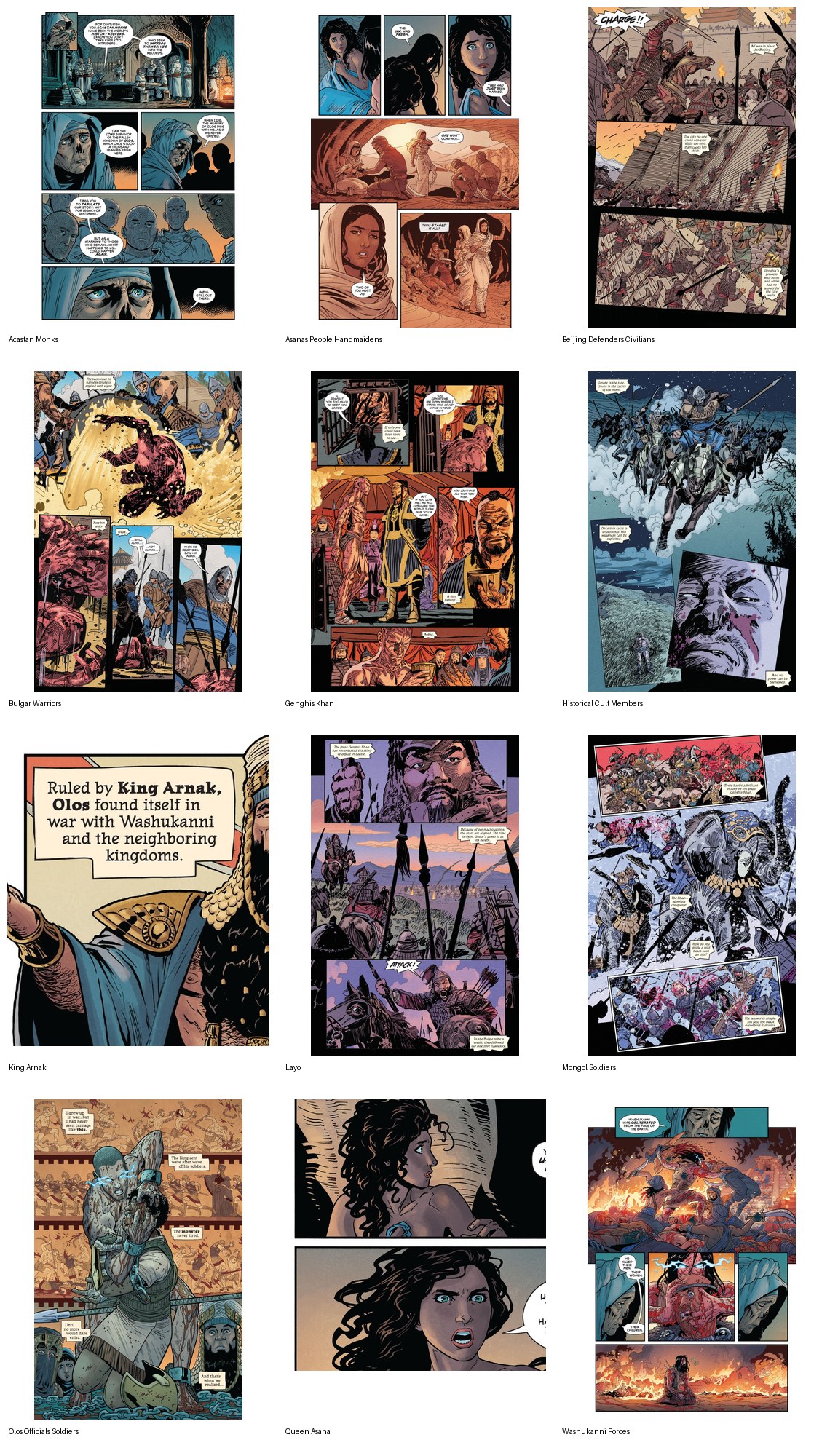
Spoilers: This article discusses the Bulgar and Mongol campaigns, Lugalṭur's creation, Theosebeia, Zosimus, and the historical framing of The Lost Book of B.
BRZRKR: The Lost Book of B. #1 is a historical and alchemical one-shot about the ways B's body becomes a story, a weapon, and a source of independent life. The issue moves from a Bulgar camp where a hidden cult keeps B trapped in a cycle of injury and rage, to Genghis Khan's campaign against Beijing, and then into the later history of Lugalṭur Dumu-Biritum, a being created from B-derived material who must decide what to do with an origin he did not choose.
The publication's title suggests a missing record, but the story is less interested in a literal book than in the people who attempt to control B's history. Cult members prepare rulers, soldiers carry legends, alchemists work with fragments, and witnesses reinterpret what they see. The issue asks whether a person made from another person's body can escape the purpose assigned by the people who made him.
The cult's preparation
The opening narration describes a hidden tradition that understands B as cyclical and exploitable. The cult does not need to command every army directly. It studies the way rulers respond to power and arranges for B to be in the right place when a larger ambition appears. The Bulgar group that holds him has been given a method for keeping him angry and weak: repeated boiling, injury, and controlled recovery.
The tactic is brutal because it treats B's regeneration as a mechanism that can be tuned. The captors do not try to kill him permanently. They try to keep him in a state that makes him useful when the next ruler arrives. B's body is made into a clock that measures the cult's preparation. Every wound returns, and every return is used to maintain the cycle.
The Bulgars are not shown as a complete nation or as the sole authors of the plan. They are a local force acting inside a scheme designed by people who know more about B's history than they do. Their camp becomes the staging ground for Genghis Khan's arrival, and their loss of control demonstrates how a hidden organization can use ordinary power without sharing the consequences.
Genghis Khan and the offer
Genghis arrives as a ruler whose ambition can absorb B. He sees the captive's survival as an opportunity to strengthen the Mongol campaign. The offer is not framed as simple friendship. B is given release from the Bulgar camp in exchange for service, and the terms appeal to the same desire that has shaped his life since childhood: a powerful institution promises that his body can be useful within a larger order.
The difference is scale. The Bulgar captors can barely contain B. Genghis can place him inside an army that moves across regions and attacks fortified cities. The offer turns B from a local prisoner into an imperial weapon. It also gives him access to rewards—opium, companionship, and proximity to the Khan—that can temporarily soften the violence of the arrangement.
Opium and manufactured need
The issue presents opium as a tool of control rather than a neutral pleasure. B is given the drug and encouraged to associate it with relief from the pain and pressure of his existence. The promise is oblivion. For an immortal who remembers everything, the promise has unusual force. B can survive a wound, but he cannot forget it. A substance that quiets the mind becomes another way for a ruler to keep him functional.
The relationship between B and opium echoes the earlier relationship between B and the tribal weapon. Someone else identifies a need, supplies the means of meeting it, and expects obedience in return. The difference is that B recognizes the trap more clearly after thousands of years. He may accept the reward, but the reward does not become freedom. It becomes another chain attached to the body that cannot die.
The siege of Beijing
The Mongol campaign eventually reaches Beijing, a fortified city whose walls and barricades resist the ordinary advantages of horse and arrow. The siege turns the army's resources toward engineering, attrition, and the breaking of a population's ability to withstand pressure. B becomes one part of the campaign, but his presence cannot make the walls disappear.
The issue keeps the defenders and civilians in view even though they receive no complete roster. Beijing is a lived city behind military defenses. Its people are not a faceless obstacle; they are the reason the siege has a human cost. The Mongol army's decisions affect families as well as soldiers, and B's participation makes the cost personal because he can see and remember what the campaign does.
The corpse siege tactic
When the siege continues, the Mongol forces use the dead as weapons, loading bodies into engines to spread disease and stench. The tactic is presented as a calculation intended to break the city's resistance. Its horror comes from the conversion of human remains into military material. The dead are denied even the dignity of being outside the campaign.
The method also reflects the issue's larger view of bodies. B's body is used because it regenerates. The soldiers' bodies are used after death. Lugalṭur will later be created from B-derived material. In each case, a person or a body is treated as a means to an end. The story does not claim that the situations are identical. It places them in the same moral landscape.
The legend of the campaign
The Mongol army transforms B's actions into an imperial legend. Soldiers witness his endurance, commanders rely on him, and later narrators remember him as part of Genghis Khan's victories. The legend is useful to the empire because it turns a confusing biological fact into a story of conquest. B becomes proof that the Khan's order is favored by forces beyond ordinary humanity.
B's own memory is less triumphant. He remembers the bodies, the commands, and the moments when his violence solved a military problem while creating a human disaster. The contrast between imperial history and personal memory is one of the issue's most important themes. A victory can be true and still be a loss for the person whose body made it possible.
Lugalṭur's creation
The issue then moves toward Lugalṭur, a being formed from material derived from B. The creation is not treated as a simple clone. Lugalṭur develops through a vessel or egg and emerges with a body whose origin is connected to B but whose identity is not predetermined by that connection. The alchemical and biological process remains partly unexplained, which keeps attention on the ethical question rather than a recipe.
Lugalṭur's existence makes the separated fragment problem personal. Earlier, the First World War fragment is an object held by researchers. In this story, B-derived material becomes someone who can speak, feel, and make choices. The material origin is real, but it cannot settle the question of ownership. Lugalṭur is not B's property, and B is not automatically Lugalṭur's master or father in a simple human sense.
Theosebeia
Theosebeia becomes Lugalṭur's protector and gives the new being a relationship not based on utility. She sees a person where others see an experiment or weapon. Her care allows Lugalṭur to survive long enough to develop a sense of self. The relationship echoes B's mother's attempt to protect him from weaponization, but it is not a repetition. Theosebeia encounters a being already created by another person's body and chooses to defend his independence.
Her role also shifts the issue away from B. The story remains about B's history, but the emotional center becomes the question of what a derived person deserves. Lugalṭur's life cannot be measured only by what he tells us about B's biology. He has his own fear, curiosity, and future.
Zosimus and alchemical ambition
Zosimus represents another form of institutional desire. Where the cult uses prophecy and Genghis uses imperial command, Zosimus uses alchemy and experimentation. He is interested in transformation, preservation, and the possibility that B-derived material can cross boundaries ordinary human bodies cannot.
The issue keeps Zosimus's alchemy distinct from the Source and from B's original regeneration. Similar results—long life, altered bodies, survival beyond ordinary limits—do not prove a shared mechanism. The separation matters because The Lost Book of B. expands the BRZRKR world into a history of competing explanations. Some characters speak in the language of gods, some of science, and some of alchemy. Each can produce real effects without becoming the same system.
B and Lugalṭur
B eventually encounters Lugalṭur and recognizes the connection. The meeting is not a conventional reunion between creator and child. B sees a person who carries part of his material history, while Lugalṭur sees the source of the body that has shaped his life. Both have reasons to feel fear and curiosity.
The most important choice B makes is to release Lugalṭur rather than claim him. B knows what it means to have a father decide what a body is for. He refuses to repeat that history by telling Lugalṭur that derived origin creates an obligation to serve. The release is an ethical correction to the first bargain of B's life. Lugalṭur is allowed to become someone whose future is not a military assignment.
The meaning of a lost book
The title can be read as a metaphor for the lives that institutions fail to preserve accurately. The cult writes B into prophecy. Genghis writes him into imperial history. Alchemists write him into experiments. Lugalṭur has to write himself into a future that does not already belong to another author.
The story's witnesses are partial and sometimes compromised, but the issue does not treat that as a reason to abandon history. It asks the reader to listen for the person inside each account. A soldier can be part of a conquest and still be afraid. A ruler can admire B and still use him. A derived being can come from another body and still possess an independent self.
Place in B's history
The Lost Book of B. expands the historical chain between B's ancient campaigns and the modern program. It shows the cult's long preparation, the imperial use of B, and the emergence of a new being from B-derived material. The issue explains why later scientists might believe that B's biology can be copied, while also demonstrating that copying material does not copy identity.
The publication also broadens the emotional range of B's history. He is a weapon at the Bulgar camp and in Genghis's army, but he becomes a protector when he releases Lugalṭur. That choice does not undo the violence of the earlier campaigns. It shows that B can learn from the way he was used and refuse to make another person carry the same burden.
Place in the wider series
The one-shot belongs to the historical branch of BRZRKR and should be read alongside Poetry of Madness and Fallen Empire. Atlantis shows a gateway catastrophe. Olos shows political captivity and betrayal. The Lost Book of B. shows how legend, empire, and alchemy turn B's body into a chain of new histories. The stories share a subject without merging their supernatural systems or making every historical figure part of the original twelve-issue cast.
The final impression is not that B has finally solved the mystery of himself. It is that he has made one choice that the institutions around him rarely make: he recognizes another extraordinary body as a person who deserves to leave.
A history written in bodies
The issue's settings—camp, court, battlefield, laboratory, and ruined road—are connected by the ways people read bodies. Genghis sees B as a force that can change a campaign. Zosimus sees a material that might reveal the water of life. The cult sees a sign that can support a prophecy. Theosebeia sees a child who needs protection. Lugalṭur eventually sees himself. The story moves from one interpretation to the next until B is forced to decide which interpretation he will offer another person.
That movement gives the title its melancholy. The lost book is not simply a missing object. It is the unwritten account of people who were turned into evidence before they could explain themselves. Lugalṭur's future cannot be recovered from B's tissue, because a body does not contain the whole person. B's release is therefore an act of historical humility: he accepts that another life may remain unknown to him.
References
[1] Keanu Reeves and Matt Kindt, BRZRKR: The Lost Book of B. #1 (BOOM! Studios, 2024), cult preparation, Bulgar captivity, Genghis Khan, Beijing siege, opium, and corpse siege tactic.
[2] Reeves and Kindt, The Lost Book of B. #1, Lugalṭur's creation, Theosebeia's protection, Zosimus's alchemy, B's encounter with Lugalṭur, and the decision to release him.