Selected scenes
BRZRKR in pictures.
Spoilers: This article discusses the complete events of BRZRKR: Fallen Empire #1.
Overview
The Washukanni forces are the military defenders of Washukanni, a kingdom or civilization at war with Olos during the reign of King Arnak. They become the victims of one of the most complete massacres in B's known history after Queen Asana stages her own abduction and manipulates B into believing Washukanni is responsible. BRZRKR: Fallen Empire #1 does not provide names for individual Washukanni commanders, rulers, or soldiers. The forces should therefore be documented collectively, with the distinction between military personnel and civilian population preserved in the database.[1][2]
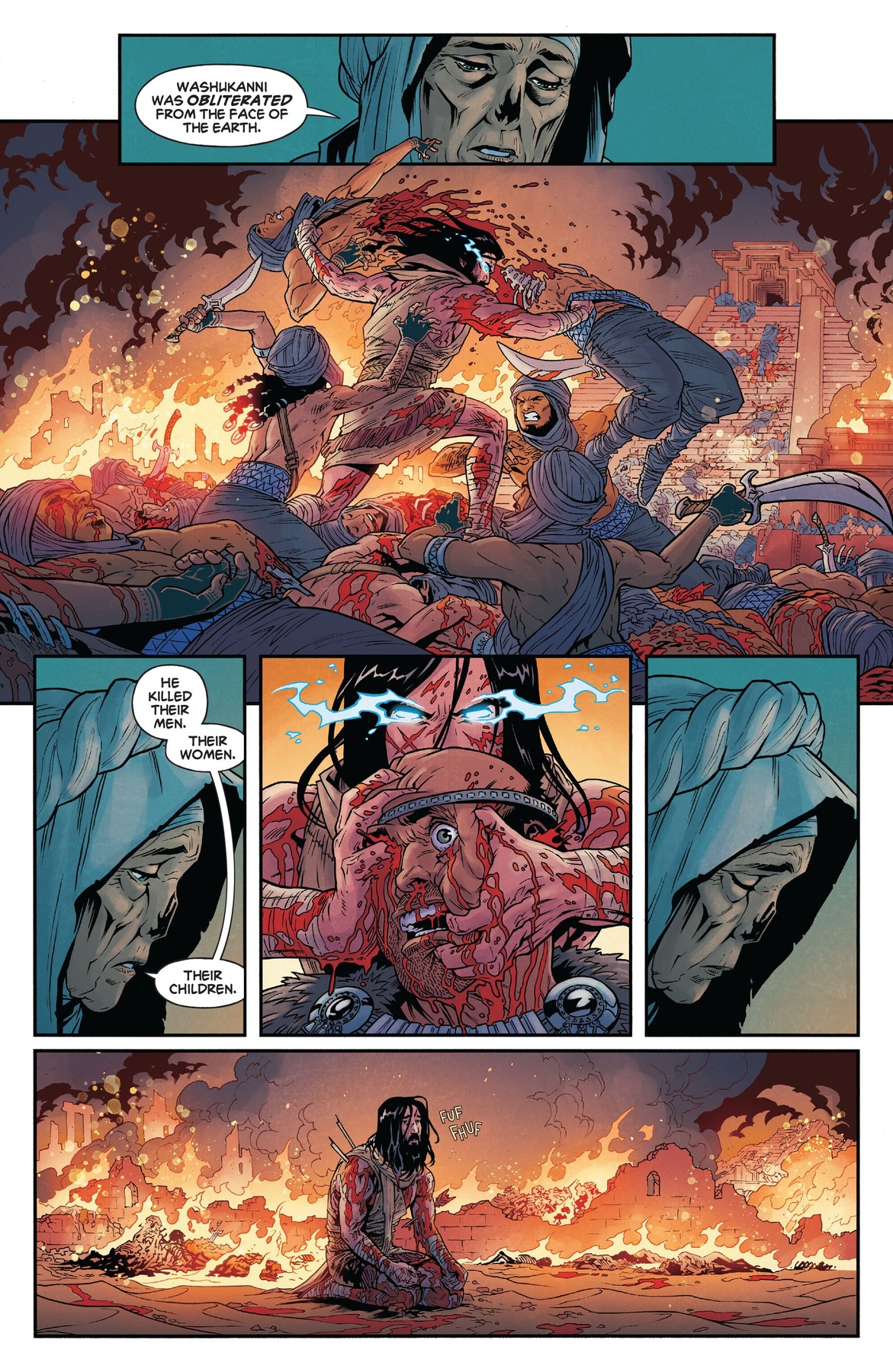
Washukanni matters less because of a detailed military order of battle than because its destruction reveals the consequences of treating B as a strategic weapon. Asana has spent her life trying to end cycles of regional war. She concludes that B can be used to eliminate the enemy her husband cannot defeat. The result is not a controlled military campaign. B kills the defenders, then continues through the population until the narration can say Washukanni has been obliterated from the face of the earth.[2]
The surviving moments within the story add an important qualification. Washukanni realizes that B is attacking because of Asana. Its people release her, hoping that returning the apparent captive will stop him. The effort fails. This shows that at least some Washukanni authorities understand the immediate cause of the attack and attempt a de-escalation, but by that point B's berserker violence cannot be recalled like an ordinary army.[3]
Historical context
Regional rivalry with Olos
When King Arnak is introduced, Olos is already at war with Washukanni and neighboring kingdoms. The comic does not state when the conflict began, what territory was disputed, or which side initiated the contemporary war. It should therefore be recorded simply as an established regional conflict rather than reconstructed from real-world geography.[1]
Olos's warfare is tied to the king's public death sport. Captured enemies are brought inside the protected city and used as arena combatants. It is possible that some arena prisoners come from Washukanni, but the issue does not label every captive by origin. That relationship should remain probable context, not a confirmed appearance for every prisoner.
Asana's larger peace project
Asana's birth people had also suffered through Olos expansion. Their elders made her part of a treaty with Arnak in an effort to stop bloodshed. Her adult political worldview remains dominated by the idea that she is supposed to bring peace to the desert.[4]
Washukanni eventually becomes the obstacle she chooses to remove. She describes B as a weapon fate has offered against the kingdom. Her logic is not that every Washukanni person has wronged her. It is strategic: a rival power can be destroyed if B is given sufficient emotional reason to attack.[5]
This is why the Washukanni forces page must link closely to Asana's biography. Their annihilation is not merely another ancient battle in B's timeline. It is the outcome of a deliberate manipulation by someone who knows B's emotional attachments and perfect memory.
The staged abduction
Asana arranges evidence suggesting that she has been violently taken from the desert refuge she shares with B. Participants bear black-hand markings associated with her people. The scene includes blood and signs of struggle. Later, B's memory reveals that the ink was fresh and that the attack had been staged.[6]
The deception is designed to point B toward an external enemy. He returns to Olos and ultimately identifies Washukanni as the target.
The comic does not establish that Washukanni actually participated in Asana's disappearance. On the contrary, the later reveal establishes the attack as a construction. Any article claiming that Washukanni kidnapped the queen as an objective event would be incorrect.
B's attack
Once directed at Washukanni, B becomes something conventional military defense cannot stop. The issue depicts him cutting through armed defenders while the city burns. He is covered in blood and injuries but continues to kill.[2]
The defenders use blades and other period weapons. Their exact numbers are not given. There is no named general, elite unit, or magical defense. The visual narrative emphasizes the impossibility of fighting an immortal whose rage and regeneration make normal attrition meaningless.
Failure of conventional defense
The Washukanni forces face the same fundamental problem encountered by Olos's arena soldiers. B can be wounded, but injury does not end the attack. Killing him temporarily cannot secure a lasting victory.
A battle against B therefore operates on a different strategic scale from warfare between Olos and Washukanni. Human forces can exhaust one another. B can regenerate and resume.
Release of Asana
During the destruction, the Washukanni understand that B has come because of Asana. They release her when they realize they cannot defeat him, hoping the gesture will stop the rampage.[3]
This moment implies decision-making authority inside the collapsing kingdom, even though no leader is named. Someone is capable of ordering or allowing Asana's release. The source does not identify whether this is a king, general, council, jailer, or civilian group.
The attempt fails. B continues killing.
Annihilation of the population
The narrator's language is explicit: Washukanni is obliterated from the face of the earth. B kills their men, their women, and their children.[2]
For data architecture, this requires two related but distinct entities:
- Washukanni Forces, representing the combatants who oppose B and Olos.
- Destruction of Washukanni, the event encompassing both military defeat and mass killing of civilians.
The wiki should not call every victim a soldier. The story emphasizes civilian deaths precisely to show that B's attack escapes the boundaries of warfare.
Military characteristics
Weapons and armor
Washukanni defenders are depicted with bladed weapons, helmets, shields, and regional clothing or armor. No named weapon system is established.
Urban defense
The destruction occurs in and around substantial built structures, indicating a settled civilization rather than a small nomadic camp. The comic does not provide a map, population estimate, or formal city name separate from Washukanni.
Command structure
Unknown. No officer or ruler is named in Fallen Empire #1.
Tactical response to B
The forces attempt direct physical resistance. When that fails, the society attempts to remove B's perceived motive by releasing Asana. This is the only clearly depicted strategic adaptation.
Relationship with Olos
Washukanni is one of Olos's principal enemies under Arnak. The conflict is ongoing before B becomes involved. Asana later weaponizes that rivalry, exploiting the fact that both Arnak and B can plausibly accept Washukanni as the source of violence against her.
The annihilation temporarily removes Olos's rival but contributes to Olos's own destruction by revealing the scale of Asana's deception.
Relationship with Asana
Asana is not a Washukanni captive by origin. She comes from a different desert people and entered Olos through treaty. Her later claim that Washukanni abducted her is false as a causal account.[6]
After B destroys the kingdom, she says the Washukanni released her because they knew he had come for her. This may indicate she was physically present in or near their territory as part of the staged plan, but the precise logistics are not explained. The article should not invent how she entered Washukanni custody.
Relationship with B
The Washukanni forces encounter B as an existential attacker rather than a conventional invading commander. There is no diplomacy shown between B and their leaders. By the time the story depicts the attack, he is acting under the false belief generated by Asana's evidence.
Their destruction becomes one of the clearest examples of why B cannot be treated as a controllable strategic asset.
Moral and narrative significance
Washukanni functions as the point at which Asana's abstract language of peace becomes mass death. Before the attack, she can think of B as a weapon against an enemy state. Afterward, the narration forces the reader to confront individuals beyond the military category: women and children die too.
The event also rejects the fantasy that weaponizing B can be precise. Arnak wanted to harness him with force. Asana believes she can harness him through knowledge and affection. Washukanni is the proof that success at initiating B's violence is not success at controlling its limits.
Status and fate
Destroyed. The story describes Washukanni as obliterated. No surviving Washukanni character is identified. If later canon introduces survivors, the database should update the collective status while preserving the original narrator's wording as the historical claim made in Fallen Empire #1.
Defenders facing a weapon they cannot contain
The Washukanni forces enter the story with a conventional understanding of war. They know that Olos is an enemy, that a queen has been taken, and that an armed force can be resisted by organizing soldiers around walls and gates. B breaks that understanding. He is not an army that can be exhausted through attrition; he is a single body that returns after every wound and continues toward the target supplied by Asana's deception.
The defenders are therefore placed in an impossible tactical position. They can injure B, but injury does not end the attack. They can protect a location, but the location itself becomes a trap for everyone inside it. Their eventual decision to release Asana is an attempt to remove the reason for B's rage. It is a rational response to the information available to them, yet it comes after the false story has already made B's violence self-sustaining.
Civilians inside the military story
The narration's reference to men, women, and children prevents the Washukanni sequence from being read as a battle between equal forces. The kingdom is a population, not only a garrison. B's attack reaches beyond the people who can carry weapons and into homes, families, and daily life. The comic does not name every victim, but its language insists that the catastrophe is collective.
That emphasis also changes B's later discovery of the truth. He has not merely been tricked into fighting an army. He has been directed toward a society. Asana's confession forces him to understand that his grief was used to erase people who had no role in her captivity. The realization is one of the reasons the fall of Olos cannot be treated as simple revenge. B's anger turns back toward the city that shaped the lie, but nothing can restore Washukanni.
A civilization remembered through its absence
After the destruction, Washukanni survives in the series as an absence: a name attached to a ruined landscape, a population described in the past tense, and a warning about what happens when an immortal weapon is aimed at civilians. The lack of named survivors is painful, but it does not make the kingdom insignificant. Its disappearance gives later characters a measure for the scale of Asana's decision and B's guilt.
The forces of Washukanni should consequently be understood as defenders and victims within the same historical event. They resist B because they must, release Asana because they hope to stop him, and are destroyed despite those choices. Their story is one of the clearest demonstrations that courage and strategy cannot guarantee survival when the enemy is being driven by a lie.
Appearances
- BRZRKR: Fallen Empire #1 - regional enemy of Olos and civilization annihilated by B.
- BRZRKR: Fallen Empire Pen & Ink #1 - alternate presentation of the same story.
- BRZRKR Bloodlines collected editions - reprint context.
Canon limitations and unresolved questions
Unknown details include the name of the Washukanni ruler, capital, population, exact borders, government form, religion, language, military ranks, origin of the war with Olos, and exact method by which Asana comes to be physically released by them during B's attack.
The spelling Washukanni should be standardized exactly as it appears in Fallen Empire #1.
Washukanni in the larger desert war
The comic gives Washukanni no dynastic catalogue or complete account of its institutions. What it does show is enough to make the kingdom significant. Washukanni constrains Olos, shapes Arnak's military thinking, and becomes the enemy Asana believes must be eliminated for peace to become possible. Its importance comes from those pressures and from the human cost of B's attack, even though the kingdom's internal political history remains unknown.
The kingdom also illustrates how BRZRKR uses gaps in ancient history. The audience encounters Washukanni mainly at the moment of destruction, which means almost everything known about it is filtered through its enemies and through Asana's retrospective narrative. A rigorous article should label the description of total annihilation as direct narrator testimony supported by depicted destruction, while leaving open the abstract possibility that later material could reveal people outside the attacked center who survived.
Civilians and the limits of military terminology
The source deliberately moves beyond soldiers. By naming men, women, and children, the narration prevents the event from being summarized as a battlefield defeat. The people killed include noncombatants. This is one reason the event deserves a separate Destruction of Washukanni article rather than being buried inside a military history page.
Individual background figures remain unidentified defenders or civilians unless the narrative supplies a canonical name.
The failed attempt to stop B
The release of Asana is the closest thing the comic gives Washukanni to a strategic decision after B's attack begins. It proves that the people confronting him are not simply mindless victims waiting for destruction. They identify the motive driving the attack and try to remove it. In an ordinary war, releasing a captive can function as negotiation. Against B in a berserker state, it is too late.
Washukanni provides one of the strongest historical examples of the difference between giving B a target and possessing the ability to stop him once the attack is underway.
Sequence of events
The events unfold in the following order, without a more precise date:
- Olos and Washukanni are already at war under King Arnak.
- B is captured by Olos and later escapes with Asana.
- Asana decides B can be used against Washukanni.
- Her allies stage evidence of a violent abduction.
- B returns to Olos seeking the supposed kidnappers.
- Washukanni becomes the identified target.
- B attacks the kingdom and overwhelms its military defenders.
- Washukanni releases Asana in an effort to stop him.
- B continues the attack.
- The narration records the destruction of Washukanni's men, women, and children.
- B later discovers Asana's deception.
- The revelation leads directly to the destruction of Olos.
This event chain is one of the clearest cause-and-effect sequences in Fallen Empire and should be represented visually on Asana's page, the Washukanni page, and the master BRZRKR timeline.
The people inside the destroyed kingdom
Washukanni's forces are often remembered through the scale of their defeat, but the story first presents them as a living society with defenders, families, and a chain of command. They fight because a rival kingdom has made war part of the region's political order. When B arrives, their ordinary military logic fails against a person whose body and rage no longer respond to the limits of a human campaign.
The release of Asana is a final attempt to speak to the motive behind the attack. It reveals that the defenders understand B is not simply an enemy commander. He is a person pursuing a perceived abduction, and the city tries to return the person he believes it holds. That effort fails because the deception has already transformed grief into momentum. The tragedy is not that Washukanni lacked intelligence. It is that intelligence arrives after the weapon has been pointed.
The annihilation therefore carries two kinds of weight. It is a military defeat, and it is the destruction of a population that never consented to Asana's plan. B discovers the lie only after the deaths have occurred. His later destruction of Olos is not a clean correction. It is another violent answer to a political act, and the forces of Washukanni remain the innocent center of that chain.
References
[1] Mattson Tomlin and Rebekah Isaacs, BRZRKR: Fallen Empire #1 (BOOM! Studios, 2023), introduction of Olos's war with Washukanni and neighboring kingdoms, digital page image 0007.
[2] Tomlin and Isaacs, Fallen Empire #1, B's destruction of Washukanni and explicit narration that men, women, and children are killed, digital page image 0037.
[3] Tomlin and Isaacs, Fallen Empire #1, Asana's statement that the Washukanni released her after realizing B had come for her and could not be stopped, digital page images 0038-0039.
[4] Tomlin and Isaacs, Fallen Empire #1, history of Asana's people, Olos expansion, and her treaty marriage, digital page images 0028-0029.
[5] Tomlin and Isaacs, Fallen Empire #1, Asana's confession that fate offered B as a weapon against Washukanni, digital page image 0042.
[6] Tomlin and Isaacs, Fallen Empire #1, B's discovery that the black-hand evidence was freshly created and revelation of the staged attack, digital page images 0040-0041.