Selected scenes
BRZRKR in pictures.
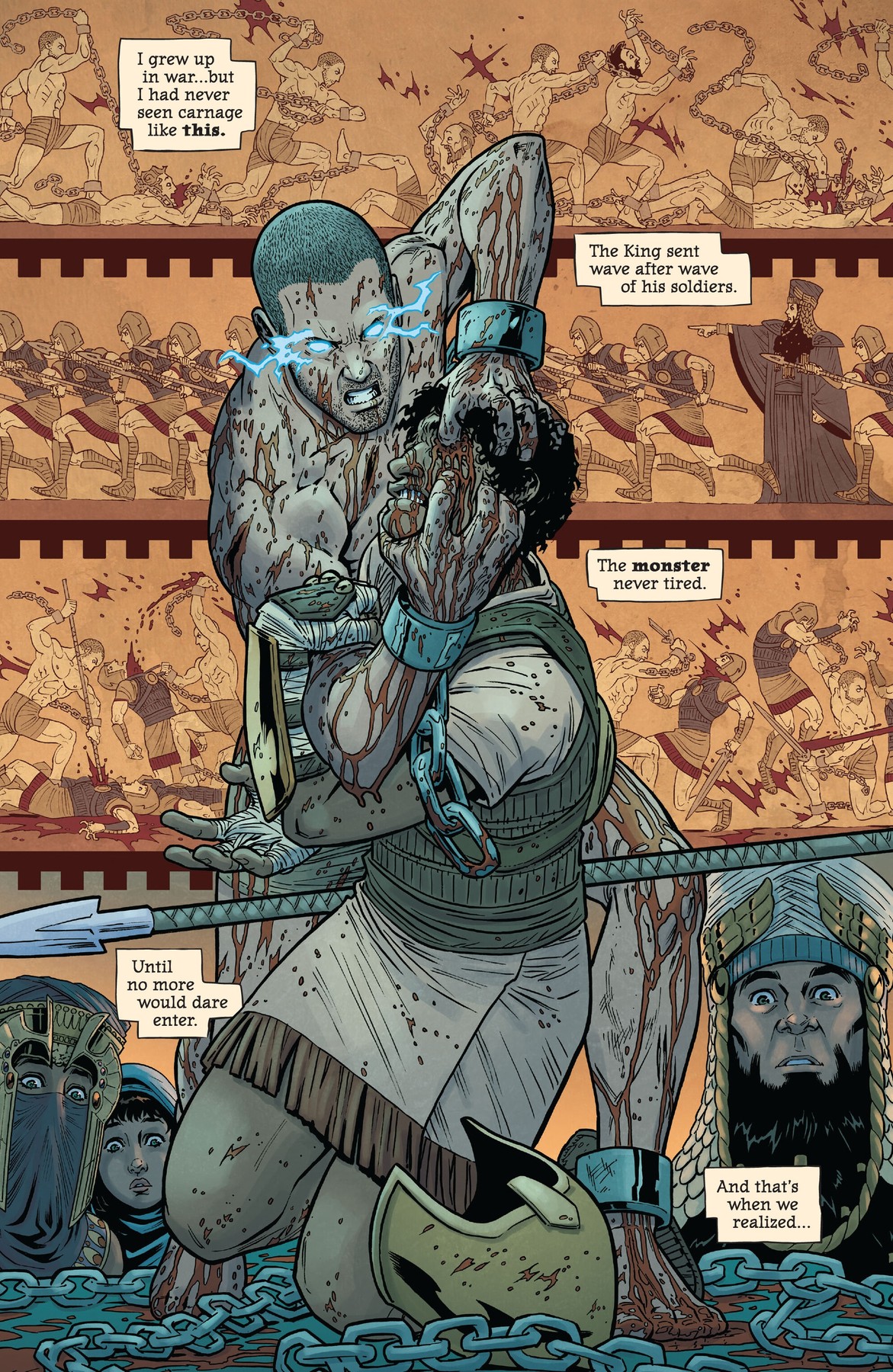
Spoilers: This article discusses the complete events of BRZRKR: Fallen Empire #1.
Overview
The officials and soldiers of Olos are the unnamed administrators, guards, arena personnel, jailers, military forces, courtiers, and royal agents who carry out the policies of King Arnak during the final period of the kingdom. No individual member of this institutional group is given a confirmed personal name in BRZRKR: Fallen Empire #1. They are nevertheless important to the story because Olos's fall is not caused by a single private decision. It emerges from a state apparatus that captures enemies, converts prisoners into public death sport, keeps B confined for roughly a year, and repeatedly attempts to turn the immortal into a military asset.[1][2]
The Olos personnel should therefore be documented as a collective historical entity rather than split into invented biographies. Their functions can be traced with unusual clarity: troops fight regional wars, captured enemies are transported through the gates, arena guards maintain the spectacle, prison staff restrain B, soldiers are sent against him in waves, handmaidens and dungeon guards are questioned after Queen Asana's escape, and royal forces remain present when B returns to the city seeking answers.[3][4]
The group is also central to the story's theme of institutional violence. King Arnak is personally responsible for the death-sport policy, but a kingdom can only sustain that policy because many people execute it. Fallen Empire depicts Olos as a society in which spectacular violence has become normalized enough to fill an arena. The namelessness of most officials and soldiers makes their role less individual and more systemic.
History
Olos before B
Olos survives in the desert for thousands of years, protected by walls that keep outsiders beyond the city. In the period remembered by Asana, the kingdom expands outward and fights neighboring peoples. Her own desert ancestors describe a prolonged war with Olos in which thousands die. By King Arnak's reign, Washukanni and other neighboring kingdoms remain military enemies.[5]
The soldiers of Olos are therefore not a ceremonial palace force. They belong to a kingdom accustomed to regional warfare. The comic does not provide unit names, officer ranks, army size, or a formal chain of command. Those details should remain unknown unless later BRZRKR material supplies them.
Captive enemies and death sport
Arnak decides to use enemies for death sport. This policy changes the function of war captives. Instead of remaining outside the walls or being held only for strategic reasons, prisoners become a source of mass entertainment. The narrator explicitly treats this as the irony at the center of Olos's collapse: the walls had protected the city from outsiders for centuries, but the kingdom's own cruelty brought dangerous outsiders in.[1]
Officials and soldiers are required at every stage. Someone must capture enemies, transport them, maintain cells, prepare arena combatants, protect the king and spectators, and control the flow of prisoners. The comic rarely isolates these roles by title, but the visual record shows armed personnel and attendants throughout the arena and prison sequences.
Capture and processing of B
B arrives in Olos as a prisoner. His body has already been subjected to violence, but the arena system initially treats him like another mortal captive. That assumption collapses when he survives catastrophic injuries and returns to fight.[6]
The officials who observe him cannot produce a reasonable explanation. The kingdom has encountered an entity outside its normal military and religious categories. Instead of releasing him, Arnak interprets the anomaly as potential value.
This moment is critical for the institutional history of Olos. B does not enter the kingdom as an invading army. He is brought inside by Olos personnel because the state classifies him as usable property.
Repeated combat tests
Arnak sends soldiers against B in successive waves. The troops attack a prisoner who cannot be permanently killed. B kills them. The process is repeated despite mounting evidence that normal force cannot secure obedience.[2]
These soldiers should not be represented as uniquely foolish individuals. They are royal troops operating under command. Their deaths illustrate the asymmetry between Olos's political system and B's physical nature. A monarch can replace ordinary soldiers. B regenerates.
Asana sees what Arnak's system fails to recognize. After violence, B retreats into himself. He is not an inexhaustible machine. Yet the response of the state is to continue using the same methods.
The prison apparatus
B remains confined for approximately a year. He is chained, beaten, and deprived of food. The Olos prison personnel can maintain this treatment because B's body repeatedly recovers. Ordinarily, torture has a biological endpoint. With B, the state can restart it.[7]
The dungeon staff also become part of Asana's escape plan. A handmaiden distracts prison guards so that the queen can visit B. Eventually Asana asks the immortal to take her away, and the pair escape the kingdom.[8]
When Arnak discovers the queen is missing, he pressures her handmaidens and the dungeon guards. Through that investigation he learns that Asana was not simply kidnapped. She chose to leave.[4]
This makes the guards more than background figures. Their failure exposes the fracture within the royal household and demonstrates that Olos's coercive institutions cannot fully contain either B or the queen.
Continued war with Washukanni
Olos remains at war with Washukanni. The comic does not show a conventional major battle between named Olos and Washukanni commanders, but the conflict shapes the entire political environment. Arnak's death sport is fed by enemies from regional wars, Asana's childhood treaty emerges from earlier Olos expansion, and Washukanni becomes the target toward which B is eventually directed.[1][5]
Olos soldiers therefore belong to a wider cycle of frontier violence rather than an isolated palace drama.
B's return to Olos
After Asana's apparent abduction from her desert refuge, B returns to Olos. He confronts Arnak and searches for the responsible party. The royal court becomes a source of information rather than a place where he can be reimprisoned.[9]
Arnak points him toward Washukanni. B then annihilates that civilization. The Olos military benefits temporarily from the destruction of its rival, but the victory contains the seed of its own destruction. The weapon the kingdom had wanted is not under its command.
The destruction of Olos
B discovers that Asana staged the abduction in order to manipulate him into attacking Washukanni. She admits that Arnak could not harness B but she believed she could. The confession turns the history of Olos into a sequence of failed attempts to convert B into state violence.[10]
B's response is to destroy Olos. The narration says Asana has sentenced them all to death. Soldiers, officials, and ordinary inhabitants are consumed in the catastrophe. The government ceases to function.[11]
The issue later presents Asana as the only confirmed survivor of the kingdom. B tells her Olos had no survivors except her. This wording is stronger than merely saying the royal family died. It indicates that the officials and soldiers shown within the destroyed kingdom should be treated as dead unless another source explicitly establishes an exception.[12]
Organization and roles
Royal soldiers
Royal troops enforce Arnak's authority and participate in the kingdom's wars. They guard court spaces and confront B when ordered.
Arena personnel
Armed guards and attendants maintain the death sport. The comic does not identify a named arena master, champion, or executioner.
Dungeon guards and jailers
These personnel maintain B's confinement and are later questioned after Asana escapes. Their individual fates are not separately shown before Olos is destroyed.
Court officials
Officials and attendants appear around the king as the court attempts to understand B's regenerative nature. None are given a confirmed name or ministerial portfolio.
Torturers and combatants
Some personnel participate directly in the repeated physical abuse and testing of B. The article should avoid assuming every soldier shown fighting B is a professional torturer; the source depicts overlapping military and prison functions without formal labels.
Culture of service
The Olos forces operate inside a kingdom that celebrates violent spectacle. Public participation matters. The arena is crowded. The king's use of enemies as entertainment has become a social ritual, not a private punishment.
This context does not prove every Olos soldier personally approves of Arnak. The comic gives them almost no individual dialogue. The strongest supported statement is that they continue to staff and enforce the system.
Equipment and combat
Olos personnel use period-appropriate blades, spears, shields, restraints, and armor as depicted. The art includes helmets, body armor, chains, and prison hardware. No unique named Olos weapon is established in the issue.
B's destruction of their forces demonstrates that the equipment is ineffective against his regeneration and strength.
Relationship with King Arnak
The officials and soldiers function under Arnak's command. He authorizes the death sport, keeps B captive, and sends soldiers into repeated confrontations. There is no depicted mutiny or institutional opposition to the king.
Relationship with Queen Asana
Asana has access to handmaidens and can move within the royal system, but her opposition to the death sport does not stop it. Her secret visits to B require circumventing prison personnel. After she escapes, Arnak pressures the household and guards for information.
Asana later uses B in a way that destroys the entire institution these personnel serve.
Relationship with B
For Olos personnel, B moves through four statuses: captive enemy, arena combatant, impossible prisoner, and destroyer of the kingdom. No named soldier is shown forming a personal relationship with him. Their relationship is institutional and coercive.
Status and fate
The Olos state apparatus is destroyed. The final revelation identifies Asana as the only survivor of Olos. Unless future canon revises that statement, the officials and soldiers present in the kingdom should be classified as presumed or confirmed dead as a collective, with no named survivors.
The people who make Arnak's rule possible
King Arnak's cruelty is visible in his orders, but the Olos officials and soldiers make those orders ordinary. Guards maintain the prison, attendants prepare the arena, officers organize attacks, and court personnel turn B's suffering into a public event. None of these roles is as spectacular as B's regeneration or Arnak's speeches, yet together they create the machinery that keeps the king in control.
The group is consequently more than a list of anonymous faces. It shows how a city can normalize violence by distributing responsibility. A jailer does not need to believe that B is a monster to lock the door. An arena attendant does not need to approve of the death sport to prepare the ground. The system works because each person performs a limited task while the king claims the larger purpose.
Witnesses to B's captivity
Olos personnel see B at his most vulnerable and most terrifying. He is chained, starved, beaten, and repeatedly sent into combat, yet every injury becomes evidence that the prison has failed to define him. The guards respond by adding restraints and increasing surveillance. Their escalating effort gives the reader a physical measure of the gap between ordinary confinement and B's regenerative body.
The officials also witness the difference between public and private power. In the arena, Arnak presents B as proof of royal strength. In the prison, the same king needs secrecy, routine, and layers of control. Asana's visits expose a further weakness: a system built to hold B can still be crossed by someone who has the trust of the household.
The end of a state
When Olos falls, its personnel disappear with the institutions they served. The destruction is not simply the death of a palace. It is the collapse of courts, records, military chains, prison practices, and the social order that made B's captivity possible. B survives the city's end, but the officials who could explain how the system worked do not.
That loss of ordinary witnesses contributes to the later uncertainty around Olos. Asana remains to tell the story, but her account is shaped by guilt and concealment. The dead guards and soldiers cannot contradict her, and the Acastan monks who might have preserved the testimony are killed before their work is secure. The state disappears twice: first as a political power, then as a community of witnesses.
Appearances
- BRZRKR: Fallen Empire #1 - military, prison, arena, and court personnel of Olos.
- BRZRKR: Fallen Empire Pen & Ink #1 - alternate presentation of the same story.
- BRZRKR Bloodlines collections - collected reprint context.
Canon limitations
No Olos official, general, jailer, or ordinary soldier in the issue receives a confirmed personal name. The wiki should resist generating separate character pages from visual differences alone. If later source material names an officer, the collective article can be updated and the relevant appearance records migrated to a dedicated entity.
The article should also distinguish soldiers from civilians. Fallen Empire depicts the annihilation of Olos as broad and catastrophic, but it does not provide an exact population or casualty count.
Institutional significance in the history of Olos
The collective personnel are especially important because Fallen Empire presents Olos as a functioning state rather than merely the household of one cruel king. Arnak's ideas become historically consequential only after institutions carry them out. The soldiers who capture enemies, the guards who hold prisoners, the attendants who maintain the arena, and the officials who observe B's impossible recovery turn royal desire into routine practice. A definitive history page should therefore connect these personnel to both King Arnak and the larger Olos political system.
This also provides a useful contrast with Asana's later conspiracy. Arnak's violence is formal, public, and bureaucratic. It uses recognizable state roles. Asana's manipulation of B occurs through a private network, emotional trust, and staged evidence. The two methods look different, but both depend on other people following instructions. The Olos personnel are the human infrastructure behind the first method.
The cost of obedience
The repeated attacks on B demonstrate the danger of absolute command. Once Arnak decides that B must be broken, ordinary soldiers are sent against an opponent the court already knows cannot be handled normally. The issue does not show these soldiers volunteering, objecting, or refusing. Their deaths are therefore best understood within the command system rather than as individual quests for glory.
That distinction matters for character indexing. An unnamed soldier killed by B in the prison is an appearance record, not automatically a named character. The database can still preserve the event, location, weapon type, and death without pretending the source supplies a biography.
Destruction of the archive of Olos
After the state is destroyed, there is no surviving Olos bureaucracy to preserve its own version of events. Asana turns to the Acastan monks precisely because the institutions that once recorded royal policy have disappeared. In that sense, the death of the officials is also an archival collapse. Administrative memory dies with the kingdom, leaving a former queen and an external order of historians as the only known routes by which the story might endure.
The later destruction of the Acastan record makes the disappearance still more complete. The wiki's timeline should connect FALL_OF_OLOS not only to deaths but also to LOSS_OF_OLOS_RECORDS, while clearly marking that the full extent of surviving material is unknown.
References
[1] Mattson Tomlin and Rebekah Isaacs, BRZRKR: Fallen Empire #1 (BOOM! Studios, 2023), King Arnak's wars, death-sport policy, and Olos's protected walls, digital page image 0007.
[2] Tomlin and Isaacs, Fallen Empire #1, repeated waves of soldiers sent against B and the effort to force him into service, digital page images 0014-0017.
[3] Tomlin and Isaacs, Fallen Empire #1, arena and prison sequences surrounding B's captivity, digital page images 0008-0017.
[4] Tomlin and Isaacs, Fallen Empire #1, questioning of Asana's handmaidens and dungeon guards after her escape, digital page image 0021.
[5] Tomlin and Isaacs, Fallen Empire #1, Asana's history of Olos expansion, desert wars, and treaty marriage, digital page images 0028-0029.
[6] Tomlin and Isaacs, Fallen Empire #1, B's arrival and repeated survival in Olos's public arena, digital page images 0008-0013.
[7] Tomlin and Isaacs, Fallen Empire #1, B's prolonged imprisonment, starvation, beatings, and regeneration, digital page image 0017.
[8] Tomlin and Isaacs, Fallen Empire #1, handmaiden diversion and Asana's prison visits, digital page images 0018-0020.
[9] Tomlin and Isaacs, Fallen Empire #1, B's return to the Olos court after Asana's apparent abduction, digital page images 0035-0036.
[10] Tomlin and Isaacs, Fallen Empire #1, Asana's admission that she succeeded in harnessing B where Arnak failed, digital page image 0042.
[11] Tomlin and Isaacs, Fallen Empire #1, destruction of Olos, digital page images 0043-0044.
[12] Tomlin and Isaacs, Fallen Empire #1, B's statement that Olos had no survivor except Asana, digital page image 0047.