Selected scenes
BRZRKR in pictures.
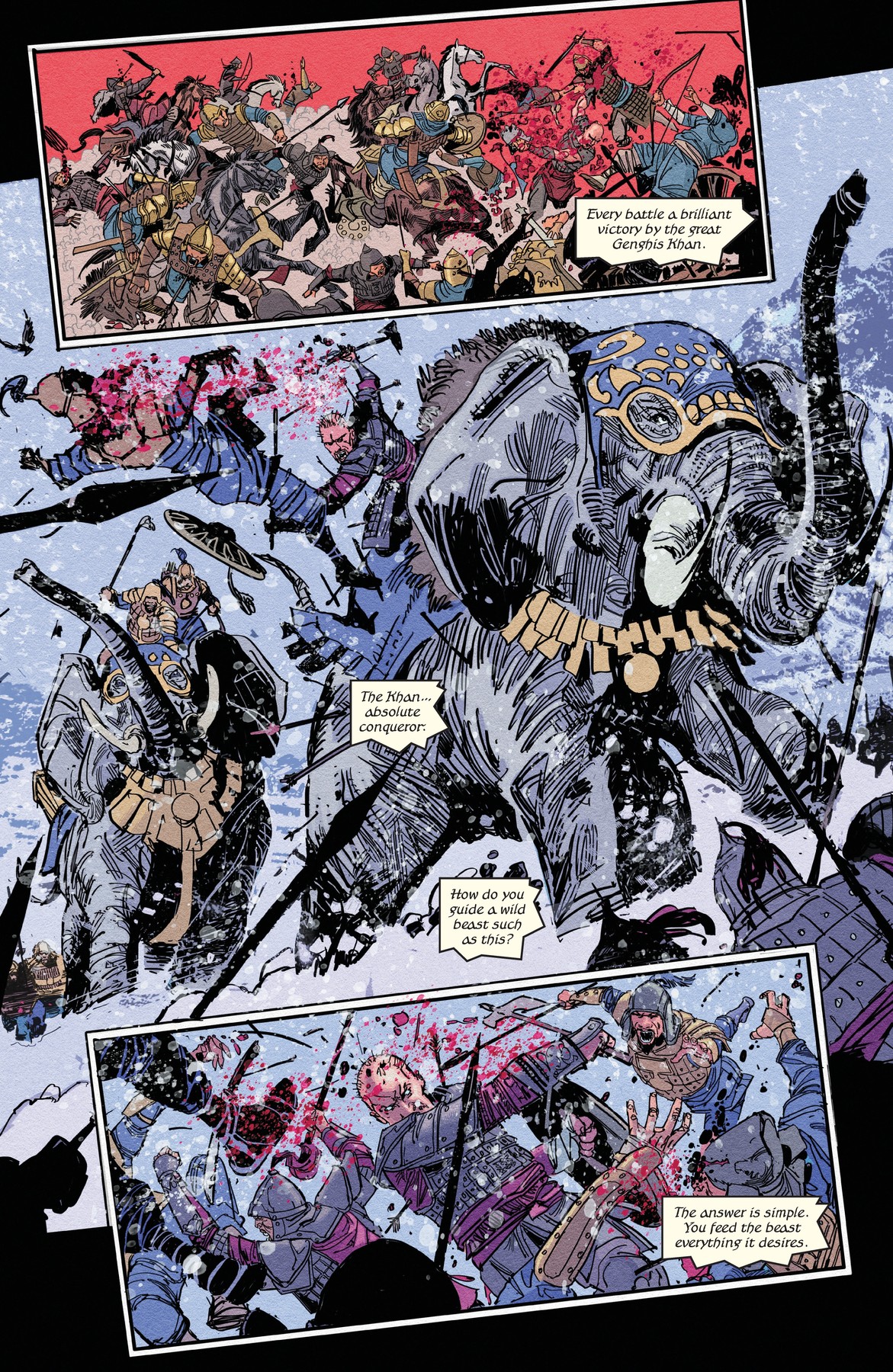
Spoilers: This article discusses the Mongol campaigns in BRZRKR: The Lost Book of B #1.
Overview
The Mongol advisers and soldiers are the military personnel serving Genghis Khan during BRZRKR: The Lost Book of B #1. They encounter B after a hidden Unute cult manipulates a Bulgar tribe into preparing the immortal for discovery, and they subsequently fight within campaigns in which B serves as the Khan's extraordinary weapon. The comic emphasizes cavalry, massed troops, siege warfare, heavy casualties, brutal logistical innovation, and the contrast between ordinary soldiers who die once and B, who can return from catastrophic injury.[1][2]
The group should be treated as a collective faction page rather than a collection of fabricated historical biographies. Although real Mongol history contains many famous generals and members of Genghis Khan's family, The Lost Book of B does not license the wiki to insert those people into scenes unless the comic names or unmistakably identifies them. The BRZRKR encyclopedia documents the fictional source first.
Their role is also important because the Mongol army becomes the institution that normalizes B's violent compulsion for a period. He is not hidden in a cell. He is placed within a military system where killing is rewarded, victories are celebrated, and material pleasures are supplied afterward. The army provides the social machinery through which Genghis's promise to give B whatever he wants can operate.[3]
History in *The Lost Book of B*
Approach to the Bulgar encampment
Genghis Khan's forces enter a situation prepared by the historical Unute cult. The cult narration says the stars are aligned and that the Bulgar tribe has followed its directive. The Bulgars step aside, allowing the Mongol force to enter rather than forcing a conventional battle.[1]
This is the Mongol army's first contact with B in the story. The warriors do not initially possess the cult's accumulated knowledge of Unute. They encounter an impossible captive and react as soldiers confronting an unknown threat.
First slaughter
B's initial response to the Mongol presence is catastrophic. The page sequence explicitly calls the encounter a slaughter. Warriors die as B demonstrates what he can do outside the Bulgar control cycle.[4]
This is crucial to understanding the later alliance. Genghis does not recruit B based on rumor alone. His forces experience the violence directly.
From enemy to imperial weapon
Genghis eventually releases B from his cage and offers him a place in the Mongol project. Once B accepts, the soldiers' relationship with him changes. The being who slaughtered their comrades becomes a fighter on the same side.[5]
The source does not show a formal induction ceremony or military rank for B. It is safer to describe him as the Khan's weapon, favored warrior, or extraordinary ally than assign a historical Mongol office.
Campaign warfare
The comic depicts sweeping victories involving cavalry, infantry, mass formations, and B fighting through enemy troops. Genghis's campaigns remain recognizable as organized warfare rather than B simply wandering from settlement to settlement.[6]
The Mongol soldiers provide the scale that B alone cannot. They occupy territory, move supplies, maintain camps, conduct sieges, and convert battlefield destruction into imperial expansion.
B, in turn, provides a combatant who can survive situations that would consume any number of ordinary troops.
Advisers and command structure
The comic shows Genghis surrounded by officers, attendants, guards, and other high-status personnel but does not provide confirmed names for individual advisers. Genghis Khan is the named commander; the other figures remain unidentified members of the Mongol command environment. Their resemblance to historical roles does not identify them with particular real-world generals.
The siege of Beijing
Limits of horse and arrow
The story explicitly names Beijing as a city that cannot be conquered by Genghis's established strengths. Its walls and barricades neutralize the advantages of mobile horse-and-arrow warfare.[7]
The Mongol forces therefore enter a siege environment that demands new tactics.
Heavy losses
The assault produces significant Mongol casualties. The narration says weeks of heavy losses serve a purpose. Dead soldiers themselves become material in the siege plan.[8]
This treatment of the army is brutally instrumental. Soldiers die for the campaign, and their bodies continue serving the campaign afterward.
Corpse catapults
The Mongols load dead bodies into siege engines and throw them over the walls. The narration identifies disease and stench as direct weapons.[8]
The tactic belongs on the site's Weapons and Methods index even though the bodies are not conventional equipment. Suggested entity: DISEASE_CORPSE_SIEGE_TACTIC, linked to the siege, Mongol forces, city defenders, and Genghis Khan.
B in the siege
B can go where ordinary soldiers cannot survive. The comic's campaign imagery places his regenerative violence inside the larger siege system. He is not the only attacker, but his presence changes what the army can attempt.
The art later shows massive battle scenes, harsh weather, and an elephant among the imagery associated with the campaigns.[6]
Rewards and camp life
Genghis promises B anything he wants. The army and court infrastructure make that promise practical. The story shows B receiving drink, sexual companionship, and opium.[3]
The exact personnel who procure or distribute those rewards are unnamed. The encyclopedia should not create a specific opium steward or camp official without evidence.
The sequence nevertheless demonstrates that military control extends beyond commands. A camp can surround B with an environment designed to keep him cooperative.
Relationship with B
The Mongol soldiers experience B in three ways:
- Enemy or unknown threat during the first encounter.
- Extraordinary allied combatant after Genghis recruits him.
- Potential internal danger once B begins breaking free from the system controlling him.
The story reminds readers that no human army can be entirely safe around B. His allegiance is personal and conditional, not institutional.
Relationship with Genghis Khan
The soldiers publicly embody Genghis's power. Their victories, losses, siege works, camps, and occupation make imperial conquest possible. Even with B present, the Khan still requires an army.
The cult narrator's claim that Genghis himself can be guided by feeding his appetite for conquest also means the army participates in a historical project whose hidden rationale it may not understand.
Relationship with the historical cult
The Mongol soldiers do not need to be cult members for the cult to influence the campaigns. The hidden organization acts upstream, arranging B's availability and studying the motivations of the Khan.
Unless a specific soldier is shown belonging to the cult, MEMBER_OF relationships should not be created between ordinary Mongol troops and Caldwell's ancestral cult.
Relationship with Beijing defenders and civilians
The article should avoid describing every person inside the city as an enemy combatant.
Weapons, armor, and tactics
Depicted elements include:
- Horse archery and cavalry.
- Swords, spears, bows, and armor.
- Large formations.
- Siege engines.
- Corpse catapults or trebuchet-like machines.
- Cold-weather campaigning.
- Heavy assault around fortified walls.
- Use of B as a regenerative shock weapon.
Exact technical terminology should follow what can be identified visually without forcing modern archaeological specificity onto stylized comic art.
Narrative significance
The Mongol army shows what happens when B's compulsion finds a vast institution designed to reward violence. His destructive capacity does not disappear into chaos. It is integrated into a military machine capable of turning individual battles into empire.
This is why The Lost Book of B is important to the broader wiki. It demonstrates that B's history is not only a sequence of personal fights. At times his presence can alter the scale, speed, and mythology of major political events.
It also establishes the limits of such integration. The moment B refuses the arrangement, the military institution cannot permanently force him back into it.
Status and fate
The Mongol army as an institution survives beyond the story's immediate events. Many individual soldiers die in the first encounter with B and later campaigns. The comic does not provide a complete roster or casualty count.
The army around an impossible soldier
The advisers and soldiers around Genghis Khan make the Mongol campaign feel like a system rather than a duel. B may be the most extraordinary fighter present, but he is surrounded by scouts, archers, cavalry, siege crews, guards, attendants, and commanders who make movement across a continent possible. Their ordinary skills give B a context. He can break a line, but the army supplies the line; he can survive an assault, but the army supplies the horses, food, weapons, and orders that bring him to the next one.
The contrast is especially sharp in the camp scenes. Genghis can reward B with opium, companionship, and a place close to power, while ordinary soldiers remain subject to discipline and exhaustion. The army's hierarchy turns B's body into a privilege for the ruler and a danger for everyone near him. Advisers help interpret the new weapon, but none can make the relationship safe.
Siege warfare and moral distance
At Beijing the army's tactics become increasingly impersonal. Walls turn the defenders into a problem of engineering, supply, and attrition. The use of disease and the dead in siege weapons is presented as a calculated method rather than a moment of personal hatred. B's presence intensifies the horror because he is still close enough to see the consequences even when the command decision has been made far away.
The soldiers therefore occupy an uneasy moral position. They carry out orders, survive battles, and may believe in the empire they serve, but the story does not give them equal responsibility for every decision made by Genghis or the cult. Their collective page is a record of proximity to power, not a claim that every unnamed fighter shared one motive.
The legend made by witnesses
The army is also the first large audience for B's regeneration. Soldiers see wounds close, bodies rise, and a captive become an asset. Their reactions help turn a biological mystery into a military legend. Stories carried by veterans can travel farther than B himself, making him known as a demon, a weapon, or a chosen champion in places he has never visited.
That process explains how B's reputation grows while his identity disappears. The soldiers remember what he did for the army. They do not necessarily know his mother's name, the loss of his first home, or the reason he wants to die. The empire preserves the feat and forgets the person who endured it.
Appearances
- BRZRKR: The Lost Book of B #1 - soldiers and advisers serving Genghis Khan during the encounter with B and subsequent campaigns.
- BRZRKR: Bloodlines Vol. 2 - collected appearance.
- Later BRZRKR Bloodlines collections - edition appearances.
Canon limitations
No named Mongol general, adviser, or ordinary soldier should be added to the character database solely from real-world history. The comic is the authority for fictional appearances.
The name Beijing should be preserved when describing the comic's siege. Any discussion of historical naming or chronology belongs in the analytical Real History vs. BRZRKR History page.
Army as the mechanism of empire
B can destroy an extraordinary number of opponents, but he cannot by himself perform every function of conquest. The Mongol army converts his violence into durable political change. Soldiers scout, ride, occupy, guard, transport, besiege, and maintain the command structure around the Khan. This distinction is important for the wiki's event model because the result of a campaign should not be attributed to B alone simply because he is the most visually spectacular combatant.
Soldiers as witnesses to B
The first Mongols who encounter B see him as an unknown horror. Later soldiers fight beside him and participate in a culture where his presence can become normalized. The transition is historically significant. Stories about B need not spread only through cult archives; thousands of ordinary troops may witness things that later become rumor, legend, religious story, or deliberately suppressed memory.
The wiki should therefore link the Mongol campaign to Legends Generated by B and Historical Witnesses to Regeneration. Individual unnamed soldiers do not need biographies for those relationships to exist.
Discipline, reward, and expendability
The siege material shows the army from two directions. Genghis can reward a uniquely valuable fighter like B with extraordinary access to pleasure, while ordinary soldiers can be expended in large numbers against fortifications. Their dead bodies are then reused as siege material. The military system assigns radically different values to different bodies based on utility.
That contrast is one of the strongest thematic connections between B and the human army. B's body is valuable because it returns. A common soldier's body is valuable first as a fighter and later, grotesquely, as a projectile. Both are instrumentalized by the imperial campaign.
Advisers as an unresolved category
The art places commanders and attendants around Genghis, but explicit names and titles are not supplied. No individual figure can be identified conclusively as a general, family member, shaman, minister, or guard.
Roles shown in the campaign
The campaign depicts cavalry, archers, siege crews, guards, court attendants, and unnamed commanders. These descriptions identify visible functions within the army, not canonical personal names.
The army around an immortal legend
The Mongol forces make B's presence feel different from his service to a single king. An army can absorb a fighter into its movement, repeat stories about him, and carry his reputation farther than any one witness. Soldiers see the immediate result of his violence, while advisers and commanders translate that result into policy. The distance between those views is where B becomes an imperial legend.
The campaign also exposes the limits of a legend. B can break a formation, but he cannot supply food, choose a road, or decide what a city will surrender. Genghis Khan understands that distinction and offers B a place inside a larger machine. The offer is flattering because it recognizes B's power, yet it remains another attempt to give that power a political purpose.
The unnamed soldiers matter because they are the people who must live inside the strategy. They see the dead returned as a siege weapon, smell the disease carried toward the walls, and understand that a victory can leave an army morally damaged. B's immortality makes him unforgettable, but the ordinary participants bear the consequences that history may attribute only to a ruler and his champion.
References
[1] Keanu Reeves and Matt Kindt, BRZRKR: The Lost Book of B #1 (BOOM! Studios, 2024), cult-prepared Mongol arrival at the Bulgar camp, digital page images 0009-0010.
[2] Reeves and Kindt, The Lost Book of B #1, large-scale Mongol campaign imagery and B fighting within the imperial army, digital page images 0026-0027.
[3] Reeves and Kindt, The Lost Book of B #1, rewards supplied to B including opium and sexual companionship, digital page images 0028-0029.
[4] Reeves and Kindt, The Lost Book of B #1, first encounter described as a slaughter, digital page image 0011.
[5] Reeves and Kindt, The Lost Book of B #1, Genghis Khan's offer to release and recruit B, digital page image 0018.
[6] Reeves and Kindt, The Lost Book of B #1, campaign montage showing B, Mongol formations, and expanded warfare, digital page images 0026-0027.
[7] Reeves and Kindt, The Lost Book of B #1, introduction of fortified Beijing and limitations of horse and arrow against its defenses, digital page image 0019.
[8] Reeves and Kindt, The Lost Book of B #1, heavy losses and use of dead bodies in siege engines for disease and stench, digital page image 0022.
Collected edition
BRZRKR: Bloodlines Vol. 2 (BOOM! Studios) collects The Lost Book of B #1 and provides the publisher-level summary of B as Genghis Khan's weapon and pawn.