Selected scenes
BRZRKR in pictures.
Spoilers: This article discusses the complete events of BRZRKR: Poetry of Madness #1.
Overview
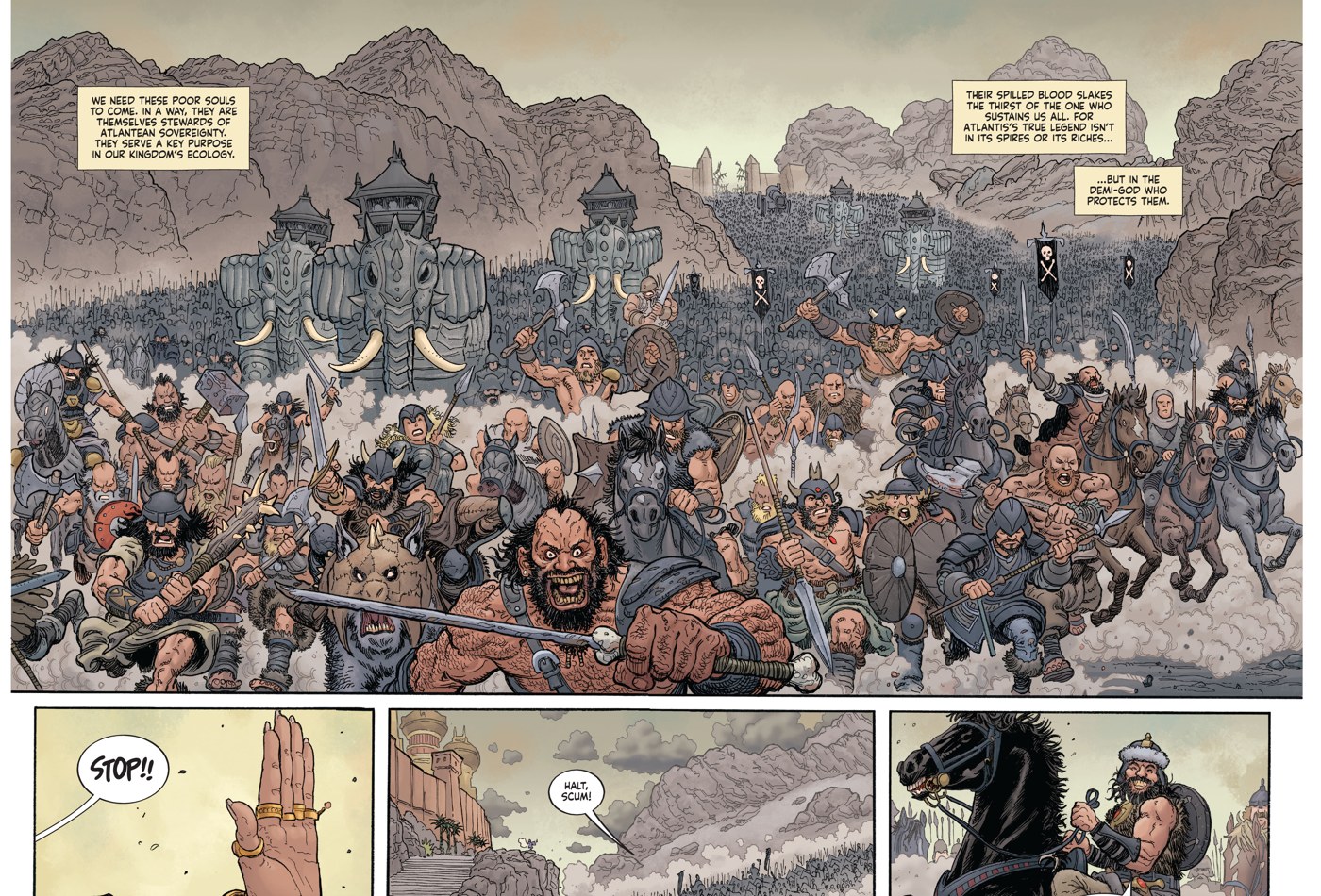
The invading warriors of Atlantis are the unnamed foreign forces who attack Atlantis at the beginning of BRZRKR: Poetry of Madness #1. They serve as the story's first demonstration of Atlantis's wealth, military reputation, and absolute dependence on B as its ultimate defender.[1]
Zubatai's chronicle describes outside peoples as being drawn toward Atlantis by its gold, beauty, cultural fame, and stories of conquest. The narration references peoples ranging from the Jiahu tribes to the Mehrgarh oasis, framing the pressure on Atlantis as broad and recurring rather than limited to a single named kingdom.[1]
The particular army shown in the opening sequence is not given a formal nation, ruler, commander, language, or political identity. Its warriors arrive in large numbers, reject Zubatai's demand for surrender and tribute, mock the idea of the king's guard, and discover that the "guard" she means is B / Unute alone.[2]
B then destroys the attacking force with overwhelming violence. The battle establishes the basic military reality of Azaes's Atlantis: ordinary armies can threaten its walls, but while B chooses to defend the city, conventional invasion is effectively hopeless.[3]
For the wiki, these warriors should receive a collective article and structured minor-entity records rather than invented biographies for visually distinct but unnamed fighters.
Historical context
Poetry of Madness presents Atlantis as a civilization so rich and celebrated that it becomes a magnet for aggression. Zubatai's opening narration describes the city as legendary for beauty, culture, and wealth, with outsiders repeatedly drawn by gold, rumor, and ambition.[1]
The invaders therefore belong to a broader historical pattern. They are not necessarily the first army to attack Atlantis, and the source does not state that they are the last conventional force to try before the city's supernatural destruction.
The comic's reference to the Jiahu tribes and the Mehrgarh oasis should be recorded carefully. It demonstrates the narrator's broad geographical or cultural frame, but it does not automatically identify every warrior in the depicted army as a member of one of those real-world archaeological cultures. Nor does it establish a precise date for Atlantis by itself.
A definitive wiki should avoid using the visual designs to assign unsupported ethnic identities or modern national labels.
Why Atlantis is attacked
Zubatai gives the clearest explanation for the constant external pressure: Atlantis possesses extraordinary wealth and reputation.[1]
The city is described as a place of:
- beauty;
- cultural distinction;
- riches and gold;
- legends that circulate beyond its borders;
- military prestige tied to its immortal protector.
These qualities create both admiration and predation. Foreign forces do not merely want to destroy Atlantis. They want to possess what Atlantis has.
The opening invaders are therefore part of the story's larger theme of desire becoming exploitation. Later Vizane's cult wants B's blood and immortality. The opening army wants Atlantis's riches and status. In both cases, outsiders or internal factions see something extraordinary and attempt to seize it.
Arrival at Atlantis
The invading force approaches the city in large numbers, armed for close combat and mass assault.[1][2]
The opening imagery emphasizes confidence and scale. The warriors appear to believe ordinary numerical superiority and martial strength are enough to challenge Atlantis.
Zubatai meets them before B fully engages. Her role as herald, chronicler, and squire allows the city to offer a formal choice rather than beginning with immediate slaughter.[2]
She identifies herself as a loyal servant of King Azaes and squire to the king's personal guard. She offers the attackers an opportunity to surrender and pay tribute.
The exact legal or diplomatic status of this offer is not explained. It may be Atlantean military custom, Zubatai's own formulation, or a standing policy under Azaes. The comic does not provide enough evidence to claim a formal law of war.
Rejection of Zubatai's terms
The invaders refuse the offer.[2]
Their reaction includes mockery when Zubatai warns that refusal means facing the king's guard. The scene depends on a visual misunderstanding: the attackers assume she is referring to the visible human defenders associated with Atlantis.
Zubatai points instead toward B.
Her correction reframes the battlefield. The army has not arrived to fight a comparable army. It has arrived to fight one immortal being whom Atlantis treats as its decisive military defense.
The exchange is also important for B's reputation. Zubatai does not introduce him as an unknown secret weapon. His epithets and legend already carry cultural weight. She names him Unute, the Berserker, and the narration surrounds him with titles such as Poseidon's pet demon, the tip of the trident, and hope slayer.[3]
Those names belong on B's alias and title index, but the invading-warrior page helps establish the social context in which the titles function: they are warnings directed at people who believe they can conquer Atlantis.
B / Unute enters the battle
B responds to the invasion with the extreme violence that defines his role in this period.[3]
The opening kills make clear that he is not constrained by ordinary human limits. He tears through armed fighters, survives wounds, and continues attacking despite injuries that would incapacitate a mortal soldier.
The invaders have no demonstrated countermeasure for regeneration. Their weapons can penetrate and damage B's body, but damage does not produce conventional battlefield victory.
This asymmetry is the central tactical fact of the battle.
An army normally succeeds by degrading the enemy's ability to fight. B's body repeatedly restores that ability. Every warrior he kills is permanently removed from the battlefield, while wounds inflicted on him are temporary.
The longer the engagement lasts, the worse the exchange becomes for the invaders.
Scale of the slaughter
The battle occupies a substantial opening section of the issue and is presented as mass slaughter rather than a close contest.[3]
B kills warriors with his hands, weapons, improvised force, and relentless forward movement. Bodies accumulate around him. The scene is deliberately excessive because the story wants the reader to understand how the people of Atlantis experience B: not merely as a skilled champion, but as something closer to a supernatural force of war.
Zubatai's narration states that spilled blood will feed the protector. The phrase should be treated as figurative chronicler language unless another source establishes a literal biological need for enemy blood during this period.[2]
The opening battle therefore belongs in the site's Known Battles of B, Mass-Casualty Events, and B Through the Ages databases.
Weapons and equipment
The invading warriors use a range of ancient or stylized premodern equipment visible in the battle, including bladed weapons, spears, shields, helmets, armor, and other close-combat gear.[2][3]
No individual weapon is named.
The issue's art combines historical visual vocabulary with the fictional setting of Atlantis. The wiki should therefore describe what is visibly demonstrated without assigning specific archaeological classifications unless the comic or creator commentary provides them.
Generic swords, spears, and shields should be structured equipment records, not standalone articles.
Any unique object taken from or used against B should receive separate treatment only if it becomes plot-relevant.
Tactics
The army's strategy appears to depend on numbers, direct assault, and encirclement.[3]
Warriors engage B at close range and attempt to overwhelm him physically. The comic does not depict sophisticated anti-regeneration tactics, traps designed specifically for B, or prior intelligence about how to incapacitate an immortal.
This suggests either that the army underestimates the stories about Atlantis's protector or that it has no practical alternative.
Because the source never shows a military council or commander explaining the plan, any more detailed tactical reconstruction would be speculative.
The site's battle article can tag demonstrated behaviors such as:
- massed advance;
- close-quarters engagement;
- multi-directional attack;
- use of spears and blades;
- continued assault despite heavy casualties;
- eventual collapse under B's counterattack.
Command structure
No commander is named.
Some warriors may appear visually more ornate or centrally positioned, but costume alone is insufficient to establish rank. The wiki should not create a "General of the Invaders" page unless a future source supplies a name or title.
The collective group can have structured descriptive entities for recurring visual roles, such as:
- invading envoy or spokesman;
- front-rank spearmen;
- armored swordsmen;
- shield bearers;
- mounted or elevated figures if clearly depicted;
- surviving fighters during the final stage of battle.
These are editorial identifiers, not canonical names.
The envoy or spokesman
The initial exchange with Zubatai includes warriors who function as the army's voice during the surrender demand.[2]
The comic does not provide a name, office, or biography for the spokesman. He can be recorded as Invading Army Spokesman or Invading Envoy in the appearance database, with a clear note that this is a descriptive label.
His narrative function is important despite the lack of identity. His mockery of Atlantis's guard allows the story to reveal B through contrast. The invaders' confidence exists for only a moment before the scale of their mistake becomes visible.
Relationship with Zubatai
Zubatai serves as the human intermediary between Atlantis and the army.
She approaches the attackers confidently, identifies herself and the authority she represents, offers surrender, and then presents B as the consequence of refusal.[2]
Her composure suggests that this type of confrontation is not unprecedented. She knows exactly how to frame the choice and appears certain of the outcome once B is involved.
The comic does not state whether Zubatai personally fought the invaders during the opening battle. Her primary demonstrated role is herald, observer, chronicler, and squire.
Her narration transforms the attackers from anonymous bodies into evidence of B's long service to Atlantis.
Relationship with King Azaes
The invaders challenge the kingdom ruled by Azaes, but the king is not shown commanding the opening defense directly.
Zubatai speaks in his name, and B functions as his personal or royal protector. The battle therefore demonstrates how Azaes's reign is secured by B even when the monarch is not physically present on the battlefield.[2][4]
Later, Zubatai explicitly states that Azaes's reign was enabled solely by B's will.[4]
The invading-warrior sequence provides the clearest practical evidence for that claim. Azaes can preside over a celebrated and wealthy city partly because armies that might otherwise conquer it cannot survive contact with B.
Relationship with B's public status
The defeat of the invaders does not end at the battlefield. Atlantis turns B's return into public spectacle.[5]
Horns announce victory. Citizens gather. The wounded immortal regenerates while people celebrate him.
The attacking warriors therefore contribute indirectly to B's civic and religious status. Each failed invasion reinforces the public narrative that Atlantis survives because of its immortal protector.
Zubatai says the people hunger for the blood-soaked spectacle of B's victories and place him near Poseidon in their pantheon hierarchy.[5]
The invaders are consequently part of a feedback loop:
- Atlantis's wealth attracts attackers.
- B destroys the attackers.
- His victory increases his legend.
- The legend strengthens Atlantis's prestige and perceived invulnerability.
- Atlantis remains wealthy and desirable.
- More challengers may eventually come.
The story does not state that every invasion follows this exact cycle, but the opening establishes it as the social pattern surrounding B's role.
Defeat
The depicted army is decisively defeated by B.[3]
The comic shows extremely high casualties and no successful breakthrough into Atlantis. It does not provide a formal surrender scene, prisoner count, or named survivor.
The group status should therefore be recorded as defeated, with most depicted combatants killed; individual survivor count unknown.
This phrasing is more precise than claiming every invader dies.
Casualties
B kills a large number of warriors directly. The exact total is not stated.[3]
Because crowd scenes contain many anonymous fighters and the art emphasizes scale rather than countable continuity, the wiki should not attempt a speculative body count.
The death database can instead record a group event:
Mass casualties among invading army during B's defense of Atlantis
with fields for:
- perpetrator: B / Unute;
- location: outskirts or approaches of Atlantis;
- source: Poetry of Madness #1;
- exact count: unknown;
- weapons: multiple, including direct physical force and battlefield weapons;
- confidence: confirmed group event.
Cultural identity and source limitations
The opening narration names broad cultural reference points, but the individual warriors are not assigned explicit ethnic identities.[1]
This is an area where a wiki can easily overstate what the art proves. Clothing, helmets, skin tones, hairstyles, and weapons may be visually inspired by historical cultures, but visual resemblance is not equivalent to canonical identification.
The article should therefore avoid categorical language such as "the Jiahu army" or "the Mehrgarh army" unless an explicit caption or dialogue identifies the depicted force that way.
Similarly, the story's Atlantis should not be assigned a precise archaeological date solely because the narration invokes ancient real-world names.
The broader Real History vs. BRZRKR History page can discuss those references separately and transparently distinguish comic fiction from archaeological chronology.
Motivation
The only collective motivation supplied by the narration is attraction to Atlantis's wealth, fame, and the possibility of conquest.[1]
Individual soldiers may have been conscripts, mercenaries, tribal warriors, retainers, volunteers, or people pursuing personal motives. None of those categories is established.
The article should therefore speak about the army's narrative objective rather than claiming every fighter personally chose invasion for greed.
This distinction matters because the comic treats them primarily from the perspective of Atlantis and Zubatai. Their internal viewpoint is absent.
Narrative role
The invaders perform four major functions in the story.
First, they establish Atlantis as a prize worth fighting over.
Second, they demonstrate B's military power without requiring exposition.
Third, they establish Zubatai's role as chronicler and squire.
Fourth, they create a baseline for the later Cthulhu crisis. At the beginning, B can solve Atlantis's problems by killing an army. By the end, the threat comes from inside the royal court and summons something so destructive that even B's victory cannot save the city.
The contrast is essential. Conventional enemies prove how safe Atlantis is under B. Vizane proves how vulnerable it remains to internal corruption.
Appearances
- BRZRKR: Poetry of Madness #1 - opening invasion and battle against B.
- BRZRKR: Poetry of Madness Pen & Ink #1 - alternate presentation of the same story, not a separate canonical invasion.
Canon limitations and unresolved questions
The comic does not establish:
- the army's official name;
- a named homeland;
- whether it represents one polity or multiple groups;
- the commander's identity;
- exact force size;
- exact casualty count;
- whether any named historical culture directly corresponds to the depicted fighters;
- the route by which the army reaches Atlantis;
- prior negotiations with Azaes;
- whether the attackers know B is truly immortal;
- whether any survivors return home;
- whether this is the first or most recent of multiple similar invasions.
These gaps should remain explicit rather than being filled from visual speculation.
References
[1] Keanu Reeves and Steve Skroce, BRZRKR: Poetry of Madness #1 (BOOM! Studios, 2023), opening narration describing Atlantis's beauty, culture, wealth, and the outside peoples drawn toward it, including the Jiahu-to-Mehrgarh reference, digital page image 002.
[2] Reeves and Skroce, BRZRKR: Poetry of Madness #1, invading warriors at Atlantis, Zubatai's introduction, surrender demand, warning about the king's guard, and reveal that she means B, digital page images 003-004.
[3] Reeves and Skroce, BRZRKR: Poetry of Madness #1, B introduced as Unute the Berserker and the extended slaughter of the invading force, digital page images 005-012.
[4] Reeves and Skroce, BRZRKR: Poetry of Madness #1, adult Azaes's relationship with B and Zubatai's statement that Azaes's reign was enabled solely by B's will, digital page image 014.
[5] Reeves and Skroce, BRZRKR: Poetry of Madness #1, horns announcing victory, public celebration, B's regeneration, and Zubatai's explanation of B's place in Atlantean popular and religious culture, digital page images 012-013.