Selected scenes
BRZRKR in pictures.
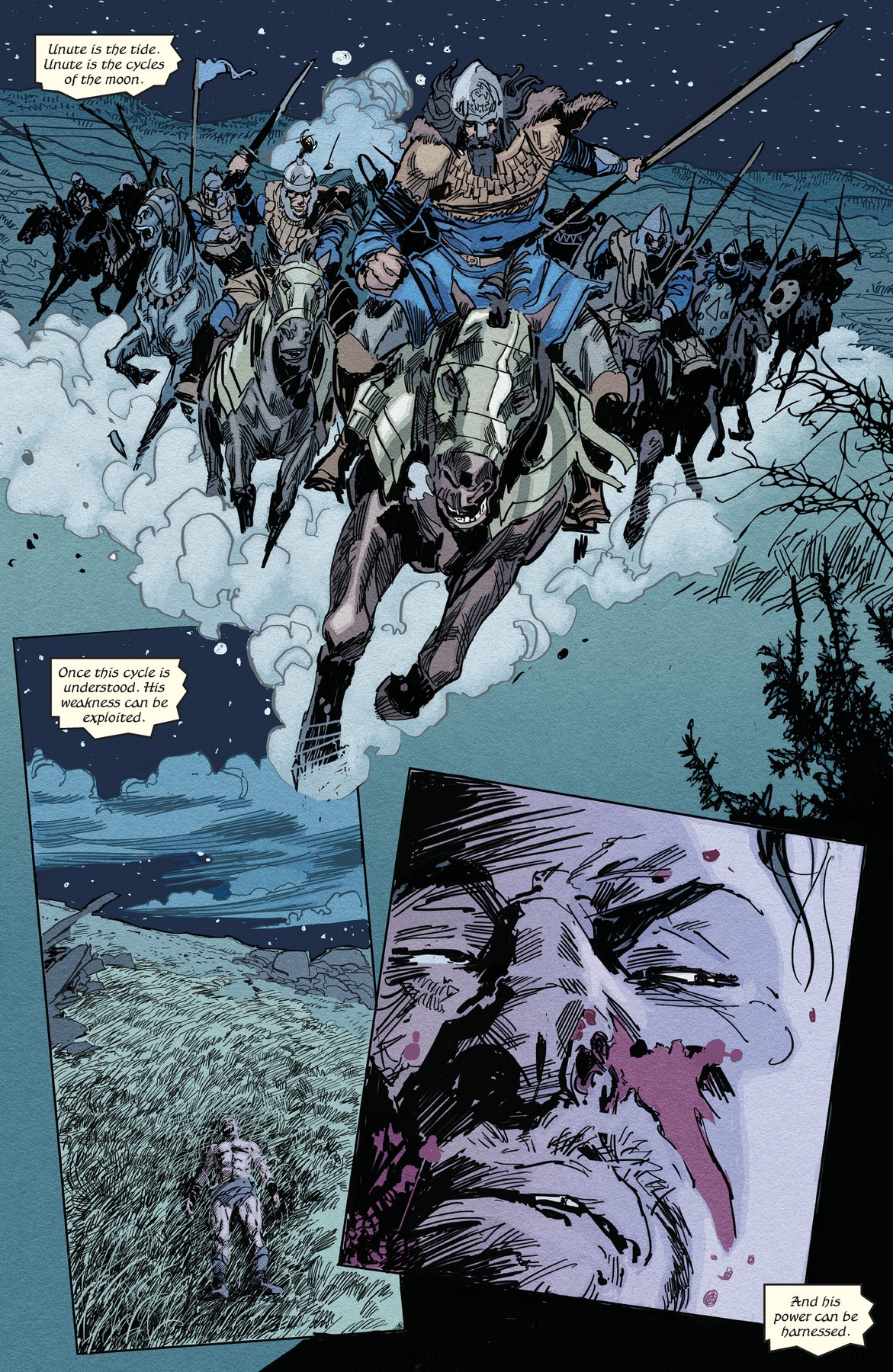
Spoilers: This article discusses the cult material in the original BRZRKR series and BRZRKR: The Lost Book of B #1.
Editorial context reference from the user-supplied digital edition of BRZRKR: The Lost Book of B #1. The image illustrates the historical operation surrounding Unute and should not be treated as a portrait of every cult member.
Overview
The historical members of Caldwell's cult are the unnamed and partially named people who preserve, study, worship, and exploit knowledge of B across centuries before Dr. Caldwell appears in the modern original series. BRZRKR: The Lost Book of B #1 supplies one of the clearest historical examples of the tradition in action. A cult agent identified in the site's corrected canon inventory as Layo narrates or frames a scheme in which knowledge of Unute's cycles is used to direct a Bulgar tribe, stage B for discovery by Genghis Khan, and help convert the immortal into an instrument of conquest.[1][2]
The group should not be understood as a single unchanging organization with a fully documented corporate structure. The original series establishes Caldwell as part of a long lineage tied to fanatical beliefs about B, while the historical one-shot shows earlier adherents using related knowledge. The safest wiki model is a cult tradition or ancestral cult lineage that persists through changing members, cells, methods, and historical contexts.
Their importance to the definitive wiki is enormous. They create continuity between ancient history and the modern scientific program. Long before government laboratories analyze B's blood, historical cultists are already collecting observations about regeneration, rage, memory, and vulnerability. They are not merely worshippers waiting for miracles. They are experimenters in a premodern idiom.
Origins and continuity
A tradition older than Caldwell
The modern original series reveals that Caldwell's obsession is not purely personal. He belongs to a lineage connected to people who have followed B's existence across time. This makes the cult a historical information network whose value accumulates over generations.
The specific founder is unknown. The comic does not provide a date on which the cult begins, a complete genealogy, or proof that every member is biologically related to Caldwell.
Worship and exploitation
The word cult can suggest pure religious devotion, but the behavior shown in The Lost Book of B is more practical. The historical members describe Unute in patterned, almost scientific terms. B is compared to tides and lunar cycles. His weakness can be exploited. His power can be harnessed.[1]
This is a crucial continuity point. The cult's reverence does not prevent experimentation. B can be a godlike being and a subject to manipulate at the same time.
That combination later reappears around Caldwell, who joins scientific research with inherited obsession.
Study of Unute's cycles
Observation as power
The cult believes B's apparently impossible body still has rhythms. He is not invulnerable at every instant. Catastrophic injury forces regeneration. Recovery takes a form that can be observed. Rage can be provoked. Memory creates psychological burdens. Needs can be manufactured.
A cult that survives long enough to record repeated encounters can discover patterns ordinary enemies never live long enough to learn.
The Bulgar experiment
The historical members direct a Bulgar tribe to keep B in a repeated cycle of boiling, injury, and recovery. The narration says the technique is applied with vigor and instructs the handlers to keep him angry and weak.[3]
The use of proxies protects the cult. Its members do not need to stand over the boiling vessel themselves. They can provide instructions and observe outcomes.
This decentralized method should inform the wiki's organization model. Historical cult activity may appear through rulers, tribes, collectors, scholars, or agents who do not know the full scope of the network.
Engineering the Mongol encounter
Timing Genghis Khan's arrival
The cult narration states that the stars are aligned and the timing is correct as Genghis Khan approaches. It praises the Bulgar tribe for following instructions.[2]
This is an explicit claim of historical manipulation. The cult sees the encounter between B and one of history's most ambitious conquerors not as chance but as an engineered junction.
Why Genghis Khan
Genghis represents an ideal user of B because conquest is already his goal. The cult does not need to create ambition. It needs only to provide an extraordinary weapon.
The later narration asks how a wild beast such as the Khan can be guided and answers that he must be fed what he wants.[4]
The cult therefore applies similar logic to mortal and immortal subjects. Both B and Genghis possess appetites. Both can be steered by arranging the environment around those appetites.
Opium and psychological control
Once B is inside the Mongol system, the method evolves. Genghis offers him anything he wants. B receives opium and companionship. The narration calls opium the manufacture of a need and the promise of oblivion.[5]
For a being with perfect memory, that insight is strategically profound. The cult's historical knowledge is not limited to physical regeneration. It includes psychological vulnerability.
Historical narration and propaganda
The cult as narrator
Much of The Lost Book of B is framed by narration that interprets events through the cult's worldview. The narrator describes cycles, alignment, manipulation, and the hidden meaning of conquest.
The wiki should not flatten this into omniscient fact.
Claims of causation
When cult narration implies that it shaped Genghis Khan's victories, the proper wording is "the cult claims," "Layo interprets," or "the narration attributes." The art may confirm that the cult influences specific events while leaving open whether it is truly as powerful as it believes.
The Silk Road
Publisher descriptions of later collected editions say B is used to destroy and pave the way for the Silk Road.[6] Within the story's historical ideology, Layo's statements about that outcome should remain attributed to him.
This approach prevents the wiki from turning fictional conspiratorial narration into real-world historical assertion.
Connection to Caldwell
Institutional inheritance
Caldwell belongs to a line of people obsessed with B. The historical cult pages give that line depth. By the modern era, inherited lore can combine with contemporary laboratories, military access, and advanced technology.
What can be connected safely
Safe relationships include:
Unsafe without evidence:
Methods
Long-term observation
Members preserve information over generations, allowing a cumulative understanding of B.
Proxy manipulation
The Bulgars execute instructions while the cult maintains distance.
Political placement
The cult positions B where Genghis Khan can discover and recruit him.
Psychological leverage
The story recognizes the value of opium, oblivion, desire, and violent compulsion.
Narrative control
The cult also tells history. Its power comes partly from deciding which events are remembered as deliberate outcomes rather than accidents.
Beliefs
The exact theology remains incomplete. Members use divine or cosmic language around Unute, but the historical one-shot is more interested in what they do with belief than in a formal creed.
The original series' broader cult material should supply any slogans, symbols, or doctrines that are directly attested there. The historical page should cross-link rather than duplicate unsupported details.
Organization
No complete hierarchy is shown. Layo is the only named historical agent identified in the corrected inventory for this story. Other participants should remain unnamed cult members, acolytes, or agents only where the source uses or supports those descriptions.
A future entity page may separate:
- Observers
- Record keepers
- Ritual adherents
- Field agents
- Political intermediaries
- Caldwell's family line
but only after the primary source demonstrates those categories.
Relationship with B
The cult both reveres and violates B. It seeks knowledge from his suffering and tries to route his violent power into historical projects.
This contradiction is central to the organization. Worship does not produce respect for B's autonomy.
Relationship with Genghis Khan
The cult views Genghis as useful because his ambition can absorb B's violence into a massive war machine. Whether Genghis understands the cult's full plan is unclear.
Relationship with the Bulgars
The Bulgars follow cult directives and become operational handlers of B. They should be modeled as DIRECTED_BY, not automatically MEMBER_OF.
Relationship with modern government research
The cult is a historical predecessor, parallel, and competitor to later scientific programs. Both accumulate data about B. The difference is that modern programs can analyze his biology with instruments, while historical cultists rely on inherited observation, ritualized interpretation, and repeated human experiments.
Narrative significance
The historical cult transforms B's 80,000-year life into a knowledge problem. Individual rulers encounter him and disappear. An institution that survives across generations can learn.
This is why Caldwell becomes more dangerous than an ordinary scientist. He does not begin with a blank slate. He inherits a culture of attention.
The cult also destabilizes the reader's understanding of history. Once such a network exists, every great battle involving B raises the question of whether someone deliberately placed him there. The wiki should ask that question only when sources support it, not retroactively turn every BRZRKR flashback into a cult conspiracy.
Status and fate
The historical cell active during Genghis Khan's era has no complete roster or final casualty record. The broader tradition survives long enough to connect with Caldwell's lineage in the modern era.
A hidden hand in the Mongol campaign
The historical cult members are dangerous because they do not need to command an army directly. They study B, anticipate the movement of rulers, and arrange circumstances so that other men believe they are acting for themselves. In the Bulgar and Mongol material, the cult prepares the conditions of B's capture and treats Genghis Khan's ambition as something that can be steered. The campaign becomes a political experiment: if an empire can be given the right prisoner and the right promises, it can be made to carry B across the world.
This method differs from the public violence of a king or general. Cult members work through information, timing, and selective revelation. They tell a ruler what he wants to hear, hide the larger purpose, and allow the ruler's own desires to supply the force. The result is a recurring BRZRKR idea: the person who pulls the trigger may not be the person who designed the crime.
Prophecy as a technology of control
The cult's language about B makes him sound inevitable. It presents his return, his anger, and his usefulness as parts of a cycle that can be observed and exploited. Prophecy gives the members authority because it hides planning behind destiny. If a campaign succeeds, the cult can claim that it was foretold. If it fails, the failure can be explained as another turn in the cycle.
That rhetoric has consequences for B. It denies him the possibility of an unplanned life. Every escape can be recast as a step toward a future someone else has chosen. The modern Caldwell lineage inherits the same temptation, replacing ancient prophecy with records, experiments, and institutional secrecy while preserving the belief that B's body is a resource to be managed.
Continuity of a method, not a family tree
The surviving material supports a continuity of purpose more clearly than a complete genealogy. Some historical members may be ancestors of later cult figures, but the comic does not provide a roster that would justify naming every link. What persists is the method: gather fragments of B's past, preserve them inside a closed group, and use the information to direct rulers and scientists toward the next opportunity.
That distinction keeps the cult frightening without making it omnipotent. Its members can misread B, lose control of their plans, and depend on the ambitions of other people. The Mongol campaign is successful in expanding B's legend, but it does not give the cult ownership of him. B remains capable of escaping, remembering, and turning the consequences back on the people who thought they understood him.
Appearances
- BRZRKR: The Lost Book of B #1 - historical manipulation of Bulgars, B, and Genghis Khan.
- Original BRZRKR #1-12 - modern Caldwell lineage and cult context that establishes the longer tradition.
- BRZRKR: Bloodlines Vol. 2 - collected edition containing The Lost Book of B.
Canon limitations and unresolved questions
Unknown: founder, original date, headquarters, exact number of members, relationship between religious membership and Caldwell's bloodline, whether Layo is biologically related to Caldwell, and how records survive between historical eras.
The page should not claim the cult literally causes every event it narrates. Its accounts are evidence of what its members believe they accomplished.
Information as the cult's form of immortality
B survives because his body regenerates. The cult survives in a different way: information passes from one generation to another. Individual members can die, but observations about Unute remain useful centuries later. This creates a thematic parallel between biological immortality and institutional immortality that should be explicit in the site's lore network.
The original series' Caldwell material becomes more significant when read through this lens. Caldwell's advantage is not simply wealth or access to a modern laboratory. He enters the relationship with B carrying inherited questions and assumptions. The historical cult provides the long memory that ordinary human institutions lack.
Records, secrecy, and selective truth
A secret archive is not automatically an accurate archive. Members may preserve observations faithfully while interpreting them through a religious or conspiratorial framework. They may also omit failures, exaggerate successful manipulations, or describe coincidence as design. The source system should therefore treat record preservation and claim reliability as separate properties.
A future cult database could assign each historical claim a provenance chain: WITNESS, CULT_RECORDER, LATER_COPY, CALDWELL_ACCESS, MODERN_CONFIRMATION. This would allow the wiki to explain not only what Caldwell believes but where that belief may have come from.
Relationship to other history keepers
The cult should be compared with Zubatai and the Acastan monks, but not merged with them. Zubatai records B from loyalty and personal service. The Acastans preserve testimony as professional history keepers. Caldwell's cult preserves knowledge in order to pursue power, revelation, immortality, or control. These institutions can record the same immortal and still create radically different histories.
That comparison belongs in Who Records B?, a future flagship thematic page linking every major archive, chronicler, laboratory, and oral tradition in the franchise.
References
[1] Keanu Reeves and Matt Kindt, BRZRKR: The Lost Book of B #1 (BOOM! Studios, 2024), opening cult narration describing Unute as cyclical and exploitable, digital page image 0004.
[2] Reeves and Kindt, The Lost Book of B #1, cult narration stating the Bulgar tribe followed its directive and the timing of Genghis Khan's arrival was prepared, digital page image 0009.
[3] Reeves and Kindt, The Lost Book of B #1, repeated boiling and injury used to keep B angry and weak, digital page images 0006-0007.
[4] Reeves and Kindt, The Lost Book of B #1, campaign narration asking how Genghis Khan can be guided and answering that he must be fed what he desires, digital page image 0026.
[5] Reeves and Kindt, The Lost Book of B #1, opium described as a manufactured need and promise of oblivion, digital page images 0028-0029.
[6] BRZRKR: Bloodlines Vol. 2 (BOOM! Studios), publisher synopsis describing B as a pawn used by Genghis Khan to destroy, devastate, and pave the way for the Silk Road.
Related primary series source
See the original BRZRKR limited series, especially the Caldwell and ancestral-cult material, for the modern endpoint of the tradition. The exact issue-to-claim mapping should use the already prepared Caldwell and cult source index from the earlier biography package.