Selected scenes
BRZRKR in pictures.
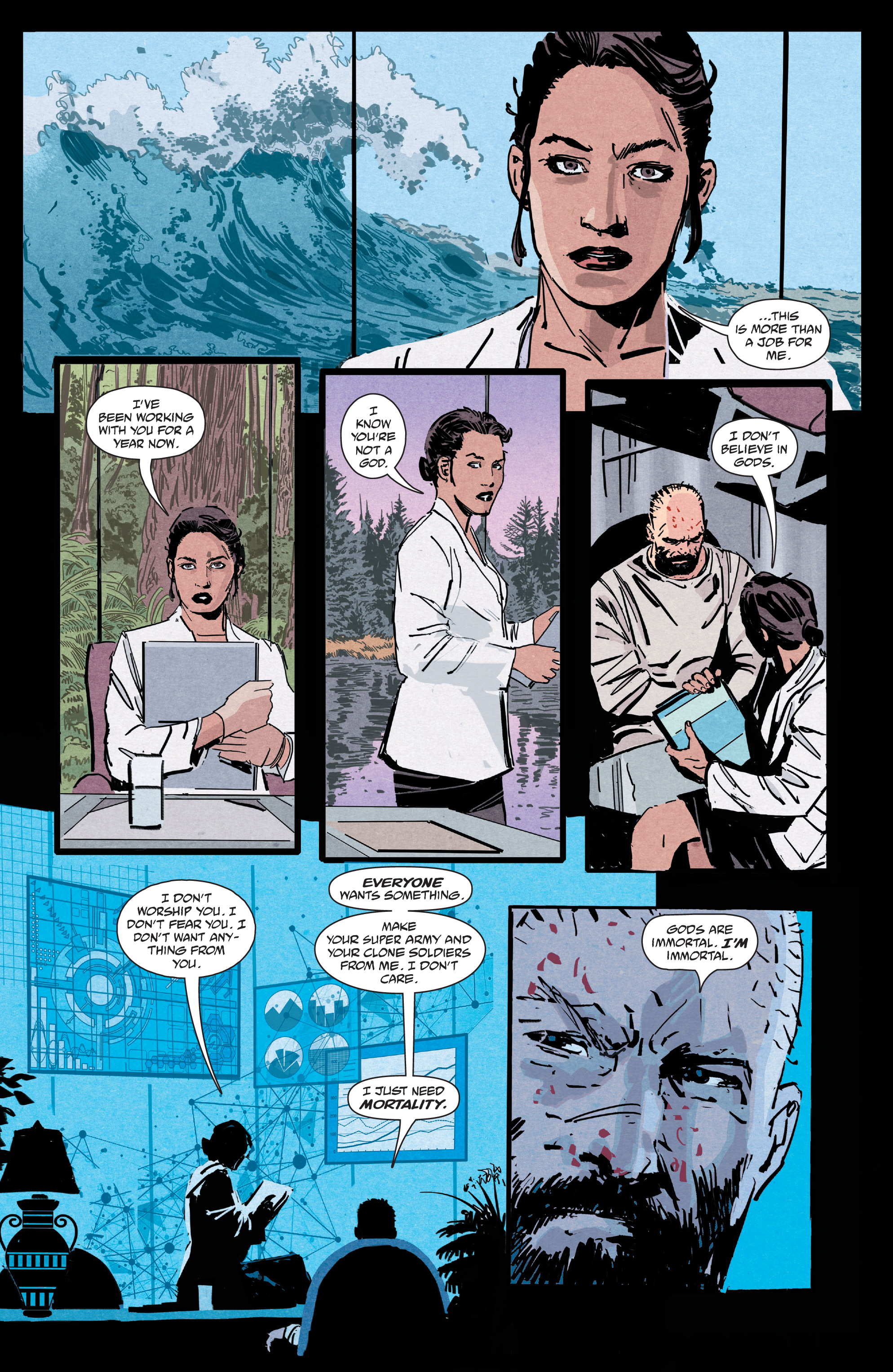
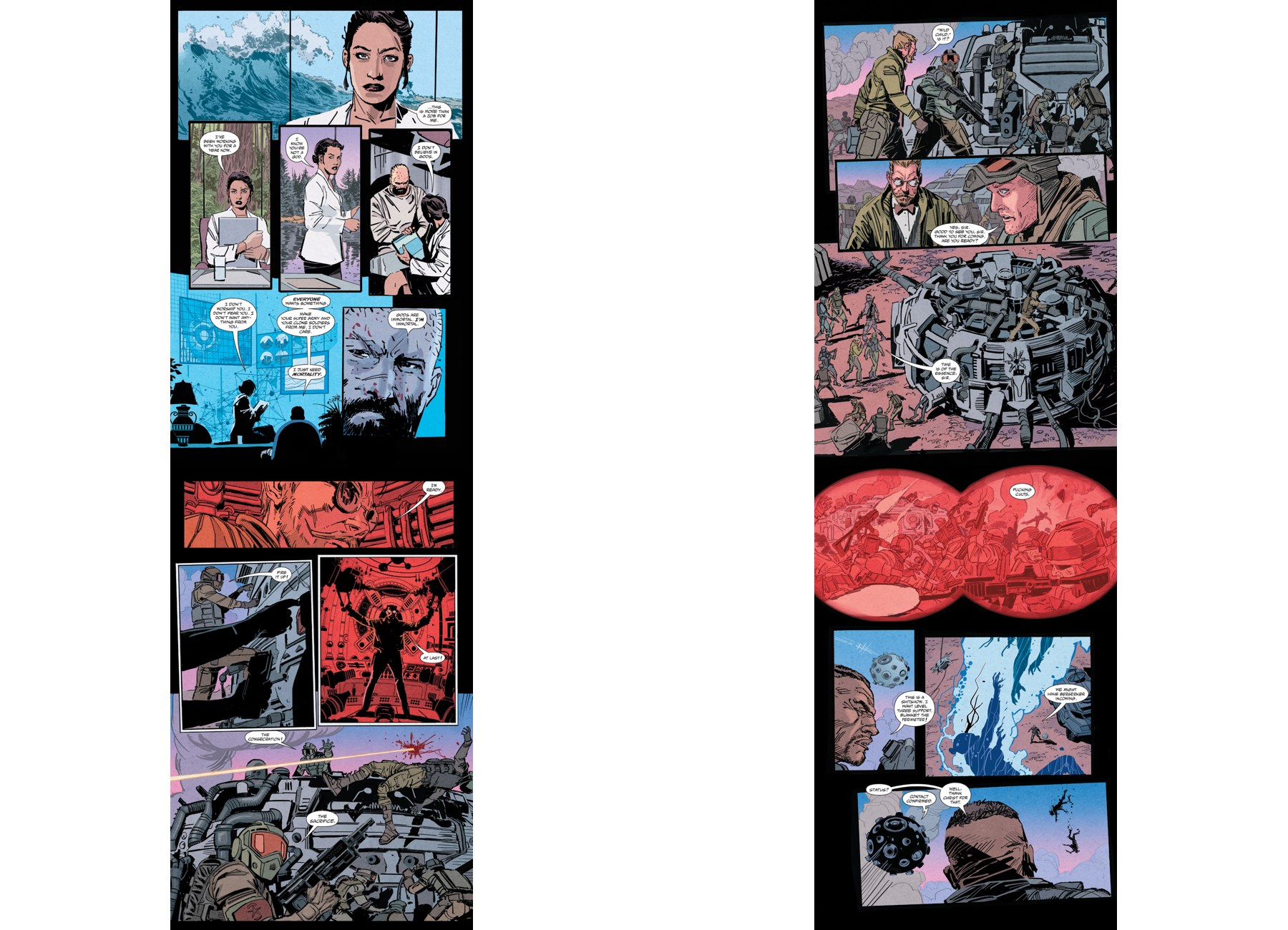
Spoilers: This article discusses the original twelve-issue BRZRKR limited series and The Book of Elsewhere. The two continuities are documented separately because the novel reuses several central characters while introducing a substantially different government organization, personnel roster, and chain of events.
Overview
B's modern relationship with the United States government is one of the central structures of BRZRKR. In both the original comic series and The Book of Elsewhere, an American black-operations apparatus uses the immortal warrior's military capabilities while studying the biology, history, psychology, and larger meaning of his existence. The two versions share recognizable roles, especially B, Dr. Diana Ahuja, Caldwell, and Keever, but they are not interchangeable. The original comic presents a government program whose named core personnel are comparatively concentrated. The novel expands the institutional world into a more densely populated Unit with named soldiers, counselors, researchers, widows, support staff, and casualties.[1][2]
The distinction is important for any definitive BRZRKR reference system. A reader searching for a character such as Dr. Shur, Stonier, Thakka, Jon Ulafson, Kaz Miller, Chapman, Grayson, Cohn, or Sunderland should not be led to believe that the character appears in BRZRKR #1-12. Those names belong to the novel continuity of The Book of Elsewhere. Conversely, the visual details and exact events of the comic program should not automatically be applied to the novel's Belief Systems and Ancient Technology Migration Unit simply because both institutions employ versions of Diana, Caldwell, and Keever.
The government-personnel network also demonstrates why BRZRKR's modern era cannot be reduced to a single antagonistic organization. Some personnel genuinely try to help B. Some consider him a strategic asset. Some treat him as a scientific question. Some are willing to sacrifice soldiers around him. Others become psychologically damaged by repeated exposure to his violence and the deaths of their colleagues. Caldwell, in both continuities, pursues a private agenda that exceeds his official role. The soldiers who work beside B therefore occupy a morally and emotionally unstable position: they are colleagues of an immortal weapon, beneficiaries of his combat power, potential casualties of his berserker state, and participants in an institution that claims it can help him die.
Original comic continuity
B / Unute
B is simultaneously the program's most valuable field asset and the subject around which its scientific infrastructure is built. In the opening issue he is deployed on a modern operation with government support, demonstrating that the program is willing to send him into combat environments where his immortality and regenerative capacity make conventional risk calculations almost meaningless.[3] His arrangement with the government is transactional. He performs missions; the program studies him and promises to help discover why he cannot die and whether that condition can be ended.
This relationship makes B neither an ordinary soldier nor a prisoner in the simplest sense. He has agency, can refuse or disappear, and is capable of overwhelming any normal security force. At the same time, the government controls facilities, records, research, mission planning, and access to the technology used in increasingly dangerous experiments. The balance between cooperation and exploitation is one of the original series' recurring tensions.
Dr. Diana Ahuja
Diana is the original series' principal named scientific and therapeutic figure. Her role is built around establishing trust with B, recovering memories, studying the psychological burden of his extraordinary lifespan, and helping determine the origin of his condition. She becomes the person with whom B is most willing to discuss experiences that precede written history.[4]
Diana's importance eventually exceeds institutional research. Her connection with B becomes personal and later metaphysical, and she participates directly in events surrounding the contact with the intelligence responsible for B's origin. Her eventual pregnancy and the birth of B's children move her permanently beyond the boundaries of a government employee studying a subject.[5]
Caldwell
Caldwell is the principal named scientific administrator and hidden antagonist of the original limited series. Publicly, he is part of the research apparatus attempting to understand B. Privately, he belongs to an ancestral cult that has followed traces of B across history and seeks access to the power behind him.[6]
His position gives him unusual access to government technology, research, tissue, artifacts, and operational planning. That access allows his institutional work and private obsession to converge. The result is a program in which official scientific goals become entangled with cult history, attempts to reproduce B's biology, the Franken-B project, and the late-series transfer operation.
Keever
Keever is B's most prominent named military handler in the original comic continuity. He functions as the practical bridge between B's destructive field capability and the government's command structure. His role includes mission coordination, tactical oversight, communication with B, and later direct involvement in the government response to Caldwell's operation.[7]
Keever's perspective is valuable because he is close enough to B to recognize him as a person but remains embedded in an institution that ultimately treats B as an asset whose freedom can be revoked. In BRZRKR #11, Keever leads the push against Caldwell's location and identifies the forces defending it as cultists. In BRZRKR #12, his loyalty to institutional orders contributes to the final confrontation with B and Diana.[8][9]
Unnamed comic personnel
The original twelve issues visually establish many additional soldiers, tactical operators, technicians, scientists, medical workers, command personnel, pilots, and security staff. Most are not individually named in the supplied comic pages. A definitive database should record their appearances where they have a distinct role, but it should not manufacture names in order to create a larger roster.
This is an important editorial quality gate. A heavily armed operator who appears during the assault on Caldwell's site may be a meaningful appearance record without supporting a biography. A technician who reports energy levels during the transfer sequence may be a distinct minor character, but unless the comic identifies that person by name or establishes a recurring identity, the correct record is an unnamed personnel entry tied to the event and issue.
The original series therefore has a smaller named government roster than the visual density of the modern scenes might suggest.
Eagle Team is not an ordinary government unit
Earlier planning material contained the uncertain form “Eaze/Eaze Team.” Verification against BRZRKR #11 and contemporary descriptions identifies the intended designation as Eagle Team.[10] The team belongs to the Caldwell conflict in the issue rather than to the ordinary roster of B's government handlers.
The surrounding sequence is decisive. Caldwell arrives at a heavily armed position staffed by tactical personnel and specialized equipment. The group prepares him for the transfer process, refers to the procedure in religious language such as consecration and sacrifice, and fights government forces that Keever describes as cultists.[8] Eagle Team should therefore be indexed as a Caldwell-aligned tactical force / cult combat unit, with a cross-reference from the government-personnel article because its members fight personnel from the government program in the same operation.
The Book of Elsewhere continuity
The Book of Elsewhere describes a modern U.S. black-operations organization with a much broader named supporting cast. Publisher material summarizes the premise as B working with a U.S. black-ops group that promises to help him die in exchange for his service.[2] Critical descriptions identify the organization more specifically as the Belief Systems and Ancient Technology Migration Unit, usually shortened in the narrative to the Unit.[11]
The novel's Unit is not merely a combat team. It brings together soldiers, behavioral support, scientific investigation, ancient-technology research, intelligence work, and secrecy management. Its personnel are exposed to both B's battlefield utility and the destabilizing consequences of working around a being whose violence can kill allies as easily as enemies.
Keever, novel continuity
The novel's Keever is a field leader and handler who commands Unit soldiers around B. He is the map-studying leader seen in the prologue's locker-room sequence and remains central to the investigation after Thakka's impossible return.[12]
His relationships with the soldiers matter in ways that expand his role beyond tactical command. He remembers the dead, visits bereaved relatives, investigates suspicious developments, and is forced to confront the cumulative human cost of the Unit's relationship with Unute. He was Kaz Miller's superior and later speaks with Miller's widow Joanie before learning of her death.[13]
The novel version belongs on the Keever article under a clearly separated continuity section rather than being merged into the original-comic biography.
Dr. Diana Ahuja, novel continuity
Diana again occupies a major research role but operates within the novel's distinct mythology and institutional structure. She investigates B's biology and the impossible return of Thakka while also becoming increasingly involved with the mystery surrounding the Life Project and the forces of change and stillness that structure the novel's metaphysics.[2]
The novel's Diana should receive an alternate-continuity subsection on the existing Diana article, with links into Dr. Shur, Stonier, Thakka, and the Unit.
Caldwell, novel continuity
Caldwell again mixes official research with private obsession. The novel emphasizes his interest in ancient relics, clandestine accumulation of information, and lethal pursuit of people who possess material connected to Unute. His private victims include Josh Barrientes, Weatherly Knighton, and Jon Peters.[14]
His novel biography should therefore link to a distinct Caldwell's Named Victims cluster, the Unit, Franken-B or the patchwork Unute project, and his cult activity in the novel.
Dr. Shur
Dr. Shur is the Unit's counselor and one of the most important novel-only personnel. She works with soldiers affected by Unit service, including Stonier, and her presence is explicitly connected to the psychological conditions produced by repeated exposure to Unute's violence. Caldwell notes that she is there because Jon Ulafson attempted to kill Unute, while Shur frames Ulafson's breakdown as an understandable extreme response to an environment in which colleagues are repeatedly injured or killed.[15]
Shur initially appears to be a professional concerned with how people think rather than with studying Unute directly. The novel later reveals that this apparent role conceals a much larger supernatural agenda. Her relationship to the Thowless or principle of stillness makes her one of the narrative's major antagonistic forces.[16]
Stonier
Stonier is a Unit soldier and the husband of Thakka. He appears in the recorded locker-room sequence before Ulafson's attack, working with a detector while other soldiers prepare equipment and weapons.[17] His defining personal crisis is Thakka's death and impossible return.
Caldwell attempts to use Stonier's grief as a possible point of recruitment into his own secret belief system, but Stonier does not respond to the coded invitation. He instead frames the dangers of working with Unute through duty and accepted risk.[18] His later involvement with grief, counseling, and the Life Project makes him one of the novel's strongest examples of how the Unit's human personnel live in the aftermath of B's presence.
Thakka
Thakka is a Unit soldier whose impossible return to life drives the novel's central mystery. Keever believes Thakka died during an operation and later finds him alive in a collapsed tunnel despite a catastrophic head wound.[19] The event is extraordinary specifically because Unute's regeneration had previously been unique within the Unit's experience.
Thakka's brief return is confused and frightening. He speaks about a dog and something that had been present at the site. His revival becomes evidence that the rules around death are changing and points the story toward the other force operating around Unute.[19]
Jon Ulafson
Jon Ulafson is a Unit soldier whose attempted killing of Unute becomes a defining institutional trauma. The novel's prologue shows Ulafson entering a locker room in an insignia-less jacket, approaching B, threatening his comrades with a pistol, and detonating a bomb packed with folk protections and anti-supernatural materials after other soldiers fire on him.[12]
The bomb includes items such as holy water, salt, horseshoe nails, sage, and names of Unit dead who had been connected to B. Ulafson's posthumous message argues that too many good people have died and questions whether the Unit truly uses B as a weapon or whether the relationship has reversed.[20]
His attack causes physical casualties, drives personnel turnover, and leads to the introduction of psychological support represented by Dr. Shur. Sunderland transfers out of the Unit and Chapman leaves the service in the aftermath.[21]
Kaz Miller
Kaz Miller is a named Unit soldier seen in the locker-room recording. He is paired socially with Cohn, the two laughing together while their teammates prepare for deployment.[17] Later dialogue establishes that Keever was Miller's superior and that Miller has died before Keever receives news concerning Miller's widow, Joanie.[13]
The novel does not provide enough material for a responsible 2,500-word standalone biography without extensive repetition or speculation. Kaz Miller should therefore receive a detailed structured character record and a substantial section in Minor Unit Personnel, with promotion to a standalone article only if future canonical material expands his history.
Chapman
Chapman appears in the locker-room recording checking weapons alongside Thakka.[17] After Ulafson's attack, Chapman leaves military service.[21] The combination of pre-mission competence and post-trauma departure makes Chapman useful in documenting the institutional consequences of Ulafson's breakdown, but the novel does not provide a full personal biography.
Grayson
Grayson is a Unit soldier remembered for performing push-ups in the middle of the locker room before operations.[17] He is later found dead in the tunnel where Keever discovers Thakka alive, with a fatal gunshot wound to the neck.[19]
A later unrelated character sharing the surname Grayson should not be automatically merged with the soldier. Identity relationships must be source-confirmed rather than inferred from surname reuse.
Cohn
Cohn appears with Miller in the recorded locker-room sequence, laughing during the team's pre-mission preparations.[17] No supplied primary passage establishes a first name, detailed history, family, or later independent arc. Cohn should remain a minor Unit personnel record.
Sunderland
Sunderland is not foregrounded in the prologue roster but is named when Diana remembers the aftermath of Ulafson's attack. Sunderland requests a transfer away from the Unit.[21] This is one of the clearest indicators that the locker-room bombing does more than produce immediate casualties. It destabilizes the workforce and forces personnel to reassess whether service alongside Unute is survivable.
The human cost of working with B
The government-personnel network is most useful when read as more than a roster. Both continuities ask what it means for ordinary people to build an institution around an immortal combatant.
B can return from injuries that would annihilate a human soldier. The people beside him cannot. This imbalance changes command decisions, battlefield expectations, grief, and responsibility. Keever's willingness to enter unstable environments beside B does not make Keever invulnerable. Thakka's revival is shocking because it temporarily violates the line separating Unute from everyone else. Ulafson's attack is driven by the belief that the accumulated dead around B have become morally intolerable. Stonier responds to loss through duty and later grief work. Sunderland transfers. Chapman quits. Joanie Miller's life is shaped by the death of her husband.[19][20][21][13]
The original comic expresses the same problem more institutionally. Government commanders are willing to use B because his body absorbs extraordinary punishment, and the program increasingly treats his origin as a strategic opportunity. Diana's empathy challenges that logic. Keever occupies the middle position between personal familiarity and institutional obedience. Caldwell exploits the system from within.
A definitive wiki should therefore cross-link government personnel not only by employer but by casualty, handler relationship, mission participation, psychological consequence, and continuity.
Continuity rules
The following distinctions should be enforced across the database:
- Comic-only events should not be added to novel biographies unless the novel independently establishes them.
- Novel-only personnel should carry
continuity: book-of-elsewhereand should not appear in original-series issue appearance tables. - Shared names such as Diana, Caldwell, and Keever require continuity-specific appearance records rather than a single merged chronology.
- Eagle Team belongs to the comic's Caldwell conflict and should not be linked as a member unit of the novel's Belief Systems and Ancient Technology Migration Unit.
- Josh Barrientes, Weatherly Knighton, and Jon Peters are connected to Caldwell's private novel investigation, not established as Unit employees.
- Unnamed comic operators should remain unnamed database entities until a primary source supplies an identity.
Related personnel and pages
Major links from the government-personnel hub should include:
Appearances
Comic continuity
Named core government personnel appear throughout BRZRKR #1-12. Eagle Team is specifically associated with BRZRKR #11.
Novel continuity
The Unit personnel discussed here appear in Keanu Reeves and China Miéville's The Book of Elsewhere (Del Rey, 2024). Because pagination varies among hardcover, paperback, ebook, and international editions, database citations should store chapter / scene anchors plus edition-specific page numbers when an edition is available locally.
Canon limitations
The precise first names, ranks, and occupational titles of several Unit soldiers are not supplied in the cited passages. Those fields should remain blank rather than be inferred from military convention. Likewise, not every person killed around Unute is identified by name, and not every name in Ulafson's memorial materials can be reconstructed from the surviving narrative.
The original comic does not establish a large named tactical roster equivalent to the novel's Unit. Treating unidentified helmeted operators as named novel characters would collapse two continuities and undermine the site's source hierarchy.
The people inside the program
The government personnel surrounding B are not a single personality. Scientists want to understand the body. Handlers want to make missions predictable. Soldiers want to survive the operation. Commanders want a result that can justify the expense. Diana begins inside the research structure but gradually refuses to let its language replace B's humanity. Keever begins as the field partner who knows what B can do and becomes the person most able to recognize when an order has crossed a moral line.
That variety explains why the program can be both protective and coercive. It gives B medical care, a place to sleep, and access to memories that no one else can reach. It also sends him into violence, treats his wounds as expected, and allows Caldwell to pursue a private theory inside the institution. The danger does not come only from one villain. It comes from a system in which each person can perform a reasonable task while the combined result becomes exploitation.
The novel's Unit personnel echo this tension without becoming the same cast. Dr. Shur, Stonier, Thakka, and Jon Ulafson belong to the prose branch and carry the burden of missions in a different form. Their shared structure creates a thematic rhyme: wherever B is placed inside a black operation, the humans around him must decide whether obedience is enough.
References
[1] Keanu Reeves, Matt Kindt, Ron Garney et al., BRZRKR #1-12, BOOM! Studios, 2021-2023. Original comic continuity.
[2] Keanu Reeves and China Miéville, The Book of Elsewhere, Del Rey, 2024. Novel continuity. The publisher describes B's present-day arrangement with a U.S. black-ops group.
[3] BRZRKR #1, opening modern operation and government recovery / mission framework.
[4] BRZRKR #2-5, Diana's therapy, memory work, and investigation of B's early life.
[5] BRZRKR #11-12, Source-contact aftermath, Diana's pregnancy, and the children.
[6] BRZRKR #7-11, Caldwell's historical research, cult connection, experimentation, and transfer plan.
[7] BRZRKR #1, #6-8, Keever's handler and operational roles.
[8] BRZRKR #11, digital sequence approximately pp. 10-20, Caldwell's armed position, consecration sequence, and Keever's assault.
[9] BRZRKR #12, final government pursuit and confrontation.
[10] BRZRKR #11. The exact designation Eagle Team is associated with Caldwell's tactical force. “Eaze Team” is retained only as a redirect for prior transcription error.
[11] Reeves and Miéville, The Book of Elsewhere. The organization is identified in published descriptions as the Belief Systems and Ancient Technology Migration Unit.
[12] Reeves and Miéville, The Book of Elsewhere, “Prologue.” The Unit's pre-mission locker room, Ulafson's attack, B, and Keever are established in the opening sequence.
[13] Reeves and Miéville, The Book of Elsewhere, later Keever sequence concerning Joanie Miller and Kaz Miller; Keever states that he was Kaz Miller's superior.
[14] Reeves and Miéville, The Book of Elsewhere, Caldwell recollection naming Josh Barrientes, Weatherly Knighton, and Jon Peters among people he killed while acquiring hidden Unute-related information and objects.
[15] Reeves and Miéville, The Book of Elsewhere, Caldwell and Dr. Shur discussion of Ulafson and the psychological burden of Unit service.
[16] Reeves and Miéville, The Book of Elsewhere, later Dr. Shur / Diana and Thowless sequences.
[17] Reeves and Miéville, The Book of Elsewhere, review of the locker-room recording naming Thakka, Chapman, Stonier, Miller, Cohn, Grayson, Keever, and Ulafson.
[18] Reeves and Miéville, The Book of Elsewhere, Caldwell's post-Thakka conversation with Stonier and failed attempt to identify or recruit him through Caldwell's secret belief system.
[19] Reeves and Miéville, The Book of Elsewhere, “Signs of Life,” Keever and B's discovery of Grayson's corpse and the inexplicably living Thakka in the collapsed tunnel.
[20] Reeves and Miéville, The Book of Elsewhere, “Prologue” and later discussion of Ulafson's posthumous message and improvised anti-supernatural bomb.
[21] Reeves and Miéville, The Book of Elsewhere, Diana and Keever's recollection of the aftermath of Ulafson's attack, including Sunderland's transfer and Chapman's departure from service.