Selected scenes
BRZRKR in pictures.
Spoilers: This article discusses Caldwell's armed operation and the assault in BRZRKR #11.
Eagle Team is the armed force that protects Caldwell during the late-series operation in BRZRKR #11. The group combines modern tactical equipment with the language and loyalty of Caldwell's hidden religious movement. Its members defend a remote transfer site, prepare the machinery that Caldwell intends to use, and fight Keever's government forces when the operation is attacked. No individual member is named in the issue, so the team is understood through its collective actions rather than through a roster of personal histories.
The team matters because it shows that Caldwell's betrayal is not a private idea held by one scientist. By the time of the assault, his cult-linked project has personnel, vehicles, communications, heavy equipment, and enough discipline to establish a defended position. The old desire to control B has adapted to modern warfare. Ritual language is spoken beside rifles and machinery, and a battlefield becomes the threshold of a ceremony.
Caldwell's arrival
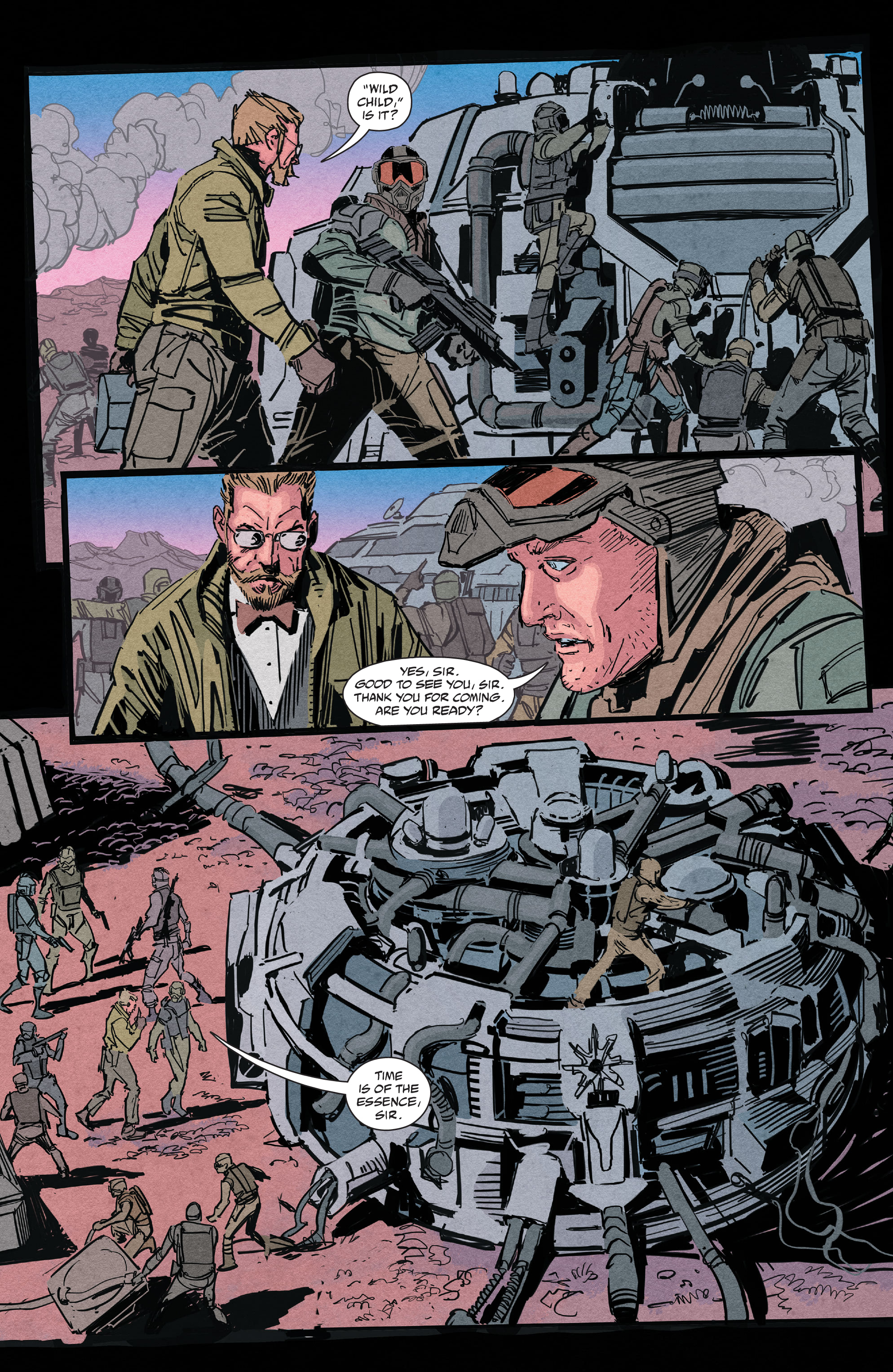
The sequence begins with Caldwell arriving at the site. The personnel greet him with the formal respect given to a commander or a religious leader. They confirm that the apparatus is ready and that time is pressing. Caldwell is not a prisoner being delivered to a machine. He is the person whose arrival allows the operation to begin.
That detail defines the team's relationship to him. Eagle Team is not a neutral security detail that happens to be present when Caldwell makes a decision. The group has prepared the site for his use and is willing to defend the process once it starts. Their loyalty is expressed through procedure: the perimeter is held, the equipment is energized, and the men around the machine obey the instructions that bring Caldwell into the center of the operation.
The scene also keeps the team's beliefs partly hidden. The personnel look and move like trained soldiers, but their language gradually reveals that they understand the apparatus as more than a piece of technology. Their respect for Caldwell contains a ceremonial quality. They are waiting for a consecration as much as for a technical transfer.
The transfer site
The defended location is remote, heavily equipped, and organized around a large apparatus capable of channeling extraordinary energy. The issue does not give it a public name. Its importance comes from what happens there: Caldwell attempts to join himself to the power associated with B and the Source while Eagle Team holds the surrounding ground.
The site includes transport, communications, technical structures, armed positions, and a central machine. The surrounding vehicles and equipment suggest a planned operation rather than a spontaneous retreat. The team has had time to prepare defensive lines and to place personnel where they can protect both Caldwell and the apparatus.
The absence of an official facility name is meaningful. Caldwell's operation exists outside ordinary oversight, even though it uses resources that resemble government or military infrastructure. The site is a physical expression of the separation between Caldwell's public role and his private cult agenda. It looks like a modern operation until the ritual vocabulary makes the purpose visible.
Tactical appearance
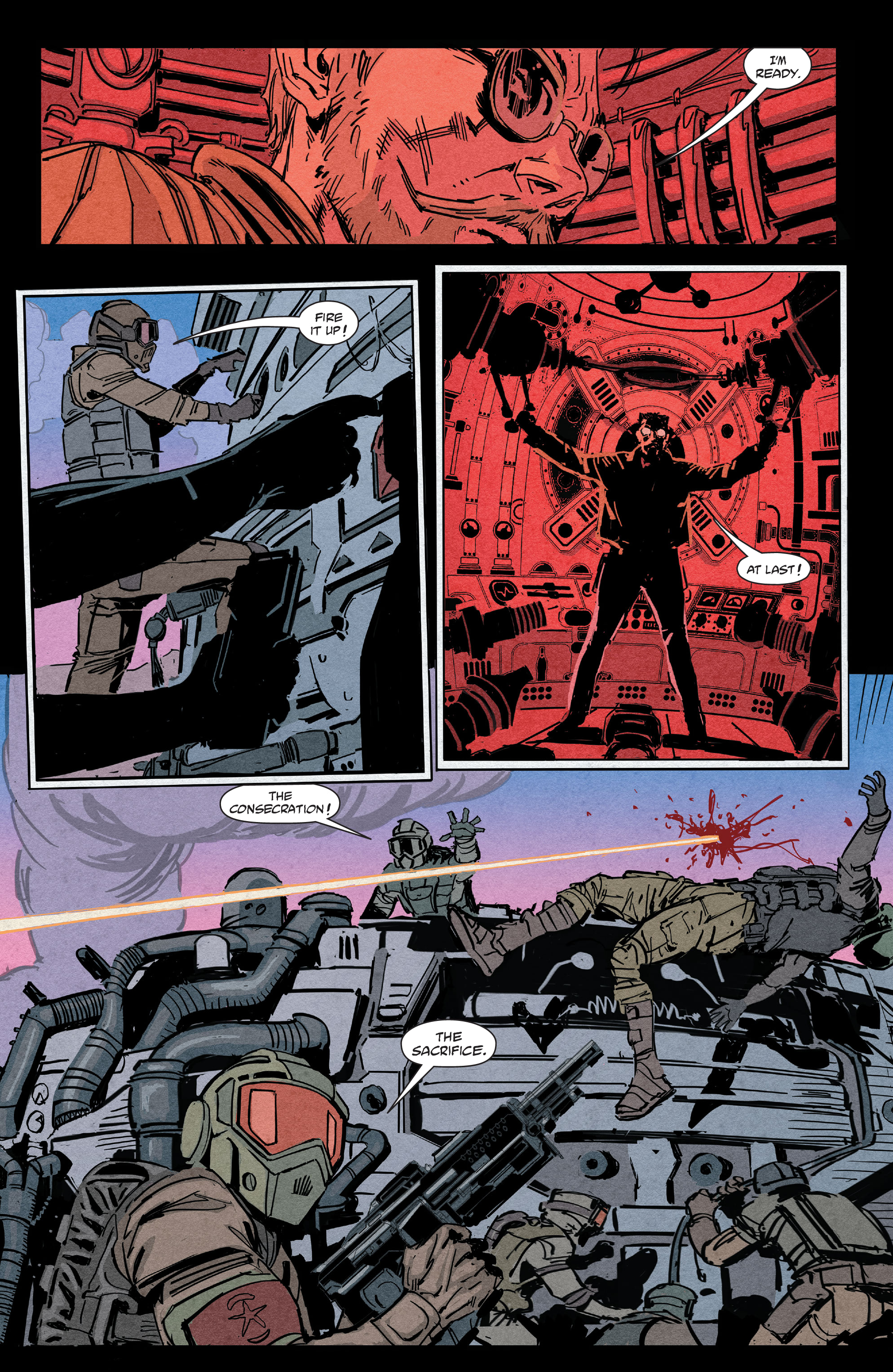
Eagle Team members wear contemporary tactical clothing, body armor, helmets, load-bearing equipment, and communications gear. They carry modern rifles and heavier weapons and move as an organized defensive force. Their appearance is intentionally close to a professional military unit. The cult identity is communicated through allegiance, language, and the machine they protect rather than through theatrical robes.
That visual restraint prevents the team from becoming a fantasy army detached from the world of the original series. Caldwell's cult has survived by adapting to the institutions around it. In earlier eras, the network works through rulers, priests, soldiers, and scholars. In the modern era, it can use tactical training and advanced equipment. The group's clothing shows how old belief can hide inside familiar systems.
The issue does not name manufacturers, ranks, or an official branch of service. Individual weapons are visible, but the narrative importance lies in their use. Eagle Team's rifles create a perimeter. Heavy weapons slow the government assault. Communications keep the operation coordinated. The equipment turns a religious ambition into a defensible military objective.
Ritual and military language
The most distinctive feature of Eagle Team is the coexistence of combat procedure and ritual speech. The personnel do not describe Caldwell's entry into the machine only as activation or transfer. They invoke consecration and sacrifice. Those words connect the scene to the long history of the cult, whose members have pursued B's power through changing civilizations.
The combination is unsettling because it reveals how the team understands the violence around them. A soldier defending a technical installation might believe he is protecting national security or a research program. Eagle Team protects a sacred event. The machinery is an altar as much as a device, and Caldwell's body is the offering as much as the operator.
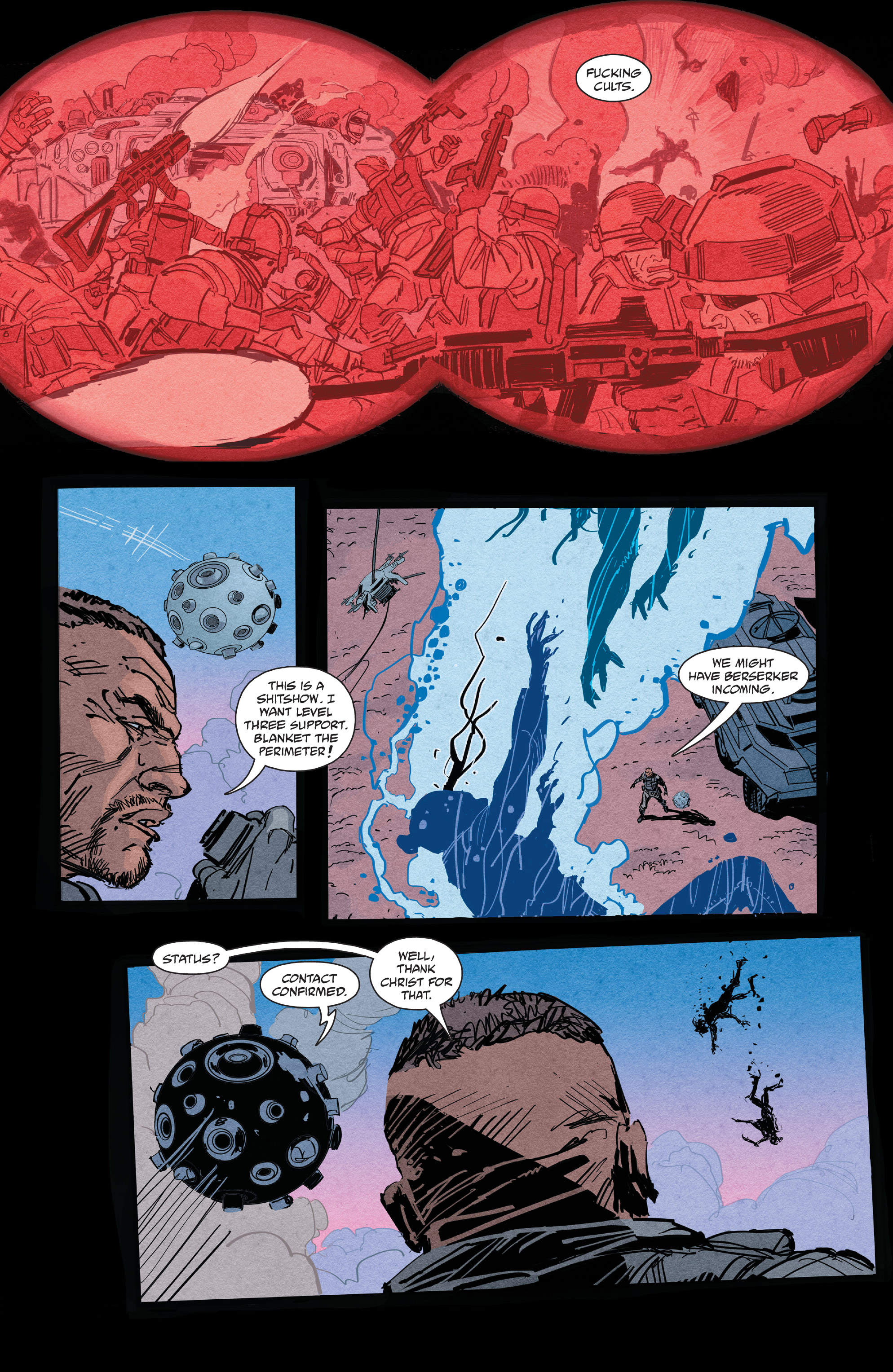
This language also explains why Keever's forces treat the defenders as cultists. The government side recognizes that the group is not simply another unit acting under ordinary orders. Caldwell has converted access to modern infrastructure into a religious operation. The members may have different levels of belief, but the force as deployed serves the cult-linked purpose.
The assault under Keever
Keever's government forces attack the location because Caldwell's operation has moved beyond what the program can tolerate. Earlier issues place Caldwell inside the same broad institutional world as B, Diana, and Keever. In #11, the relationship breaks. The government is no longer supporting Caldwell; it is trying to stop him.
The assault creates a direct contrast between two armed groups with overlapping equipment and opposed purposes. Keever's soldiers advance to prevent the transfer. Eagle Team fires to keep the site in Caldwell's control. The fight is therefore not a battle between an army and a supernatural monster. It is an institutional rupture made visible through gunfire.
Keever's response is shaped by his history with B. He understands that a mission can disguise a moral compromise, and he recognizes the danger of allowing Caldwell to use the machine. The team's defense forces him to act against people who may once have belonged to the same security apparatus. The action shows how the B Program's secrecy has created enemies inside its own perimeter.
The transfer and its consequences
As Caldwell enters the machine, the ritual language intensifies. The apparatus is meant to receive or channel a power connected to B and the Source, but the process does not remain within the team's control. Energy spreads through the site, changing the battlefield faster than ordinary tactics can respond.
Eagle Team's equipment becomes less useful as the transfer escalates. Armor cannot protect against the forces moving through the apparatus. Vehicles and weapons that establish control at the beginning of the scene cannot make the energy obey. The team's attempt to defend a ritual ends with the ritual overwhelming the people who prepared it.
The collapse carries a thematic consequence. Caldwell's organization believes that modern technology can give a stable form to an ancient desire. The Source does not respect the boundaries they build. The operation turns its defenders into casualties and exposes the danger of treating a living or cosmic power as a controllable resource.
The issue does not provide a complete list of deaths or a final report on every surviving member. Some figures are visibly caught in the violence, while the wider fate of the organization remains uncertain. The important result is that Eagle Team is no longer an intact force with a secure site. Caldwell's attempt to control the transfer destroys the conditions that made the team's tactical confidence possible.
Relationship to the government program
Eagle Team's access to vehicles, machinery, and trained personnel raises the question of how Caldwell assembled the operation. The original series shows that he occupied a privileged position inside the government research world and had access to information about B's body and history. It also shows that he had a private cult lineage stretching back through earlier eras.
The issue does not narrate every procurement step. It does establish the observable divide. Keever's forces are acting to stop Caldwell. Eagle Team is defending Caldwell. Keever identifies the defenders as cultists. The team's exact employment history can remain unknown without changing its role during the assault.
That distinction keeps the group from being mislabeled as a normal government team. Caldwell may have repurposed institutional resources, recruited specialists, or drawn on people who already shared his beliefs. The team is defined by the operation it chooses to defend, not by a title that the issue never supplies.
A force assembled from two traditions
Eagle Team's unusual character comes from the way two traditions meet inside it. The first is the practical tradition of modern special operations: secure the perimeter, keep communications open, protect the principal, and hold a position until the objective is complete. The second is the older tradition that treats B as a sacred or transformative figure. That tradition supplies the words consecration and sacrifice and gives the machinery a purpose beyond its visible functions.
Neither tradition fully controls the other. Tactical discipline can keep a group alive during the first minutes of an attack, but it cannot answer what the transfer will do to Caldwell's body. Religious conviction can make soldiers willing to die for the operation, but it cannot make the Source obey a schedule. The team's failure comes from that mismatch. It has enough ordinary competence to build a dangerous site, yet it has no language for the moment when the power inside the site becomes larger than the plan.
The members may have joined through different doors. A soldier could be recruited for skill and only later learn the ritual meaning of the mission. A believer could receive tactical training in order to serve the cult more effectively. A technician could accept the work because Caldwell's authority made it appear legitimate. The issue does not choose among these possibilities, and it does not need to. The force's collective decision to defend the ceremony is the fact that defines it.
This mixture also explains why Eagle Team's visual identity is restrained. The cult has learned that modern power is most effective when it looks ordinary. Helmets, vehicles, radios, and rifles allow the operation to pass as a military movement until the language around Caldwell reveals its deeper purpose. The team is frightening because it does not need to look like a fantasy army. It can stand inside the visual grammar of a government convoy and still be serving an ancient obsession.
No named roster
The original series does not identify individual Eagle Team members by personal name. A greeter welcomes Caldwell. Operators prepare the machinery. Armed personnel hold the perimeter. Others invoke the ritual stages or use heavier weapons. These roles can be recognized in the scene without inventing biographies that the issue does not provide.
The absence of names is part of the team's effect. Caldwell's cult has turned people into functions just as it has turned B into a source of power. The soldiers are visible enough to carry out the operation but not individualized enough to challenge its purpose. Their anonymity lets the reader see the institution at work and also shows the cost of being absorbed into it.
It is possible that the members joined for different reasons. Some may be committed believers, some may be hired personnel, and some may have been drawn in by promises of scientific or military advancement. The issue does not provide private testimony. What can be said is that the force operates together in defense of Caldwell's ceremony, and the consequences reach everyone on the site regardless of individual belief.
Eagle Team and B
The team's direct relationship with B is indirect but central. Eagle Team is not shown as a regular field unit assigned to B. Its operation is built around the power associated with him, the history preserved in his body, and the Source that Caldwell hopes to reach. B is therefore the unseen center of the team's mission even when he is not standing in the perimeter.
This arrangement repeats the series' pattern of weaponization. A tribe trains B for defense. Kings put him into war. A government sends him on black operations. Caldwell's team protects a machine designed to take the power that made those uses possible. The difference is that B is no longer merely being commanded to fight. His body and origin have become the object of a transfer that could alter Caldwell and everyone nearby.
The team's role makes the moral stakes physical. A person can be used by an institution long after the institution stops asking for consent. Caldwell's followers have built an armed structure around that use. When the government attacks, the group defends the machine rather than asking whether the machine should exist.
The operation also shows how B's absence can shape a battle. The team is acting because of what B is, what his body has survived, and what Caldwell believes can be taken from that history. B does not need to issue an order for people to arrange their lives around him. The cult has spent generations making his existence into a reason for action, and the modern team inherits that momentum. The result is a battlefield in which the person at the center of the belief is treated as a resource even before he can answer.
That indirect relationship matters when the transfer begins to fail. Eagle Team's members are not confronting B as a rival combatant whose tactics they can study. They are defending an attempt to reach the power behind him. Their training prepares them for an assault by soldiers, not for a change in the nature of the battlefield. The gap between those situations is where Caldwell's followers lose control.
Fate of the organization
The assault and the transfer leave Eagle Team heavily degraded. The site is overwhelmed, personnel are killed or incapacitated, and the operation loses the controlled shape it had at the beginning. The issue does not confirm that the organization survives as an intact unit or that a successor force takes its place.
The uncertainty fits the team's narrative function. Eagle Team is a modern expression of Caldwell's cult, not a separate political movement with a public history. Its members can disappear into the same secrecy that protected the operation. What is visible is the collapse of the defended site and the failure of the group to make the Source obey.
The lack of a later report also leaves the human aftermath open. Survivors may face arrest, injury, or the realization that they protected a ritual that destroyed them. If the cult continues, it will have to adapt again, as it has across earlier eras. If the team ends, its equipment and language may become part of the evidence used to explain Caldwell's final attempt.
For the people who survive, the collapse creates a moral problem as well as a practical one. A soldier who believed he was protecting a commander may discover that the commander treated the entire force as expendable. A technician who prepared the machine may realize that the promises attached to it were never promises of safety. A believer may interpret the disaster as proof that the sacrifice was incomplete, while a frightened survivor may understand it as evidence that the belief was wrong. The issue leaves those responses unstated, but the possibility is important. Institutions do not end when the machinery stops. They continue in the explanations people carry away.
The team's uncertain aftermath also mirrors the way the cult survives across earlier centuries. Names disappear, equipment is repurposed, and a failed operation becomes a story that can be used to justify the next one. Caldwell's immediate force may be gone, but the desire to control B's power has not been destroyed by one battlefield. What changes is the evidence available to anyone who follows the trail: a site damaged by energy, a group of soldiers who called a transfer a consecration, and a government that finally treated its own secrecy as an enemy.
Narrative significance
Eagle Team matters because it externalizes Caldwell's transformation from compromised scientist to active religious commander. Earlier material can be read as the story of one man's research and obsession. The team proves that he has built a constituency capable of defending those beliefs with modern force.
The group also joins two recurring BRZRKR motifs: the migration of technology and the persistence of cult history. The cult survives because it learns the tools of each era. It can use prophecy in one age, alchemy in another, and tactical vehicles in the present. Its continuity is not a single unchanging ritual. It is the willingness to turn whatever a civilization knows into a way of pursuing B.
At the same time, Eagle Team shows the limits of adaptation. Modern gear can protect a perimeter, but it cannot guarantee that the power inside the perimeter will remain human or obedient. The team is strongest when the operation still looks like a military mission. Once the transfer begins, the equipment becomes a shell around forces it cannot command.
What remains unknown
The issue does not establish a formal founding date, individual names, rank structure, membership total, permanent base, legal status, or complete post-assault history. It does not confirm that every member belongs to Caldwell's cult or that every piece of equipment came from the government. It does not name the site or explain every technical detail of the transfer apparatus.
Those limits do not make Eagle Team vague. The group is clearly the armed body protecting Caldwell's cult-linked transfer operation in #11. Its members use military discipline to defend a ritual, oppose Keever's intervention, and become casualties when the power they guard escapes their control. That is enough to show how far Caldwell's private agenda has spread and why the late-series conflict cannot be contained inside a laboratory.
References
[1] Keanu Reeves, Matt Kindt, Ron Garney, Bill Crabtree, and Clem Robins, BRZRKR #11 (BOOM! Studios), Caldwell's transfer operation, the armed defenders, Keever's assault, ritual language, and the energy event.
[2] BRZRKR #12, the aftermath of Caldwell's operation and the consequences for B, the government, and the Source.